
去美元化

Search documents
高频数据显示生产和外需平稳,投资增速改善仍需观察
China Post Securities· 2026-01-26 05:49
从高频数据来看,2026 年春节位于 2 月中旬,1 月是春节前的最 后一个完整生产月,为了保持供应平稳,1 月生产或小幅回升,外需 或存在提前发货,1 月出口亦有望保持韧性,关注中国与欧盟、一带 一路沿线国家合作加深。生意社 BPI 代表的广谱价格指数环比延续上 行,除了全球定价商品之外,亦包括国内定价的煤炭、螺纹、化工品 等,年后 3 月开工季的价格趋势值得期待。值得注意的是,12 月 PMI 建筑业景气度较为明显改善,但 1 月高频数据显示,建筑业实物工作 量并未显著启动,100 大中城市拿地意愿相对较弱,30 大中城市商品 房销售景气度较低,或掣肘投资,需要密切跟踪节后复工复产情况, 这或对投资止跌回稳产生显著影响。 证券研究报告:宏观报告 发布时间:2026-01-26 研究所 分析师:袁野 SAC 登记编号:S1340523010002 Email:yuanye@cnpsec.com 研究助理:苑西恒 SAC 登记编号:S1340124020005 Email:yuanxiheng@cnpsec.com 近期研究报告 《内外需增长斜率分化,关注出口和 科技共振方向》 - 2026.1.22 宏观研 ...
全球宏观及大类资产配置周报-20260126
Dong Zheng Qi Huo· 2026-01-26 05:44
1. Report's Investment Rating for the Industry | Asset Category | Rating | | --- | --- | | Gold | Oscillation | | US Dollar | Bearish | | US Stocks | Oscillation | | A-Shares | Oscillation | | Treasury Bonds | Oscillation | [28] 2. Core Viewpoints of the Report - Overseas markets face high geopolitical risks, with persistent concerns about the independence of the Federal Reserve and the fiscal sustainability of developed economies. The risk aversion sentiment remains high, and the market is expected to maintain high volatility. The US and Japan's potential joint intervention in the foreign exchange market increases the downward pressure on the US dollar index, while the yen appreciates significantly [5]. - In the domestic market, although most of the economic data in December were below market expectations, the annual economic growth rate reached the 5% target. Policies such as investment and national subsidies at the beginning of the year are taking effect, and some domestic demand - related data have the potential for marginal improvement. The bond market remains under bearish pressure, while the stock market continues its slow - bull pattern but faces regulatory cooling in the short term [5]. 3. Summary by Directory 3.1 Macro Context Tracking - Geopolitical risks continue to ferment, including the sovereignty dispute over Greenland and concerns about the independence of the Federal Reserve. The expansionary fiscal policy expectations in Japan challenge the country's fiscal discipline, leading to a rise in global sovereign bond yields [5]. - In the domestic market, the economic data in December were mostly disappointing, but the full - year economic growth target was achieved. Policies are being implemented, and there is potential for marginal improvement in domestic demand - related data [5]. 3.2 Global Overview of Major Asset Trends 3.2.1 Equity Market - Global stock markets fluctuated and adjusted this week, with mixed performance. In developed countries, the S&P 500 fell 0.35%, the German DAX fell 1.57%, and the Nikkei 225 fell 0.17%, while the South Korean KOSPI rose 3.08%. In emerging markets, the Shanghai Composite Index rose 0.84%, the Hong Kong Hang Seng Index fell 0.36%, and the Brazilian IBOVESPA rose 8.53% [7][8]. - The performance of MSCI indices was differentiated, with emerging markets > frontier markets > global markets > developed markets [8]. 3.2.2 Currency Market - The US dollar index weakened rapidly, depreciating 1.88% to 97.5. The RMB exchange - rate index appreciated slightly, and the RMB against the US dollar continued to appreciate 0.07%. Most emerging - market currencies and developed - market currencies appreciated, such as the Mexican peso (1.44%), the Brazilian real (1.49%), the euro (1.95%), and the yen (1.49%) [9][10]. 3.2.3 Bond Market - The yields of ten - year government bonds in major developed countries rose significantly, mainly due to concerns about Japan's radical fiscal policy. The yield of US Treasury bonds remained unchanged at 4.24%, the yield of UK Treasury bonds rose 7bp, and the yield of Japanese Treasury bonds rose 6bp. In emerging - market countries, the yield of Chinese Treasury bonds fell 1bp to 1.83%, the yield of Indian Treasury bonds fell 1bp, and the yield of Brazilian Treasury bonds fell 12bp [15][16]. 3.2.4 Commodity Market - The global commodity market oscillated and rose this week, with energy and precious - metal prices leading the increase. WTI crude oil rose 3.48%, natural gas rose 17%, COMEX gold rose 8.3%, and silver rose 14.8%. In the domestic commodity market, most commodities rose, with precious metals > non - ferrous metals > energy and chemicals > industrial products > agricultural products > black metals [22][26]. 3.3 Weekly Outlook for Major Assets 3.3.1 Precious Metals - Gold is expected to oscillate. Geopolitical tensions drive funds into precious metals, but after a rapid rise, gold price volatility is expected to increase. It is recommended to wait for a pullback before making long - positions [28][30]. - The speculative net long - positions in Comex gold futures rebounded slightly, the holdings of SPDR Gold ETF increased slightly to 1,086 tons, and the positions of Shanghai gold futures rose to around 360,000 lots. The silver price showed a frothy trend, and attention should be paid to the risk of a market reversal [40]. 3.3.2 Foreign Exchange - The US dollar is bearish. Geopolitical risks are rising, and the process of de - dollarization is accelerating, leading to a short - term weakness in the US dollar [28][41]. 3.3.3 US Stocks - US stocks are expected to oscillate. Geopolitical conflicts still have the risk of fermentation. With the approaching of the January FOMC meeting and the earnings season of technology giants, market sentiment is expected to remain cautious, and the volatility of the US stock market may further increase [28][44]. 3.3.4 A - Shares - A - shares are expected to oscillate. The domestic stock market continues to face a pattern of differentiation. The core contradiction is between the bottom - up bull - market expectations and the top - down regulatory cooling. The regulatory authorities may take more strict and precise measures to limit excessive speculation, and the market may continue to oscillate at a high level [28][58]. 3.3.5 Treasury Bonds - Treasury bonds are expected to oscillate. The bond - market rebound may not be over, but the long - term bearish logic remains unchanged. The net financing of government bonds will decrease next week, and the market news will be calm, but risks such as an unexpected increase in the manufacturing PMI still need to be vigilant [28][61]. 3.4 Global Macroeconomic Data Tracking 3.4.1 Overseas High - Frequency Economic Data - The US economy remains resilient, with the GDPNow model estimating a Q4 growth rate of 5.4% and the red - book retail sales growing 5.5% year - on - year. The employment market also remains stable, with the number of continued unemployment claims falling to 1.849 million and the number of initial claims remaining at 200,000 [77]. - The liquidity in the US banking - system is expected to improve, the credit spread of high - yield corporate bonds is oscillating and falling, and the market's expectation of interest - rate cuts has changed little. The probability of a pause in interest - rate cuts in January has risen to 95.6%, and it is expected that there will be only 1 - 2 interest - rate cuts in 2026, more likely in the second half of the year [84]. - In December, the US CPI increased 2.7% year - on - year as expected, and the core CPI increased 2.6% year - on - year, the lowest level since March 2021 and lower than expected. The PPI rebounded to 3% in November, mainly driven by energy prices, and the core PCE increased 2.8% year - on - year in November, in line with market expectations [87]. 3.4.2 Domestic High - Frequency Economic Data - The real - estate market remains weak, with only a seasonal rebound in second - hand housing transactions. The market is still waiting and seeing, and the follow - up of new policies in Shanghai and Shenzhen is slow [93]. - As of January 23, the R007, DR007, SHIBOR overnight, and SHIBOR 1 - week were 1.54%, 1.49%, 1.40%, and 1.49% respectively, with slight changes from the previous weekend. The average daily trading volume of inter - bank pledged repurchase this week was 8.57 trillion yuan, slightly less than last week, and the overnight trading volume accounted for 90.49%, slightly higher than the previous week [96]. - In December, the economic data showed a pattern of overall weakness, with supply stronger than demand and domestic demand weaker than external demand. The growth rate of industrial added value, exports, and service production increased, while the growth rate of social retail sales, fixed - asset investment, and real - estate investment decreased [97]. - In December, the financial data showed that the private sector, especially the household sector, had a low willingness to borrow actively. However, there were also some positive changes, such as an increase in short - term and medium - long - term loans of the enterprise sector, an increase in the issuance scale of enterprise bonds, and a slight increase in entrusted loans [102]. - In December, the PPI increased - 1.9% year - on - year, and the CPI increased 0.80% year - on - year, both showing a recovery trend. In the future, inflation is expected to continue to rise due to policy support and rising commodity prices [109]. - In December, the year - on - year growth rates of exports and imports exceeded expectations, with exports growing 6.6% and imports growing 5.7%. In the future, exports are expected to maintain their resilience, and imports are expected to recover moderately [115].
永赢基金刘庭宇:黄金突破5000美元再创新高,黄金股的戴维斯双击或将延续
Xin Lang Cai Jing· 2026-01-26 05:24
作者:刘庭宇 永赢基金基金经理 2、联储独立性弱化+美国债务上行+欧洲多国卖美债买黄金,去美元化支撑黄金配置需求 美国2026年将加大在福利、基建与国防等领域的财政支出,同时日本和欧洲的财政赤字压力同样在增 加。随着美联储独立性弱化、内部政策分歧持续加剧,叠加赤字率上行不断侵蚀美元和美债信用,全球 "去美元化" 趋势持续深化,丹麦、波兰、瑞典等欧洲国家计划或正在抛售美债。新兴市场央行的黄金 储备占比显著低于全球平均水平,各市场参与方都有更强动力持续增加黄金资产配置,配置需求推动下 或将持续抬升黄金和黄金股的价格中枢。 3、黄金股三季报业绩整体符合预期,2026年戴维斯双击或将继续 中证沪深港黄金股指数前十大成分股 2025 年前三季度业绩继续保持 62% 的高增速,整体符合市场预 期,同时龙头金矿公司披露高增速年报业绩预告引发市场关注。这一高增态势得益于金价中枢上行,叠 加金矿公司积极扩产带来的量价齐升,且这一逻辑后续有望持续兑现。截至12月31日,若按照4200美 元/盎司的金价进行测算,主要金矿公司2026年的平均PE仅10~15倍,而历史上金矿公司估值中枢约20 倍,当前仍具备显著的估值修复空间。越来越 ...
有色板块 “狂飙” 不止,新一轮“超级周期”备受关注
Sou Hu Cai Jing· 2026-01-26 05:21
Core Viewpoint - The non-ferrous metal sector is experiencing significant growth, driven by high international gold prices and strong performance from leading companies, making it a focal point for investors in 2026 [1][2]. Group 1: Market Performance - The non-ferrous metal sector has outperformed other sectors, with the MSCI Metals and Mining Index rising nearly 90% since the beginning of 2025, surpassing semiconductor and global banking sectors [2]. - Major companies in the sector, such as Zijin Mining, are expected to report substantial profit increases, with projected net profits for 2025 reaching between 51 billion to 52 billion yuan, reflecting a year-on-year growth of 59% to 62% [2]. Group 2: Fund Inflows and ETF Growth - There has been a remarkable influx of capital into the non-ferrous metal sector, with over 36 billion yuan net inflow into non-gold themed ETFs as of January 22, 2026, pushing the total scale of these ETFs to over 100 billion yuan [3]. - The non-ferrous metal ETF (512400) reached a scale of 40 billion yuan, indicating strong investor interest and positioning in this sector [3]. - Public funds have significantly increased their holdings in the non-ferrous sector, with 15 related fund products reported in a short span from early December 2025 to mid-January 2026, indicating a robust investment trend [3]. Group 3: Geopolitical and Economic Factors - The non-ferrous metal sector is transitioning from traditional cyclical characteristics to a new phase characterized by a combination of safe-haven demand, strategic security, and tight supply-demand balance due to rising geopolitical risks [4]. - The recent surge in gold prices, surpassing 5,000 USD per ounce, and silver prices exceeding 100 USD per ounce, reflects a shift in the global monetary system and increased demand for these metals as safe-haven assets [4][5]. Group 4: Specific Metal Insights - Gold and silver are experiencing a "super cycle" driven by geopolitical conflicts, loss of confidence in the US dollar, and ongoing central bank purchases, making them attractive for investment [5]. - Copper prices are showing resilience due to strong pre-holiday stocking, with supply constraints emerging as copper concentrate treatment charges have dropped to negative values, indicating a tight supply situation [6]. - Aluminum prices are expected to rebound due to low global inventories and strong demand driven by investments in power grids and solar exports, despite slight domestic inventory increases [7]. - The strategic importance of metals like cobalt and lithium is being reaffirmed, with supply concentrated in regions like the Democratic Republic of Congo, highlighting their long-term investment potential [8].


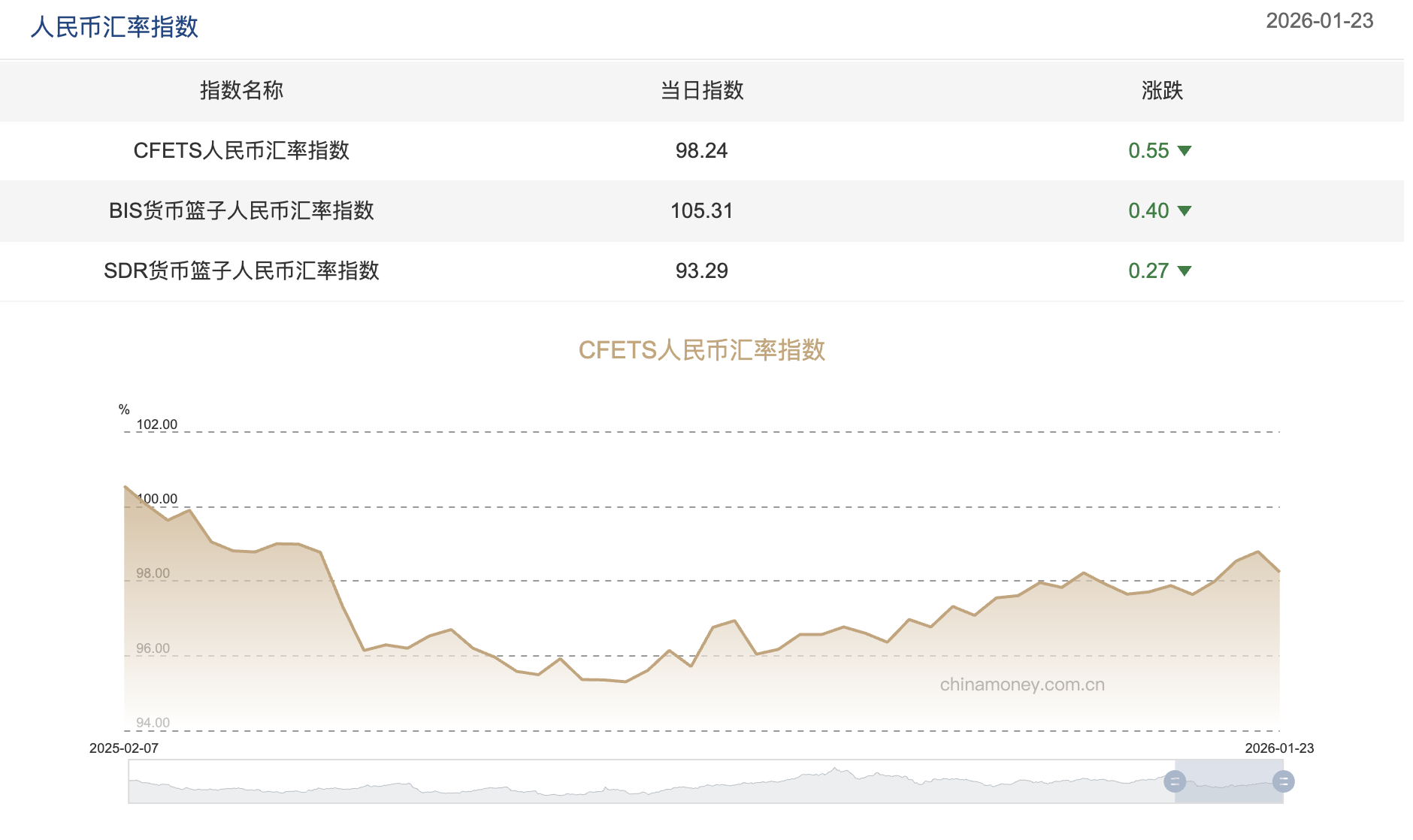
人民币汇率延续升值态势 三大人民币汇率指数小幅下挫
Sou Hu Cai Jing· 2026-01-26 05:14
Core Viewpoint - The Chinese yuan exchange rate indices have all declined in the week of January 23, with the CFETS index at 98.24, down 0.55% week-on-week, indicating a weakening trend in the yuan's value against a basket of currencies [1][2]. Group 1: Exchange Rate Indices - The CFETS yuan exchange rate index reported at 98.24, reflecting a weekly decline of 0.55% [1][2]. - The BIS currency basket yuan exchange rate index stood at 105.31, down 0.4% week-on-week [1][2]. - The SDR currency basket yuan exchange rate index was at 93.29, with a weekly decrease of 0.27% [1][2]. Group 2: Market Dynamics - The US market experienced a "triple hit" of stocks, bonds, and currency declines, leading to a lower dollar index at 97.46, with a cumulative drop of over 1.8% for the week [5]. - Non-US currencies strengthened against the dollar, with the euro, pound, and Australian dollar showing significant gains, while the New Zealand dollar and Norwegian krone led the increases [5]. - The onshore yuan appreciated by 60 basis points, closing at 7.1221 against the dollar, while the offshore yuan rose by 187.5 basis points, closing at 6.94865 [5]. Group 3: Analyst Insights - Analysts suggest that the weakening of the dollar, influenced by external factors such as tariff risks, has contributed to the appreciation of non-US currencies, including the yuan [6]. - Seasonal factors and market expectations for yuan appreciation are stabilizing the settlement intentions of market participants, supporting the yuan's strength [6]. - Short-term forecasts indicate potential reversals in "de-dollarization" trading, while long-term risks from US policies may undermine the dollar's reserve status [6]. Group 4: Future Outlook - Short-term expectations suggest that the yuan will remain strong due to continued corporate settlement demands ahead of the Chinese New Year [7]. - Long-term projections indicate a weaker dollar, which may affect its dominant position and enhance the roles of other currencies like the yuan and euro in the international monetary system [7]. - The ongoing global uncertainties, such as trade tensions and supply chain disruptions, suggest that the yuan should not appreciate too quickly [8].

特朗普强硬警告,丹麦率先抛售美债,中国无惧,美债危机加速爆发
Sou Hu Cai Jing· 2026-01-26 05:12
如果有人告诉你,养老基金居然成了"美债收割机",你会不会觉得自己听错了? 2024年,欧洲的金融圈着实被这波操作整得措手不及。 丹麦AkademikerPension养老基金直接官宣:2025年1月底前,把账上那1亿美元的美债全卖了,干净利落,毫不拖泥带水。 紧接着,瑞典最大养老基金Alecta也扔出同样的"清仓令"。 这不是一时冲动,而是对美国信用风险和地缘局势的高度警觉。 更让人咂舌的是,专家们还特地出来"背书":这股风潮可能只是刚刚开始。 其实,北欧的"断舍离"并不是孤例。 荷兰ABP养老基金早在2023年9月就宣布减少美债配置,转而加大可再生能源投资,直接把资金从大洋彼岸拉回到欧洲本地。 ABP高层玛丽亚·范德霍夫曾一针见血地说:"美国财政政策像过山车,我们实在坐不住!"德国、比利时等地的养老基金也立马跟风,大家在金融圈的小道 消息里议论得沸沸扬扬。 欧洲的金融大佬们都在问:美元的"安全感"还剩多少? 如果你以为只有欧洲在"撤退",那就太天真了。 中国央行这些年也在悄悄调整外汇储备结构,美债持仓逐步减少,黄金储备却节节攀升。 美欧之间的龃龉也愈发公开,尤其是在格陵兰岛问题上,特朗普又"复读机"一样抛出 ...
美欧摩擦不断,国内经济顺利收官
Guo Mao Qi Huo· 2026-01-26 05:10
1. Report Industry Investment Rating No relevant content provided. 2. Core Viewpoints of the Report - This week, domestic commodities rebounded again, with both industrial and agricultural products rising. The main reasons include geopolitical risks, the acceleration of de - dollarization, the rise of anti - involution expectations, and the cold wave driving up energy prices [3]. - In 2025, China achieved a 5% growth target, but faced downward pressure in the second half of the year. In 2026, domestic economic growth may be driven by economic re - balancing, with domestic demand expected to improve, and policies will continue to support economic growth [3]. - The IMF raised China's economic growth rate forecast for 2025 by 0.2 percentage points to 5% and for 2026 by 0.3 percentage points to 4.5%, and also raised the global economic growth forecast for 2026 to 3.3% [3][23][24]. - Multiple factors are driving the rebound in the commodity market, including the rift between the US and its allies, the pre - emptive fiscal policy, and the geopolitical situation and cold wave [3]. 3. Summary by Directory PART ONE: Main Viewpoints - **Domestic Commodity Market**: This week, domestic commodities rose. Geopolitical risks and de - dollarization led to the rise of gold and silver, anti - involution expectations drove up new energy metals, and the cold wave pushed up energy prices, causing the energy and chemical sectors to rebound [3]. - **Overseas Situation**: - US: The December 2024 existing - home sales index dropped significantly, affected by inventory shortages and rising mortgage rates. Trump mentioned potential candidates for the new Fed chair. The US threatened to impose tariffs on eight European countries and then postponed the decision [3]. - Japan: The Prime Minister announced the dissolution of the House of Representatives and an upcoming election, and proposed an expansionary fiscal policy, which triggered market concerns and led to a sell - off of Japanese government bonds [3]. - **Domestic Situation**: In 2025, China achieved a 5% growth target, but faced downward pressure in the second half. In 2026, economic re - balancing may drive growth, and policies will continue to support the economy. The IMF raised China's economic growth forecast, and the government announced fiscal and financial policies to boost domestic demand [3]. - **Commodity Market Viewpoint**: Multiple factors are driving the rebound in the commodity market, including the rift between the US and its allies, the pre - emptive fiscal policy, and the geopolitical situation and cold wave [3]. PART TWO: Overseas Situation Analysis - **US Real Estate**: The December 2024 existing - home sales index dropped 9.3% month - on - month and 1.3% year - on - year, the largest decline since April 2020 and the largest for December since 2001. Inventory shortages and rising mortgage rates are the main factors [3]. - **Fed Chair Candidate**: Trump mentioned that the list of candidates for the new Fed chair has been narrowed down, and he hopes the new chair will be like Greenspan [3]. - **Japan's Fiscal Policy**: The Japanese Prime Minister announced the dissolution of the House of Representatives and an expansionary fiscal policy, which led to a sell - off of Japanese government bonds [3]. - **US - Europe Trade**: The US threatened to impose tariffs on eight European countries and then postponed the decision, but the implementation of the agreement is still uncertain [3]. PART THREE: Domestic Situation Analysis - **Economic Growth**: In 2025, China achieved a 5% growth target, but faced downward pressure in the second half. In 2026, economic re - balancing may drive growth, and domestic demand is expected to improve [3]. - **IMF Forecast**: The IMF raised China's economic growth rate forecast for 2025 by 0.2 percentage points to 5% and for 2026 by 0.3 percentage points to 4.5%, and also raised the global economic growth forecast for 2026 to 3.3% [3][23][24]. - **Fiscal Policy**: In 2026, the fiscal deficit, debt, and expenditure will remain at necessary levels, and the government announced fiscal and financial policies to boost domestic demand [3]. PART FOUR: High - Frequency Data Tracking - **Industrial Data**: Data on the start - up rates of the polyester industry chain and blast furnaces are presented, showing the operating conditions of related industries [31][32]. - **Agricultural Product Data**: Data on the average wholesale prices of fruits, vegetables, and pork, as well as the Agricultural Product Wholesale Price 200 Index, are provided [44].
最高5085美元:国际金价首次突破5000美元!为何黄金突然失控狂飙?
Sou Hu Cai Jing· 2026-01-26 05:07
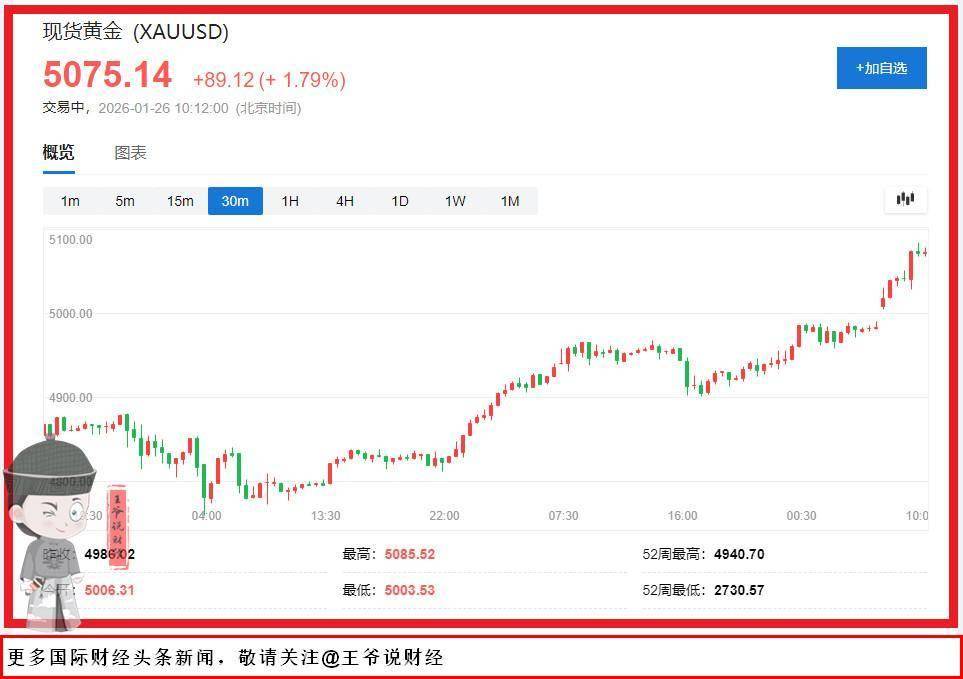
别急着骂金价贵,咱们得先搞懂是谁在背后推波助澜。 其实,黄金这一轮暴涨,绝不是什么散户炒作,而是四大"核动力"引擎同时点火的结果! 第一引擎:美元不行了,大家都在"去美元化"。 以前大家觉得美元是"硬通货",但现在呢? 美国那边债务高达38万亿美元,还在疯狂印钱。 更要命的是,美国居然把美元当成武器,动不动就威胁制裁欧洲、封锁SWIFT系统。 你看丹麦养老基金,直接宣布清仓所有美债,全换成黄金! 波兰央行更狠,一口气批准买150吨黄金。这说明什么?全球央行都在用脚投票——美元信用正在崩塌,黄金才是真正的"无国籍货币"! 王爷说财经讯: 金价彻底疯了! 你敢信吗?一觉醒来,黄金直接"上天"了! 就在刚刚过去的周末,国际金融市场炸响了一声惊雷。1月26日, 现货黄金价格像坐了火箭一样,盘中最高直接飙升到5085美元/盎司!这可是人类历史上 从未有过的高点啊!你没看错,不是4000,是实打实的5000美元整数关口被踩在脚下。 什么概念?如果你在一年前买了一根金条,现在已经赚翻了;但如果你现在才想去金店买个戒指,对不起,周大福、老凤祥的足金饰品已经干到了1550元/ 克!这哪里是买首饰,简直是在"吞金"! 为什么黄金 ...
长江期货贵金属周报:避险情绪升温,价格偏强震荡-20260126
Chang Jiang Qi Huo· 2026-01-26 05:05
1. Report Industry Investment Rating - Not provided in the given content 2. Core Viewpoints of the Report - Due to the escalating Greenland issue, geopolitical tensions have risen, leading to an increase in market risk - aversion sentiment. Precious metal prices have continued to be strong. The Fed held its December meeting, cutting interest rates by 25 basis points as expected and initiating a reserve - management balance - sheet expansion. The US employment situation has slowed down, and Fed Chairman Powell said that changing economic risks give the Fed more reasons to cut interest rates. The expectation of Hassett becoming the Fed Chairman has changed, and the market expects fewer interest - rate cuts this year. The US economic data has shown a downward trend, and there are concerns about the US fiscal situation and the Fed's independence. Central bank gold purchases and de - dollarization trends remain unchanged. Driven by industrial demand, the silver spot market remains tight, and the mid - term price centers of gold and silver have shifted upward. Platinum and palladium lease rates remain high, and their prices are expected to continue to fluctuate strongly. Attention should be paid to the Fed's January interest - rate decision to be announced on Thursday [11]. - It is expected that precious metal prices will continue to be strong. It is recommended to hold long positions and be cautious about opening new positions [13]. 3. Summary According to the Directory 3.1 Market Review - Due to the escalating Greenland issue, geopolitical tensions have risen, and risk - aversion sentiment has increased. Gold prices have shown a strong upward - trending fluctuation. As of last Friday, the price of US gold closed at $4,983 per ounce, with a weekly increase of 8.3%. The upper resistance level is $5,100, and the lower support level is $4,900 [6]. - Due to the escalating Greenland issue, geopolitical tensions have risen, risk - aversion sentiment has increased, and the silver spot market has remained in short supply. Silver prices have risen strongly. As of last Friday, the weekly increase was 14.8%, and the price closed at $103.3 per ounce. The lower support level is $98, and the upper resistance level is $107 [9]. 3.2 Weekly Viewpoint - The Greenland issue continues to escalate, geopolitical tensions rise, market risk - aversion sentiment increases, and precious metal prices remain strong. The Fed cut interest rates by 25 basis points and initiated a balance - sheet expansion. The US employment situation has slowed down, and there are concerns about the US fiscal situation and the Fed's independence. Central bank gold purchases and de - dollarization trends remain unchanged. Driven by industrial demand, the silver spot market remains tight, and the mid - term price centers of gold and silver have shifted upward. Platinum and palladium lease rates remain high, and their prices are expected to continue to fluctuate strongly. Attention should be paid to the Fed's January interest - rate decision [11]. - Gold: COMEX inventory increased by 260.61 kg to 1,124,213.61 kg this week, and SHFE inventory increased by 1,956 kg to 102,009 kg. Silver: COMEX inventory decreased by 395,996.63 kg to 12,952,270.73 kg, and SHFE inventory decreased by 45,753 kg to 581,090 kg. This week, the net long position of gold CFTC speculative funds was 223,928 lots, a decrease of 6,535 lots from last week. The net long position of silver CFTC speculative funds was 24,615 lots, a decrease of 6,010 lots from last week. It is expected that prices will continue to be strong, and it is recommended to hold long positions and be cautious about opening new positions [13]. 3.3 Overseas Macroeconomic Indicators - The report presents multiple charts related to overseas macroeconomic indicators, including the US dollar index, euro - US dollar exchange rate, pound - US dollar exchange rate, real interest rate (10 - year TIPS yield), US Treasury bond yield spread (10Y - 2Y), gold - silver ratio, Fed balance - sheet scale and its weekly change, and WTI crude oil futures price trend [15][17][20]. 3.4 Important Economic Data of the Week - The annual rate of the US November PCE price index was 2.8%, with an expected value of 2.7% and a previous value of 2.8%. - The preliminary value of the US January SPGI manufacturing PMI was 51.9, with an expected value of 52 and a previous value of 51.8 [27]. 3.5 Important Macroeconomic Events and Policies of the Week - US President Trump said he had reached an agreement with NATO to ensure full and permanent access to Greenland. NATO leaders said allies must strengthen their commitment to Arctic security to counter threats from Russia and China. However, details of the agreement are unclear. Denmark insists on its sovereignty over Greenland, and the EU's foreign - policy chief said US - EU relations have been "severely damaged" in the past week. The Danish Prime Minister said no negotiations on Greenland's sovereignty have been held with NATO. - US consumer spending increased by 0.5% month - on - month in November, in line with expectations. The annualized quarterly growth rate of the US economy in the third quarter was revised up to 4.4%, the fastest in two years. The number of initial jobless claims in the week ending January 17 increased slightly by 1,000 to 200,000 after seasonal adjustment, lower than the expected 210,000 [28]. 3.6 Inventory - Gold: COMEX inventory increased by 260.61 kg to 1,124,213.61 kg, and SHFE inventory increased by 1,956 kg to 102,009 kg. - Silver: COMEX inventory decreased by 395,996.63 kg to 12,952,270.73 kg, and SHFE inventory decreased by 45,753 kg to 581,090 kg [13][31]. 3.7 Fund Holdings - As of January 20, the net long position of gold CFTC speculative funds was 223,928 lots, a decrease of 6,535 lots from last week. The net long position of silver CFTC speculative funds was 24,615 lots, a decrease of 6,010 lots from last week [13][35]. 3.8 Key Points to Watch This Week - On Thursday (January 29) at 21:30, the number of initial jobless claims in the US for the week ending January 24 will be released. - On Friday (January 30) at 21:30, the US December PPI annual rate will be released [37].
贵金属周报(AU、AG):避险升温和美元走弱,金银强劲上涨-20260126
Guo Mao Qi Huo· 2026-01-26 04:51
投资咨询业务资格:证监许可【2012】31号 【贵金属周报(AU、AG)】 避险升温和美元走弱,金银强劲上涨 国贸期货 贵金属与新能源研究中心 2026-1-26 白素娜 从业资格证号:F3023916 投资咨询证号:Z0013700 本报告非期货交易咨询业务项下服务,其中的观点和信息仅供参考,不构成任何投资建议;期市有风险,投资需谨慎 周度观点摘要 ◆ 上周黄金持续上涨逼近5000美元关口,白银震荡后再度加速上行,历史上首次破 百。主要影响因素分析如下:(1)虽然特朗普TACO收回对欧洲8国的关税威胁、明 确不会武力夺岛一度引发贵金属市场扰动,但格陵兰岛危机并未解除,欧洲部分基金称 将抛售美债和减少美股投资,特朗普威胁若欧洲抛售美债等资产将面临大规模报复、并 表示美国将取得格陵兰岛美军基地所在区域"主权",加剧了市场的担忧;与此同时, 美国宣布针对伊朗实施新一轮制裁措施、外媒报道美国正调集重兵前往伊朗、特朗普政 府被指正考虑推动古巴政权更迭、美加政治关系紧张等,地缘政治风险的不断扩散、发 酵,导致市场避险情绪急剧升温,提振贵金属价格大幅走强。(2)格陵兰岛危机外溢的 地缘主权风险和美联储独立性的削弱,市场正 ...