消费升级

Search documents
“苏超”的最大价值,是什么?
3 6 Ke· 2025-11-04 08:33
Group 1 - The core viewpoint of the article is that the Jiangsu Provincial Urban Football League ("Su Super") has emerged as a phenomenon-level sports event IP, significantly contributing to consumer spending and economic growth [1][2][29] - "Su Super" provides a new approach to stimulate consumption by creating a high-frequency, high-attachment consumption scenario that encourages spending beyond just attending the matches [12][15][29] - The league has successfully attracted large audiences, with the final match drawing 62,329 spectators, and has led to increased spending in various sectors such as travel, dining, and accommodation [15][21] Group 2 - The article discusses the importance of expanding domestic demand, with a focus on consumption as a key driver of economic growth, emphasizing the need for a systematic approach to stimulate consumer spending [2][33] - Traditional methods like "national subsidies" and "holiday economy" have limitations, such as diminishing returns and concentrated spending periods, which "Su Super" aims to overcome by providing a sustainable and continuous consumption rhythm [7][10][11] - The league's integration of local cultural elements enhances its appeal and serves as a platform for city branding, leading to increased visibility and recognition for Jiangsu cities [19][21][24] Group 3 - The success of "Su Super" has inspired similar provincial football leagues across China, indicating a replicable model for stimulating local economies through sports events [29][30] - The article highlights the significant economic impact of these events, with examples of increased attendance and spending in other provinces, showcasing the potential for sports to drive economic development [30][32] - The ongoing support from government policies aimed at boosting consumption and promoting sports events aligns with the broader economic strategy of transitioning towards consumption-driven growth [34][35]


会展“流量”变消费“增量”的杭州实践
Zhong Guo Jing Ji Wang· 2025-11-04 06:57
Core Insights - The exhibition industry is recognized as a "barometer" of economic development, with a well-known "1:9 leverage effect," meaning every unit of exhibition revenue can generate nine units of related industry income [1] Group 1: Economic Impact of Exhibitions - Hangzhou is transforming its exhibition activities into a year-round consumption engine, with 178 exhibitions planned for 2024, covering 3 million square meters, a 110% increase from 2023 [2] - The city aims to convert the temporary excitement of exhibitions into sustained consumer engagement, enhancing the overall economic vitality [3] Group 2: Event Evolution - The West Lake International Expo has evolved from a single exhibition to a city-wide event, featuring diverse activities that promote various consumption themes [4] - Historical significance of the West Lake Expo as a long-standing cultural and economic event, attracting millions of visitors and enhancing Hangzhou's image as a consumption destination [5] Group 3: Consumer Engagement - Consumer-oriented exhibitions like the China Wedding Expo and the Huaxia Home Expo are designed to stimulate direct consumer spending, with significant transaction volumes reported [7][8] - The first Hangzhou Bay Greater Bay Area Auto Show achieved over 32.4 billion yuan in total transaction value, showcasing the city's robust consumer potential [8] Group 4: Industry-Specific Exhibitions - Hangzhou is leveraging its local industry strengths by hosting specialized exhibitions in sectors like fashion, pets, and beauty, which not only showcase trends but also provide direct access to new products for consumers [8][9] - The China (Hangzhou) International Textile and Apparel Supply Chain Expo attracted over 85,000 visitors, highlighting the city's role as a hub for industry innovation and consumer engagement [9] Group 5: Broader Consumption Trends - The city is effectively channeling the influx of visitors from exhibitions into local businesses, enhancing overall consumption across various sectors [10] - Digital trade exhibitions are creating new consumption opportunities, integrating online and offline experiences to enhance consumer engagement [12] Group 6: Cultural and Tourism Integration - Major events like the World Biosphere Reserve Conference have significantly boosted local tourism, demonstrating the interconnectedness of exhibitions, culture, and natural attractions [12] - The ongoing development of Hangzhou as a "City of Exhibitions and Shopping Paradise" invites global visitors to explore the city's unique cultural and natural offerings [13]
全球最大鱼子酱,要IPO了
3 6 Ke· 2025-11-04 05:42
Core Insights - The article discusses the journey of Sturgeon Technology, a domestic caviar giant in China, preparing for an IPO in Hong Kong, highlighting its role in the domestic production of a luxury food item previously reliant on imports [1][9][10]. Company Overview - Sturgeon Technology began its operations twenty years ago in Qiandao Lake, China, focusing on the artificial breeding of sturgeon and caviar production, which was almost entirely imported at that time [3][4]. - The company has developed a full industry chain model, covering breeding, farming, extraction, processing, and branding, allowing it to control costs and maintain quality [4][5]. Market Position - The brand "Kaluga Queen" targets the high-end market, supplying five-star hotels, high-end restaurants, and international airlines, while also exporting to Europe, North America, and the Middle East [5][10]. - Sturgeon Technology is estimated to hold a significant share of the domestic caviar market, becoming one of the largest caviar producers globally [5][10]. Challenges and Risks - The company faces challenges in balancing production expansion with maintaining the quality of caviar, as the farming process is sensitive to environmental conditions [6][11]. - The luxury food market is subject to cyclical demand influenced by global economic conditions, consumer psychology, and trends in the tourism and restaurant industries [6][10]. Capital Market Journey - Sturgeon Technology's path to capital markets has been complex, with multiple attempts to list, reflecting the challenges in financial transparency and market perception of its business model [9][10]. - The decision to list in Hong Kong is seen as a strategic move, as the market is more receptive to companies with export capabilities and brand potential [9][10]. Future Prospects - The company plans to use the funds raised from the IPO to expand farming operations, upgrade processing facilities, and enhance brand visibility [10][12]. - The success of Sturgeon Technology could symbolize a shift in the perception of luxury food production in China, potentially paving the way for other high-end agricultural products [13][17]. Industry Trends - The high-end food market in China is undergoing structural changes, with a growing middle class and a resurgence in luxury food demand, providing opportunities for Sturgeon Technology [15][16]. - The company must navigate the complexities of brand building and market education to establish itself as a trusted name in the luxury food sector [14][15]. Conclusion - Sturgeon Technology's IPO represents a significant milestone for China's high-end agricultural branding, reflecting a broader trend of domestic brands gaining recognition in the global luxury market [17].
大消费组十一月消费金股:提高消费率,布局消费股
CMS· 2025-11-04 05:34
Investment Rating - The report maintains a "Recommended" rating for the industry, indicating a positive outlook for the sector's fundamentals and expected performance relative to market benchmarks [2]. Core Insights - The report emphasizes the importance of consumer spending recovery and highlights various sectors within the consumer industry, including agriculture, food and beverage, textiles, home appliances, retail, pharmaceuticals, and social services [1][6][20][22][25]. - Key recommendations include focusing on high-quality breeding stocks in agriculture, structural growth opportunities in consumer goods, and the potential for recovery in textile manufacturing orders due to stable overseas demand [6][9][20][25]. Summary by Relevant Sections Agriculture - The report suggests a continued recommendation for high-quality breeding stocks, emphasizing food security and the ongoing reduction in pig breeding capacity, which is expected to elevate future pork prices [25][26]. Food and Beverage - The food and beverage sector is highlighted for its structural growth, particularly in the liquor market, where demand is expected to stabilize. Companies like Ximai Foods are noted for their strong revenue growth and innovative product launches [7][8]. Textiles - The textile sector is recommended for its recovery potential, with a focus on leading manufacturers benefiting from improved order conditions as global demand stabilizes [9][10]. Home Appliances - The home appliance sector shows signs of recovery, with companies like Huabao New Energy and XGIMI Technology expected to experience significant growth due to expanding market demands and improved operational efficiencies [14][15]. Retail - The retail sector is experiencing a boost in store openings and same-store sales improvements, particularly in the snack food segment, indicating a positive trend in consumer spending [18][19]. Pharmaceuticals - The pharmaceutical industry is recommended for its innovative upstream and CXO chains, with companies like WuXi AppTec and Kanglong Chemical showing strong performance and growth potential [20][21]. Social Services - The report identifies investment opportunities in the restaurant and OTA sectors, particularly in brands that are expected to benefit from ongoing consumer trends and government support for consumption [22][23].
食品饮料行业2025年信用风险研究
Lian He Zi Xin· 2025-11-04 05:31
Investment Rating - The report indicates a stable outlook for the food and beverage industry, with a focus on potential recovery driven by policy support and consumer demand [1][43]. Core Insights - The food and beverage industry is experiencing weak demand due to insufficient consumer confidence, but overall operations remain stable aided by policies to expand domestic demand and promote consumption [1][3]. - The report highlights a trend of structural optimization and increased concentration in the liquor sector, while the meat processing industry shows improvement in profitability for leading companies [1][11]. - The dairy sector is facing a downturn, but high-end products like pasteurized milk are seeing growth, and the overall consumption of dairy products is expected to rise with increasing income and health awareness [1][19]. - The snack food industry is performing well due to product diversification and channel development, while the soft drink sector faces limited growth potential despite a large market size [1][27][32]. Summary by Sections 1. Industry Overview - The food and beverage industry is a crucial pillar of the national economy, closely linked to agriculture and consumer spending [3]. - The industry is characterized by low entry barriers and intense competition, with demand closely tied to disposable income levels [3]. 2. Analysis of Sub-sectors A. Liquor Industry - The liquor industry is seeing a decline in total demand, with a significant drop in production and revenue growth for major companies [4][6]. - The number of large liquor enterprises has decreased from 1593 in 2017 to 887 in 2025, indicating increased market concentration [6][8]. - Revenue for major liquor companies was reported at 796.38 billion yuan in 2024, with a growth rate of 5.3% [6]. B. Meat Processing Industry - The meat processing sector is stable, with leading companies enhancing brand building and deep processing capabilities [11][12]. - In 2024, the total meat production reached 96.63 million tons, with pork accounting for 60% of the total [12]. - The industry is gradually moving towards scale and intensive development, benefiting larger companies with capital and brand advantages [11][17]. C. Dairy Industry - The dairy sector is experiencing a decline in sales and production, with a 3.6% drop in production in 2024 [20][23]. - High-end pasteurized milk is growing, but the overall market remains dominated by ambient milk [19][24]. - The competition is characterized by a few strong players, with the potential for growth as consumer health awareness increases [19][25]. D. Snack Food Industry - The snack food market is projected to grow to 933 billion yuan in 2024, with a year-on-year increase of 4.6% [27][28]. - The industry is benefiting from product upgrades and a focus on health trends, with a diverse range of products [29][30]. - Companies with strong brand influence and multi-channel strategies are expected to capture more market share [31]. E. Soft Drink Industry - The soft drink market is large but faces limited growth opportunities, with a concentration ratio exceeding 60% among the top five companies [32][36]. - The total production of soft drinks increased by 7.5% in 2024, reaching 188 million tons [32][34]. - Consumer preferences are shifting towards healthier options, driving innovation among leading brands [35][36]. 3. Credit Analysis of Issuers - The report identifies 27 issuers in the food and beverage sector, with a total bond balance of 133.58 billion yuan [37]. - The average credit rating distribution shows 8 issuers rated AAA, 7 rated AA+, and 8 rated AA [37]. 4. Policy and Outlook - The food and beverage industry is expected to benefit from government policies aimed at boosting consumption and stabilizing demand [43][44]. - The market is likely to see a bifurcation with high-end products catering to upgraded consumer needs and affordable options for the mass market [45][46].
食品饮料板块或迎中长期配置机会
Mei Ri Jing Ji Xin Wen· 2025-11-04 04:07
Group 1 - The food and beverage sector is experiencing downward pressure, with notable declines in popular stocks such as Dongpeng Beverage, Wuliangye, Haitian Flavoring, and Kweichow Moutai, leading to a 1.04% drop in the food and beverage ETF for the half-day session [1] - In Q3 2025, the beverage industry showed strong performance with revenue and net profit growth of 16.3% and 30.8% year-on-year, respectively, benefiting from lower raw material prices that offset the impact of price wars in the ready-to-drink category [1] - The frozen food sector is in a mild recovery phase, achieving a net profit growth of 13.5% through refined cost control amid a less competitive environment, indicating a steady improvement in profitability [1] Group 2 - The report from Guosheng Securities indicates that the liquor sector faced pressure on both volume and price due to tightening regulations on public consumption and business banquets, but has shown signs of improvement since Q3, with Kweichow Moutai stabilizing sales and benefiting from rigid demand in the wedding and family banquet segments [1] - Major liquor companies are stabilizing prices and markets while innovating products and channels to meet new demands, suggesting that the peak pressure on liquor sales has passed, with expectations for demand recovery in the future [1] - The long-term growth drivers for the food and beverage sector are clear, with consumption upgrades, product innovation, and channel transformation forming the core growth dynamics of the industry [2]

QuestMobile2025 中国移动互联网秋季大报告:12.69亿人月均使用178.2小时,三大动能推动用户黏性高速攀升
3 6 Ke· 2025-11-04 03:09
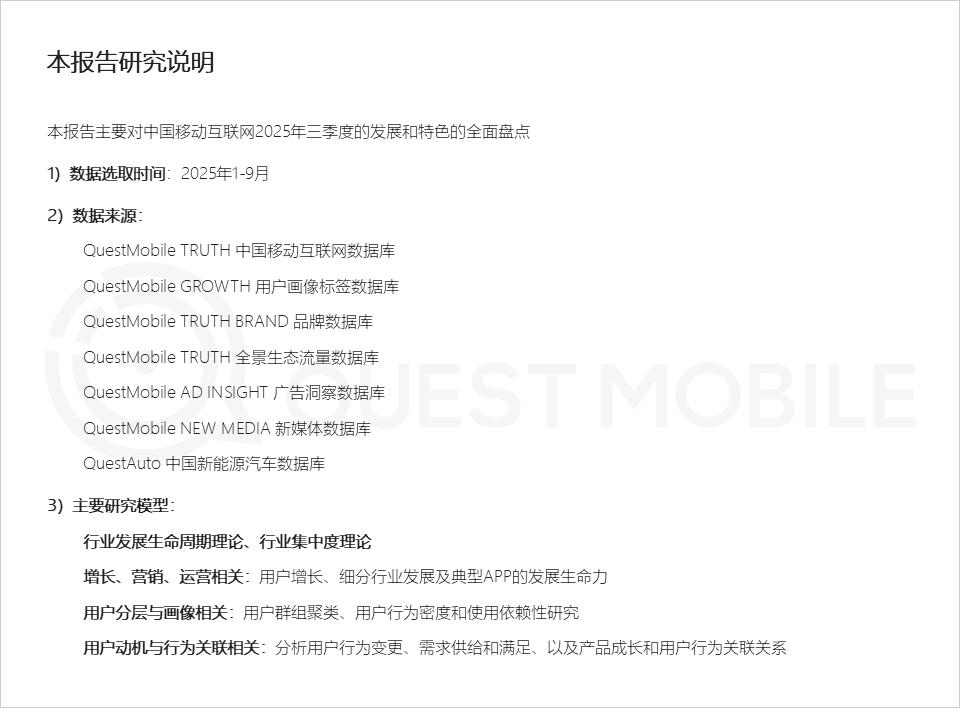
Core Insights - The mobile internet industry is entering a high-quality development phase, with user engagement and usage time showing significant growth [1][2][13] - The user base reached 1.269 billion by September 2025, with a year-on-year increase of 2%, while the average monthly usage time per user increased by 8.2% to 178.2 hours [1][13] User Engagement and Demographics - User structure is improving, with the proportion of users from first-tier cities increasing to 11.2%, up by 0.8% year-on-year [1][15] - Users with online consumption capabilities between 1,000 to 2,999 yuan account for 63%, a 0.9% increase year-on-year, indicating sustained growth in high-consumption user segments [1][15] - The proportion of users aged 46 and above has increased by 1.1%, reflecting a shift towards a more diverse user demographic [1][15] AI and Technological Integration - Generative AI is driving the integration of mobile internet services into high-frequency daily needs such as life, entertainment, and travel [1][2] - The monthly active user base for AI applications has surpassed 700 million, with significant growth in AI search engines and comprehensive assistants [29][38] - AI applications are becoming essential tools in various sectors, including education and office productivity, enhancing overall efficiency [20][18] Market Dynamics and Capital Trends - A new expansion cycle in the mobile internet sector is underway, with major companies increasing investments in AI and breaking down business boundaries [2][9] - The internet advertising market reached 187.51 billion yuan in Q3 2025, a year-on-year growth of 6.4%, driven by consumer brands and innovative advertising strategies [2][44] - Major internet companies like Tencent and Alibaba are seeing significant market capitalization growth, with Tencent's market value returning to 5.5465 trillion yuan, a 48.1% increase year-on-year [9][2] Industry Insights - The online entertainment sector, particularly short video platforms, has seen a surge in user engagement, with active users reaching 1.129 billion [70] - The online video industry is thriving, driven by summer effects and popular short dramas, with user engagement exceeding 20 hours per month [77] - The tourism and travel sector is experiencing increased demand, with platforms adapting to changing consumer preferences for self-planned travel [110][117]

消费分化中寻机遇,食品饮料板块结构性机会凸显
Mei Ri Jing Ji Xin Wen· 2025-11-04 00:57
Core Insights - The food and beverage sector is presenting structural investment opportunities, particularly highlighted by the impressive online sales performance of liquor during the holiday season, with JD's Qixian platform seeing a year-on-year increase in liquor sales exceeding 100% and Douyin's liquor sales growing by 58% month-on-month, indicating resilient consumer demand [1] - Progress has been made in industry standardization with the official release of the twelve-spice standard sample, further regulating the industry's quality system [1] Sector Performance - There is a noticeable divergence in performance across sub-sectors, with research indicating that segments such as snacks, beverages, pet products, and health supplements maintain a high level of prosperity, while traditional consumer goods like dairy products, condiments, and beer show relatively flat demand [1] - On the cost side, the prices of major raw materials continue to decline, although the rate of decrease has narrowed, while packaging material prices have increased month-on-month [1] Liquor Sector Dynamics - The liquor sector faces pressure from government and business demand; however, banquet and mass consumption remain stable, with improved sales performance month-on-month [1] - In the current market environment, it is recommended to focus on leading companies in sub-sectors with performance certainty and those benefiting from consumption upgrades to seize structural investment opportunities [1] Investment Tools - Compared to the high minimum investment thresholds of component stocks, ETFs serve as a convenient tool for small capital to participate in sector investments. The food and beverage ETF (515170) tracks the CSI sub-sector food and beverage industry theme index, focusing on high-barrier and resilient sectors such as liquor, beverages, dairy products, and fermented condiments, aiding investors in easily allocating core assets in the "food and beverage sector" [1]
王世杰常委代表民革中央的发言:激发服务消费活力 打造“十五五”发展新动能
Sou Hu Cai Jing· 2025-11-03 08:57
转自:人民政协报 中共二十届四中全会重点研究"十五五"规划建议问题,旨在更好发挥国家发展规划的战略导向作用,推动事关中 国式现代化全局的战略任务取得重大突破。中国国民党革命委员会坚决拥护中共中央决策部署,将深入学习贯彻 中共二十届四中全会精神,为确保基本实现社会主义现代化取得决定性进展贡献智慧和力量。 三、创新服务消费场景和平台载体。紧扣数字化、绿色化、品质化发展潮流,进一步健全城乡服务消费网络及功 能,着力推动线上线下深度融合与业态跨界融合,加快构建智慧商圈、智慧街区、智慧门店等消费新场景。总结 推广"中国农民丰收节""草莓音乐节""苏超"等成功经验,鼓励各地因时制宜、因地制宜,强化互动合作,举办特 色鲜明的服务消费主题活动。深化国际消费中心城市建设,支持打造具有全球吸引力的消费环境,引领全国服务 消费提质扩容。 四、丰富优质多元服务消费供给。聚焦"一老一小"等重点群体需求,推动医疗、养老、托幼、家政等服务提质升 级,加快培育健康管理、旅居、研学等新业态。顺应个性化消费新趋势,引导文化娱乐、旅游休闲、体育运动、 餐饮购物等服务向创意性、沉浸式、定制化发展。深化服务业对外开放,拓展电信、医疗、教育等领域开放试 ...

有钱的苏州,为何没有”百亿店王”?
3 6 Ke· 2025-11-03 02:38
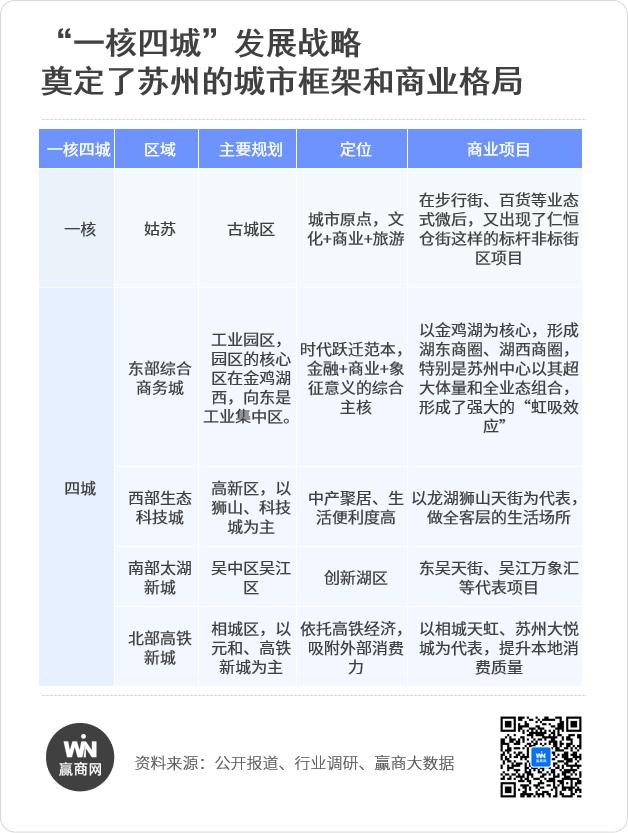
Core Insights - Suzhou's commercial landscape is characterized by a juxtaposition of traditional and modern elements, with a strong economic base yet underperforming commercial real estate, often referred to as the "commercial Bermuda Triangle" [1][25] - The city has transitioned from a single-center model to a multi-center collaborative approach, enhancing its urban framework and commercial distribution [2][4] - The evolution of Suzhou's commercial spaces reflects a shift from pedestrian streets and department stores to shopping centers, indicating a significant transformation in consumer behavior and preferences [5][10] Historical Context - The core of Suzhou was historically centered in the Gusu District, but urban expansion has led to a multi-center development strategy known as "one core and four cities" [2][4] - The opening of the Suzhou Metro Line 1 in 2012 marked a pivotal moment in the city's commercial evolution, facilitating better connectivity and access to various districts [2] Commercial Evolution - The commercial evolution in Suzhou can be categorized into three distinct phases: - **Phase 1 (1.0)**: Initiated with the opening of Suzhou Impression City in 2009, marking the beginning of the shopping center era [10] - **Phase 2 (2.0)**: Featured the emergence of significant projects like Suzhou Yuanrong Star and New Light World, enhancing the commercial landscape in the industrial park area [14][15] - **Phase 3 (3.0)**: Characterized by the opening of large-scale projects such as Suzhou Center and Longhu Lion Mountain, which have become key players in the market [19][20] Competitive Landscape - The Suzhou Center, with a total area of 300,000 square meters and over 500 brands, has established itself as the leading commercial complex in the city, significantly impacting local consumer behavior [20][21] - The competition among commercial projects is intense, particularly in the Lake West and Lake East business circles, where several large-scale projects vie for consumer attention [48][51] Brand Presence and Market Dynamics - Suzhou lacks a "billion-dollar mall," which raises questions about its commercial appeal despite its affluent consumer base [25] - The presence of luxury brands in Suzhou is limited compared to other cities in East China, with notable absences of high-end brands like Chanel and Dior [27][29] - The city has become a testing ground for various brands, indicating its potential as a market for consumer goods and services [25][30] Consumer Behavior - The consumer behavior in Suzhou reflects a decentralized approach, with a focus on the matching of products and services to consumer needs rather than being tied to iconic city landmarks [4][12] - The rise of boutique supermarkets and popular dining brands in Suzhou indicates a growing middle-class consumer base with a demand for quality and diverse offerings [30][34] Future Outlook - The upcoming Suzhou Central Plaza is anticipated to enhance the luxury shopping experience in the city, potentially filling the gap in high-end retail offerings [53] - The integration of local culture and modern commercial practices is expected to drive future growth and attract more diverse consumer segments [55]