关税战

Search documents
冠通期货早盘速递-20250430
Guan Tong Qi Huo· 2025-04-30 12:38
早盘速递 2025/4/30 热点资讯 1. 近日,国家发展改革委已印发通知,会同财政部及时向地方追加下达今年第二批810亿元超长期特别国债资金,继续大力支 持消费品以旧换新。下一步,国家发展改革委将充分发挥"两新"部际协调机制作用,强化统筹推进和跟踪调度,督促各地各 有关部门加快已拨资金审核兑付,切实减轻企业垫资压力,确保真金白银优惠直达消费者,推动消费品以旧换新政策发挥更大 效果。 2. 中国人民银行发布数据显示,2025年第一季度全国新发放商业性个人住房贷款加权平均利率为3.11%。 3. 外交部发言人郭嘉昆强调,中方多次阐明关税战、贸易战没有赢家。这场关税战是美方发起的,如果美方想通过对话谈判 解决问题,就应该停止威胁施压,在平等、尊重、互惠的基础上同中方开展对话。 4. 高盛最新研报表示,美国3月份商品贸易逆差扩大幅度超过预期。三月份货物进出口双双增长。贸易逆差扩大的主要原因是 消费品进口增加,这可能反映了在关税上调之前进口的"抢跑"。总体而言,我们将美国第一季度GDP跟踪预测下调了0.6个百 分点至-0.8%(季度环比年化)。美国GDP数据将于30日晚间公布。 5. 巴基斯坦信息部长Attaull ...
第一创业晨会纪要-20250430
First Capital Securities· 2025-04-30 11:04
Group 1: Strategy and Advanced Manufacturing - The European Commission announced on April 28 that it will impose additional tariffs of up to 66.7% on aerial work platforms imported from China, affecting companies like Hunan Xibang Intelligent Equipment Co., Ltd., Zoomlion Intelligent Aerial Work Machinery Co., Ltd., and Zhejiang Dingli Machinery Co., Ltd. [2] - The new tariffs will range from 20.6% to 66.7%, significantly impacting the profitability of the industry, especially for companies heavily reliant on exports to Europe and the US [2]. Group 2: Consumer Sector - BeiYinMei reported total revenue of 2.773 billion yuan, a year-on-year increase of 9.7%, and a net profit of 103 million yuan, up 116.92%. The growth was attributed to a decrease in sales expenses and better control of credit impairment losses [7]. - The company’s main business, infant formula, grew by only 7%, indicating a gap in market share compared to leading competitors. However, recent financial improvements and favorable government policies on childbirth subsidies are expected to boost demand for infant formula [7]. - The domestic market is seeing a clear trend of replacing imported brands due to rising costs from US-China tariff uncertainties, presenting new opportunities for BeiYinMei [7]. Group 3: Alcohol Industry - Companies like Fenjiu, ShuiJingFang, and JinShiYuan reported single-digit growth in revenue and net profit for 2024 and Q1 2025, aligning with the overall development trend of the liquor industry [8]. - The financial ratios of publicly listed liquor companies indicate a negative growth in revenue and net profit for Q1 2025, reflecting insufficient growth momentum and ongoing adjustments within the industry [8].


焦炭市场周报:宏观主导市场情绪,原料下跌焦炭弱势-20250430
Rui Da Qi Huo· 2025-04-30 09:29
瑞达期货研究院 「2025.04.30」 焦炭市场周报 宏观主导市场情绪,原料下跌焦炭弱势 研究员:徐玉花 期货从业资格号F03132080 期货投资咨询从业证书号 Z0021386 关 注 我 们 获 取 更 多 资 讯 业 务 咨 询 添 加 客 服 目录 1、周度要点小结 2、期现市场 3、产业链情况 「 周度要点小结2」 行情回顾及展望 3 来源:瑞达期货研究院 1. 宏观方面,钢协将于近期对2024年及一季度钢铁主业现金流为负、粗钢产量增长的6家企业给予提醒。坚持"三定三不要"、防 止恶性竞争应当是全体钢铁企业共同遵守的准则。据初步预测,现有美国高关税水平叠加其他国家相关贸易壁垒,2025年或影 响我国钢铁产品直接、间接出口2000万吨以上,其中大部分为高端钢材。 2. 海外方面,世界银行预测,部分由贸易动荡造成的全球经济增长放缓将导致全球大宗商品价格在2025年下跌12%,2026年再 下跌5%,标志着由新冠疫情后经济复苏和俄罗斯2022年入侵乌克兰推动的价格上涨期结束。 3. 供需方面,短期供应弹性好于焦煤,本期铁水产量244.35万吨+4.23万吨,供需均衡,铁水继续上升空间有限。利润方面,本 ...
车展观察丨“链”上世界:中外目光再次聚焦上海车展,融合共进趋势不改
Zhong Guo Jing Ji Wang· 2025-04-30 08:10
Core Viewpoint - The 2025 Shanghai International Auto Show highlights the global appeal and strength of the Chinese automotive industry, showcasing nearly a thousand manufacturers and supply chain companies from 26 countries amidst escalating tariff wars [1][4]. Group 1: Industry Dynamics - The auto show is expected to attract nearly 10,000 overseas dealers, indicating strong international interest in the Chinese automotive market [1]. - In 2024, China maintained its position as the world's largest automotive market for the 16th consecutive year, with vehicle production and sales leading globally [1]. - China's automotive exports exceeded 6.4 million units in 2024, marking a second consecutive year of leading global exports [1][4]. Group 2: Impact of Tariff Wars - The tariff wars have not deterred Chinese automotive companies from expanding internationally, with a focus on markets like Europe, while exports to the U.S. remain minimal at 11,600 units, accounting for only 1.81% of total exports [4]. - Executives from major companies, such as SAIC-GM, express confidence in their high localization rates, with over 95% of parts sourced domestically, mitigating the impact of tariffs [7]. - The ongoing tariff disputes have prompted some U.S. automakers to pause exports to China, while others are adapting their strategies to maintain market presence [7][8]. Group 3: Future Opportunities - Executives believe that crises can present new opportunities, with a focus on enhancing local operations and global collaboration [9]. - Companies like Nissan are committed to exporting models developed in China, aligning with their strategy of "in China, for China, and to the world" [9]. - The Chinese automotive industry is positioned as a leader in electrification and smart technology, attracting increased foreign investment [8][9]. Group 4: Challenges for Component Suppliers - China's exports of automotive components to the U.S. reached $17.15 billion in 2024, representing 15.6% of total component exports, indicating potential vulnerabilities due to tariff impacts [10]. - The lithium-ion battery exports also saw significant growth, with a total of $15.32 billion, highlighting the importance of this sector [10]. - Experts warn of a potential sharp decline in exports of components to the U.S. due to tariff measures, urging local suppliers to diversify their markets and enhance risk management [10].


油价今晚要涨?车主们可以松一口气了
Sou Hu Cai Jing· 2025-04-30 07:00
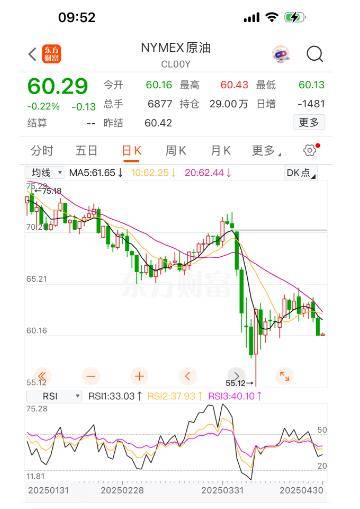
Core Viewpoint - The domestic fuel price adjustment has been suspended due to a recent decline in international oil prices, providing relief for drivers during the holiday period [1][3]. Group 1: International Oil Price Trends - International oil prices have experienced consecutive declines, with New York and Brent crude futures dropping by 1.79% and 1.93% on April 28, and further declines of 3.08% and 2.75% on April 29 [1][3]. - The current average price of crude oil is $64.82 per barrel, with a change rate of 0.65%, not reaching the minimum adjustment threshold [1]. - Factors contributing to the decline in oil prices include the U.S.-initiated tariff war, expectations of reduced oil demand, increasing U.S. oil inventories, and OPEC's proposal to accelerate production increases in June [3]. Group 2: Domestic Fuel Price Adjustments - Since the beginning of the year, domestic gasoline and diesel prices have undergone "three increases, four decreases, and one suspension," resulting in a cumulative decrease of 0.34 yuan per liter for 92-octane gasoline [5]. - On April 17, there was a significant price drop, with 92-octane gasoline decreasing by 0.38 yuan per liter, 95-octane by 0.41 yuan, and 0 diesel by 0.4 yuan [5]. - Current prices in Zhejiang Province are 7.07 yuan per liter for 92-octane gasoline, 7.52 yuan for 95-octane gasoline, and 6.72 yuan for 0 diesel [5].
中泰期货晨会纪要-20250430
Zhong Tai Qi Huo· 2025-04-30 06:45
1. Report Industry Investment Rating No relevant content provided. 2. Core Viewpoints of the Report - The overall market is affected by multiple factors such as macro - policies, trade situations, and supply - demand relationships. Different industries and products show diverse trends, with some in a weak state and others showing signs of recovery or stability [7][8][9]. - For most products, short - term market sentiment and long - term supply - demand fundamentals jointly determine price trends. Traders need to consider both short - term fluctuations and long - term impacts when making decisions [17][19][23]. 3. Summary by Related Catalogs 3.1 Macro Information - China emphasizes Shanghai's role in building an international science and technology innovation center. The Ministry of Foreign Affairs responds to the US on the tariff war. As of April 30, 2024, A - share listed companies' annual revenue and net profit decreased year - on - year. The central bank releases housing loan interest rate data. The US has certain statements on tariffs and job vacancies, and China's coal industry focuses on import order [7]. 3.2 Stock Index Futures - The market expects China's April official manufacturing PMI to decline, with enterprises under pressure from the tariff storm. The policy stance is clear, and the strategy suggests considering option covered strategies [7]. 3.3 Treasury Bond Futures - The bond market is strong due to factors such as loose funds, expected low PMI, and reduced trade volume. The policy focuses on fiscal policy, and the long - term and ultra - long - term bonds are still strong, with a flat yield curve. It is recommended that cautious investors wait and see [7]. 3.4 Container Shipping on European Routes - The price of Maersk's WEEK20 quotation has dropped, and the market is in a weak and volatile state. Before the holiday, the market is expected to remain weak, and the future price depends on the supply - demand structure. It is recommended to take appropriate profit on short positions before the holiday [8]. 3.5 Cotton - International and domestic cotton prices are under pressure due to factors such as the US tariff issue, demand concerns, and supply - side factors. Domestic cotton is in a weak position at a low level, and attention should be paid to domestic export trends [9]. 3.6 Sugar - International and domestic sugar prices are affected by factors such as supply - demand, contract expiration, and weather. The sugar price is expected to fluctuate within a range, and the 9 - 1 spread may rebound [9][10]. 3.7 Oils and Fats - **Palm oil**: It is in a short - term multi - empty intertwined state, affected by factors such as seasonal production increase and demand improvement [10]. - **Soybean meal**: The supply pressure will increase in the future, and the short - term price follows the spot market [11]. 3.8 Eggs - The egg price is weak, and the supply may increase in the future. It is recommended to have a short - bias operation on egg futures, and reduce short positions before the holiday [12][13]. 3.9 Apples - The spot price is strong, and the inventory is low. The new - season production needs to be evaluated due to weather impacts. It is recommended to lightly buy near - month contracts at low prices [13][14]. 3.10 Red Dates - The market is in a traditional off - season, and the price is weak. Attention should be paid to the growth of jujube trees and downstream stocking [14]. 3.11 Live Pigs - The spot price is weak, and the supply pressure may increase after the holiday. It is recommended to operate with a short - bias and light positions [14][15][16]. 3.12 Crude Oil - The international oil price is falling due to OPEC+ production increase and weak demand. The future trend will be mainly driven by production increase and economic recession, and may be repaired if the trade war eases [17]. 3.13 Fuel Oil - It follows the oil price decline, and the future performance depends on the demand's ability to bear the production increase under the influence of the trade war [18]. 3.14 Plastics - L and PP are recommended to be short - biased, and the long - term trade situation is not optimistic [19]. 3.15 Rubber - It is in a state of weak supply and demand, and it is recommended to hold and wait for the RU - NR spread [19]. 3.16 Methanol - It is expected to be weak and volatile in the short term, and short - bias allocation can be considered if there is a rebound [20]. 3.17 Caustic Soda - The price of high - concentration caustic soda is falling, and it is recommended to wait and see [20]. 3.18 Soda Ash and Glass - **Soda ash**: The price may rebound slightly in the short term but is restricted in the long term by high supply and inventory [20]. - **Glass**: The price is expected to be volatile or weakly volatile due to weak demand [20]. 3.19 Asphalt - The price is expected to be in the range of 3300 - 3400, and the inventory reduction provides support [21]. 3.20 Liquefied Petroleum Gas (LPG) - It mainly follows the oil price, and the future price may be in a volatile state with a long - term downward trend in the center [21]. 3.21 Pulp - It has a pattern of weak demand and high inventory, and it is recommended to short on rebounds [21]. 3.22 Logs - The demand is weak, and the short - term is expected to be volatile. Short on rebounds in the short term and buy out - of - the - money call options in the long term [21]. 3.23 Urea - The spot price is rising, and the futures price is falling. It is recommended to sell at high prices in the short term and wait and see during the holiday [21]. 3.24 Aluminum and Alumina - **Aluminum**: It is expected to be volatile and strong, continuing to repair the decline caused by tariffs [22]. - **Alumina**: It is recommended to wait and see before the holiday and lightly go long for cost support in the long term [22]. 3.25 Lithium Carbonate - It is recommended to adopt a volatile trading idea, as the short - term price decline may narrow [22]. 3.26 Steel and Iron Ore - The steel and iron ore market is under pressure in the medium - long term, and the steel price may be volatile in the short term [22][23]. 3.27 Coal and Coke - The price is expected to be volatile in the short term, and there are no conditions for long - positions for now [24]. 3.28 Ferroalloys - **Silicon iron**: Go long during the day. - **Manganese silicon**: Sell the 06 - contract put option [24][25].
4月PMI回落至收缩区间,扩内需政策需加力提速
Jing Ji Guan Cha Wang· 2025-04-30 06:07
4月30日,国家统计局发布了2025年4月制造业采购经理指数、非制造业商务活动指数、综合PMI产出指 数。其中,制造业采购经理指数(PMI)为49.0%,比上月下降1.5个百分点,回落至收缩区间。非制造业 商务活动指数为50.4%,比上月下降0.4个百分点;综合PMI产出指数为50.2%,比上月下降1.2个百分 点,均高于临界点。 4月PMI录得数据为49.0%,显示经济受外部冲击影响加大,扩内需紧迫性加强。笔者认为,美国发动的 全球新一轮关税战使我国外需承压,且内部有效需求仍显不足,下阶段需加快地方政府专项债券、超长 期特别国债等存量政策的发行使用,同时及时推出新型政策性金融工具等增量储备政策,更大力度支持 扩大内需、稳定外贸。 首先,从制造业采购经理调查指标体系的13个分类指数来看,制造业供需两端均回落,外需大幅走弱, 价格低位运行。具体来看: 1.供需两端回落:生产端,4月PMI生产指数为49.8%,比上月下降2.8个百分点;需求端,4月PMI新订 单指数为49.2%,比上月下降2.6个百分点,均跌入收缩区间; 2.外需大幅走弱:PMI新出口订单指数是出口的领先指标,4月PMI新出口订单指数为44.7% ...
关税战大败!6万亿美债“雷暴”将至,美国深陷二战后最大困局
Sou Hu Cai Jing· 2025-04-30 05:30
Group 1 - The failure of the tariff war is considered one of the most serious strategic mistakes for the US since World War II, leading to a gradual erosion of the dollar system and potential collapse of the US economy and financial system [1] - From April 2025, 12 countries including Japan, France, and the UK began to reduce their holdings of US Treasury bonds, with a single-month net reduction exceeding $90 billion, including a $44.1 billion sell-off by the UK and approximately $50 billion by Japan, marking a near 10-year high in weekly sell-offs [1] - US Treasury Secretary Janet Yellen warned that the current situation is "extremely unusual," with increasing investor skepticism regarding the future repayment capability of US Treasury bonds [1] Group 2 - The US is facing a fiscal crisis, with the potential for a "blow-up" in the Treasury bond market, driven by a series of actions from the Trump administration, including tariffs aimed at inducing high inflation to prompt Federal Reserve intervention [3] - The ultimate goal of these actions is to dilute the $6.5 trillion in Treasury bonds maturing in June, as a turbulent bond market could threaten the entire dollar financial hegemony [3] - The US may consider restructuring its $36 trillion debt by replacing Treasury bonds with long-term, non-tradable, and zero-interest bonds, potentially allowing it to evade over $30 trillion in debt and more than $1 trillion in annual interest payments [3] Group 3 - The ongoing sell-off of US Treasury bonds may continue, especially as China has not yet significantly reduced its holdings [4] - China's countermeasures, including tariff retaliation and supply chain disruptions, have led to significant market reactions, including a $5 trillion evaporation in US stock market value and a 10% drop in Tesla's stock price [4] - The US inflation rate has surged to a 40-year high, with ordinary families facing an additional $300 monthly expense due to tariffs, indicating the widespread impact of the tariff war on the economy [9] Group 4 - The tariff war has destabilized the US Treasury system, with $6.5 trillion in bonds maturing in June and an additional $3 trillion by the end of the year, followed by $8 trillion next year, creating a domino effect pushing the US towards potential bankruptcy [9] - The adverse effects of the tariff war are also evident in the technology sector, with major companies like Intel announcing plans to cut 20% of their workforce [9]
国元证券晨会纪要-20250430
Guoyuan Securities2· 2025-04-30 05:09
Key Points - The report highlights that the US trade deficit in goods expanded to a record $162 billion in March [3] - The US Treasury Secretary indicated that discussions will take place with at least 17 partners in the coming weeks [3] - Concerns over tariffs are negatively impacting economic outlook, with US consumer confidence dropping to a near five-year low in April [3] - The report notes significant layoffs, with UPS becoming the first major company to conduct mass layoffs due to the trade war, affecting 20,000 employees [3] - Amazon was forced to halt plans to display tariff impacts on product pages, while Walmart has notified Chinese suppliers to resume shipments [3] - The report also mentions that South Korea's credit card default rate reached a ten-year high in the first quarter of this year [3] Economic Data Summary - The Baltic Dry Index closed at 1403.00, up 2.18% [4] - The Nasdaq Index closed at 17,461.32, up 0.55% [4] - The Dow Jones Industrial Average closed at 40,527.62, up 0.75% [4] - The S&P 500 closed at 5,560.83, up 0.58% [4] - The ICE Brent crude oil price was $64.05, down 2.75% [4] - The USD/CNY exchange rate was 7.27, down 0.47% [4] - The Hang Seng Index closed at 22,008.11, up 0.16% [4] - The Shanghai Composite Index closed at 3,286.65, down 0.05% [4]
关税战难解美国制造业困境,旧秩序正在崩溃
3 6 Ke· 2025-04-30 04:23
Group 1 - The core of the news revolves around Trump's consideration to significantly reduce tariffs on Chinese imports by over 50% to ease global trade and financial market disruptions [1] - The trade war initiated by Trump has led to a chaotic situation in global supply chains, with both the US and China engaging in a "chicken game" where neither side is willing to make concessions [1][4] - The discussion highlights that the essence of the trade war is not merely about tariffs but reflects a deeper collapse of the old global order, with significant implications for international relations and trade dynamics [3][27] Group 2 - The historical context of Trump's tariff strategy is compared to 18th-century diplomatic tactics, emphasizing extreme pressure and ultimatums to gain negotiation advantages [5] - The recent escalation of tariffs has seen the US impose a 125% tariff on Chinese goods, while China has responded with similar measures, indicating a shift from economic tools to political weapons [5][6] - The complexity of global supply chains means that tariffs may not effectively disrupt trade, as companies find ways to circumvent them, leading to a situation where tariffs lose their intended economic impact [19][21] Group 3 - The concept of "supply chain overflow" is introduced, where manufacturing processes are not simply relocating but are instead creating a more complex network that still relies heavily on Chinese suppliers [9][10] - The discussion points out that while some assembly operations may move to countries like Vietnam, the deeper layers of the supply chain remain entrenched in China, complicating the effectiveness of US tariffs [9][11] - The rising costs in Southeast Asia, such as land prices in Vietnam, indicate that even partial relocation of manufacturing does not equate to a complete transfer of the supply chain [13][15] Group 4 - The news discusses the challenges faced by US manufacturing, highlighting that the return of manufacturing jobs is unlikely without significant changes in investment and operational efficiency [38][39] - The potential for AI and Universal Basic Income (UBI) to address economic disparities and the challenges posed by automation is explored, suggesting a shift in focus from traditional manufacturing to new economic models [41][40] - The narrative suggests that the current geopolitical landscape is leading to a new form of globalization centered around the US, moving away from the previous multilateral frameworks [30][32]