
碳市场

Search documents
专访赖晓明:推进碳市场扩容,研究配额有偿分配|四中全会预热
2 1 Shi Ji Jing Ji Bao Dao· 2025-10-14 09:27
Core Viewpoint - The national carbon market in China has become the largest in the world, effectively managing over 60% of the country's carbon dioxide emissions, with significant growth in trading volume and market participation observed in 2023 [1][2]. Market Development - The national carbon market has been operational for four years, with a cumulative trading volume of 728 million tons and a total transaction value of 49.83 billion yuan as of September 30, 2025 [1]. - The trading volume in 2023 has increased by 40% compared to the same period last year, indicating a rise in market activity and participant engagement [4]. - The number of key emission units that have opened trading accounts has reached 1,277, contributing to a more diverse market structure [2][3]. Market Structure and Participants - The expansion of the carbon market to include industries such as steel, aluminum smelting, and building materials has diversified the market, enhancing the richness and variety of market participants [3]. - The quality of market participants has improved, with many companies establishing dedicated carbon asset management departments, leading to a more proactive approach to carbon management [4]. Local Market Dynamics - Local carbon markets, such as Shanghai's, are expected to continue playing a crucial role in supporting local carbon reduction goals and green development, despite a reduction in quota coverage due to the national market's expansion [5][7]. - Shanghai's carbon market has over 2,200 registered entities, including around 400 key emission enterprises, which contributes to its high trading activity [6]. Future Directions - The carbon market is set to transition towards a model of "paid allocation + total control" during the 14th Five-Year Plan, with a focus on policy coordination between industrial and carbon market policies [10]. - Plans are in place to include all major industrial emission sectors in the carbon market by 2027, with ongoing research into paid allocation mechanisms to enhance market efficiency [8][9].

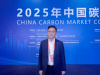
专访赖晓明:推进碳市场扩容,研究配额有偿分配
2 1 Shi Ji Jing Ji Bao Dao· 2025-10-14 09:26
Core Viewpoint - The national carbon market in China has become the largest in the world, effectively managing over 60% of the country's carbon dioxide emissions, and is evolving towards a model of "paid allocation + total control" during the 14th Five-Year Plan period [1][10]. Market Development - The national carbon market has been operational for four years, with a cumulative trading volume of 728 million tons and a total transaction value of 49.83 billion yuan as of September 30, 2025 [1]. - The trading volume in the carbon market has increased significantly, with a 40% growth compared to the same period last year, and trading activity has improved with a 75% increase in transaction volume, number of trading enterprises, and transaction counts in the first half of 2025 compared to 2024 [2][3]. Market Structure and Participants - The inclusion of new key emission units has expanded the market's participant base to 1,277 entities, enhancing market diversity and creating more trading opportunities [2]. - The market now covers four major industries: power generation, steel, aluminum smelting, and building materials, which has diversified the market structure and improved trading dynamics [2]. Local Market Role - Local carbon markets, such as Shanghai's, are expected to continue supporting local "dual carbon" goals and green development, even as they face challenges from the national market's expansion [4][6]. - Shanghai's carbon market has over 2,200 registered entities, including around 400 regulated enterprises and 1,800 investment and financial institutions, contributing to high trading activity [5]. Future Directions - The Shanghai Environmental Energy Exchange is focusing on expanding industry coverage, researching paid allocation mechanisms, and promoting market participant diversification [8][9]. - The transition to a "paid allocation + total control" model is a key focus for the 14th Five-Year Plan, with an emphasis on policy coordination between industrial and carbon market policies [10].

接连签下多笔重大订单,这家企业上半年相关业务收入同比增近40%
摩尔投研精选· 2025-10-13 10:28
Core Viewpoint - Chinese photovoltaic companies are performing exceptionally well in overseas markets, securing significant GW-level orders, particularly in the Middle East and South Asia, with nearly 25GW of overseas contracts signed since September [1] Group 1: Domestic Market Dynamics - The national carbon market construction is strengthening, providing steady support for the demand for photovoltaic storage and other green electricity [2] - The elasticity coefficient of electricity consumption in China has been increasing, with overall electricity load reaching new highs and emerging energy demands continuously surfacing [2] - The market-oriented trading of new energy generation has led to an expansion of peak-valley price differences, further supporting the demand for green energy [2] Group 2: Supply Chain and Industry Trends - Coordination among national ministries and industry associations has led to a consensus against excessive competition, resulting in a rebound in industry chain prices [2] - The overseas demand is influenced by trade environment changes and IRA subsidy policy adjustments, with the European market gradually recovering and emerging markets developing [2] - The ongoing "anti-involution" process is expected to stabilize product prices and corporate profitability, alongside the growth of overseas market demand and the gradual application of new technologies like perovskite [2] Group 3: Future Outlook - The new photovoltaic installed capacity in China is expected to maintain rapid growth throughout the year [2] - The demand for upstream photovoltaic processing equipment is anticipated to gradually stabilize and recover due to the ongoing "anti-involution" process and the application of new technologies [2]
双碳跟踪:CCER方法学加速出台,累计单吨成交均价约86.4元
Changjiang Securities· 2025-10-13 02:13
Investment Rating - The report maintains a "Positive" investment rating for the environmental industry [13] Core Insights - Since 2024, China has accelerated the establishment of a national carbon market regulatory framework, with significant progress in the CCER (China Certified Emission Reduction) methodology since October 2023. As of September 2025, the cumulative transaction volume of CCER is approximately 2.43 billion yuan, with an average transaction price of 86.41 yuan per ton [2][6][8] Summary by Sections Carbon Emission Control System - The carbon emission control system is gradually improving, with a unified national carbon market being constructed. The market includes both the national carbon quota trading market (CEA) and the voluntary greenhouse gas emission reduction trading market (CCER), which operate independently but are interconnected through a quota offset mechanism [6][19][21] CCER Methodology Expansion - The CCER methodology has been continuously expanded, with four batches of methodologies released since October 2023. The first batch includes forestry carbon sinks and offshore wind power, while subsequent batches cover various energy-saving and emission reduction projects. As of September 2025, 29 voluntary emission reduction projects have been registered, with an expected annual reduction of 10.438 million tons [7][26][27] CCER Market Performance - The average transaction price of CCER is currently higher than that of CEA, reflecting a temporary supply-demand imbalance due to strict project approvals and limited issuance. The report anticipates that as the issuance of CCER increases and market mechanisms mature, prices will gradually return to a reasonable relationship. The average transaction price of CCER from January to September 2025 is 86.41 yuan per ton, while CEA's average is 69.29 yuan per ton [8][34] Benefits of Agricultural and Forestry Biomass Projects - The report highlights the potential benefits of agricultural and forestry biomass projects under the CCER framework. For instance, assuming a CCER price of 80 yuan per ton, companies like Changqing Group and China Everbright Green Environmental Protection could see significant revenue contributions from CCER sales, amounting to 139 million yuan and 384 million HKD, respectively [9][44][45] Investment Logic for CCER - The investment logic for CCER emphasizes the importance of additionality in projects, focusing on profitability compensation rather than mere emission reduction. Key areas of interest include carbon monitoring equipment and consulting services, as well as the acceleration of related industries such as biomass power generation and hydrogen energy [10][49]

刘锋:构建更具活力与效能的新型碳市场
Sou Hu Cai Jing· 2025-10-12 12:47
Core Viewpoint - The article emphasizes the significant transformation in global climate governance, highlighting the importance of reducing greenhouse gas emissions and promoting green low-carbon transitions as a universal consensus. China's commitment to achieving its "dual carbon" goals showcases its responsibility as a major power, with the carbon market playing a crucial role in ecological civilization construction [1]. Summary by Sections Development of China's Carbon Market - China's carbon market has evolved from local pilot programs to a national unified market, covering 60% of carbon emissions and becoming the largest carbon market globally. The recent issuance of the "Opinions on Promoting Green Low-Carbon Transition and Strengthening National Carbon Market Construction" marks a new phase of comprehensive deepening in carbon market development [1][2]. Market Achievements and Trends - As of August 22, 2025, the cumulative trading volume of carbon emission allowances reached 680 million tons, with a total transaction value exceeding 47.41 billion yuan. The market has shown stability, with a nearly 100% compliance rate for allowance submissions in 2024. The market is set to expand in 2025 to include steel, cement, and aluminum industries, which together account for approximately 2.5 billion tons of CO2 emissions [3][4]. Policy Innovations and Institutional Breakthroughs - The "Opinions" provide a systematic framework for the national carbon market, outlining medium- and long-term development goals. By 2027, the market aims to cover major industrial sectors, and by 2030, it will establish a mixed allocation system combining free and paid distribution of allowances [6][7]. Market Mechanisms and Financial Innovations - The carbon market is transitioning from intensity-based allocation to total control, with a phased approach to implement total control by 2030. The introduction of a "mandatory + voluntary" dual-track market system aims to enhance flexibility and inclusivity, encouraging broader participation in emission reduction efforts [8][9]. Challenges and Opportunities - Despite significant progress, challenges remain, including the predominance of free allocation methods and the need for improved market stability mechanisms. However, the potential for financial innovation, such as carbon pledges and repurchase policies, presents opportunities for enhancing market vitality and developing new carbon financial products [10][13]. Future Directions - The article suggests that future efforts should focus on establishing a comprehensive regulatory framework, enhancing market mechanisms, and fostering international cooperation to strengthen China's position in global carbon governance. This includes developing carbon financial products and improving data governance to support market efficiency [14][15][16].
把握我国碳金融发展的未来方向与政策路径
Zhong Guo Yin Hang· 2025-10-11 01:15
Group 1: Current State of Carbon Finance in China - Carbon finance in China is still in its early development stage, with the national carbon market officially launched in 2021 and local markets starting from 2013[7] - As of August 2022, the Shanghai carbon market had conducted 16 carbon quota pledge financing transactions totaling over 41 million yuan, while the Guangdong market had 31 transactions totaling 93 million yuan[8] - The financing scale of carbon finance is insufficient compared to the over 40 trillion yuan in green loans available in China[8] Group 2: Future Directions for Carbon Finance Development - The national carbon market is expected to cover 8 billion tons of carbon emissions by 2025, making it the largest carbon market globally[10] - The development of financing tools should be prioritized to enhance the role of the carbon market in promoting green finance[11] - It is estimated that achieving carbon neutrality in China may require over 100 trillion yuan in cumulative investment[15] Group 3: Policy Recommendations for Carbon Finance - Emphasizing carbon pledge financing as a key area, with a need to clarify the financing model and extend loan periods beyond the current compliance cycle[26] - Developing a comprehensive financing product system that includes carbon repurchase agreements and carbon bonds to provide both short-term and long-term financing[27] - Establishing a quota reserve and market adjustment mechanism to prevent extreme price fluctuations in the carbon market[30]
碳月报:全国碳市场价格承压震荡运行-20251010
Jian Xin Qi Huo· 2025-10-10 08:41
Report Date - October 10, 2025 [2] Research Team - Energy and Chemical Research Team includes researchers for different sectors such as crude oil, PTA/MEG, industrial silicon, polyolefins, pulp, and glass soda ash [3] Investment Rating - Not provided Core View - The national carbon market price is under pressure and fluctuating [4] Summary by Section 1. National Carbon Market Overview - In September, the national carbon market's highest price was 69.49 yuan/ton, the lowest was 57.72 yuan/ton, and the closing price dropped 16.35% from the last trading day of the previous month. The total trading volume was 32,700,907 tons, and the total turnover was 2,003,662,939.74 yuan. From January 1 to September 30, 2025, the trading volume was 98,098,802 tons, and the turnover was 6,797,362,256.82 yuan [7] - Fudan Carbon Index shows price expectations for October and December 2025 for national carbon emission allowances (CEA) and China Certified Emission Reductions (CCER), with some price indices showing declines [8] - From January to July 2025, thermal power generation decreased 1.30% year-on-year, cement production decreased 4.5% year-on-year, electrolytic aluminum production increased 2.54% year-on-year, pig iron production decreased 1.3% year-on-year, and crude steel production decreased 3.1% year-on-year [9][10] 2. Market News - At the 2025 China Carbon Market Conference, the Deputy Minister of Ecology and Environment introduced the progress and achievements of the national carbon market since 2024 and outlined future plans. The Minister reported on the significant achievements and challenges in climate change response and carbon peaking and neutrality work, highlighting issues like the resurgence of "two high" projects [11] 3. Data Summary - Not provided with specific summary information other than the mention of data sources and some chart references [13][17][22]
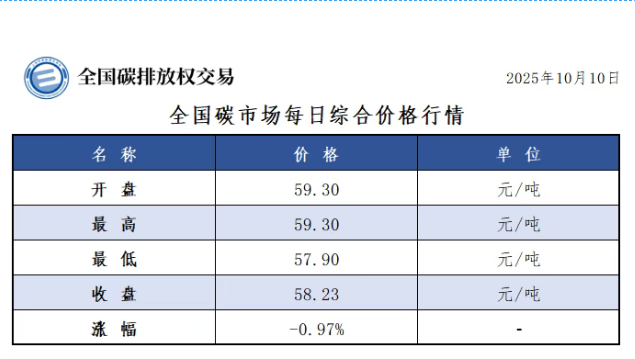
10月10日全国碳市场综合价格收盘价58.23元/吨
Xin Hua Cai Jing· 2025-10-10 08:18
Core Points - The national carbon market opened at a price of 59.30 yuan/ton, with a closing price of 58.23 yuan/ton, reflecting a decrease of 0.97% from the previous day [1][2][5] Trading Volume and Revenue - The total trading volume for the day was 981,263 tons, with a total transaction value of 53,848,590.40 yuan [4][5] - The breakdown of trading included 681,263 tons in listed agreement transactions valued at 36,856,590.40 yuan and 300,000 tons in bulk agreement transactions valued at 16,992,000.00 yuan [4] Cumulative Data - From January 1 to October 10, 2025, the total trading volume in the national carbon market reached 99,320,065 tons, with a cumulative transaction value of 6,865,222,847.22 yuan [6] - As of October 10, 2025, the cumulative trading volume in the national carbon market was 729,588,729 tons, with a total transaction value of 49,897,949,950.73 yuan [6]
让碳市场更好助力绿色低碳转型
Ren Min Ri Bao· 2025-10-09 23:06
Core Insights - The national carbon trading market in China is designed to convert emission reduction pressure into internal motivation, encouraging various sectors to participate in the green and low-carbon transition [1][2] - The market has become the largest in the world in terms of greenhouse gas emissions coverage, effectively managing over 60% of the national carbon dioxide emissions by including industries such as steel, cement, and aluminum [1][2] - The carbon market is expected to enhance trading vitality, with a projected transaction volume of 18.114 billion yuan in 2024, marking the highest level since its inception in 2021 [2] Group 1 - The carbon trading market allows companies to sell excess carbon emission allowances and reinvest the proceeds into energy-saving projects, creating a positive feedback loop [1] - The market aims to promote technological advancement and industrial upgrades by limiting carbon emissions in key sectors [2] - The establishment of a voluntary greenhouse gas reduction trading market broadens participation across various industries, complementing the mandatory carbon trading market [2] Group 2 - The construction of the carbon market is a significant institutional innovation that requires effective management mechanisms, comprehensive regulations, and reliable trading systems [3] - The government has issued guidelines to enhance the carbon market's effectiveness and international influence, aiming for a more vibrant and impactful system [3] - There is a focus on expanding the market's coverage and improving the quality of emission data while combating fraudulent activities [3]
“十五五”时期,碳排放双控制度体系建设如何推进?
Zhong Guo Huan Jing Bao· 2025-10-08 23:14
Core Viewpoint - The transition to a dual control system for carbon emissions is essential for achieving high-quality development and is a key task in the new round of ecological civilization reform in China [1] Challenges in Carbon Emission Dual Control System - The carbon emission accounting system is not yet fully developed, facing issues such as unclear statistical bases, inadequate methods, and a lack of timely data [2] - The evaluation and assessment mechanisms for carbon emissions are still underdeveloped, with insufficient accountability at local and industry levels [3] Strategies and Countermeasures for Carbon Emission Dual Control System - At the regional level, a dual control system for total carbon emissions and intensity should be implemented, focusing on accurate statistical accounting and dynamic updates of greenhouse gas emission factors [4] - At the industry level, there should be a focus on controlling fossil energy consumption and enhancing carbon emission monitoring in key sectors such as electricity, steel, and cement [5] - At the enterprise level, improving the quality of carbon emission data management and integrating it into a multi-tiered regulatory framework is crucial [6] - At the project level, establishing performance standards for carbon emissions and ensuring new projects meet advanced value levels is necessary [7] - At the product level, developing a carbon footprint labeling system and promoting low-carbon products through policy incentives and consumer education is essential [7]