
A股牛市

Search documents
A股下跌原因找到了!后市方向何在?
天天基金网· 2025-09-02 11:30
Core Viewpoint - The A-share market is experiencing a short-term adjustment, particularly in the technology sector, but the overall bullish trend remains intact with potential for recovery after the current fluctuations [1][5][9]. Market Performance - A-shares faced a decline today, with the ChiNext Index dropping nearly 3% and over 4,000 stocks falling [2][5]. - The total trading volume in the two markets reached 2.87 trillion yuan, with defensive sectors like banking and precious metals rising against the backdrop of a struggling technology sector [4][8]. Reasons for Market Adjustment - The technology sector had previously accumulated significant gains, leading to strong profit-taking sentiment and a technical need for adjustment [8]. - External market influences, particularly a drop in the US tech sector, raised concerns about the global AI chip industry's performance, negatively impacting sentiment in the A-share market [8]. - There is a structural shift in capital from high-valuation growth sectors to lower-valuation defensive sectors, exacerbating market volatility [8]. Bull Market Outlook - Despite the current adjustments, many institutions believe the upward trend in the A-share market has not changed, and a recovery is expected post-adjustment [9][12]. - The margin trading balance has reached a historical high, indicating sustained market enthusiasm [9][12]. Institutional Insights - Morgan Stanley and other institutions do not view the market as overheated, citing that current trading volumes and margin balances are not at historical highs, suggesting manageable risk levels [12]. - Analysts expect the market to maintain a high-level operation with potential for structural rotation among sectors, particularly focusing on technology and finance [12][13]. Recommended Investment Sectors - Institutions are optimistic about five key sectors for investment: technology growth (AI, semiconductors), high-end manufacturing (military, new energy), consumer goods (liquor), cyclical sectors (aquaculture, resources), and financials (brokerage, insurance) [13][14]. - Specific recommendations include focusing on resource, innovative pharmaceuticals, consumer electronics, and military sectors for September [14]. Fund Investment Strategies - Investors are advised to review their holdings, especially those heavily invested in sectors that have recently declined, and adjust their positions based on risk tolerance [16]. - Defensive strategies, such as "fixed income plus" products, are recommended to balance equity risks in a low-interest environment [17]. - Long-term investment strategies, including dollar-cost averaging in promising sectors like AI and semiconductors, are encouraged to capitalize on market corrections [18].


交易资金眼中的牛市
Guoxin Securities· 2025-09-02 11:15
Core Insights - The report focuses on the funding mechanisms driving the A-share bull market, analyzing the characteristics of capital flows during previous bull markets and providing scenarios for the current bull market based on three types of funds: "FOMO chasing funds," "right-side profit-taking funds," and "break-even funds" [3][4][10] - The analysis covers five significant bull markets since 2005, highlighting the role of "FOMO chasing funds" in driving market trends and the importance of understanding the relationship between net buying, transaction volume, and valuation levels [4][9][10] Funding Types and Market Dynamics - The three types of funds exhibit different behaviors and impacts on the market: - "FOMO chasing funds" typically enter the market early in a bull run, accelerating their entry due to fear of missing out, thus providing incremental momentum [8][9] - "Right-side profit-taking funds" begin to sell off as profits reach expectations, potentially creating temporary pressure on the market [8][9] - "Break-even funds" are those investors from the previous bear market who choose to exit when the market returns to their cost levels, often leading to increased transaction volume and reduced upward momentum [8][9] Historical Bull Market Analysis - The report reviews five historical bull markets, detailing their start and end points, as well as the overall index gains: - Bull Market 1: July 18, 2005 - October 16, 2007, with a gain of approximately 602% - Bull Market 2: November 4, 2008 - November 23, 2009, with a gain of 143% - Bull Market 3: April 28, 2014 - June 12, 2015, with a gain of 226% - Bull Market 4: January 28, 2016 - November 13, 2017, with a gain of 38.24% - Bull Market 5: October 18, 2018 - December 13, 2021, with a gain of 88.67% [11] Future Market Scenarios - The report outlines three potential future market scenarios based on the behavior of the three types of funds: - In an optimistic scenario, "FOMO chasing funds" continue to drive the market, leading to sustained high transaction volumes and positive net buying [10][29] - In a neutral scenario, the market may experience moderate growth with potential fluctuations as "right-side profit-taking" and "break-even funds" begin to exert pressure [10][29] - In a pessimistic scenario, significant outflows from "right-side profit-taking" and "break-even funds" could lead to negative net buying and a potential market correction [10][29] FOMO Dynamics - The report emphasizes the role of FOMO (Fear of Missing Out) in shaping market dynamics, noting that this sentiment typically peaks after a 20% increase in the index, indicating a strong psychological component to market movements [26][30] - The distribution of FOMO funds varies across different bull markets, with significant concentrations observed during mid to late stages of bull runs, suggesting that the timing and intensity of FOMO can significantly influence market trends [26][30]
A股牛市并未结束
Qi Huo Ri Bao· 2025-09-02 03:39
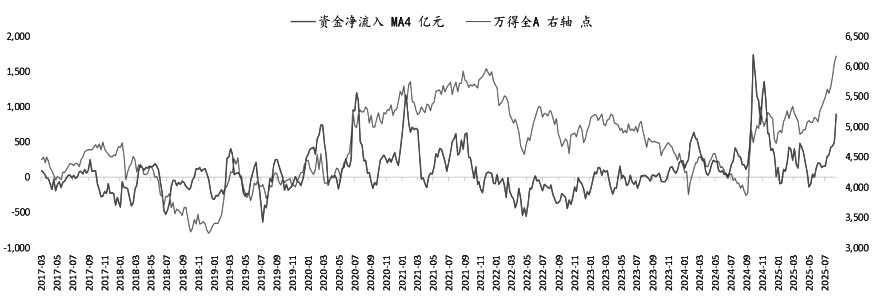
Group 1 - The A-share market liquidity has been accelerating, with net inflow reaching 1,903 billion, close to the levels seen in October 2024 [4] - Last week, stock-type ETFs ended a six-week net outflow, with a net inflow of 14.5 billion, indicating a preference for strong sectors like TMT, finance, real estate, and resources [1][4] - Northbound capital saw a net inflow of 22.4 billion, showing a continuous acceleration since August, while remaining balanced in the long term [1][4] Group 2 - Retail investors showed renewed enthusiasm, with a net inflow of 52.8 billion, marking a significant increase compared to the previous period [1][4] - The financing capital net inflow has been expanding, with a net inflow of 104.4 billion last week, becoming a major bullish force in the A-share market since mid-July [1][4] Group 3 - The overall trading congestion in the A-share market has reached historically high levels, particularly in indices like the Shanghai 50 and CSI 300 [5] - Market sentiment has been high, with the liquidity environment improving since May, leading to an expansion in stock index valuations [5][7] - The recent market rally has been driven by financing capital, which tends to favor small-cap growth stocks and aggressive sectors like semiconductors and securities [5][7]
华创证券:A股牛市“十大观察指标”,哪些已经偏高?
Xuan Gu Bao· 2025-09-02 00:22
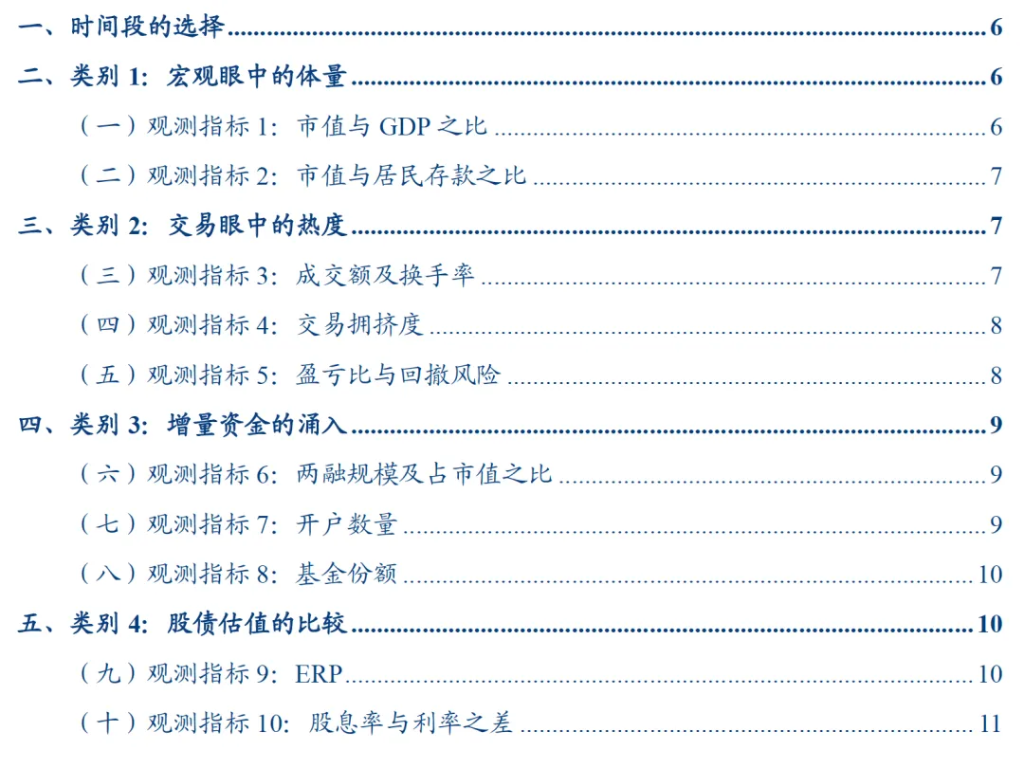
Core Viewpoint - The report identifies key observation indicators to monitor during a bull market, characterized by an index increase of over 20%. It emphasizes macroeconomic metrics, trading activity, capital inflow, and asset valuation comparisons as critical areas of focus [1]. Group 1: Macroeconomic Indicators - Indicator 1: The ratio of market capitalization to GDP is currently at 85.6%, with a change of 18.5% from the start to the end of the current market cycle, indicating room for improvement compared to historical highs [3][14]. - Indicator 2: The ratio of market capitalization to household deposits stands at 73.2%, with a change of 15.7% during the current cycle, suggesting potential for further growth [4][17]. Group 2: Trading Activity - Indicator 3: Trading volume has increased from 1.6 trillion to a peak of 3.19 trillion, indicating a potential for further expansion, with a maximum turnover rate of 2.76%, up by 0.99% from the starting point [4][21]. - Indicator 4: Trading congestion reached a maximum of 39.3%, up from 27.7%, reflecting a significant increase in trading activity [4][24]. - Indicator 5: The current drawdown risk is low at 5.9%, compared to over 10% in previous cycles, with a favorable profit-loss ratio of 2.8 [5][26]. Group 3: Capital Inflow - Indicator 6: Margin financing balance is at 2.24 trillion, a 21% increase from the starting point, with a current market value ratio of 1.91%, indicating room for growth compared to previous cycles [6][29]. - Indicator 7: The number of new accounts opened has seen limited growth, with a ratio of 1.0 compared to the starting month, suggesting potential for future increases [7][31]. - Indicator 8: The issuance of equity funds has a ratio of 1.1 compared to the starting month, which is relatively low compared to previous cycles [8][33]. Group 4: Asset Valuation Comparison - Indicator 9: The equity risk premium (ERP) has decreased by 1.58% during the current cycle, which is a lower decline compared to historical averages [8][35]. - Indicator 10: The difference between equity yields and bond yields has decreased by 1.08%, but remains at a relatively high level, indicating ongoing attractiveness of equities [8][38].
金信期货正常回调
Jin Xin Qi Huo· 2025-09-01 01:45
Report Industry Investment Rating - The report is bullish on the A-share market and expects the Shanghai Composite Index to reach the 4200 - 4300 point range in 2025 [2][26] Core Viewpoints - The recent correction of the Shanghai Composite Index is a normal adjustment in a bull market, and the bull market is still ongoing based on comprehensive analysis of macro - economy, policy, funds, and technical patterns [2][3] - The "six factors" of economic recovery, loose monetary policy, capital flow, policy support, favorable international environment, and technical breakthroughs jointly form the basis for the strong rise of the A - share market [26] Summary by Related Factors Macroeconomic Factor - Since 2025, a series of growth - stabilizing policies have shown continuous effects, and the macro - economic recovery has been further consolidated. The GDP growth rate in the first half of the year was 5.3%, and key economic indicators such as industrial added value, total retail sales of consumer goods, and fixed - asset investment have shown a steady upward trend, providing fundamental support for the stock market [4] Monetary Policy Factor - The current monetary policy remains moderately loose. The central bank has maintained reasonable and sufficient market liquidity through reserve requirement ratio cuts, interest rate cuts, and various structural tools, driving the market interest rate center to decline continuously. This makes fixed - income assets less attractive and equity assets more appealing, leading to a large - scale transfer of funds to the stock market [10] Capital Flow Factor - In June 2025, China's household deposits exceeded 16.2 trillion yuan. In the context of an "asset shortage" in the financial market, the decrease of 1.1 trillion yuan in household deposits in July and the recent high - volume trading in the stock market indicate the "movement" of household deposits [13] - In July, the number of new A - share accounts reached 1.9636 million, a 19% month - on - month increase and a 71% year - on - year increase compared with June. The margin trading balance has steadily increased, and the issuance of public funds has picked up, indicating that market risk preference has shifted from conservative to aggressive, bringing continuous incremental funds to the market [16] Policy Factor - The top - level strategic goal of "activating the capital market and boosting investor confidence" has been implemented, and the regulatory authorities have introduced a series of measures to improve the capital market ecosystem, which is expected to continuously increase the valuation center and investor confidence [19] International Environment Factor - The Fed has entered an interest - rate cut cycle, narrowing the Sino - US interest rate spread, weakening the attractiveness of US dollar assets. The stable and strong RMB exchange rate has increased the cost - effectiveness of RMB assets [21] - Global funds are re - evaluating the Chinese market with relatively low valuations and leading economic recovery, and northbound funds have shown a trend of net inflow, becoming an important driving force for the market [21] Technical Analysis Factor - The Shanghai Composite Index broke through the key resistance level of 3800 points with heavy volume, and multiple major moving averages are in a bullish arrangement and diverging upwards, providing strong technical support for the index to rise. The current market trading is active, with good volume - price coordination, and the upward trend is expected to continue, targeting the 4200 - 4300 point range [23]
A股,咋突然就牛市了?
Sou Hu Cai Jing· 2025-08-31 06:24
Market Overview - The A-share market has experienced a sudden bull market, with the CSI 300 index rising from 4055 points to a peak of 4495 points in just three weeks, marking an 11% increase [1][3] - The ChiNext index surged from 2323 points to a peak of 2822 points, reflecting a remarkable 26% increase during the same period [1][3] Bull Market Confirmation - The bull market is confirmed, as nearly all A-share stocks have risen over 30% since last August, with the CSI 300 index up 40% and the ChiNext index nearly doubling [3][4] - A bull market is generally defined as a market where major stock indices rise over 20% within a year, which has clearly been met [3] Economic Context - The current bull market has occurred despite a weakening real economy, with declining housing prices in 70 major cities and retail sales growth lagging behind nominal GDP growth [4][5] - Key economic indicators such as the consumer price index and producer price index are stagnant or declining, indicating ongoing deflationary pressures [4][5] Market Dynamics - The bull market is characterized as a "water bull," driven primarily by liquidity improvements and monetary easing rather than significant corporate profit growth [5][6] - Stock price increases can be attributed to two factors: rising corporate earnings and elevated valuations, with the current market primarily reflecting the latter [5] Liquidity Indicators - M1 money supply growth is highlighted as a key indicator of stock market performance, with a notable increase in M1 growth since September 2024 correlating with the bull market [9][10] - The phenomenon of "deposit migration" is observed, where household demand deposits have decreased while non-bank financial institution deposits have surged, indicating a shift of funds into the stock market [14][17] Future Outlook - The sustainability of the bull market hinges on the continuation of deposit migration and improvements in corporate earnings, as current market gains are largely driven by liquidity rather than fundamental economic recovery [19][20] - Monitoring PMI, PPI, and the profit growth of large industrial enterprises will be crucial to assess the potential for a lasting bull market [20]

牛气冲天!A股8月牛冠全球,“寒王”晋升新股王,韩股垫底!
Ge Long Hui· 2025-08-29 16:32
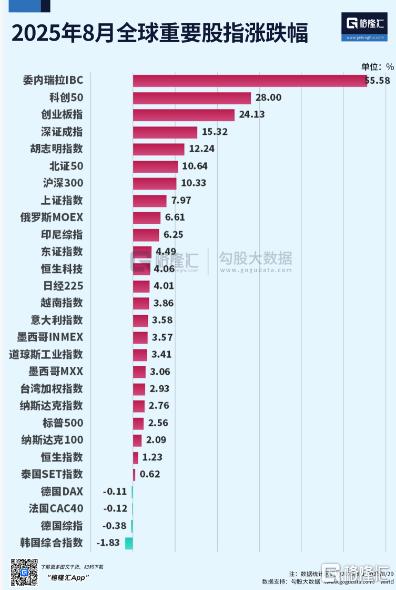
Market Performance - A-shares outperformed global markets in August, with a total market capitalization increase of over 9 trillion yuan [4][10] - The A-share Sci-Tech 50 Index surged by 28%, marking the largest monthly increase in history [4] - Among the three major indices, the ChiNext Index rose by 24.13%, the Shenzhen Component Index increased by 15.32%, and the Shanghai Composite Index gained 7.97% [5] Sector Performance - The telecommunications sector was the strongest performer, rising over 34%, followed by electronics and non-ferrous metals, which increased by over 24% and 18% respectively [6] - The banking sector showed a decline during the same period [6] Individual Stock Performance - The top three stocks in terms of monthly gains were Gobi Technology, Cape Cloud, and Sino Medical [8] - The stock of Cambrian Technology doubled in price, reaching a market capitalization of over 620 billion yuan, making it the highest-priced stock in A-shares, surpassing Kweichow Moutai [9] Market Outlook - Analysts generally agree that the A-share bull market is expected to continue, with predictions of reaching 4,000 points or higher [13] - Huatai Securities suggests that the current market rally is driven by a combination of fundamental and liquidity factors, with a positive outlook for the fourth quarter [15] - Morgan Stanley warns of potential overheating in the market, emphasizing the need for fundamental improvements and stronger policy support [17]
板块轮动速度加快,A股投资者盼望“长期牛”
Di Yi Cai Jing· 2025-08-27 13:23
Market Overview - A-shares experienced increased volatility in the first three trading days of the week, with trading volumes exceeding 3 trillion yuan on both August 25 and August 27 [1] - The market logic shifted, with Monday driven by sentiment and a broad rally in technology stocks, while today saw profit-taking from earlier gains [1] Performance Highlights - On August 25, the Shanghai Composite Index rose to 3883 points, with significant gains in technology, semiconductor, and rare earth sectors, supported by large financial institutions [1] - Approximately 3300 stocks rose, with an average gain of 1.02%, indicating strong profit potential [1] - Following a slight decline on August 26, technology stocks rebounded on August 27, particularly in AI and semiconductor sectors, before facing a rapid decline due to profit-taking [1] Market Sentiment and Future Outlook - The recent market rally has not seen significant adjustments until the recent drop, marking the largest single-day decline since April 7, with a record trading volume of 3 trillion yuan during the drop [2] - Analysts suggest that adjustments do not signal the end of the rally, as strong mid-year performance from leading companies may attract further investment [2] - The current market dynamics are primarily driven by institutional investors rather than retail, with a focus on industry trends and performance [2] Sector Focus - Key sectors of interest include telecommunications, resources, innovative pharmaceuticals, gaming, and military, which are well understood by the market and do not exhibit significant speculative bubbles [3] - Upcoming events in the consumer electronics sector in September may present thematic investment opportunities, alongside a focus on "anti-involution" and overseas expansion as potential long-term trends [3]
3200万元只是序章!127家公募年内“自掏腰包”抢筹
Hua Xia Shi Bao· 2025-08-27 09:25
Core Viewpoint - The announcement from Huatai Asset Management indicates a growing trend among public funds to invest their own capital into equity products, reflecting confidence in the long-term stability and health of the Chinese capital market [2][3][4]. Group 1: Investment Actions - Huatai Asset Management plans to invest up to 32 million yuan of its own funds into its equity public funds, with a holding period of no less than one year [2][3]. - In August alone, several leading public funds, including Southern Fund and ICBC Credit Suisse Fund, have announced self-purchases totaling over 270 million yuan, all directed towards equity products [3][4]. - A total of 127 public fund institutions have utilized their own funds to enhance their products since the beginning of the year, indicating a significant trend in the industry [4][5]. Group 2: Market Sentiment and Confidence - The active self-purchase behavior of public funds is interpreted as a positive signal for market sentiment, suggesting a gradual improvement in market conditions and a favorable investment environment for equity assets [4][5]. - Analysts emphasize that this trend reflects the confidence of public funds in their own research and investment capabilities, as well as a commitment to align interests with investors [5][6]. - The regulatory environment is also encouraging public funds to increase their equity investments, with new evaluation metrics being introduced to promote self-purchases [5][6]. Group 3: Market Outlook - The current self-purchase activities are seen as a sign of a potential "slow bull market" in A-shares, with institutions expressing optimism about future returns from their products [6][7]. - Experts suggest that the market is in the early stages of a systemic opportunity, with the potential for adjustments as bullish sentiment develops [7][8]. - The overall economic context, including China's significant economic size and growth rate, is expected to support a stable bull market, contingent on the country's ability to maintain growth and openness [8][9].

见证历史,再创新高!乘A股东风就选天弘指数基金!
Ge Long Hui· 2025-08-27 05:57
Group 1 - The article highlights the growing bullish sentiment in the A-share market, indicating a favorable environment for investments [1] - Tianhong Index Fund is presented as a strategic option for investors looking to capitalize on market opportunities [1]