货币政策

Search documents
烧碱日报:供需弱势出新低,跟踪生产企业减产情况-20260116
Guan Tong Qi Huo· 2026-01-16 09:47
Report Industry Investment Rating - Not provided Core Viewpoints of the Report - The caustic soda market is currently in a pattern of high inventory and high supply. With the short - term supply - demand being weak, the price is expected to remain weak. However, an oversold rebound should be guarded against. Attention should be paid to the start - up conditions of electrolytic aluminum and alumina enterprises and the production reduction of caustic soda production enterprises [3] Summary by Relevant Catalogs Fundamental Analysis - From January 2nd to 8th, the average capacity utilization rate of Chinese caustic soda sample enterprises with a capacity of 200,000 tons and above was 86.8%, a week - on - week increase of 0.4% [1] - From January 3rd to 9th, the alumina start - up rate increased by 1.07% week - on - week to 85.74%. From January 5th to 8th, the viscose staple fiber start - up rate increased by 3.01% week - on - week to 88.43%, and the printing and dyeing start - up rate decreased by 0.72% week - on - week to 60.09% [1] - As of January 8th, the factory inventory of fixed liquid caustic soda sample enterprises with a capacity of 200,000 tons and above in the whole country was 495,200 tons (wet tons), a week - on - week increase of 1.96% and a year - on - year increase of 76.03% [1] - From January 2nd to 8th, the weekly average profit of Shandong chlor - alkali enterprises was 183 yuan/ton [1] Macroeconomic Analysis - The People's Bank of China will use a variety of monetary policy tools including reserve requirement ratio cuts and interest rate cuts to maintain ample liquidity. Starting from January 19th, 2026, it will lower the rediscount and relending rates by 0.25 percentage points [2] Futures and Spot Market Analysis - Caustic soda is in a high - inventory and high - supply pattern. The short - term decline is due to low - price warehouse receipts and pre - holiday inventory reduction pressure. The traditional concentrated maintenance seasons for chlor - alkali enterprises are from March to May in spring and from September to October in autumn. The main downstream alumina has rebounded recently, and the electrolytic aluminum industry operates stably [3]
焦炭日报:短期偏震荡对待-20260116
Guan Tong Qi Huo· 2026-01-16 09:47
Report Industry Investment Rating - The report suggests a short - term oscillatory outlook for coke, with a low - buying strategy [2] Core Viewpoints - Coke's supply - demand pattern is affected by upstream coking coal costs, downstream steel demand, and macro - policies. Coking coal inventory is lower than usual, while coke inventory is at a moderately high level, with overall weak supply - demand. The seasonal inventory build - up of downstream steel mills and the increase in hot metal production have boosted short - term demand for coking coal and coke. With a positive macro - market atmosphere and domestic reserve requirement ratio cuts, coke is expected to be oscillatory in the short term [2] Summary by Related Catalogs Market Analysis - As of January 9, independent coking enterprises' coke inventory decreased by 6.04% to 86.07 million tons, steel mills' coke inventory increased by 0.27% to 645.73 million tons, port coke inventory rose to 249.1 million tons, and the comprehensive coke inventory increased by 2.22 million tons to 980.9 million tons, reaching a 3 - month high and a year - on - year decrease of over 1% [1] - The average profit per ton of coke for 30 independent coking plants nationwide is - 45 yuan/ton; the average profit of Shanxi quasi - first - grade coke is - 30 yuan/ton, Shandong quasi - first - grade coke is 17 yuan/ton, Inner Mongolia second - grade coke is - 86 yuan/ton, and Hebei quasi - first - grade coke is 9 yuan/ton [1] - The blast furnace operating rate of 247 steel mills increased by 0.37% to 79.31%, the blast furnace iron - making capacity utilization rate increased by 0.78% to 86.04%, the steel mill profitability decreased by 0.44% to 37.66%, and the daily average hot metal output continued to increase by 2.07 million tons to 229.5 million tons, reaching a one - month high and a year - on - year increase of 5.13 million tons or 2.29% [1] Upstream Situation - Coal mine coking coal inventory continued to increase slightly, port inventory increased by 551.96 million tons, independent coking enterprises' coking coal inventory increased to 1071.68 million tons, and steel mills' coking coal inventory decreased by 797.73 million tons. The comprehensive coking coal inventory increased to 2716.37 million tons, reaching a nearly 9 - month high, with a year - on - year decrease of over 15% [2] News - The central bank will lower the re - loan and rediscount rates by 0.25 percentage points from January 19; there is still room for reserve requirement ratio cuts and interest rate cuts this year; the central bank will consider conducting treasury bond trading operations; promoting stable economic growth and reasonable price recovery is an important consideration for monetary policy; the minimum down - payment ratio for commercial housing mortgages is reduced to 30% [2] - The financial regulatory authority will promote the regular operation of the urban real estate financing coordination mechanism and support the resolution of financing platform debt risks in accordance with the law [2] - China's M2 money supply annual rate in December was 8.5%, higher than the expected 8% and the previous value of 8% [2] Main Logic - Coke's supply - demand pattern is affected by upstream coking coal costs, downstream steel demand, and macro - policies. Coking coal inventory is lower than usual, while coke inventory is at a moderately high level, with overall weak supply - demand. The seasonal inventory build - up of downstream steel mills and the increase in hot metal production have boosted short - term demand for coking coal and coke. With a positive macro - market atmosphere and domestic reserve requirement ratio cuts, coke is expected to be oscillatory in the short term [2] Futures Market Performance - The opening price of the coke main contract was 1741, the closing price was 1717, the intraday position increased by 1479 lots, the previous low was 1625.5, and the previous high was 1817.5. Attention should be paid to the support of the previous low and the pressure of the previous high [4]
沪锡市场周报:美元走强库存回升,预计锡价承压调整-20260116
Rui Da Qi Huo· 2026-01-16 09:24
1. Report's Investment Rating for the Industry - No information about the industry investment rating is provided in the report. 2. Core Viewpoints of the Report - The report predicts that the Shanghai tin price will face pressure and adjust in the short - term. It is expected to be adjusted at a high level in the short - term, with attention to the MA10 support, in the range of 39 - 42 [7]. 3. Summary According to the Directory 3.1. Weekly Highlights Summary - **Market Review**: This week, the main contract of Shanghai tin rose first and then pulled back. The weekly gain was + 14.95%, and the amplitude was 25.32%. As of the end of this week, the closing price of the main contract was 405,240 yuan/ton [7]. - **Market Outlook**: - **Macro - level**: The People's Bank of China decided to lower the re - loan and rediscount rates, and cut the monetary policy tool rates by 25 basis points, indicating that there is still room for reserve requirement ratio and interest rate cuts this year. In the US, the number of initial jobless claims unexpectedly dropped to 198,000 last week, the lowest since November last year. The US dollar rebounded to a more than one - month high [7]. - **Fundamental - level**: - **Supply**: The resumption of production in Myanmar and the end of the rainy season led to an increase in domestic tin ore imports, which are expected to continue to rise in the first quarter. Recently, tin ore processing fees have increased slightly, indicating a relief in the tight supply of tin ore. However, most smelting enterprises still have low raw material inventories and are operating at a loss. With more year - end maintenance, refined tin production continues to be restricted, but there is pressure for production to rebound after the Chinese New Year. In addition, Indonesia's export volume increased significantly in November, alleviating concerns about supply constraints. Recently, the import window has opened, increasing import pressure [7]. - **Demand**: Recently, the rise in tin prices has led to a decline in downstream procurement demand, a significant increase in inventory, and a spot premium of 500 yuan/ton. LME inventory has increased significantly, and the spot premium has declined [7]. - **Technical - level**: With the reduction in positions and price adjustment, the bullish sentiment has declined, and there may be an adjustment [7]. 3.2. Futures and Spot Market Conditions - **Price Changes**: As of January 16, 2026, the closing price of Shanghai tin was 405,240 yuan/ton, up 52,330 yuan/ton from January 9, a rise of 14.83%. As of January 15, 2026, the closing price of LME tin was 52,031 US dollars/ton, up 8,281 US dollars/ton from January 9, a rise of 18.93% [9][12]. - **Ratio Changes**: As of January 16, 2026, the current ratio of Shanghai tin to Shanghai nickel was 2.87, an increase of 0.33 from January 9. As of January 14, 2026, the Shanghai - London ratio of tin was 7.67, a decrease of 0.32 from January 8 [16]. - **Position Changes**: As of January 16, 2026, the position of Shanghai tin was 115,615 lots, an increase of 9,920 lots from January 9, a growth rate of 9.39%. As of December 26, 2025, the net position of the top 20 in Shanghai tin was - 3,681 lots, a decrease of 2,310 lots from December 22, 2025 [20]. 3.3. Industrial Chain Conditions - **Supply - side**: - **Tin Ore Imports and Refined Tin Production**: In November 2025, the monthly import of tin ore concentrates was 15,099.34 tons, a month - on - month increase of 29.81% and a year - on - year increase of 24.42%. From January to November this year, the import of tin ore concentrates was 118,119.99 tons, a year - on - year decrease of 21.51%. In October 2025, the refined tin production was 15,618 tons, and the cumulative refined tin production from January to October was 142,971 tons, a year - on - year decrease of 1.25% [26][27]. - **Tin Ore Processing Fees**: On January 16, 2026, the processing fee for 60% tin concentrate was 7,500 yuan/ton, a rise of 1,000 yuan/ton from January 14, a growth rate of 15.38%. The processing fee for 40% tin concentrate was 11,500 yuan/ton, a rise of 1,000 yuan/ton from January 14, a growth rate of 9.52% [32]. - **Refined Tin Imports**: As of January 15, 2026, the profit and loss of tin imports was 9,027.98 yuan/ton, a rise of 9,460.69 yuan/ton from January 9. In November 2025, the refined tin import volume was 1,194.53 million tons, a month - on - month increase of 127.04% and a year - on - year decrease of 66.05%. From January to November, the cumulative refined tin import was 20,949.89 million tons, a year - on - year decrease of 5.21%. In November 2025, the refined tin export volume was 1,948.49 million tons, a month - on - month increase of 31.62% and a year - on - year increase of 33.73%. From January to November, the cumulative refined tin export was 20,620.28 million tons, a year - on - year increase of 34.87% [37][38]. - **Inventory**: As of January 15, 2026, the total LME tin inventory was 5,925 tons, an increase of 520 tons from January 8, a growth rate of 9.62%. As of January 16, 2026, the total tin inventory was 9,549 tons, an increase of 2,614 tons from last week, a growth rate of 37.69%. The tin futures inventory was 9,462 tons, an increase of 3,033 tons from January 9, a growth rate of 47.18% [41]. - **Demand - side**: - **Semiconductor Index**: On January 15, 2026, the Philadelphia Semiconductor Index was 7,837.3, a rise of 401.2 from January 8, a growth rate of 5.4% [44]. - **Domestic Electronic Industry Output**: From January to November 2025, the integrated circuit output was 43,184 million pieces, an increase of 3,657.072 million pieces compared with the same period last year, a growth rate of 9.25% [44]. - **Domestic Tin - Plated Sheet Exports**: As of November 2025, the tin - plated sheet output was 100,000 tons, a decrease of 10,000 tons from October 2025, a decline of 9.09%. The tin - plated sheet export volume was 147,375.58 tons, a decrease of 75,214.24 tons from October, a decline of 33.79% [47].

两大重磅会议同日召开!专家详解2026年银行业政策红利与发展机遇
Jin Rong Jie· 2026-01-16 09:09
Core Insights - The People's Bank of China and the National Financial Regulatory Administration have outlined their monetary policy and regulatory framework for 2026, emphasizing the importance of these policies for the banking sector's development path [1] Group 1: Monetary Policy Initiatives - The central bank's monetary policy focuses on precise measures, including interest rate cuts, increased quotas, and expanded scope, to inject strong momentum into the banking sector's support for the real economy [2] - The central bank has lowered the one-year re-lending rate from 1.5% to 1.25%, a reduction of 0.25 percentage points, which expands the available funds for banks and reduces funding costs [2] - A new quota of 500 billion yuan for re-lending to support agriculture and small enterprises has been established, along with a 1 trillion yuan quota specifically for private enterprises [2] - The re-lending quota for technological innovation and transformation has increased from 800 billion yuan to 1.2 trillion yuan, ensuring sufficient funding for tech enterprises and traditional industry upgrades [2] - The down payment ratio for commercial housing has been reduced to 30%, aiding the health and elderly care industries and addressing real estate market inventory issues [2] Group 2: Banking Sector Stability - The net interest margin for the banking sector has stabilized at 1.42%, providing ample room for future policy adjustments [3] - The potential implementation of a reserve requirement ratio cut could further enhance liquidity, supporting both the real economy and maintaining a reasonable net interest margin for banks [3] Group 3: Regulatory Framework - The National Financial Regulatory Administration has set three core tasks for 2026: risk prevention, strong regulation, and promoting development, creating a three-pronged approach [4] - Risk management for small financial institutions is prioritized, with ongoing reforms aimed at improving quality while reducing quantity [4] - A coordinated mechanism for real estate financing will continue to support the completion of housing projects, with over 70 trillion yuan in loans already provided [4] - A four-tier regulatory system has been established, enhancing regulatory capabilities through financial technology and smart regulation [4] Group 4: Focus on High-Quality Development - The banking sector is encouraged to focus on differentiated guidance in five key areas, including inclusive finance, pension finance, green finance, and technology finance, to achieve high-quality development [5] - Financial institutions are advised to leverage their unique strengths rather than pursuing a one-size-fits-all approach, particularly in the context of the upcoming 15th Five-Year Plan [5] - The policies released by the two major departments are expected to provide substantial policy dividends and clear development directions for the banking sector [5]
数读中国 5个字看货币金融政策效能明显
Ren Min Wang· 2026-01-16 08:34
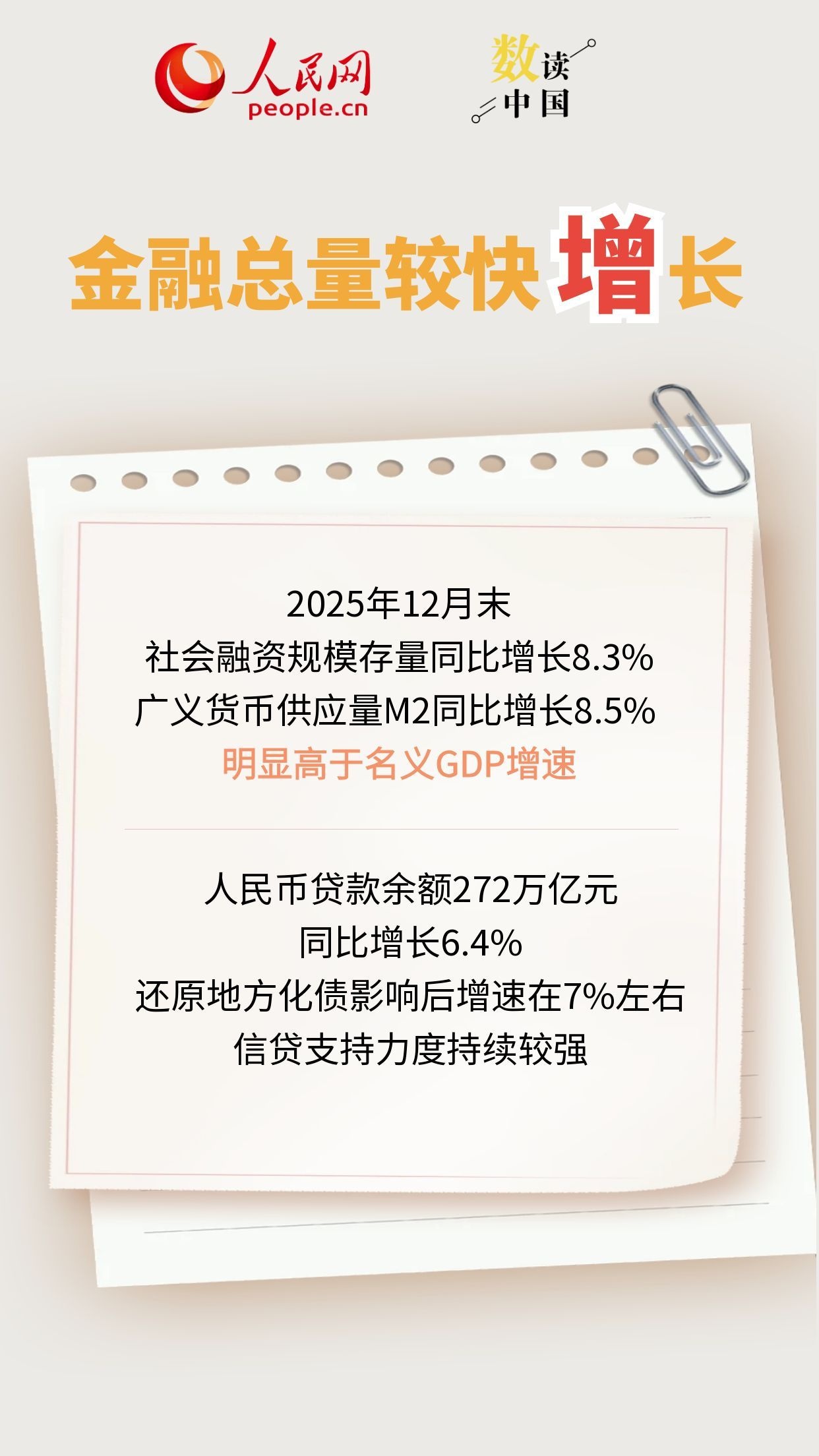
Group 1 - The People's Bank of China (PBOC) has utilized various monetary policy tools to maintain ample liquidity and guide financial institutions to meet the effective financing needs of the real economy, resulting in significant support for the real economy [1] - The PBOC has cumulatively lowered policy interest rates 10 times, leading to a steady decline in the overall financing costs in society. As of December 2025, the weighted average interest rates for newly issued corporate loans and personal housing loans are both around 3.1%, down by 2.5 and 2.6 percentage points respectively since the second half of 2018 [3] - Loans in key sectors such as technology, green finance, inclusive finance, elderly care, and digital economy have maintained double-digit growth, significantly outpacing the overall loan growth rate. The credit structure continues to optimize, with direct financing's share increasing [5] Group 2 - The foreign exchange market is fundamentally balanced, with the RMB maintaining stability against a basket of currencies and appreciating by 4.4% against the US dollar [7] - The bond market is developing steadily and healthily, with effective boosts to capital market confidence and active trading [8]

固定收益点评:从新闻发布会理解央行货币政策
GOLDEN SUN SECURITIES· 2026-01-16 08:34
1. Report Industry Investment Rating No information provided in the document. 2. Core View of the Report - The structural monetary policy remains the main focus. The central bank has cut the interest rates of various structural monetary policy tools by 0.25 percentage points and increased the scale of structural tools. The bond market is expected to gradually recover as the structural interest rate cut may open up the space for interest rate decline [2][6][9][19]. 3. Summary by Relevant Catalogs 3.1 Central Bank's Monetary Policy Direction - **Structural Monetary Policy**: The central bank has cut the interest rates of various structural monetary policy tools by 0.25 percentage points, such as reducing the one - year re - loan interest rate from 1.5% to 1.25%. It has also increased the scale of structural tools, adding 500 billion yuan of agricultural and small - business re - loans and raising the science and technology innovation and technological transformation re - loans from 800 billion yuan to 1.2 trillion yuan [2][9]. - **Interest Rate and Reserve Requirement Ratio Adjustment**: There is room for interest rate cuts and reserve requirement ratio cuts, and they will be used flexibly and efficiently according to the actual situation. If there are unexpected risk events or macro - policy changes that require interest rate cuts, the central bank will implement them efficiently [3][10]. - **Bond - buying Operation**: The central bank will dynamically adjust the bond - buying scale according to market conditions to prevent sharp market fluctuations. It is estimated that the monthly bond - buying scale may be maintained at several billion yuan [3][10]. - **Price and Exchange Rate**: The central bank is optimistic about prices, believing that the current price decline is mainly due to cyclical factors, while prices in some industries are rising. The exchange rate is expected to remain stable at a reasonable level, with limited risk of rapid appreciation [4][11]. 3.2 December 2025 Financial Data - **Credit**: In December 2025, new social financing was 2.2 trillion yuan, a year - on - year decrease of 646.2 billion yuan. The year - on - year growth rate of social financing stock was 8.3%, a slight decrease of 0.2 percentage points from the previous month. Corporate credit increased by 107 billion yuan, with short - term and medium - to - long - term loans showing significant increases. However, compared with December 2023, the medium - to - long - term corporate loans decreased by 531.2 billion yuan. Resident loans have been negative for three consecutive months, and the year - on - year increase has been decreasing for six consecutive months, which is in line with the slowdown in real estate sales [5][12][13]. - **Money Supply**: In December 2025, the year - on - year growth rate of M1 continued to decline by 1.1 percentage points to 3.8%, while the year - on - year growth rate of M2 was 8.5%, an increase of 0.5 percentage points from the previous month. The increase in deposits was mainly due to the significant reduction in the year - on - year decrease of non - bank deposits, which was caused by the low base after the implementation of the inter - bank deposit self - regulatory mechanism last year [6][15][17]. 3.3 Bond Market Outlook - The bond market has been fluctuating recently. With the expectation of an overall interest rate cut, the adjustment space is limited. After January 15, the central bank cut the interest rates of various structural monetary policy tools by 0.25 percentage points. With the increase in bond interest rates, the relative cost - effectiveness of bonds has improved, and the bond market is expected to recover under the expectation of monetary easing [6][19].
博时市场点评1月16日:两市震荡收跌,成交超3万亿
Xin Lang Cai Jing· 2026-01-16 08:19
Market Overview - The three major indices in the Shanghai and Shenzhen markets experienced fluctuations, with total trading volume slightly increasing to over 30 trillion, although trading enthusiasm has cooled compared to previous periods [1][7] - The margin financing balance continues to grow, reaching 2.7 trillion [1][6] - The People's Bank of China (PBOC) reported that new loans in December amounted to 910 billion, significantly exceeding expectations and showing a notable month-on-month increase, particularly in corporate loans [1][8] Monetary Policy - On January 15, the PBOC announced eight specific policy measures, including a 0.25 percentage point reduction in various structural monetary policy tool rates and an increase in re-loan quotas for agriculture and small enterprises by 500 billion, with an additional 1 trillion dedicated to private enterprises [2][8] - The policy aims for "precise drip" structural easing rather than a broad rate cut, focusing on reducing financing costs in specific sectors such as technology innovation and green transformation [2][8] - The PBOC emphasized that there is still room for further rate cuts and reserve requirement ratio reductions, but actions will be taken cautiously to allow for observation [1][2] Financial Data - As of the end of 2025, the total social financing scale increased by 8.3% year-on-year, and the broad money (M2) balance grew by 8.5%, both exceeding nominal GDP growth rates [2][9] - In 2025, the total increase in RMB loans was 16.27 trillion, with corporate loans dominating the composition [2][9] - The average interest rate for newly issued corporate loans fell to approximately 3.1%, indicating a continued decline in financing costs [2][9] Investment Plans - The State Grid Corporation of China announced that fixed asset investments during the 14th Five-Year Plan period are expected to reach 4 trillion, a 40% increase compared to the previous plan, aimed at enhancing effective investment and supporting the development of new power systems [3][9] - This large-scale investment plan is expected to provide long-term growth momentum for related sectors such as power equipment, grid automation, energy storage, and digital grids [3][9] Market Performance - On January 16, the A-share market saw declines across the three major indices, with the Shanghai Composite Index closing at 4101.91, down 0.26% [4][10] - The Shenzhen Component Index and the ChiNext Index also experienced slight declines, while the Sci-Tech Innovation 100 Index rose by 2.67% [4][10] - Among the sectors, electronics, automotive, and machinery equipment showed positive performance, while media, computing, and oil and petrochemicals faced declines [4][10]

美国关税暂缓 铜价偏强震荡可能尚未结束
Jin Tou Wang· 2026-01-16 08:07
Group 1 - The domestic copper futures market is experiencing a downward trend, with the main contract closing at 103,030.00 CNY/ton, reflecting a decline of 2.26% [1] - Market sentiment has cooled due to the temporary suspension of tariffs on key minerals by the U.S., while supply concerns persist due to ongoing strikes in Chile [2] - The recent downtrend in copper prices is influenced by weak downstream consumption and increased production halts, leading to an overall surplus in the domestic market [2] Group 2 - The People's Bank of China has lowered various structural monetary policy tool rates by 0.25 percentage points, indicating potential for further rate cuts to boost market confidence [3] - The copper market narrative remains focused on tight raw material supplies, with the U.S. controlling over half of the global copper inventory, which may lead to price increases due to potential restocking behavior before and after the Spring Festival [3] - Recent declines in LME inventory suggest a potential for price increases, with the main contract expected to fluctuate between 101,000 and 105,000 CNY [3]
全球外汇市场一日纵览:美元政策信号密集释放,欧元复苏乏力,日元走向再起波澜
Sou Hu Cai Jing· 2026-01-16 08:07
Group 1: USD Dynamics - The core variable for the USD remains the Federal Reserve, with recent discussions indicating heightened congressional interest in monetary policy [3] - Multiple Federal Reserve officials have signaled that there is no urgent need for rate cuts, suggesting that the USD will have policy support in the short term [5] - The market is expected to experience more volatility from adjustments in expectations rather than a trend reversal [5] Group 2: EUR Challenges - The Eurozone is facing significant economic pressures, with Germany's economic growth projected at only 0.2% for 2025, highlighting a lack of momentum [6] - The European Central Bank's medium-term outlook shows inflation returning to target levels, but economic growth is expected to remain between 1.2% and 1.4%, which may not provide strong support for the Euro [6] - The Euro's performance is likely to depend more on relative stability rather than a clear strengthening [6] Group 3: JPY Outlook - The Japanese Yen is in focus due to potential interest rate stability and concerns over its weakness, with the possibility of coordinated intervention being discussed [7] - Internal divisions within the Bank of Japan suggest that interest rate hikes may occur sooner than the market currently anticipates, increasing sensitivity to news [7] - The volatility in the Yen impacts various sectors, including consumer spending and international trade [7] Group 4: Other Currencies and Regional Dynamics - Other regions are also experiencing significant developments, such as the UK delaying employment survey releases, reflecting challenges in data quality and policy judgment [8] - India aims to conclude trade negotiations with the EU by January 26, which could positively affect regional currencies and capital flows [8] - In Asia, Hong Kong's finance chief has stated there will be no reduction in stock stamp duty, while South Korea's finance minister emphasizes the need to halt excessive depreciation of the Won [8] - The overall forex market is characterized by a phase of "policy expectations driving dynamics and differentiated fundamentals" [8]

央行重要发布,最新解读来了
Zhong Guo Ji Jin Bao· 2026-01-16 07:37
Group 1 - The core viewpoint of the article emphasizes that the stable growth of financial aggregates creates a favorable monetary and financial environment for economic recovery in 2025 [1][4] - By the end of 2025, the total social financing scale reached 442.12 trillion yuan, with a year-on-year growth of 8.3%, and the broad money supply (M2) increased by 8.5% [4][5] - The credit structure shows a significant divergence, with strong growth in corporate loans and a continued decline in household loans, indicating a need for policy measures to stimulate consumer demand [5][6] Group 2 - The People's Bank of China announced a series of structural policy measures aimed at optimizing monetary policy, including a 25 basis point reduction in structural tool rates and the establishment of new financing support tools for private enterprises [8][9] - Analysts predict that these measures will catalyze favorable conditions for banks, reducing the burden of interest payments for both residents and enterprises, thereby promoting effective credit demand [8][9] - The focus for future policies will be on boosting consumption and expanding domestic demand, with an emphasis on improving income and optimizing supply to stimulate consumer spending [7][9]