去美元化

Search documents
2026年度商品投资策略会
2026-01-23 15:35
Summary of Key Points from Conference Call Records Industry Overview - **Global Market Trends**: The global equity markets performed well in 2025, with a notable bull market in both U.S. stocks and bonds driven by the Federal Reserve's loose monetary policy and a trend towards de-dollarization. However, market fragmentation risks due to U.S.-China tensions need to be monitored [1][2] - **Japanese Yen Depreciation**: The Japanese yen has depreciated to its lowest level since 1985, with high inflation preventing effective interest rate hikes by the Bank of Japan. This divergence between nominal and real interest rates may persist until 2026, impacting emerging markets [1][4] - **High Leverage Risks**: The ratio of private sector credit to GDP has reached a new high, posing potential risks that could emerge in emerging markets and drag down developed economies. This high leverage is a significant precursor to cyclical risks [1][5] China Market Insights - **Chinese Stock and Bond Markets**: In 2025, China's stock market showed strength while the bond market was weak, indicating increased economic and social confidence. Large capital inflows suggest a favorable investment environment [1][7] - **Economic Performance**: China's GDP growth rate for 2025 was 5%. Despite moderate domestic demand, significant capital inflows were observed, similar to Japan's past experiences. The strategy of leveraging low-interest debt to invest in high-yield overseas assets is recommended [1][8] - **Government Bond Market**: The three-year government bond market in China has been adjusting, with M1 growth and positive PPI putting pressure on the bond market. The behavior of financial institutions, particularly brokerages, has shifted towards shorting in Q4 2025 [1][9][10] Monetary Policy Changes - **Central Bank Policy Shifts**: The central bank's monetary policy has shifted from emphasizing increased control to focusing on the integrated effects of incremental and stock policies. This indicates a more moderate approach to monetary easing in 2026, with lowered expectations for interest rate cuts [1][11] Commodity Market Outlook - **Precious Metals**: Gold and copper have shown strong performance, with gold favored as a risk hedge by central banks and sovereign institutions. The demand for copper is influenced by supply-demand structural issues, particularly in the U.S. and China [1][13][14] - **Investment Strategies**: Gold is viewed as a hedge rather than a high-return investment, with attention needed on futures pricing and market limitations. Copper prices are expected to remain strong unless significant negative news arises [1][16][20] Future Projections - **Economic Growth and Interest Rates**: There are differing views on the U.S. economic growth and interest rate outlook for 2026, with some expecting significant rate cuts due to a lack of recovery in traditional industries and others believing that limited cuts will suffice for recovery [1][27][28] - **Gold Market Dynamics**: The gold market is expected to remain bullish, driven by central bank purchases and ETF inflows. The potential for a 10%-15% price correction exists if economic recovery leads to rising real interest rates [1][29][55] Structural Opportunities - **Long-term Gold Demand**: Emerging market countries are increasingly diversifying their reserves into gold, which could significantly impact global demand. The interest from institutional investors in gold is also on the rise [1][23][51] Conclusion - The global economic landscape is characterized by significant fragmentation, high leverage risks, and evolving monetary policies. The Chinese market shows resilience with strong capital inflows, while commodities like gold and copper present both opportunities and challenges. The outlook for 2026 remains cautiously optimistic, with careful monitoring of macroeconomic indicators and geopolitical developments essential for investment strategies.
一周热榜精选:特朗普格陵兰执念TACO收局?金银迈向新高度!
Jin Shi Shu Ju· 2026-01-23 13:58
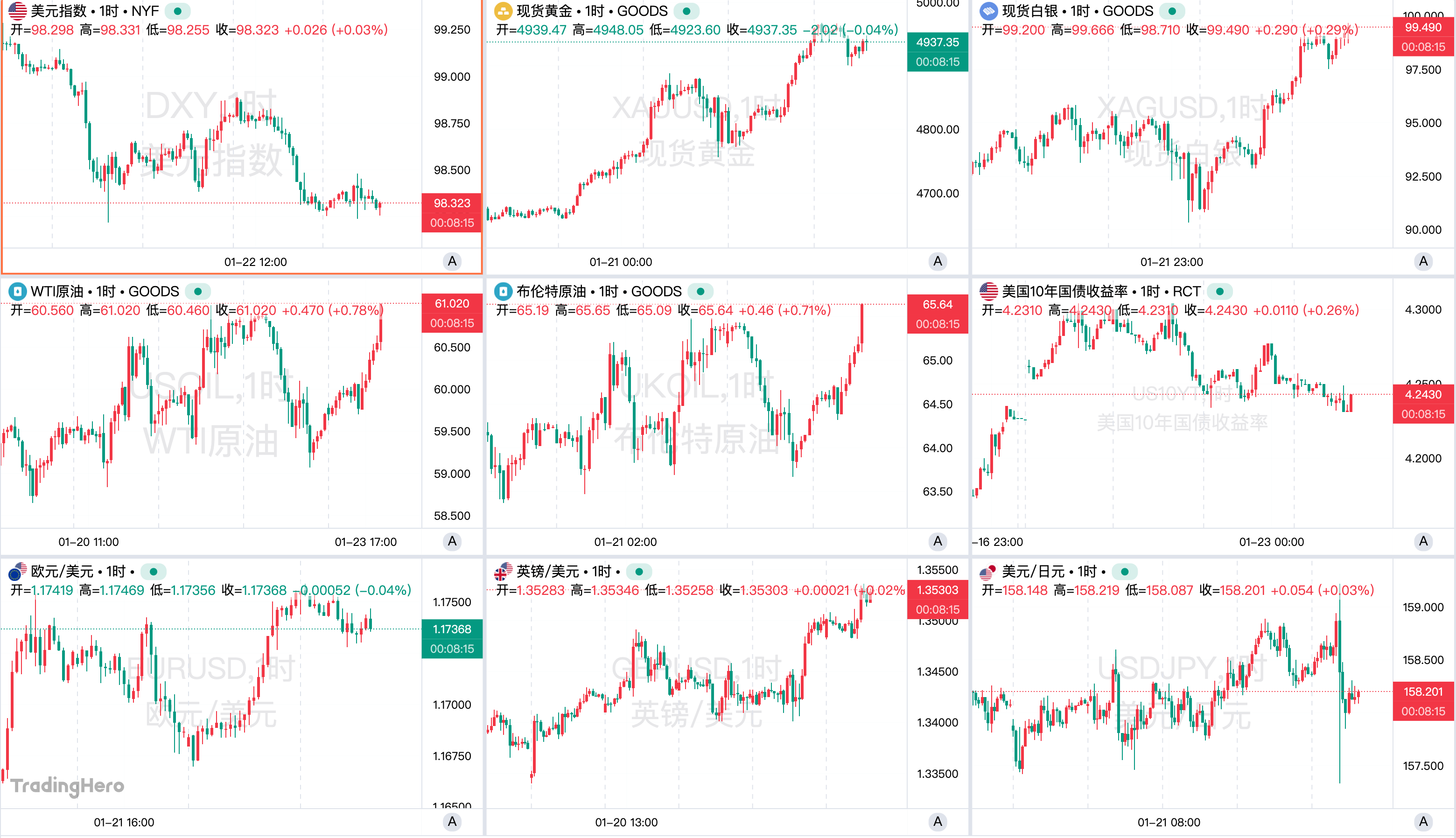
Market Overview - The US dollar index faced downward pressure this week, influenced by Trump's stance on Greenland and fluctuating tariff comments, leading to a volatile decline [1] - Gold and silver prices surged due to heightened risk aversion, with gold approaching $5000 per ounce and silver nearing $100 per ounce [1] - Non-US currencies like the euro, pound, and Australian dollar strengthened against the US dollar, while the USD/JPY pair saw significant fluctuations, with a drop of nearly 200 points on Friday [1] Oil Market - International oil prices experienced fluctuations driven by geopolitical tensions and supply disruptions, with prices expected to rise for the fifth consecutive week [2] Investment Bank Insights - Goldman Sachs raised its 2026 year-end gold price forecast from $4900 to $5400 per ounce, citing increased demand from private investors and central banks [5] - The head of commodity strategy at Societe Generale noted that new geopolitical uncertainties are pushing gold prices towards $5000 per ounce faster than expected [6] Central Bank Actions - Poland's central bank approved the purchase of 150 tons of gold, aiming to increase its reserves to 700 tons, which is seen as a key move to enhance national financial security [23] Corporate Developments - Alibaba is planning to push its semiconductor division, Pingtouge, towards an IPO, indicating a significant move in the AI chip market [27] - Tesla's Optimus robot is expected to start public sales by the end of next year, with plans for widespread deployment in factories and homes [28] Geopolitical Developments - The US government is reportedly accelerating efforts to change the Cuban regime by applying economic pressure, following a strategy similar to that used in Venezuela [24]

别纠结回调了!黄金暴涨的3条硬逻辑,看完就知道该不该买
Sou Hu Cai Jing· 2026-01-23 13:54
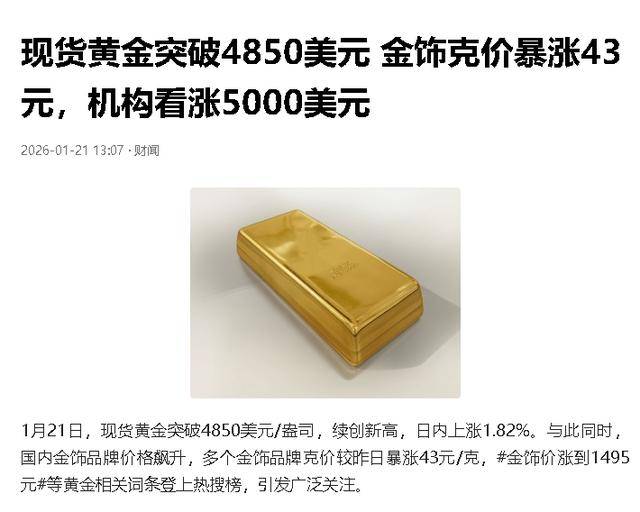
Core Viewpoint - The recent surge in gold prices, surpassing $4850 per ounce, is driven by a combination of geopolitical tensions, significant central bank purchases, and inflation concerns, indicating a complex market dynamic that ordinary investors may not fully grasp [1][4][6]. Short-term Factors - Geopolitical conflicts, such as the territorial disputes in Greenland and aggressive U.S. trade policies, have heightened market fears, leading to a 30% increase in gold futures trading volume [8][10]. - The Federal Reserve's substantial interest rate cuts, including a historic 75 basis point reduction, have weakened the dollar, making gold more attractive as a store of value [10][12]. - The anticipation of further tariffs has prompted investors to stockpile gold, reminiscent of past market reactions to similar situations [12][13]. Mid-term Support - Central banks are expected to continue their aggressive gold purchases, with projections indicating an average annual acquisition of over 1000 tons from 2023 to 2025, providing a solid foundation for gold prices [4][17]. - Concerns over global credit risks and rising government debt, projected to exceed $300 trillion by 2025, position gold as a hedge against these uncertainties [17][19]. - The correlation between gold prices and global inflation rates has been strong, with gold serving as a natural hedge against inflation, particularly as inflation remains high [19][21]. Long-term Logic - The shift towards de-globalization and geopolitical tensions has transformed the global economic landscape, enhancing gold's role as a stable asset amid uncertainty [22][24]. - Historical trends show that as countries engage in resource competition and confrontational policies, gold's status as a universally accepted asset becomes increasingly significant [26][28]. - The ongoing trend of increasing gold reserves among BRICS nations, rising from 10% to 15%, underscores gold's strengthening monetary properties and its potential for long-term price stability [21][30]. Investment Recommendations - For ordinary households, a gold allocation of 10% of total assets is recommended, with a potential increase to 15%, while exceeding 20% may be considered speculative [30][32]. - Preferred investment vehicles include physical gold bars, gold ETFs, and paper gold, avoiding high-cost jewelry and speculative trading in gold futures [32][34]. - Caution is advised against misleading advertisements for gold buybacks and speculative investments, emphasizing the importance of reliable channels for gold transactions [34][36].
美指维持震荡偏弱 政策博弈主导走势
Jin Tou Wang· 2026-01-23 13:26
2026年开年以来美元指数延续震荡偏弱格局,整体围绕低位区间波动,市场对美联储宽松政策的预期成 为主导走势的核心,叠加全球央行政策分化、美国经济基本面表现分化,美元呈现"趋势走弱、间歇反 弹"的特征,短期暂无明确单边方向。 美联储政策重心已从抗通胀转向防衰退,市场普遍预期2026年将延续降息步伐,上半年降息预期尤为浓 厚,政策宽松方向明确对美元形成持续压制。同时美联储领导层或迎来更迭,市场对新任掌舵者偏宽松 的政策倾向预期,进一步强化了美元的长期弱势逻辑。 但美联储内部对降息节奏仍存显著分歧,核心通胀仍高于政策目标,叠加关税政策带来的输入性通胀压 力,通胀韧性成为制约降息力度的关键因素,市场激进的降息预期存在修正可能。若后续通胀回落不及 预期,美联储或放缓宽松步伐,将成为美元阶段性反弹的重要诱因。 美国经济展现出一定韧性,财政扩张政策与人工智能产业的发展为经济注入活力,官方对2026年经济增 速的预期上修,实体经济的积极表现为美元提供了一定支撑,也成为对冲宽松政策的重要因素。 就业与通胀数据则呈现分化特征,就业市场整体降温,新增就业不及预期,劳动参与率回落使得失业率 数据缺乏实际支撑;通胀虽较峰值显著回落,但 ...
2026怎么投?中国银行第八年发布《个人金融全球资产配置白皮书》
凤凰网财经· 2026-01-23 11:52
Core Viewpoint - The article emphasizes the importance of seizing opportunities in global liquidity shifts and the revaluation of Chinese assets in 2026, advocating for a resilient investment strategy that balances both "hedging and growth" [1] Group 1: Overweighting Chinese Equity Assets - In 2026, the global economy is expected to enter a "weak recovery" phase, with China emerging as a relatively stable asset allocation choice due to its policy consistency and economic resilience [2] - China's GDP reached 140.19 trillion yuan in 2025, marking a significant milestone with a year-on-year growth of 5.0%, providing a solid foundation for the capital market [2] - The A-share market is anticipated to transition from a valuation recovery driven by policy and liquidity to a solid upward trend supported by corporate profit improvements, establishing a "slow bull" market [2] - Chinese equity assets are shifting from "marginal allocation" to "core allocation," driven by external uncertainties and a transformation in domestic wealth structure, leading to a systematic migration of savings towards equity assets [2] Group 2: Hong Kong Market Insights - The Hong Kong market, as a bridge connecting global capital with Chinese assets, is expected to benefit from the U.S. interest rate cut cycle, with sectors like technology and innovative pharmaceuticals poised for value revaluation [3] - In contrast, the U.S. stock market, despite the ongoing AI boom, is facing high valuations and concentrated profit growth among a few tech giants, indicating a "K-shaped" divergence [3] Group 3: Overweighting Precious Metals (Gold) - Gold has emerged as the standout asset over the past three years, with a cumulative increase of nearly 150% from 2022 to 2025, driven by trust reconstruction, currency credit reassessment, and heightened demand for safe-haven assets [4] - The acceleration of de-dollarization is evident, with global central banks purchasing over 1,000 tons of gold for three consecutive years, indicating a long-term structural shift rather than short-term speculation [4] - Geopolitical risks are becoming normalized, with gold's role as a safe-haven asset becoming increasingly significant amid rising global tensions [4] - The Federal Reserve's entry into a rate-cutting cycle enhances the attractiveness of holding gold, with spot gold prices recently surpassing $4,800 per ounce, marking a significant milestone [5] - Gold ETF holdings reached historical highs in 2025, with global inflows into physical gold ETFs totaling $89 billion, reflecting unprecedented investor interest [5] Group 4: Strategic Investment Approach - The true strength of the report lies in its ability to make precise predictions and construct optimal risk-return ratios through scientific methodologies, including multi-asset allocation and risk assessment [6] - The investment landscape in 2026 is characterized as a patient journey, emphasizing the importance of aligning with broader trends rather than chasing fleeting market fads [6] - The year 2026 is viewed as a pivotal year that could shape the wealth landscape for the next five years, with a focus on long-term investment strategies and the revaluation of Chinese assets [6]

点石成金:黄金:地缘风险频现,金价重心抬升
Guo Tou Qi Huo· 2026-01-23 10:58
1. Report Industry Investment Rating - Not provided in the given content 2. Core View of the Report - The current bull market in gold is driven by factors such as currency over - issuance, debt expansion, and the weakening of the US dollar's core position as the global legal currency. With geopolitical risks and the global trend of de - dollarization, gold is a strategic asset for hedging against currency depreciation and systemic risks, and it still has upward potential [2][3][4] 3. Summary According to Related Content Geopolitical and Market Impact - Since 2026, geopolitical events around Venezuela, Iran, and Greenland have increased political and economic uncertainties, causing the international gold price to rise by nearly 15%. The recent geopolitical tension has led to a surge in the VIX volatility index [1] - Trump's actions, including a NATO agreement on Greenland access, threats against European asset - selling and trade with Iran, and seeking regime change in Cuba, have added to market uncertainties [1] Gold as a Hedge Against Dollar Credit Weakening - The US dollar credit system is being impacted, and gold, as a natural hedge against currency credit, has an inverse relationship with the US dollar. The US debt is approaching $39 trillion, and it is predicted to exceed $50 trillion by 2030, with the debt - to - GDP ratio rising from 120% to 140% [2] - Unrestrained fiscal expansion and actions by the US government are damaging US debt credit. Some pension funds are selling US Treasuries, while Poland's central bank plans to buy up to 150 tons of gold, increasing its reserves to 700 tons [2] Global De - dollarization and Gold's Role - The global de - dollarization trend is evident. As non - US currencies lack strong competitiveness, gold, with its rigid supply, is becoming an important reserve asset. At an estimated $5000 per ounce, the global gold market value could exceed US Treasury bonds and central bank US dollar foreign exchange reserves [3] Market Outlook and Investment Considerations - The upcoming Fed interest - rate meeting and the announcement of the Fed chairperson are important events. The Fed's interest - rate policy will have a positive impact on gold prices as long as there is no expectation of a rate hike [3] - In 2026, various events bring high uncertainty to the global macro - environment. Gold is a key tool for hedging and strategic asset allocation. It still has upward potential, but short - term fluctuations may occur when it breaks through key price levels [4]
21深度|逼近5000美元!金价“扶摇直上”
Xin Lang Cai Jing· 2026-01-23 10:41
(资料图) 南方财经 21世纪经济报道记者吴斌 2025年10月8日,伦敦现货黄金价格首次站上4000美元/盎司整数关口,创历史新高。彼时一些投资者已经有些"高处不胜寒",担心金价可能已 经涨得太高。 短短三个多月后,金价的"狂飙"之势让众多投资者始料未及。1月23日,现货黄金逼近5000美元/盎司关口,2026年已经飙升约15%。 在这轮行情背后,美欧围绕格陵兰岛的博弈是关键导火索。据新华社报道,美国总统特朗普1月21日在瑞士达沃斯举办的世界经济论坛年会上 发表演讲时说,格陵兰岛是美国的"核心国家安全利益"。丹麦首相弗雷泽里克森1月22日强调,丹麦是主权国家,"主权问题不容谈判"。丹麦 愿意与美国合作,并且一直在安全领域合作,但这种双边合作不能讨论一些涉及"红线"和外交规则的问题。 当美元"失信",黄金"扶摇直上"。黄金的光芒穿透地缘政治的迷雾,其价格曲线早已不仅是简单的商品波动,而成为测量全球信任体系的特殊 标尺。在重构中的世界里,某种超越主权信用的恒定价值,正被重新唤醒。 混乱与失序 格陵兰岛问题以及日趋紧张的跨大西洋关系意外成为本次达沃斯世界经济论坛上的关注焦点,混乱与失序无处不在。 据央视新闻报道, ...
商品日报(1月23日):金银连创新高 碳酸锂突破18万元关口 化工全线大涨 商品指数单日涨超2%
Xin Hua Cai Jing· 2026-01-23 09:41
Group 1 - The domestic commodity futures market experienced a broad rally, with platinum and silver leading gains of over 10% and 8% respectively, while carbon lithium surged over 7% to surpass 180,000 yuan per ton [1][4] - The international gold price broke through $4,950 per ounce, and silver exceeded $99 per ounce, indicating strong demand for precious metals as safe-haven assets amid global market uncertainties [2] - Chemical products saw significant inflows, with synthetic rubber and ethylene glycol hitting their daily price limits, driven by low valuations and expectations of a commodity bull market [3] Group 2 - Carbon lithium futures rose over 7%, marking the first time since September 2023 that prices exceeded 180,000 yuan, with inventory levels decreasing significantly, indicating a shift towards downstream replenishment [4] - The crude oil market showed weakness, with prices declining by nearly 1% despite a slight recovery during the day, primarily due to oversupply concerns and geopolitical uncertainties [5] - The egg market experienced a decline after a brief surge, attributed to high inventory levels and reduced purchasing activity as the pre-holiday stocking phase concluded [5]
“抛售美国”大浪再度兴起 全球资金默契蜂拥至两大主题:亚洲科技股与黄金
智通财经网· 2026-01-23 08:37
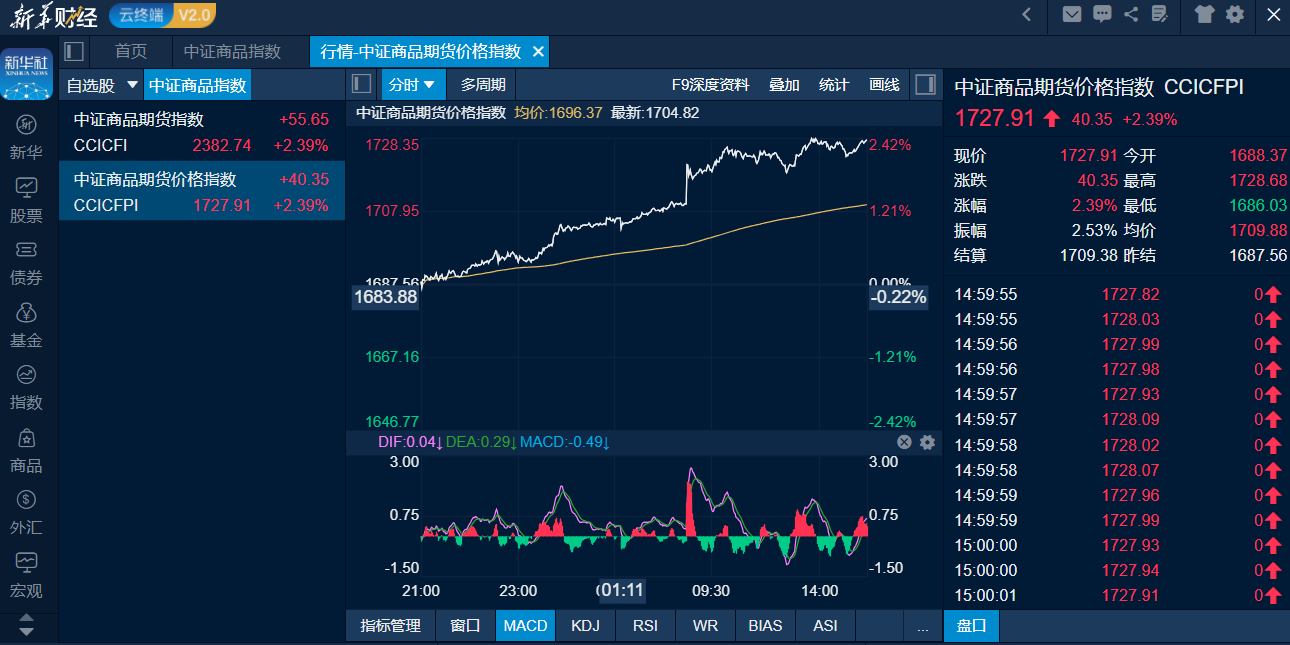
黄金价格在"去美元化"大浪潮以及货币贬值危机、地缘政治局势升温导致避险资金持续涌入推动之下,上涨至接近 5000美元/盎司这一史诗级关口。本周交易时间段,在格陵兰主权危机以及日本政府长期限债券价格上演大崩盘、美 联储货币政策独立性遭遇特朗普威胁、主权货币因债务压力而陷入贬值危机等因素强劲支撑全球避险需求之际,贵金 属之一的黄金延续其创纪录的价格涨势,黄金现货/期货价格2025年狂飙式上涨70%之后,2026年初可谓延续涨势如虹 般的牛市轨迹。 智通财经APP获悉,以亚洲新兴股市为核心的全球新兴市场股票,以及新兴市场主权货币、黄金与白银等国际贵金属 资产延续了2025年末以及2026年开年以来的无比强劲涨势。随着美国与包括欧洲传统盟友在内的多国主权政府之间的 日益紧张关系对美元资产造成重大抛售压力,新一波"抛售美国"浪潮,可谓彻底激活全球范围内的多元化资金流动并 且重新点燃全球多元资产配置趋势。 围绕韩国股市、中国A股与港股以及中国台湾股市、印度股市为主题的亚洲新兴市场股市投资浪潮可谓吸引全球资金 蜂拥而至,黄金与白银等贵金属资产也在积极跟随这股多元化资金流动趋势。 在周五亚盘交易时间段,随着新兴亚洲股市加速上 ...
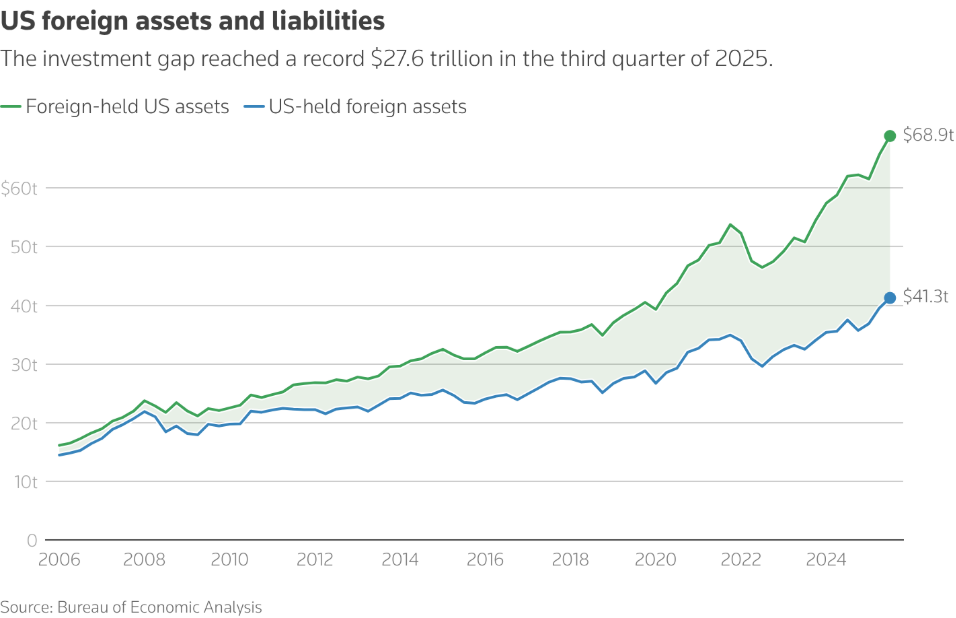
27.6万亿美元失衡头寸暗藏杀机!全球资金“抛售美国”可行性几何?
Jin Shi Shu Ju· 2026-01-23 08:18
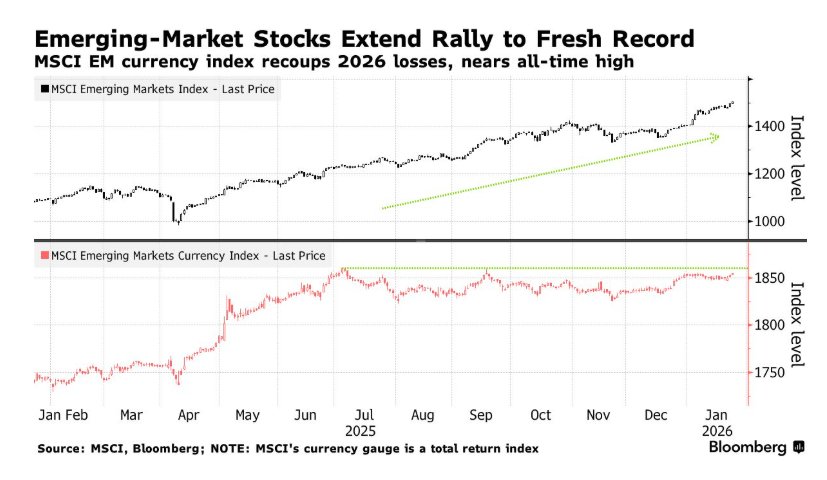
Core Viewpoint - The discussion around "selling off America" has resurfaced, despite a temporary easing due to potential agreements related to Greenland by President Trump. However, concerns about a significant reduction in exposure to U.S. assets remain prevalent [1]. Group 1: Market Sentiment and Investment Trends - Last year, the term "de-dollarization" gained popularity amid fears stemming from Trump's trade war, leading investors to consider reducing their exposure to U.S. assets. Ultimately, this concern did not materialize, as overseas investors net purchased $1.27 trillion in U.S. securities in the first 11 months of the year, largely driven by private investments attracted by the AI boom [1][5]. - The current net international investment position (NIIP) of the U.S. stands at approximately $27.6 trillion, indicating a significant net long position in U.S. assets globally. This figure reflects a disparity between $68.9 trillion in U.S. assets held by foreign investors and $41.3 trillion in foreign assets held by U.S. investors [5][6]. Group 2: Geopolitical Implications and Asset Allocation - Trump's controversial policies have disrupted the longstanding U.S.-Europe alliance and the rules-based global order, reigniting discussions about shorting U.S. assets. The core question now is whether global investors will maintain their high positions in U.S. assets or begin reallocating their investments [5][6]. - Some Nordic pension funds have indicated plans to reduce their holdings in U.S. bonds, but their impact on the market is expected to be minimal due to their relatively small size [6]. - The concept of "mutually assured destruction" in finance has resurfaced, reflecting concerns that if major economies like Europe begin to sell off U.S. debt, it could lead to increased yields and negatively impact the U.S. economy. However, historical trends show that reductions in U.S. debt holdings by countries like China have not led to significant market turmoil, as demand from European countries has filled the gap [6][7]. Group 3: Economic Fundamentals and Capital Flows - The U.S. continues to face a substantial current account deficit, requiring over $1 trillion in net capital inflows annually to support its economy. Although the current account deficit has narrowed recently, the sustainability of last year's capital inflows remains uncertain [8]. - In the first 11 months of last year, overseas investors net purchased $1.27 trillion in U.S. securities, with $663 billion attributed to equities, marking a more than twofold increase compared to the same period in 2024 [8]. - The challenge now lies not only in convincing investors to hold U.S. assets but also in persuading them to increase their holdings amid geopolitical tensions and shifting global dynamics [8].