
货币政策

Search documents
权威发布|金融支持实体经济力度更大结构更优
Ren Min Ri Bao· 2026-01-16 03:04
Core Viewpoint - The Chinese government is implementing monetary and financial policies to support high-quality development of the real economy, with significant results observed in financing and structural optimization. Group 1: Monetary Policy and Economic Support - By the end of December 2025, the total social financing stock increased by 8.3% year-on-year, and the RMB loan balance reached 272 trillion yuan, growing by 6.4% year-on-year [1][2] - The People's Bank of China (PBOC) has maintained ample liquidity and effectively met the financing needs of the real economy through various monetary policy tools [1][2] - The PBOC plans to continue implementing moderately loose monetary policies in 2026, with room for further interest rate cuts and reserve requirement ratio reductions [3] Group 2: Financial Structure Optimization - The financial structure has been continuously optimized, with loans in key areas such as technology, green finance, and digital economy growing at double-digit rates, significantly outpacing overall loan growth [2][9] - By the end of November 2025, the loan balance for the "Five Major Articles" reached 107.7 trillion yuan, with a year-on-year growth of 12.8% [4] - The PBOC is adjusting structural monetary policy tools to enhance support for key sectors, including reducing interest rates on various policy tools by 0.25 percentage points [4][5] Group 3: Foreign Exchange Market and Cross-Border Financing - The foreign exchange market has remained stable, with the RMB appreciating by 4.4% against the US dollar in 2025, and cross-border capital flows shifting from net outflows to net inflows [3][7] - In 2025, total cross-border income and expenditure reached 15.6 trillion USD, a nearly 10% increase from 2024 [7] - The PBOC is enhancing the management of foreign exchange to support the real economy, with measures implemented to facilitate cross-border trade and investment [7][8] Group 4: Support for Private Enterprises and Consumption - The PBOC is increasing support for private enterprises, with a dedicated 1 trillion yuan loan for private companies under the agricultural and small business loan program [5][6] - Efforts to boost consumption include enhancing financial support for service consumption and optimizing consumer finance services, with a consumption loan balance of 21.2 trillion yuan by the end of November 2025 [6][9] - The PBOC aims to improve the effectiveness of financial services for private enterprises and enhance consumer spending capabilities [6][9]
债市早报:央行打出结构性货币政策工具的“组合拳”;资金面明显改善,债市偏强震荡
Jin Rong Jie· 2026-01-16 02:56
Group 1: Domestic News - The People's Bank of China (PBOC) announced a 0.25 percentage point reduction in the interest rates of various structural monetary policy tools starting January 19, 2026, as part of its efforts to implement a moderately loose monetary policy [3] - The PBOC reported that in 2025, the total increase in RMB loans was 16.27 trillion yuan, with M2 money supply growing by 8.5% year-on-year [4] - The Financial Regulatory Authority emphasized the importance of risk resolution for small and medium financial institutions, particularly in the real estate sector, to prevent financial "explosions" [5] Group 2: Bond Market Dynamics - On January 15, the bond market showed a strong oscillation, with the yield on the 10-year government bond at 1.8550%, down by 0.20 basis points, while the 10-year policy bank bond yield rose by 0.10 basis points to 1.9680% [12] - The bond market saw a total issuance of 60 billion yuan for the 25-year policy bank bond and 132.5 billion yuan for the 25-year government bond on January 15 [13] - The convertible bond market experienced a collective increase, with major indices rising by 0.20% to 0.25% on January 15, and a total trading volume of 953.71 billion yuan [19] Group 3: International News - The U.S. labor market showed resilience, with initial jobless claims falling to 198,000, significantly below market expectations [7] - In the international bond market, U.S. Treasury yields rose, with the 2-year yield increasing by 5 basis points to 3.56% and the 10-year yield up by 2 basis points to 4.17% [24] - European bond yields displayed mixed trends, with Germany's 10-year yield rising by 3 basis points to 2.81%, while Spain's yield decreased by 1 basis point [26]


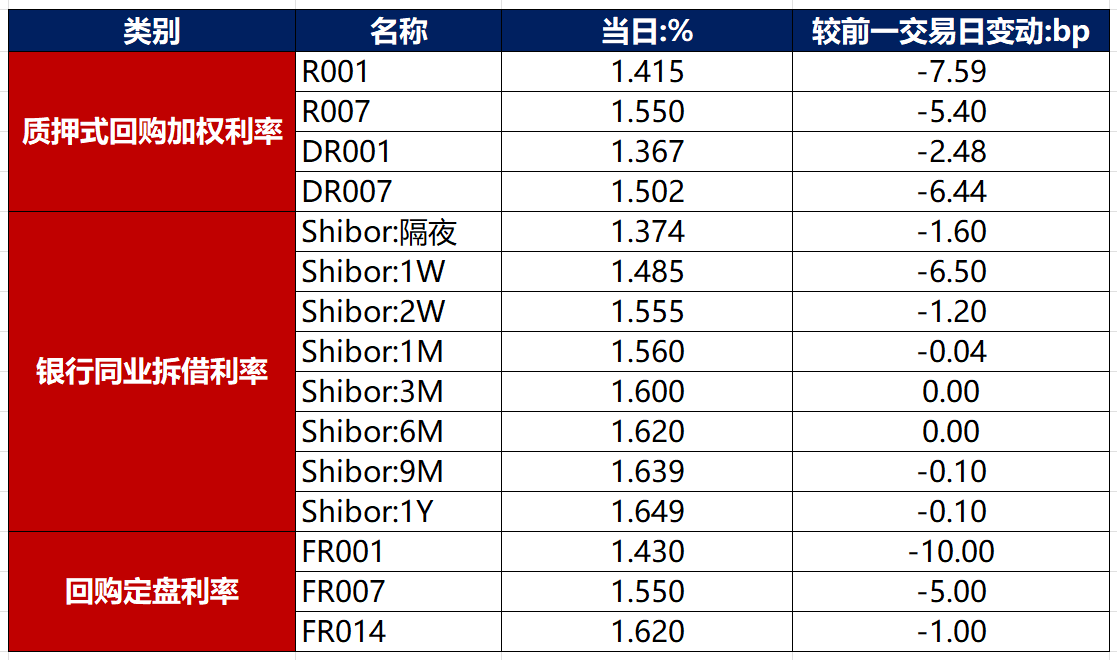
央行发布会关键细节
2026-01-16 02:53
Summary of Key Points from the Conference Call Industry or Company Involved - The conference call primarily discusses the monetary policy and economic outlook in China, focusing on the central bank's (PBOC) strategies and their implications for various sectors, including the stock market and bond market. Core Points and Arguments 1. **Monetary Policy Approach** The central bank favors a prudent monetary policy, utilizing structural tools rather than broad quantitative easing to support the economy, including a 0.25 percentage point reduction in the rates of structural monetary policy tools and an increase of 900 billion in structural monetary policy tool quotas [1][2] 2. **Potential for Rate Cuts** Despite low market expectations, there remains a possibility for rate cuts in 2026, especially during the third quarter when economic growth pressures are significant. The easing of the yuan's appreciation space and bank interest margin pressures provides a window for monetary easing [1][4] 3. **Yuan Exchange Rate Forecast** The yuan is expected to maintain elasticity and appreciate by 3-4% in 2026, with an exchange rate level between 6.7 and 6.8. The increase in the proportion of trade settlements in yuan to 30% reduces the impact of exchange rate fluctuations [1][5] 4. **Impact on Stock Market** The macroeconomic environment is anticipated to positively influence the stock market, with a projected recovery in the profit growth rate of non-financial companies in the A-share market to 14%. This recovery is expected to support equity asset returns [1][6][7] 5. **Return on Equity (ROE) Recovery** The ROE for the non-financial sector in the A-share market rose to 6.7% in Q3 2026, nearing levels seen in Q2 2020, indicating market recovery. The focus should be on Hong Kong internet companies benefiting from domestic demand and global easing policies [1][7] 6. **Investment Recommendations for A-shares** Investors are advised to exercise patience and avoid chasing high prices. Recommended sectors include those related to smart driving and AI applications, as well as assets with global competitive advantages that are influenced by exports and domestic supply improvements [1][8] 7. **Bond Market Dynamics** The bond market faces challenges related to the direction of monetary policy and supply-demand issues. The central bank emphasizes low interest rates but has not clearly indicated further rate cuts. The ten-year government bond yield is expected to remain around 1.85% [3][9] 8. **Inflation and Exchange Rate Monitoring** The central bank is currently in a wait-and-see mode regarding inflation and exchange rates, with no intention to cut rates based on deflationary pressures. There is a focus on monitoring inflation trends and maintaining exchange rate stability [3][10] 9. **Changes in Government Bond Operations** The central bank has resumed government bond trading operations to ensure market stability, which is expected to help maintain stable bond yields and enhance investor confidence [14] 10. **Future Monetary Policy Flexibility** The central bank's future monetary policy will depend on international economic conditions and domestic economic development. While the likelihood of rate cuts in the short term is low, there remains a possibility for adjustments based on actual circumstances [22][23] Other Important but Possibly Overlooked Content - The central bank's emphasis on structural monetary policy tools indicates a shift from traditional broad-based monetary easing, reflecting a more targeted approach to economic support [18][21] - The focus on the real estate market has shifted from broad financial support to addressing specific qualification issues, indicating a more nuanced approach to managing this sector [20]
华泰期货:央行“组合拳” 助力市场回升
Xin Lang Cai Jing· 2026-01-16 02:38
Core Viewpoint - The central bank has introduced a significant policy package aimed at supporting high-quality economic development, which includes various measures to enhance liquidity and support specific sectors [1][6]. Monetary Policy - The central bank has lowered the re-lending and rediscount rates by 0.25 percentage points [1][6]. - The quota for re-lending to support agriculture and small enterprises has been increased by 500 billion yuan, with a total quota of 1 trillion yuan specifically for private enterprises [1][6]. - The re-lending quota for technological innovation and technical transformation has been increased by 400 billion yuan, with an expanded support scope [1][6]. - The minimum down payment ratio for commercial property loans has been reduced to 30% [1][6]. - The central bank indicated that there is still room for further rate cuts and reserve requirement ratio reductions this year [1][6]. Market Performance - The A-share market showed mixed performance, with the Shanghai Composite Index down 0.33% at 4112.60 points, while the ChiNext Index rose 0.56% [1][6]. - Sector performance varied, with electronics, basic chemicals, and non-ferrous metals leading gains, while defense, media, and computer sectors experienced declines [1][6]. - The trading volume in the Shanghai and Shenzhen markets decreased to 2.9 trillion yuan [1][6]. - In the U.S., major stock indices saw slight increases, with the Dow Jones up 0.6% at 49,442.44 points [1][6]. Strategy - The central bank's policy measures are expected to enhance market liquidity and strengthen the growth drivers for the technology sector within the equity market [3][8]. - The overall monetary policy remains accommodative, with the continuous release of liquidity expected to positively impact the equity market, providing upward momentum for stock indices [3][8]. - It is recommended to buy on dips for IC and IM contracts [3][8].

华泰期货:铝价快速上涨抑制消费可能产生负反馈
Xin Lang Cai Jing· 2026-01-16 02:32
Key Points - The core viewpoint of the articles revolves around the current state of aluminum and alumina prices, market trends, and inventory levels, indicating a bearish sentiment in the short term for aluminum and alumina markets [7][17]. Group 1: Aluminum Market Data - As of January 15, 2026, the A00 aluminum price in East China is reported at 24,190 CNY/ton, a decrease of 480 CNY/ton from the previous trading day [2][12]. - The main aluminum futures contract opened at 24,610 CNY/ton and closed at 24,375 CNY/ton, with a trading volume of 766,880 contracts [2][12]. - Domestic electrolytic aluminum social inventory stands at 736,000 tons, with a slight increase of 600 tons from the previous period [2][12]. Group 2: Alumina Market Data - On January 15, 2026, alumina prices in various regions are as follows: Shanxi at 2,625 CNY/ton, Shandong at 2,575 CNY/ton, and Guangxi at 2,735 CNY/ton [3][13]. - The main alumina futures contract opened at 2,804 CNY/ton and closed at 2,789 CNY/ton, reflecting a decrease of 6 CNY/ton [3][13]. Group 3: Aluminum Alloy Market Data - The procurement price for civilian aluminum is 17,600 CNY/ton, while the mechanical aluminum price is 17,900 CNY/ton, both showing a decrease of 400 CNY/ton from the previous day [4][14]. - The total theoretical cost for aluminum alloy production is 23,119 CNY/ton, with a theoretical profit of 481 CNY/ton [6][16]. Group 4: Market Analysis - The aluminum market is experiencing high volatility, which is beginning to suppress consumption, leading to potential short-term negative feedback on prices [7][17]. - The alumina market is seeing a slight decline in prices, with an oversupply situation persisting, indicating limited upward price support in the near term [7][17]. Group 5: Strategy - The current market strategy is neutral for aluminum, cautiously bearish for alumina, and neutral for aluminum alloys [8][18].
央行“组合拳”发力稳经济,逆回购加量续作不断,30年国债ETF(511090)备受资金青睐
Sou Hu Cai Jing· 2026-01-16 02:30
Group 1 - The core viewpoint of the news is that the 30-year government bond ETF is actively traded and supported by the central bank's monetary policy to promote high-quality economic development [1][2] - As of January 15, the average daily trading volume of the 30-year government bond ETF over the past year was 84.00 billion yuan, with a current scale of 233.53 billion yuan [1] - The central bank conducted a 867 billion yuan reverse repurchase operation with a fixed interest rate of 1.40% on January 16, resulting in a net injection of 527 billion yuan for the day [1] Group 2 - According to the Central Economic Work Conference, fiscal policy in 2026 is expected to remain relatively proactive, but the overall deficit rate is high, which may limit the government's ability to increase bond financing significantly [2] - The social financing growth is expected to slow down, with a projected year-on-year increase of around 8.0% in 2026 [2] - The 30-year government bond ETF closely tracks the China Bond 30-Year Government Bond Index, which consists of publicly issued 30-year government bonds [2] Group 3 - The 30-year government bond ETF employs a sampling replication strategy, which allows it to efficiently track the index without needing to purchase all constituent bonds [6][15] - This strategy enhances liquidity by focusing on actively traded bonds, making transactions smoother for investors [16] - The ETF's design reduces the investment threshold, allowing participation with as little as 10,000 yuan, thus catering to small investors [16]

冠通期货早盘速递-20260116
Guan Tong Qi Huo· 2026-01-16 02:28
| | | | 大类资产表现 | | | | --- | --- | --- | --- | --- | --- | | 类别 | 名称 上证指数 | 日涨跌幅% -0.33 | 月内涨跌幅% 3.62 | 年内涨跌幅(%) 3.62 | 近一年走势 | | | 上证50 沪深300 | -0.21 0.20 | 2.46 2.62 | 2.46 2.62 | | | | 中证500 | -0.05 | 10.15 | 10.15 | | | 权益 | 标普500 | 0.26 | 1.45 | 1.45 | | | | 恒生指数 | -0.28 | 5.05 | 5.05 | | | | 德国DAX | 0.26 | 3.52 | 3.52 | | | | 日经225 | -0.42 | 7.49 | 7.49 | | | | 英国富时100 | 0.54 | 3.10 | 3.10 | | | | 10年期国债期货 | 0.11 | 0.16 | 0.16 | | | 固收类 | 5年期国债期货 | 0.09 | 0.00 | 0.00 | | | | 2年期国债期货 | 0.04 | -0.08 | - ...
炸场!欧元濒临破位 美联储成最后“救命稻草”
Jin Tou Wang· 2026-01-16 02:26
Group 1 - The core viewpoint is that the Euro is currently under pressure against the US Dollar, primarily due to strong US economic data and a robust Dollar index, despite positive industrial output data from the Eurozone [1][2]. - Eurozone industrial output for November increased by 0.7% month-on-month and 2.5% year-on-year, exceeding market expectations, but this improvement is seen as insufficient to reverse the overall downtrend of the Euro [2]. - The Dollar index has recently stabilized above 99.25, providing strong support for the Euro's downward trend, with market expectations for the Federal Reserve to maintain interest rates in the 3.50%-3.75% range [1][2]. Group 2 - The Eurozone's economic recovery is perceived as lacking momentum, with the manufacturing PMI indicating weak manufacturing sentiment, which contributes to the Euro's inability to sustain upward momentum [2]. - The current trading environment is characterized by a "strong Dollar pressure + limited Eurozone positives" scenario, with short-term downward risks dominating [2]. - Traders are advised to closely monitor US economic data and Federal Reserve statements, as well as Eurozone economic indicators, to assess the potential for a trend reversal in the Euro [3].
金融支持实体经济力度更大结构更优(权威发布)
Ren Min Ri Bao· 2026-01-16 01:28
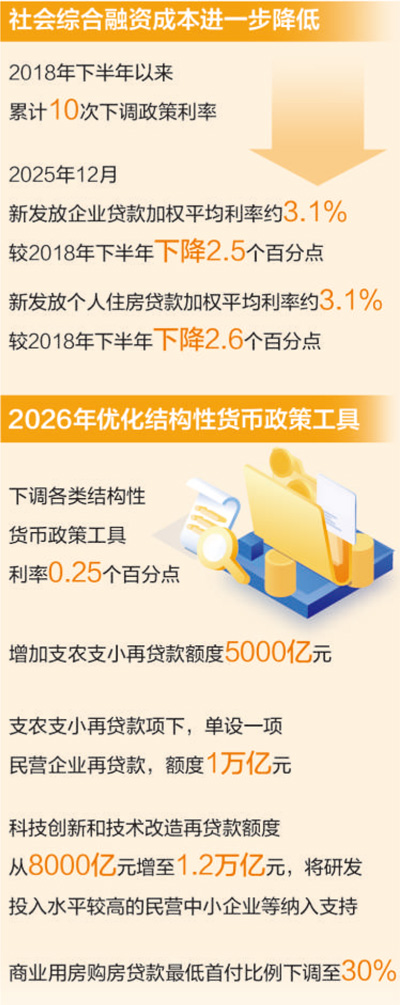
Core Insights - The overall financing cost in society has decreased significantly, with new corporate and personal housing loan rates at approximately 3.1%, down 2.5 and 2.6 percentage points respectively since the second half of 2018 [1][3] - The People's Bank of China (PBOC) has implemented a series of monetary policy tools to support the real economy, resulting in a notable increase in social financing scale and a stable growth in loans [2][3] - The PBOC plans to continue a moderately accommodative monetary policy in 2026, with potential for further rate cuts and liquidity support [4][10] Financing Cost Reduction - Since the second half of 2018, the PBOC has lowered policy rates 10 times, leading to a steady decline in financing costs [1][3] - By December 2025, the weighted average interest rates for new corporate and personal housing loans were both around 3.1% [1][3] Monetary Policy Tools - In 2025, the PBOC increased the quota for agricultural and small enterprise re-loans by 500 billion yuan and raised the quota for technology innovation and transformation re-loans from 800 billion yuan to 1.2 trillion yuan [1][6] - The PBOC is optimizing structural monetary policy tools by reducing interest rates by 0.25 percentage points and enhancing support for key sectors [5][6] Financial Market Stability - The foreign exchange market has remained stable, with the RMB appreciating by 4.4% against the USD in 2025 [4][8] - The PBOC has implemented measures to maintain balance in the foreign exchange market and enhance risk management for enterprises [8][9] Support for Key Sectors - Loans for technology, green initiatives, inclusive finance, and digital economy sectors have shown double-digit growth, significantly outpacing overall loan growth [3][10] - The PBOC aims to enhance financial support for consumption and the health industry, with a focus on improving the effectiveness of financial services [7][10] Direct Investment and Cross-Border Financing - In 2025, cross-border income and expenditure totaled 15.6 trillion USD, reflecting a nearly 10% increase from 2024 [8][9] - The PBOC is promoting high-level institutional openness in direct investment, securities investment, and cross-border financing [9][10]
中国期货每日简报-20260116
Zhong Xin Qi Huo· 2026-01-16 00:47
Investment consulting business qualification:CSRC License [2012] No. 669 投资咨询业务资格:证监许可【2012】669 号 中 信 期 货 国 际 化 研 究 | 中 信 期 货 研 究 所 International 2024-10-09 中信期货国际化研究 | CITIC Futures International Research 2026/01/16 China Futures Daily Note 中国期货每日简报 桂晨曦 Gui Chenxi 从业资格号 Qualification No:F3023159 投资咨询号 Consulting No.:Z0013632 CITIC Futures International Service Platform:https://internationalservice.citicsf.com 摘要 Abstract Macro News: The People's Bank of China (PBOC) cut the interest rates of structural mon ...