
地缘政治风险

Search documents
地缘政治+财政赤字攀升,黄金将在2026上半年冲到5000美元?
Hua Er Jie Jian Wen· 2026-01-09 10:41
Core Viewpoint - HSBC predicts that gold prices may surpass $5,000 per ounce in the first half of 2026, driven by a combination of geopolitical risks and deteriorating fiscal conditions [1][2] Group 1: Factors Influencing Gold Prices - HSBC's report highlights that the rising fiscal deficits in the Western world, particularly the projected $2.05 trillion federal deficit in the U.S. for the 2026 fiscal year, are becoming a hidden driver for gold price increases [2] - The increasing fiscal deficits are eroding the credibility of fiat currencies, thereby amplifying the appeal of gold as a non-debt asset [2] - Deutsche Bank notes a fundamental shift in market structure, where the pricing power of gold is moving from price-sensitive consumers to less price-sensitive official buyers, such as central banks [3] Group 2: Market Dynamics and Investor Behavior - Institutional investors are currently experiencing "FOMO" (Fear of Missing Out), which is driving short-term volatility in the gold market [4] - The report warns that if anticipated interest rate cuts do not materialize, the rebound in gold prices may face suppression and potential corrections [4] - The gold market in 2026 is expected to exhibit characteristics of "high volatility and high prices," reflecting a broader distrust in the existing credit system [4]


特朗普对伊强硬表态 能源板块借势开启“补涨”行情
Ge Long Hui A P P· 2026-01-09 10:00
Group 1 - European energy stocks strengthened due to geopolitical risks driving up oil prices, with Shell and BP rising by 1.7% and 1.55% respectively [1] - TotalEnergies increased by 1.7%, Equinor rose by 2.3%, while Repsol had a smaller gain of 0.7%, and Galp Energia went up by 1.4% [1] - The benchmark crude oil closed with a gain of over 3% following President Trump's renewed warnings to Iran and progress on a bill for further sanctions on Russian oil [1] Group 2 - Citi analyst Alastair Syme indicated that the merger talks between Galp and Spain's Moeve signal positive value release for Iberian energy companies [1]


非农夜,黄金迎终极审判!
Sou Hu Cai Jing· 2026-01-09 09:39
隔夜,现货黄金在经历早盘下探后强劲反弹,最终收于4477.28美元附近,涨幅约0.5%。今日欧市盘中,黄金小幅下跌,目前在4475美元附近徘徊。 降息150个基点? 目前,市场正密切关注将于当地时间周五发布的美国2025年12月非农就业报告。这是自2025年10月美国政府停摆六周、导致关键经济数据收集工作中断数 月以来的首次恢复发布。 隔夜,美股三大指数涨跌不一,截至收盘,道琼斯工业指数涨0.55%,纳斯达克指数跌0.44%,标普500指数涨0.01%。 消息面上,美国上周首次申请失业金人数不及预期。 美国劳工部发布的数据显示,截至1月3日当周的首次申请失业金人数经季节性调整后为20.8万,较前一周增加8000人,但略低于21万的预期值。截至12月 27日当周续请失业金人数191.4万人,预期190万人,前值自186.6万人修正至185.8万人。 另外,美联储货币政策走向也备受市场关注。 隔夜,美联储理事米兰表示,预计在2026年降息约150个基点。此举有望创造约100万个就业岗位,同时不会引发通货膨胀。米兰表示,很难说政策是中性 的,基础通胀水平基本已经回落至美联储2%的目标附近。预计美国经济今年将保持强劲 ...


1月9日金市晚评:今晚美非农数据将来袭 黄金站在多空博弈十字路口
Jin Tou Wang· 2026-01-09 09:32
Core Viewpoint - The current gold market is experiencing a tug-of-war between bullish and bearish forces, influenced by short-term passive selling due to the BCOM annual rebalancing, mid-term focus on U.S. non-farm payroll data, and long-term support from low interest rate expectations and geopolitical risks [2][3][4]. Group 1: Market Conditions - The U.S. dollar index has slightly increased, trading around 99.106, while gold prices are at $4470.89 per ounce, reflecting a 0.15% decline [1]. - The BCOM annual rebalancing, which started on January 9, is expected to lead to passive selling of approximately 240 million ounces (6800 tons) of gold, potentially causing short-term volatility [3]. - The market anticipates the U.S. non-farm payroll data to be a key indicator, with expectations of 60,000 new jobs; a significant deviation from this could influence the Federal Reserve's interest rate decisions [3]. Group 2: Long-term Outlook - Geopolitical complexities and rising global fiscal debt are increasing the demand for gold as a safe-haven asset, with institutions maintaining a bullish consensus on gold prices [4]. - Major financial institutions have raised their gold price forecasts, with HSBC predicting $5000 per ounce in the first half of 2026, and Morgan Stanley and CITIC Securities adjusting their targets to $4800 and $5100 respectively [4]. Group 3: Technical Analysis - Current gold prices are above the 200-day exponential moving average (EMA) of $4315.87, indicating a bullish trend, with technical indicators suggesting that the downward pressure is diminishing [5][6]. - The MACD indicator shows a reduction in bearish momentum, while the RSI is at 56, indicating a neutral stance with potential for further upward movement [5][6]. - A breakthrough above the $4500 level could strengthen bullish sentiment, while a drop below the 200-day EMA may signal a deeper correction [6].
贵金属市场周报-20260109
Rui Da Qi Huo· 2026-01-09 09:16
1. Report Industry Investment Rating - Not mentioned in the report 2. Core View of the Report - This week, the precious metals market fluctuated widely. Silver price volatility intensified significantly, gold price stabilized and rebounded, and the gold - silver ratio rose. Geopolitical risks in Latin America boosted the safe - haven property of gold. US labor market data showed differentiation, but the service sector PMI was unexpectedly strong. If the Venezuela situation does not cool down quickly next week, non - farm payrolls are weak, and Fed officials signal rate cuts, the precious metals price center may remain high. In the medium - term, the bullish logic for precious metals remains intact, but short - term correction risks should be watched out for. The recommended trading ranges for next week are 4300 - 4500 dollars per ounce for London gold and 70 - 85 dollars per ounce for London silver [5] 3. Summary by Relevant Catalogs 3.1 Weekly Key Points Summary - This week, the precious metals market was affected by long - position profit - taking and fluctuations in Fed rate - cut expectations. The US taking tough action against Venezuela strengthened global geopolitical risk concerns. US initial jobless claims rose to 208,000 last week, still at a historically low level. In October, the US trade deficit narrowed by 39% month - on - month. US labor market data was divided, with ADP private employment and JOLTS job openings weaker than expected, but the ISM services index in December unexpectedly rebounded. Looking ahead to next week, if the Venezuela situation persists, non - farm payrolls are poor, and Fed officials hint at rate cuts, precious metals prices may remain high, but short - term correction risks due to concentrated long - position liquidation should be noted. In the medium - to - long - term, a dip - buying strategy is recommended [5] 3.2 Futures and Spot Markets - This week, the precious metals market continued to oscillate strongly at a high level. As of January 9, 2026, the Shanghai silver main contract 2604 rose 9.70% week - on - week, and the Shanghai gold main contract 2602 rose 2.96% week - on - week. This week, the net positions of foreign gold and silver ETFs had slight outflows. As of January 8, 2026, the SPDR gold ETF holdings decreased by 0.32% month - on - month, and the SLV silver ETF holdings decreased by 1.40% month - on - month. As of December 30, 2025, the net long positions of COMEX gold and silver both decreased. This week, the basis of gold and silver strengthened. As of January 8, 2026, the basis of the Shanghai gold main contract was 0.46 yuan per gram, with a basis ratio of 0.05%; the basis of the Shanghai silver main contract was 970 yuan per kilogram, with a basis ratio of 5.26%. This week, the gold inventories of domestic and foreign exchanges increased, while silver inventories decreased [6][10][11] 3.3 Industry Supply and Demand Situation 3.3.1 Silver Industry - As of November 2025, the import volumes of silver and silver ore sand increased. China's silver import volume was 263,505.88 kilograms, a month - on - month increase of 9.90%, and the import volume of silver ore sand and its concentrates was 180,915,984 kilograms, a month - on - month increase of 21.23%. Due to the growth in silver demand for semiconductors, the output of integrated circuits continued to rise, and the year - on - year growth rate tended to stabilize. As of November 2025, the monthly output of integrated circuits was 4,390,000 pieces, with a year - on - year growth rate of 15.6% [32][36][38] 3.3.2 Silver Supply and Demand - The silver supply and demand was in a tight - balance pattern. As of the end of 2024, the industrial demand for silver was 680.5 million ounces, a year - on - year increase of 4%; the demand for coins and net bars was 190.9 million ounces, a year - on - year decrease of 22%; the net investment demand for silver ETFs was 61.6 million ounces, compared with - 37.6 million ounces in the same period of the previous year; the total silver demand was 1,164.1 million ounces, a year - on - year decrease of 3%. The silver supply - demand gap was narrowing year by year. As of the end of 2024, the total silver supply was 1,015.1 million ounces, a year - on - year increase of 2%; the total silver demand was 1,164.1 million ounces, a year - on - year decrease of 3%; the silver supply - demand gap was - 148.9 million ounces, a month - on - month decrease of 26% [44][48][50] 3.3.3 Gold Supply and Demand - According to the World Gold Council, in Q3 2025, the investment demand for gold ETFs increased significantly. Central banks net - purchased about 220 tons of gold in the third quarter, and a total of 634 tons in the first three quarters of 2025 [54] 3.4 Macroeconomic and Options - This week, the US dollar index and the 10 - year US Treasury yield stabilized and rebounded. The 10Y - 2Y US Treasury yield spread narrowed slightly, and the CBOE gold volatility increased. The US inflation - balanced interest rate rebounded slightly. In January 2026, the central banks of China and Turkey continued to buy gold, about 0.93 tons and 3.0 tons respectively [58][62][66]

ATFX:非农夜黄金陷多空博弈,剑指新高还是威胁4400美元?
Sou Hu Cai Jing· 2026-01-09 09:10
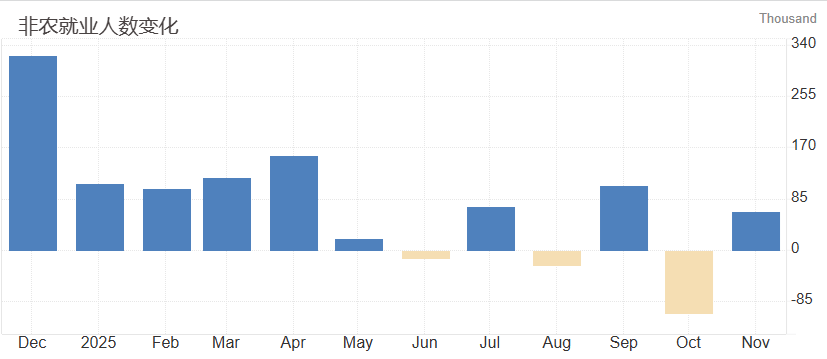
Group 1 - The core viewpoint of the articles revolves around the upcoming U.S. non-farm payroll data, which is expected to provide critical insights into the Federal Reserve's potential monetary policy actions, particularly regarding interest rate cuts in 2025 [1][4]. - The market anticipates an increase of 55,000 jobs in December, down from a previous value of 64,000, with the unemployment rate expected to decrease from 4.6% to 4.5% [1]. - Average hourly wage growth is projected to rise to 0.3% from the previous 0.1%, indicating a potential structural tightening in the labor market as companies increase wages to retain core employees [1]. Group 2 - There is a risk of data noise, particularly concerning revisions to the previous two months' data, which could alter the overall employment trend perception [3]. - Comments from Federal Reserve officials post-data release will significantly influence market interpretations of policy direction, especially regarding inflation concerns [4]. - HSBC forecasts that geopolitical risks and rising debt could push gold prices to $5,000 per ounce in the first half of 2026, while adjusting the average price forecast for 2026 from $4,600 to $4,587 per ounce due to anticipated price corrections later this year [4]. Group 3 - A significantly stronger-than-expected report could delay expectations for the first interest rate cut, negatively impacting gold prices, particularly around the $4,400 support level [4]. - If the data meets or slightly exceeds expectations, it may not disrupt the rate cut outlook or trigger recession fears, allowing gold to consolidate within its current high range [4]. - A significantly weaker-than-expected report could elevate rate cut expectations and increase safe-haven demand, potentially driving gold prices higher [5].
每日投行/机构观点梳理(2026-01-09)
Jin Shi Shu Ju· 2026-01-09 09:05
Group 1 - Fitch expects the Federal Reserve to cut interest rates twice in the first half of 2026, with the unemployment rate stabilizing at 4.6% [1] - Goldman Sachs reports that investor sentiment towards oil is at its most pessimistic level in nearly a decade, with over 59% of surveyed institutional investors bearish on the oil market [2] - Goldman Sachs forecasts a robust global economic growth of 2.8% in 2026, surpassing the market expectation of 2.6%, driven by a strong performance in the US and China [3] Group 2 - Guggenheim indicates that the market has largely absorbed geopolitical risks but remains cautious about headline risks that could impact stock market resilience [4] - UOB raises its gold price forecast due to increased demand for safe-haven assets amid rising geopolitical risks, projecting gold prices to reach $5,000 per ounce by Q4 2026 [5] - CICC anticipates a short-term supply gap in the wood chip market in 2026, leading to a potential increase in pulp prices as demand improves [6] Group 3 - Tianfeng Securities is optimistic about A-share gaming companies entering a strong product cycle in 2026, driven by improved competition and stable regulatory environments [7] - CITIC Securities expects an expansion in the issuance of local government bonds in 2026, with a focus on matching issuance pace with market conditions [8] - CITIC Securities predicts that the Hang Seng Index will undergo adjustments, with 38 stocks expected to enter the Hong Kong Stock Connect [9] Group 4 - CITIC Securities highlights the potential for increased domestic tourism revenue in 2026, estimating an annual increment of 500 to 1,650 billion yuan due to new policies promoting worker consumption [10] - CITIC Jian Investment identifies a bottoming opportunity in the liquor sector, suggesting that the current adjustment phase may soon reverse as market expectations improve [11] - Huatai Securities sees a recovery in the innovative drug sector in Hong Kong, driven by liquidity restoration and multiple catalysts expected in the upcoming year [12]
世界黄金协会:若特朗普关税被取消 短期内或引发黄金回调
Jin Rong Jie· 2026-01-09 07:52
Core Viewpoint - The potential cancellation of Trump tariffs may lead to increased volatility in all assets, commodities, and gold, with significant impacts on regional prices and gold inventory flows into or out of the U.S. [1] Group 1: Market Reactions - If tariffs are lifted, gold may experience short-term corrections as uncertainty diminishes and risk appetite shifts to other asset classes [1] - Geopolitical risks and ongoing policy fluctuations are likely to provide support for gold prices in the long term [1] Group 2: Long-term Outlook - The spot gold market remains resilient and stable, typically benefiting from safe-haven capital flows [1] - Even with potential tariff cancellations, gold is expected to be supported by central bank demand, diversification investment needs, and its role as a hedge against broader economic and policy risks [1]
【comex黄金库存】1月8日COMEX黄金库较上一交易日减少0.5吨
Jin Tou Wang· 2026-01-09 07:24
CME交易所上调保证金及重要商品指数下调金银权重,或对金价构成潜在利空,但地缘政治风险引发 的避险情绪仍为金价提供支撑。此外,美国最新ADP就业数据表现不佳,增强了市场对美联储降息的预 期,目前市场预期明年将降息两次。本周,投资者需重点关注非农数据的公布,以进一步判断金价走 势。 日期 COMEX黄金库存量(吨) 增持(吨) 2026-01-07 1131.77 0.50 2026-01-06 1132.27 0.00 【要闻回顾】 摘要1月8日,COMEX黄金库存录得1131.77吨,较上一交易日减少0.5吨;COMEX黄金周四(1月8日) 收4486.50美元/盎司,上涨0.52%,comex黄金价格日内最高上探至4488.60美元/盎司,最低触及4415.00 美元/盎司。 1月8日,COMEX黄金库存录得1131.77吨,较上一交易日减少0.5吨;COMEX黄金周四(1月8日)收 4486.50美元/盎司,上涨0.52%,comex黄金价格日内最高上探至4488.60美元/盎司,最低触及4415.00美 元/盎司。 最新comex黄金库存数据: ...
大华银行:地缘政治风险强化避险需求 上调全年金价目标
Ge Long Hui· 2026-01-09 06:11
Group 1 - The core viewpoint of the report is that rising global geopolitical risks have increased the demand for safe-haven hedging tools, with gold being identified as the de facto global safe-haven asset [1] - Following events related to Venezuela, gold prices surged by $150 per ounce, indicating heightened volatility in high price ranges [1] - The bank has revised its gold price forecasts upward, projecting prices of $4,400 per ounce in Q1, $4,600 in Q2, $4,800 in Q3, and $5,000 in Q4, all higher than previous estimates [1][1][1]
