即时零售

Search documents
美团闪购推出退货免运费服务
Xin Lang Ke Ji· 2025-09-05 04:12
Core Viewpoint - Meituan has launched the first free return shipping service in the instant retail industry, covering various retail brands and targeting its premium members [1] Group 1: Service Overview - Meituan's instant retail service, Meituan Flash Purchase, is the first platform to offer an official return service without shipping fees [1] - The service is initially available to millions of Meituan's premium members, including Black Gold and Black Diamond users [1] - Customers can return products with a seven-day no-reason return policy without incurring shipping costs, simply by applying through the platform [1] Group 2: Operational Details - Users only need to submit a request and select "Meituan Pickup Return" for the return process [1] - Upon approval, a delivery rider will pick up the returned item, providing a "free return within 30 minutes" experience for consumers [1] - All costs associated with this return service are covered by Meituan Flash Purchase, relieving merchants of any financial burden [1]

阿里海外再加速,小米、泡泡玛特等或入围速卖通高级别出海项目
Xin Jing Bao· 2025-09-04 13:17
Core Insights - AliExpress is preparing a high-profile brand expansion project, with invitations sent to Fortune 500 and leading brands, expected to launch before Double 11 [1] - The shift from low-price competition to brand collaboration is seen as a potential solution to the profit decline faced by nearly half of cross-border e-commerce sellers in 2024 [2] - The brand expansion initiative aims to enhance the platform's brand positioning and has already shown success with previous brand plans, where 95% of participating brands achieved annual sales of over $1 million [2] Company Developments - AliExpress has previously launched a "Brand Going Global Plan," with a goal to support 1,000 new brands to achieve annual sales exceeding $1 million by 2025 [2] - The platform has seen significant sales growth from brands like Pop Mart, with a 300% year-on-year increase in the collectible toy category driven by the Labubu IP [3] - The introduction of "hourly delivery" services in the UK and the expansion of "overseas hosting" in multiple markets are part of AliExpress's strategy to enhance its supply chain and logistics capabilities [4] Financial Performance - Alibaba Group reported a 19% year-on-year revenue growth for its International Digital Commerce Group, reaching approximately 34.741 billion yuan (about $4.850 billion), with cross-border business being a key growth driver [5] - The CFO indicated that the core business revenue growth supports strategic investments, with a focus on optimizing resource allocation and increasing investments in instant retail and AI technology [6] - The competitive landscape in cross-border e-commerce is intensifying, with major players like Amazon and Shein enhancing their brand support initiatives, which poses challenges for AliExpress's new project [6]


秋风没到蟹脚已“痒”?大闸蟹旺季提前蟹卡销量涨13倍
Yang Zi Wan Bao Wang· 2025-09-04 11:59
Core Insights - The demand for hairy crabs is increasing as consumers are already looking forward to the taste of the Chinese mitten crab, even though the season has just begun [1][3] - This year is expected to be a bumper harvest for hairy crabs due to favorable weather conditions and the lunar calendar, with production expected to be higher than in 2024 [3] Group 1: Market Trends - As of early September, live female hairy crabs weighing 2.5 taels are already available for sale on e-commerce platforms [1] - The sales of crab cards and vouchers have surged, with sales during the Tmall Super Category Day from August 31 to September 2 increasing 13 times compared to the same period last year [3] - Many merchants are optimistic about sales this year, especially with the Mid-Autumn Festival and National Day falling close together [3] Group 2: Product Quality and Variety - The production season will focus on live crab sales, integrating high-quality hairy crabs from eight major lakes to meet diverse market demands [4] - Different regions are known for their unique crab qualities, such as Yangcheng Lake crabs being a classic gift choice and Guicheng Lake crabs being highly favored for their size and quality [4] Group 3: Consumer Protection and Sales Channels - Tmall has implemented stricter regulations for the sale of Yangcheng Lake hairy crabs, including a "one crab, one code" system to ensure authenticity [5] - The industry is enhancing instant retail services, with some merchants offering delivery within 24 hours and even 30-minute delivery options in select areas [5]


互联网大厂们,扑向「穷鬼超市」
3 6 Ke· 2025-09-04 11:04
Core Insights - The hard discount supermarket model is gaining traction among major players like Meituan, Hema, and JD, with multiple stores opening in Jiangsu, Zhejiang, and Shanghai [1][2] - The hard discount model, initially popularized by Aoleqi, is being embraced by these giants as they seek new growth avenues amid a saturated online market [1][2] - The focus on fresh food and competitive pricing, typically between 19.9 to 29.9 yuan, is central to the hard discount strategy [5][14] Group 1: Market Dynamics - Meituan's first hard discount store, "Happy Monkey," opened on August 29, with Hema and JD also expanding their hard discount formats [1][2] - The competition is intensifying, with new entrants like JD and Meituan targeting lower-tier cities while established players like Aoleqi and Hema are expanding their market presence [2][16] - The hard discount market in China is projected to exceed 200 billion yuan by 2024, with a current penetration rate of only 8%, indicating significant growth potential compared to mature markets like Germany and Japan [9] Group 2: Operational Strategies - Hard discount supermarkets leverage supply chain efficiencies to enhance private label offerings, which helps in differentiating their product lines [2][5] - The operational model requires time and meticulous management to achieve profitability, as evidenced by Meituan's "Happy Monkey," which is currently estimated to be losing around 10,000 yuan daily due to high staffing levels and initial subsidies [2][15] - Efficient store management, including reduced SKU counts and streamlined staffing, is crucial for enhancing operational efficiency and profitability [15][16] Group 3: Competitive Landscape - The pricing strategy of hard discount stores positions them as "price killers," with significant price advantages over traditional supermarkets [5][14] - Aoleqi's success in the market is attributed to its high private label penetration, which has reached 90%, compared to lower figures for newer entrants like "Happy Monkey" [14][15] - The competition is not only among hard discount players but also includes traditional supermarkets adapting to the new market dynamics, indicating a broader shift in the retail landscape [16]

美团-W(03690):FY2025Q2业绩点评:短期补贴影响盈利能力,关注后续补贴拐点
Changjiang Securities· 2025-09-04 08:43
Investment Rating - The investment rating for Meituan-W (3690.HK) is "Buy" and is maintained [9]. Core Views - In FY2025Q2, the company achieved revenue of 91.84 billion yuan, which was below Bloomberg's consensus estimate of 93.69 billion yuan, representing a year-on-year increase of 11.7%. The adjusted net profit totaled 1.49 billion yuan, significantly lower than the expected 9.85 billion yuan, marking a year-on-year decline of 89.0%. The report suggests that the company is sacrificing short-term revenue performance for long-term strategic choices, reflecting its determination to gain market share. Although short-term profitability may fluctuate due to increased investments, the reliance on subsidies for competition is not sustainable, and such performance disturbances do not alter the long-term growth trend. The current intensified competition is accelerating the overall penetration of instant retail, opening up upward space for the company. Attention should be paid to the marginal turning point of subsidy investments, which could lead to a return of company value [2][6][9]. Summary by Sections Overall Performance - The core local business revenue was 65.3 billion yuan, below the consensus estimate of 67.5 billion yuan, with an operating profit of 3.7 billion yuan, also below the expected 12 billion yuan, reflecting a year-on-year decline of 75.6%. New business revenue was 26.5 billion yuan, slightly above the expected 26 billion yuan, but the operating loss expanded by 43.1% to 1.9 billion yuan, compared to the expected 2.4 billion yuan. The significant decline in performance was mainly due to the impact of subsidies starting in Q2, which affected the profitability of the food delivery business [9]. Core Local Business - Short-term subsidies are disrupting profitability, and losses are expected to widen in Q3. With the current subsidy pace, following Alibaba's entry into the food delivery market in May, subsidies have increased. It is anticipated that Meituan's food delivery losses will primarily occur in June, with further expansion of subsidies in July and August. The average loss per order is expected to exceed that of June, and the future subsidy trend will depend on Alibaba's investments. The company has indicated that significant losses will occur in Q3 for food delivery and core local business, but the gap in advantages over competitors will further widen. The flash purchase business has expanded to over 50,000 locations nationwide, with a year-on-year growth rate exceeding 50% in lower-tier markets, which is expected to create new growth for the company [9]. New Business - The company is accelerating the expansion of its Xiaoxiang supermarket and steadily advancing its overseas business. By the end of the reporting period, approximately 1,000 front warehouses for Xiaoxiang supermarkets had been established in nearly 20 cities. With adjustments to Meituan's preferred offerings, more resources will be allocated to Xiaoxiang's expansion, which is expected to cover all first- and second-tier cities in the country, aiming for a long-term profit margin target of 3%. In terms of overseas business, Keeta has expanded to 20 cities in Saudi Arabia, achieving a market share of first in Hong Kong and second in Saudi Arabia, with an expected GMV of 100 billion yuan by 2033 [9]. Investment Recommendations and Profit Forecasts - Looking ahead, the report emphasizes that the company is making a long-term strategic choice by sacrificing short-term revenue performance to gain market share. Due to increased subsidies and operational expenses, profitability may experience unexpected fluctuations in the short term. However, the reliance on subsidies for competition is not sustainable, and such performance disturbances do not alter the long-term growth trend. Under a neutral assumption, it is expected that Meituan's average loss per order in Q3 will be 1.44 yuan, corresponding to an adjusted net loss of 5.351 billion yuan. If subsequent subsidy reductions are better than expected, the average profit per order for food delivery could recover to 0.37 yuan in 2026, leading to an adjusted net profit of 38.6 billion yuan for the year. The projected overall revenue for Meituan from 2025 to 2027 is 373.966 billion, 418.687 billion, and 465.337 billion yuan, with adjusted net profits of 12.11 billion, 38.646 billion, and 57.476 billion yuan, respectively. The corresponding PE ratios for 2026 and 2027 at the current stock price are 15x and 10x, maintaining a "Buy" rating [9].
王卫“独立第三方”战略奏效,顺丰同城成即时零售“水电煤”
Sou Hu Cai Jing· 2025-09-04 06:42
Core Insights - The article highlights the competitive landscape of the food delivery and instant retail market, emphasizing the ongoing subsidy wars among major players like Meituan, Alibaba, and JD, which indicates a strong commitment to maintaining market positions [1][8] - SF Express's subsidiary, SF City, reported significant growth in its mid-2025 financial results, showcasing a revenue increase of 49% year-on-year, reaching 10.24 billion yuan [1][3] - The report indicates that SF City has successfully expanded its active merchant and rider base, with 850,000 active merchants and 1.14 million active riders by mid-2023, alongside a 50% increase in delivery order volume [5][7] Financial Performance - SF City achieved a gross profit of 680 million yuan, a 44% increase year-on-year, with a gross margin of 6.7% [3] - The net profit surged to 140 million yuan, marking a 120% year-on-year growth, with an adjusted net profit of 160 million yuan, reflecting a 139% increase [3] Market Dynamics - The article discusses the increasing reliance on third-party delivery platforms like SF City, which are becoming essential infrastructure in the instant retail market, akin to utilities [18][23] - It notes that the competition in the food delivery sector has catalyzed growth for third-party logistics providers, which are now seen as critical to supporting various platforms and merchants [8][10] Strategic Positioning - SF City maintains a neutral stance, collaborating with a wide range of clients without being tied to any specific platform, which enhances its strategic advantages in the competitive landscape [7][10] - The company has focused on improving rider compensation and support, resulting in a 65% increase in high-income riders and a 107% increase in riders earning over 10,000 yuan per month [7][12] Industry Trends - The article emphasizes the shift towards diversified logistics solutions, with merchants increasingly seeking to reduce dependency on single platforms due to high fees and restrictions [10][11] - It highlights the growing demand for specialized third-party delivery services across various sectors beyond food, including groceries, pharmaceuticals, and electronics, which require tailored logistics solutions [11][12] Future Outlook - The instant delivery market is projected to continue expanding, with estimates suggesting that the volume of instant delivery orders may surpass that of e-commerce orders in the future [27] - The article concludes that the third-party delivery sector holds significant potential for growth, with opportunities for new players to emerge and contribute to the industry's evolution [27]

顺丰同城(09699.HK):业绩超预期 看好即时配送业务加速增长
Ge Long Hui· 2025-09-04 03:34
Core Insights - The company reported a significant revenue increase of 48.8% year-on-year for the first half of 2025, reaching 10.236 billion yuan, with net profit rising by 120.4% to 137 million yuan [1] - Adjusted net profit for the same period was 160 million yuan, reflecting a 139.0% increase, with an adjusted net profit margin of 1.6% [1] Group 1: Business Performance - The company's same-city delivery service revenue grew by 43.1% year-on-year to 5.779 billion yuan, with order volume increasing by over 50% [2] - Revenue from merchant-facing and consumer-facing services grew by 55.4% and 12.7% respectively, driven by marketing activities that boosted demand for food delivery [2] - The tea beverage delivery revenue saw a remarkable growth of 105% year-on-year [2] - Non-food delivery scenarios also showed robust growth, with revenue increasing by 28.6% to 2.142 billion yuan [2] - The number of active merchants reached 850,000, a 55% increase year-on-year, indicating an expanding customer base [2] Group 2: Last-Mile Delivery - Last-mile delivery service revenue surged by 56.9% year-on-year to 4.457 billion yuan, benefiting from increased penetration in SF Express's delivery volume [3] - Revenue from subsidiaries of SF Express grew by 63% year-on-year, highlighting strong collaboration [3] - The company is enhancing its delivery capabilities and expanding services such as "same-day delivery" and multi-scenario logistics [3] Group 3: Profitability and Cost Management - The company maintained stable gross margins while reducing sales, R&D, and management expense ratios, leading to a net profit margin increase of 0.4 percentage points to 1.3% [4] - The revenue growth is driving economies of scale, improved operational efficiency, and enhanced profitability potential [4] - Profit forecasts for 2025-2027 have been adjusted upwards, indicating a positive outlook for long-term profit growth [4]
阿里、美团们烧钱,分众传媒得益
2 1 Shi Ji Jing Ji Bao Dao· 2025-09-04 00:41
Group 1 - The core viewpoint is that the fierce competition in the food delivery market has significantly impacted various industries, particularly the advertising market for elevator media, with a notable increase in advertising revenue from the internet sector for the company Focus Media [1] - Focus Media reported a year-on-year increase of 89.22% in internet advertising revenue, reaching 985 million yuan, which accounted for 16.12% of its total revenue [1] - In contrast, the company's largest revenue source, daily consumer goods advertising, saw a decline of 10.87% to 3.4 billion yuan, while the telecommunications and entertainment sectors experienced growth in advertising revenue [1] Group 2 - The food delivery giants, including Meituan, Alibaba, and JD, faced significant profit declines due to increased marketing expenditures, with Meituan's net profit plummeting nearly 90% in the second quarter [2][3] - The total marketing expenditure for the three major food delivery platforms during the second quarter was at least 30 billion yuan [3] - Despite the regulatory scrutiny and a potential reduction in the intensity of the food delivery competition, Focus Media remains optimistic about the long-term strategic significance of advertising in the emerging instant retail sector [4]

阿里巴巴-W(09988.HK):淘宝闪购与电商主站协同效应显著 云业务收入增长超预期
Ge Long Hui· 2025-09-03 18:47
Core Viewpoint - Alibaba reported its FY26Q1 results, showing a slight revenue growth but a decline in adjusted net profit, while also highlighting significant investments in instant retail and cloud services [1][2][3]. Financial Performance - FY26Q1 revenue reached 247.65 billion yuan, a year-on-year increase of 1.82% [1] - Adjusted EBITA was 45.735 billion yuan, down 10.61% year-on-year [1] - Adjusted net profit attributable to shareholders was 33.51 billion yuan, a decrease of 17.65% year-on-year [1] - The company repurchased 56 million shares for a total price of 815 million USD, with an authorized buyback amount remaining at 19.3 billion USD [1] Instant Retail and E-commerce Synergy - Alibaba increased its investment in instant retail starting FY26Q1, achieving a peak daily order volume of 120 million and an average of 80 million orders on Sundays in August [2] - The monthly active buyers for instant retail reached 300 million, a 200% increase compared to before April [2] - Instant retail significantly boosted the overall user scale and activity on Taobao, with a 20% increase in daily active users (DAU) in August [2] - Taobao's DAU was 374 million in May, showing a slight decline year-on-year, but increased by 17% in July compared to the previous year [2] - CMR revenue grew by 10% year-on-year to 89.252 billion yuan, supported by increased user activity and reduced marketing costs [2] Future Outlook - With ongoing improvements in logistics efficiency for instant retail, losses in user experience (UE) are expected to halve while maintaining current consumer incentives [3] - Alibaba is developing a new AI chip to fill the market gap left by Nvidia in China, currently in the testing phase [3] - The cloud business achieved revenue of 33.398 billion yuan, a year-on-year growth of 25.80%, with an EBITA margin of 8.8% [3] - Capital expenditures (CAPEX) reached 38.676 billion yuan, exceeding market expectations, with a planned investment of 380 billion yuan over the next three years [3] Investment Recommendations - Projected revenues for FY2026-FY2028 are 1.06 trillion, 1.18 trillion, and 1.30 trillion yuan, with adjusted net profits of 135.6 billion, 169.9 billion, and 198.3 billion yuan respectively [4] - The company is positioned uniquely among domestic peers with comprehensive capabilities in chips, cloud computing, large models, and applications, benefiting from the commercialization of AI applications [4]
外卖“三国杀”后,电商终究阿里“坐庄”?
Hu Xiu· 2025-09-03 14:17
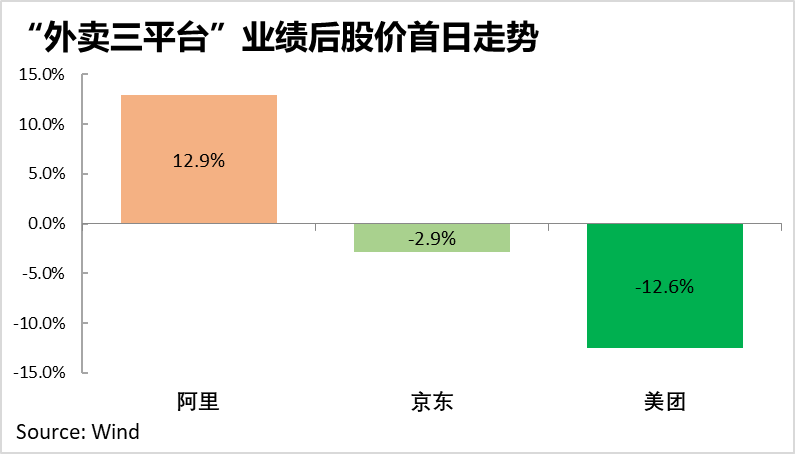
Group 1 - Alibaba achieved significant victories in both performance data and stock price during the summer of 2025, indicating a strong recovery [1] - The recent e-commerce battle involving Alibaba, JD.com, and Meituan is reshaping the market landscape, hinting at potential long-term changes in the e-commerce sector [2][3] - The stock market reaction to the earnings reports of Alibaba, Meituan, and JD.com shows that Alibaba's stock surged nearly 13% on the first day after its earnings announcement, while Meituan's stock dropped nearly 13% [4] Group 2 - In the second quarter, Alibaba's adjusted profit was 38.8 billion yuan, a decline of less than 14% year-on-year, indicating that its investments in the food delivery sector did not severely impact its profitability [18] - In contrast, Meituan's operating profit plummeted by 97% to only 200 million yuan, while JD.com reported a loss of 860 million yuan, highlighting the severe financial impact of the delivery battle on these companies [17] - The market's perception of the three companies is evident: Alibaba is seen as having a strong position due to its size and financial resources, while Meituan and JD.com face significant challenges [9][10][13] Group 3 - The food delivery battle has led to a substantial increase in daily active users (DAU) for all three companies, with Alibaba experiencing a 17% year-on-year increase in DAU by July [29][30] - Alibaba's Taobao Flash has achieved a significant increase in order volume, reaching an average of 75 million daily orders in the third quarter, nearly matching Meituan's expected 90 million [34] - The competitive landscape has shifted, with Alibaba's market share in food delivery approaching parity with Meituan, indicating a successful strategy in scaling operations [36][88] Group 4 - Alibaba's management anticipates that the integration of its various business units will create a comprehensive consumption platform, aiming for a seamless user experience across different services [89][90] - The company plans to enhance its operational efficiency and reduce average losses per order by optimizing its delivery structure and increasing the average order value [85][86] - The long-term goal for Alibaba is to establish a unified platform that encompasses all aspects of consumer needs, including food delivery, traditional e-commerce, and other services [92]