
春季躁动

Search documents
广发基金投顾团队:关注2026“春季躁动”,聚焦两大结构性方向
Zhong Zheng Wang· 2026-01-15 06:28
2025年四季度,A股市场在经历前期快速上涨后进入震荡整理期,市场交投活跃度有所回落,板块轮动 加快;债券市场则呈现震荡走弱格局。 展望2026年第一季度,广发基金投顾团队认为,近期市场主要指数持续上行,沪指也已经来到4100点附 近,整体市场风险偏好较高,在企业盈利周期延续修复、国内政策基调明晰、市场流动性相对偏宽的情 况下,重点关注春季躁动机会与市场热点结构变化。 四季度回顾:股债走势分化,价值风格补涨 回顾四季度,A股整体呈现区间震荡走势。在经历前期快速上涨后,市场进入阶段性整理,中美贸易摩 擦反复与AI产业前景的讨论带来短期扰动,"十五五"规划落地和12月重要会议召开释放积极政策信号, 对市场形成支撑。 风格方面,避险情绪有所回升,红利、价值风格开始补涨,成长风格有所回落,市场呈现再平衡态势。 债券市场方面,四季度整体震荡偏弱。10月在政策预期博弈中窄幅震荡,11月受地产债展期等信用事件 冲击持续走弱,12月在降息预期收缩、超长债供给担忧等因素影响下,收益率曲线明显走陡,30年期国 债表现承压。 后市展望:结构机会为主,关注春季行情 展望2026年第一季度,广发基金投顾团队对权益市场维持中性偏乐观看法 ...
港股午评:恒指跌0.55%、科指跌1.83%,AI应用概念股下跌,锂电池股继续活跃,中石化刷阶段新高
Jin Rong Jie· 2026-01-15 04:13
1月15日,港股早盘冲高回落维持低位窄幅震荡走势,截止午盘,恒生指数跌0.55%报26850.78点,恒生 科技指数跌1.83%报5799.85点,国企指数跌0.69%报9250.87点,红筹指数涨0.11%报4142.09点。 盘面上,大型科技股多数走低,阿里巴巴跌2.96%,腾讯控股跌1.34%,京东集团跌1.04%,小米集团涨 0.32%,网易跌1.91%,美团跌0.79%,快手跌3.42%,哔哩哔哩跌2.25%;AI应用相关概念股集体下跌, 昨日领涨的AI医疗股跌幅较大,阿里健康跌9%;旅游及观光板块大跌,携程跌超19%;中资券商股普 跌,中泰期货跌超4%。另外,锂电池股涨幅居前,赣锋锂业涨超5%;三桶油拉升,中石化刷阶段新 高。 企业新闻 中信证券(06030.HK):发布2025年度业绩快报,实现营业收入人民币748.30亿元,同比增长28.75%;净 利润人民币300.51亿元,同比增长38.46%。 中信银行(00998.HK):公布2025年度业绩快报,营业总收入为2,124.75亿元,同比减少0.55%;净利润 706.18亿元,同比增长2.98%。 越秀地产(00123.HK):2025 ...
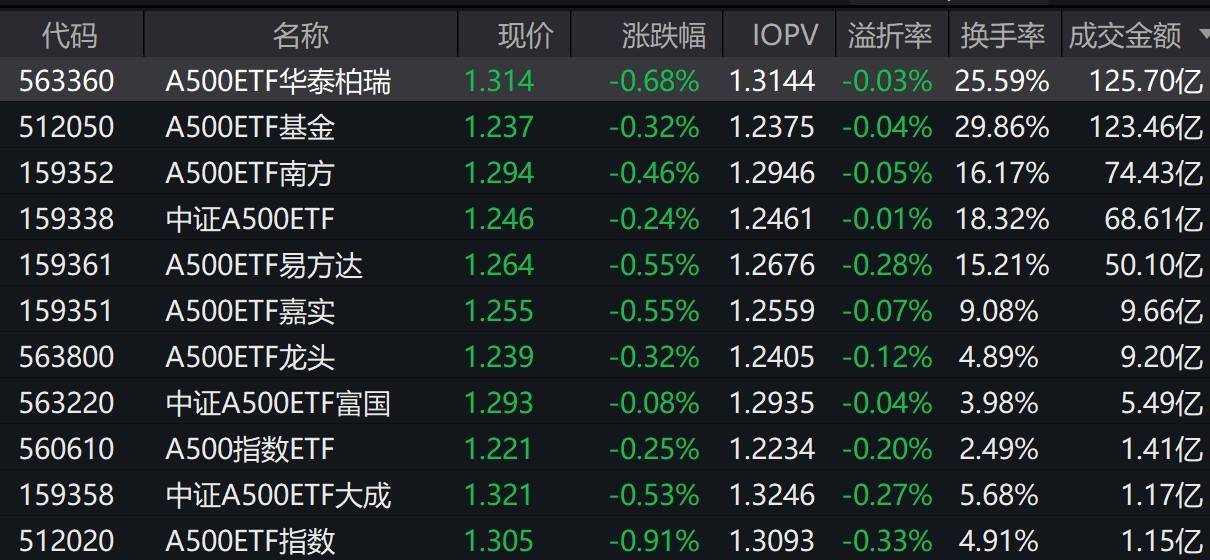
市场早盘冲高回落,中证A500指数下跌0.28%,2只中证A500相关ETF成交额超123亿元
Sou Hu Cai Jing· 2026-01-15 03:43
Market Overview - The market experienced a morning surge followed by a decline, with the ChiNext Index dropping over 1% and the CSI A500 Index down by 0.28% [1] - The tourism and hotel sector showed active performance, while the non-ferrous metals sector rose. Conversely, the commercial aerospace and AI application sectors faced declines [1] ETF Performance - As of the morning close, ETFs tracking the CSI A500 Index saw slight declines, with 11 related ETFs having transaction volumes exceeding 100 million yuan, and 2 surpassing 12.3 billion yuan [1] - The transaction volumes for A500 ETFs were as follows: Huatai-PB A500 ETF at 12.57 billion yuan, and A500 ETF Fund at 12.346 billion yuan [1] Analyst Insights - Some brokerages indicated that the current market trend is positive, suggesting a short-term oscillation while maintaining a long-term bullish outlook [1] - The expectation of a slow bull market, seasonal market activity, and global equity resonance is believed to support a new round of bullish sentiment in A-shares, encouraging the acquisition of quality A-share assets [1]

A股结束17连阳,港股接棒后续上涨?
Sou Hu Cai Jing· 2026-01-14 18:01
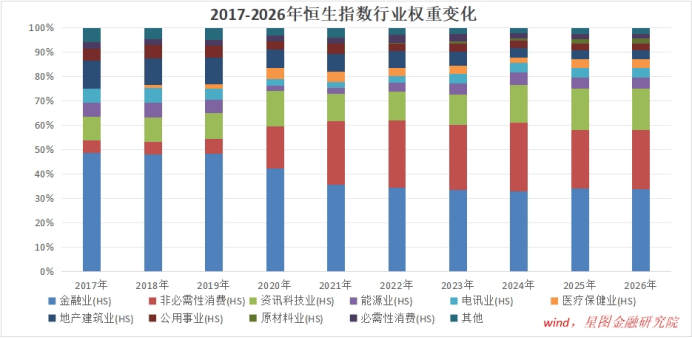
Core Viewpoint - The A-share market is performing strongly, while the Hong Kong stock market is lagging behind due to mismatched market structure and current capital preferences, alongside a weak liquidity environment [1] Group 1: Market Performance - As of January 12, 2026, the Wind All A Index has risen by 6.92%, with the Sci-Tech Innovation Index up by 13.39%, significantly outperforming the Hang Seng Index (3.82%) and Hang Seng Tech Index (6.29%) [1] - The Hang Seng Index saw a 27.77% increase in 2025, driven by global liquidity easing, valuation recovery in the financial sector, and sustained inflows from southbound capital [3] - The Hang Seng Composite Index increased by 30.98%, reflecting higher elasticity in small and mid-cap stocks favored by southbound capital [3] Group 2: Sector Analysis - Resource, technology manufacturing, and consumer services sectors have emerged as leading growth areas, with other metals and mining sectors rising by 198.56% due to global copper supply shortages and strong lithium demand [4] - The semiconductor sector surged by 136.89%, driven by breakthroughs in advanced processes and increased demand for AI servers [4] - The healthcare provider and service sector declined by 17.85% due to policy cost control and intensified industry competition [4] Group 3: Future Outlook - The Hong Kong stock market is expected to continue its recovery in 2026, transitioning from strong broad-based growth in 2025 to a more moderate recovery with structural differentiation [5] - Key drivers for market resilience include improving liquidity, steady recovery of the Chinese economy, and a rebalancing of domestic and foreign capital structures [6] - The Hang Seng Index's earnings per share is projected to grow by 9.64% in 2026, with the Hang Seng Tech Index expected to see a 34.63% increase, supported by a mild recovery in the Chinese macroeconomy [7] Group 4: Structural Changes - The composition of the Hang Seng Index has fundamentally changed from 65.85% in traditional sectors (finance, energy, real estate) to 42.02%, while new economy sectors (consumer discretionary, information technology, healthcare) have increased from 20.83% to 48.87% [8] - This shift aligns with China's "14th Five-Year Plan" focusing on technological self-reliance, indicating a new growth phase with improved visibility and sustainability in profit growth [8] Group 5: Investment Opportunities - The market is expected to be highly structured in 2026, with AI software and hardware as the main themes, driven by breakthroughs in hard technology and the practical application of AI [10] - The cyclical resource theme will benefit from supply-side optimization and demand recovery, with industrial metals likely to see price strength due to ongoing supply constraints [11] - High-dividend assets may still provide absolute returns, but the focus should shift to sectors with strong supply barriers and pricing power, such as infrastructure-related sectors and the insurance industry [12]
全球股市立体投资策略周报1月第2期:跨年行情在途,亚洲继续领涨-20260114
GUOTAI HAITONG SECURITIES· 2026-01-14 02:50
Market Performance - Emerging markets continued to lead, with MSCI Global up by 1.5%, MSCI Developed Markets up by 1.1%, and MSCI Emerging Markets up by 4.2% [8][12] - In the developed markets, the South Korean Composite Index showed the strongest performance with an increase of 11.1%, while the Australian S&P 200 was the weakest, declining by 0.5% [8][12] - In the emerging markets, the Shanghai Composite Index performed best with a rise of 4.0%, while the Indian Sensex30 was the weakest, falling by 1.7% [8][12] Trading Sentiment - The volatility of major stock indices continued to rise, with trading volumes in various markets increasing significantly [25] - In Hong Kong, the short-selling ratio decreased to 14.7%, indicating a high investor sentiment, while North American sentiment remained at a historical high with the NAAIM manager exposure index rising to 97.7% [25][28] Earnings Expectations - The overall earnings expectations for Hong Kong stocks were revised downwards, with the Hang Seng Index's 2025 EPS forecast adjusted from 2072 to 2071 [71] - In contrast, Japanese stocks saw an upward revision in earnings expectations, with the Nikkei 225's 2025 EPS forecast increased from 2447 to 2451 [71][72] - The earnings expectations for the S&P 500 remained stable at 273, while the Eurozone STOXX50's forecast was revised down from 332 to 331 [71][72] Economic Expectations - Economic indicators showed a slight decline in the US and China, with the Citigroup Economic Surprise Index for the US decreasing due to mixed non-farm data and political uncertainties [8][71] - The Eurozone's Economic Surprise Index saw a slight increase, influenced by easing geopolitical tensions and changes in trade policies [8][71] Fund Flows - The probability of a Federal Reserve rate cut in January was significantly reduced, with market expectations for 2.1 rate cuts in 2026, a slight decrease from the previous week [58][59] - Global liquidity showed signs of tightening, with significant inflows into Hong Kong stocks, amounting to 167 billion HKD, despite some outflows from stable foreign capital [68][70]
小市值+高研发+低位滞涨的活跃股,14股上榜
Zheng Quan Shi Bao Wang· 2026-01-13 11:58
Group 1 - The resilience of technology stocks continues to attract investors, with the A-share market showing strong performance and indices reaching new highs [1] - The current market liquidity is abundant, and thematic trends are expected to continue, with a focus on sectors like commercial aerospace, satellite connectivity, smart driving, and brain-computer interfaces [1] - The "spring rally" is anticipated to be more stable and prolonged compared to previous years, with attention on capital inflows and outflows in January [1] Group 2 - There are 14 stocks with a market capitalization below 5 billion yuan, a research and development expenditure ratio exceeding 10%, and a price drop of over 20% since their peak in 2025 [2] - Among these, Iron Big Technology has the lowest market cap at under 2 billion yuan, focusing on railway signal and communication equipment [2] - Mengke Pharmaceuticals leads in R&D intensity with a ratio of nearly 174%, specializing in small molecule drug development for infectious diseases [2] Group 3 - Companies like Ruina Intelligent, Meixin Sheng, and Biyiwei have R&D expenditure ratios exceeding 20% in the first half of 2025 [3] - Institutions are particularly interested in Kangnong Agriculture, with other companies like Minxin Co., Vision Intelligent, and Meixin Sheng also receiving attention [3] - Minxin Co. is recognized for its MEMS chip design and manufacturing capabilities, indicating a balanced development in its product revenue structure [3]


瑞银证券中国股票策略分析师孟磊:长线资金通过ETF持续入市A股
Zheng Quan Ri Bao Wang· 2026-01-13 10:43
对于一季度A股市场的展望,孟磊表示瑞银证券对此持乐观看法,认为A股历来有一个传统的说法为"春 季躁动",即整体流动性偏向于宽松,整体市场的股票估值出现上行,目前在演绎的行情有可能跟"春季 躁动"有一定的关联性。从全球市场来说,开年以来,全球股票市场都处在上行。 本报讯(记者毛艺融)1月13日,瑞银证券中国股票策略分析师孟磊在第二十六届瑞银大中华研讨会上表 示,2026年A股盈利同比增长预计将加速至8%,更明确的政策支持与股市结构性改革有望助力市场估 值提升,市场对盈利增长的一致预期迎来上修。 当前个人投资者情绪并未过热,主动型公募基金新发规模或温和复苏。"我们更多观察到中长线资金入 市的迹象,从主动型公募基金的历史来看,它的发行情况是落后于募资、落后于股价的,股价上涨才会 有更多的钱进股票市场。我们看到的情况是在过去6个月当中,整体的基金发行份额在温和地复苏。"孟 磊表示。 长线资金通过ETF持续入市A股。孟磊介绍,例如,人工智能等主题的相关ETF获得非常明显的资金进 入,被动资金的流入推动行业龙头跑赢市场。此外,私募证券投资基金份额的提升推升小盘股估值,保 险资金有望持续入市。 行业配置上,孟磊表示,科技创 ...
看股做债专题二:固收专题
China Post Securities· 2026-01-13 09:29
Report Information - Report Type: Fixed Income Report - Release Date: January 13, 2026 - Analyst: Liang Weichao [2] - Research Assistant: Wang Yi [2] Investment Rating No investment rating for the industry is provided in the report. Core Viewpoints - The larger the increase in the spring stock market rally, the higher the probability of pressure on the bond market. When the Shanghai Composite Index rises more than 20% in spring, the 10 - year Treasury bonds are likely to fall during the same period. In the more common 10% - 20% medium - increase range, the bond market is more likely to fluctuate or stage a phased recovery [2]. - A mid - stage acceleration in the spring stock market rally is more likely to suppress the bond market than a bottom - bouncing recovery. When the rally occurs in the mid - stage acceleration of the stock market, it's more likely to be interpreted as a signal of fundamental or policy orientation changes, and inflation and nominal growth expectations enter the core of pricing, putting pressure on the bond market [3]. - A spring rally led by cyclical sectors has a greater impact on the bond market than an independent rally in technology and consumer sectors. When cyclical and stable sectors resonate with growth sectors, the re - pricing of nominal growth and credit expansion is significantly strengthened, and the bond market is under greater pressure [3]. - In 2026, the spring stock market rally is likely to be a combination of "mid - stage acceleration, easing expectations, and growth - led", which will mainly cause short - term disturbances to the bond market rather than being a long - term negative factor. Before the rally spreads to cyclical and stable sectors and forms a resonance, interest rates are more likely to remain volatile at a high level, and the first quarter may be a phased high point [4]. Summary by Directory 1. The Impact of Past Spring Stock Market Rallies on the Bond Market Varies by Increase - **1.1 "Spring Rally" Offers Good Opportunities, Risk Preference Tilts towards the Stock Market**: The spring rally in the A - share market is a high - probability and high - return phased market window. From 2002 to 2026, the probability of a spring rally is over 90%. The average maximum increase in the main rising phase of the spring rally is about 14%, and the average increase remains at about 12% in the past 15 years. In some years, such as 2007, 2009, 2015 and 2019, the increase exceeded 30% [10]. - **1.2 Past Spring Stock Market Rallies Tend to Pressure the Bond Market, with a High Probability of Bond Market Recovery in the Medium - Increase Range**: When the Shanghai Composite Index rises more than 20% during the "spring rally", the 10 - year Treasury bond interest rate is likely to rise significantly. When the increase is less than 20%, the bond market shows different performances, including simultaneous rises in stocks and bonds, and stocks rising while bonds falling. In the medium - increase range, the bond market may either rise or fall, but there is a high probability of recovery even if it falls [13]. 2. Bond Market Performance Varies Depending on the "Stage of the Larger Stock Market Rally" during the Spring Stock Market Rally - **2.1 In the Case of a Low - Level Rebound in the Spring Stock Market Rally, Loose Liquidity May Drive Stocks and Bonds to Rise Together**: When the spring rally starts in the low - level repair stage (i.e., a rebound after an oversold), stocks and bonds often move in the same direction, and the bond market is insensitive to the rise of the stock market. In the past, when the stock market rebounded from a low level in spring and the stage increase did not exceed 20%, the 10 - year Treasury bond yield mostly remained stable or declined during the spring rally. The larger the decline in the Shanghai Composite Index in the two months before the spring rally, the greater the possible decline in interest rates during the spring rally. For example, in 2024, the stock market and the bond market both rose during the spring rally [18][22]. - **2.2 In the Case of a Mid - Stage Acceleration in the Spring Stock Market Rally, the Bond Market Is Likely to Be Pressured First and Then Ease**: When the spring rally occurs in the acceleration stage of the stock market's upward trend, the bond market may face pressure in the short term but is likely to ease later. In this context, the continued rise of the stock market is more likely to be interpreted as a signal of "expected fundamental improvement or policy orientation change", which puts pressure on the bond market [23]. 3. The Impact of Spring Stock Market Rallies Led by Different Styles on the Bond Market Varies - **3.1 Spring Stock Market Rallies Led Solely by Technology, Consumption, or Finance Have Limited Suppression on the Bond Market**: When the spring rally is led by the growth (technology) sector, the rise of the stock market mainly reflects the repair of risk preference and the anticipation of the future development of emerging industries, and has little impact on the bond market. For example, in 2010, 2014, 2024 and 2025, the average change in the 10 - year Treasury bond yield during the spring rally was only - 1.5bp. When the consumer sector leads the rally, the impact on the bond market is also positive. When the financial sector leads the rally, there is a high probability of driving both stocks and bonds up [31]. - **3.2 Spring Stock Market Rallies with Resonance of Cyclical and Stable Styles Shake Expectations and Impact the Bond Market**: When the "growth, stable and cyclical" sectors resonate in the spring rally, the impact on the bond market is more significant. The resonance of these sectors strengthens the market's pricing of the return of nominal growth, credit expansion and policy effects, and puts upward pressure on the risk - free interest rate. For example, in 2007, 2009 and 2015, the bond market was significantly pressured [35]. 4. How to "Invest in Bonds Based on the Stock Market" in the 2026 Spring Stock Market Rally? - In 2026, the spring stock market rally is likely to be a risk - preference repair - type increase, focusing on growth themes. It will mainly cause short - term disturbances to the bond market rather than being a long - term negative factor. After the spring rally, the downward pressure on interest rates may gradually ease. Before the rally spreads to cyclical and stable sectors and forms a resonance, interest rates are more likely to remain volatile at a high level, and the first quarter may be a phased high point [40][44].
有基金一天规模增加了100多亿
Xin Lang Cai Jing· 2026-01-12 14:12
Market Overview - The A-share market has experienced a significant surge, recording a "17 consecutive days" increase in indices, with total trading volume reaching 3.64 trillion yuan, setting a new historical record [1][12] - Over 4,100 stocks have risen, indicating a strong bullish sentiment among both retail and institutional investors [1][12] Fund Activity - Stock funds have seen substantial increases in positions, with a notable shift in the structure of these investments compared to the past [2][13] - Retail investors have shown heightened enthusiasm since the beginning of the year, correlating with rising margin trading and trading volumes [3][14] Sector Trends - Retail investors are primarily investing in thematic funds, particularly in emerging sectors such as brain-computer interfaces and satellites, with some funds experiencing rapid growth in assets under management [3][14] - For instance, a fund focused on commercial aerospace has surpassed 20 billion yuan in assets, up from just over 1 billion yuan last year [3][14] Fund Performance - A fund heavily invested in AI applications saw an estimated net value increase of 15% in one day, although the actual increase was reported at 8% [4][5][15][16] - The top-performing fund for the day was the Western Li De Technology Innovation fund, which achieved a single-day increase of over 14% [6][17] Institutional Behavior - Institutions, particularly small and medium-sized insurance companies, are also increasing their positions, having previously reduced their stock holdings due to solvency pressures [19] - The general consensus among institutions is that AI applications are entering a core window period, similar to the "Internet Plus" phase of 2014-2015, with expectations for significant growth in the first half of the year [19][20] Market Sentiment - There is a prevailing expectation of a "spring rally," with many investors eager to enter the market ahead of upcoming quarterly earnings reports, which may reveal disappointing short-term performance [9][21] - Investors are looking to capitalize on the current market momentum before potential downturns associated with earnings announcements [21]
“春季躁动”复盘与启示
Guo Tai Jun An Qi Huo· 2026-01-12 13:42
Report Summary 1. Industry Investment Rating No industry investment rating is provided in the report. 2. Core Viewpoints - Historically, the A-share market has a typical calendar effect, with the "Spring Rally" occurring around the end of the year, through the Spring Festival, and until the "Two Sessions." It has rarely been absent, lasting about 40 trading days on average, with the Wind All A Index rising an average of 20% and a median increase of 15%. The rally tends to favor small-cap growth stocks [1][5]. - The core logic behind the "Spring Rally" lies in the performance vacuum period, which creates room for expectation games. Positive policy expectations from the beginning - of - year policy kick - off and the "Two Sessions," seasonal improvement in liquidity, and abundant theme investment opportunities contribute to a positive feedback loop of "fund inflow - price increase - further fund inflow" [1]. - The continuation of the "Spring Rally" requires dynamic attention to core drivers such as policies, liquidity, and risk preferences. Key time points include before the Spring Festival and around the second quarter. The full - year market requires both "valuation + earnings" dual - wheel drive, especially driven by the consensus of earnings repair [2][24]. 3. Summary by Directory 3.1 "Spring Rally" Review - Except for 2022 (unilateral decline) and 2015 (atypical unilateral rise), the "Spring Rally" has occurred in other years since 2010. It usually starts between December and January, with 5 times starting in December, 7 times in January, and 3 times in February. The average duration is about 40 trading days, and the Wind All A Index rises an average of 20% with a median increase of 15%. Small - cap growth stocks are favored in 8 out of 15 rallies [5]. 3.2 "Spring Rally" Driving Factors - The "Spring Rally" is driven by liquidity and policy expectations rather than performance. After the new year, institutional funds replenish positions, and there is a peak in credit issuance. Economic data and corporate earnings are in a vacuum, and policies create a positive atmosphere at the beginning of the year. If the market has adjusted significantly before the rally, the subsequent increase is often higher than average [9]. 3.3 Turning Drivers of the "Spring Rally" - The turning points in the "Spring Rally" are mainly affected by internal and external factors. Internally, a shift in policies, such as a reduction in the intensity of pro - growth policies or actions to cool the stock market, can lead to market adjustments. Externally, overseas economic recessions, geopolitical events, or trade frictions can also impact the domestic market [12][13]. - In early 2019, after the market adjustment in 2018, policies turned to "Six Stabilities" at the end of 2018, leading to a significant "Spring Rally." However, in the second quarter of 2019, the Politburo meeting did not mention "Six Stabilities" and re - emphasized "housing is for living in, not for speculation," and trade frictions reignited, causing the rally to end [14][17]. - In early 2012, after the market decline in 2011, policies shifted at the end of 2011, resulting in a "Spring Rally." The rally ended due to policy tightening, pessimistic economic expectations, and external factors such as the re - emergence of the European debt crisis and the US fiscal cliff issue [19][20]. 3.4 Two - stage Focus for the Current "Spring Rally" - To predict the sustainability or inflection point of the current "Spring Rally," it is necessary to track the realization of positive expectations and key time points. Before the Spring Festival, pay attention to the local "Two Sessions," the confirmation or refutation of easing expectations, and the appointment of the new Fed chair. Around the second quarter, focus on events such as Trump's possible visit to China in April, the Politburo meeting in late April, the verification of real - world demand and macro data during the "Golden March and Silver April," and corporate earnings reports [23][24].