风格切换

Search documents
中信建投:牛市底层逻辑仍在
Di Yi Cai Jing· 2025-10-20 00:07
Core Viewpoint - The underlying logic of the bull market remains intact, supported by ample liquidity and limited downward adjustments [1] Group 1: Market Conditions - Capital market reforms are stabilizing expectations, with multiple measures promoting market upgrades [1] - Structural prosperity continues to serve as a driving force for the market [1] Group 2: Investment Strategy - A style switch has already begun, with short-term focus on "countermeasures + risk aversion" themes due to US-China tensions [1] - At year-end, profit realization and seasonal effects typically favor dividend and large-cap growth styles [1] - After sufficient adjustment and recovery in the technology sector, a year-end rally is expected in high-prosperity sectors if liquidity remains abundant [1]

风格切换当下,周期有哪些看点?
2025-10-19 15:58
Summary of Key Points from Conference Call Records Industry Overview Power Generation Industry - The thermal power industry benefits from a significant decrease in coal costs, with Q3 performance continuing the recovery trend. The expected bottom for coal prices provides confidence for electricity price negotiations, and the anticipated increase in capacity prices improves the industry's business model. However, attention is needed on the potential impact of coal supply and demand changes on costs [1][4][7]. - The hydropower sector experienced significant fluctuations in Q3 due to the flood season, but the unexpected autumn floods may lead to an upward adjustment of the annual power generation target. Key players like the Yangtze River Basin, Sichuan Investment, and Huaneng Hydropower show strong competitiveness [1][5]. - Nuclear power has a confirmed long-term growth potential, with a peak in new unit commissioning expected in 2027. The acceleration of new unit approvals and the macroeconomic backdrop of declining interest rates enhance its influence, although market-oriented trading may exert short-term pressure on performance [1][6]. Construction and Building Materials - Silver Dragon Co. benefits from an increased proportion of high-strength product usage and overseas business expansion, with Q3 performance expected to maintain high growth rates. Emerging businesses in aerospace steel wire products show strong competitiveness [1][8]. - Three Trees reported growth in revenue and net profit in Q3, driven by demand for existing and second-hand housing, and accelerated development of high-margin retail formats. The trend of domestic substitution is evident [1][8]. - Rabbit Baby's stock price increase is attributed to sector rotation and its low valuation with high dividend characteristics. Q3 revenue growth is expected to turn positive, with investment income enhancing performance and maintaining a high dividend yield [1][9]. - Huanxin Cement's mid-year performance saw a significant increase, with domestic and international cement business net profit per ton rising. The acquisition of Nigerian cement assets enhances performance, supported by supply-side reform logic [2][10]. Market Trends and Insights Market Sentiment and Style Changes - Recent changes in market sentiment and style have positively impacted the public utility sector, with the utility index rising nearly 3% since October, outperforming the Shanghai Composite Index by about 3% [3]. Real Estate Market Dynamics - During the National Day holiday, the real estate market showed signs of recovery, with first-tier cities experiencing slight growth and third-tier cities seeing a 20% year-on-year increase. However, second-hand housing transactions showed a significant decline [11]. - High-frequency data indicates a doubling of new housing supply in core cities from August, with a 30%-40% year-on-year increase. This suggests a positive outlook for future sales driven by optimistic expectations [12]. Future Policy Expectations - The fourth quarter is expected to maintain a loose policy tone, with ongoing implementation of real estate storage and urban renewal policies. There is also an increasing expectation of interest rate cuts, creating a favorable environment for the real estate sector [15]. Investment Recommendations - Investors are advised to focus on pure development companies, particularly smaller and mid-sized real estate firms that may experience valuation recovery or fundamental-driven trading opportunities due to improving policy expectations and fundamentals [16].
中信建投:缩量轮动继续 风格切换已起
Zheng Quan Shi Bao Wang· 2025-10-19 14:42
Core Viewpoint - CITIC Securities believes that the bull market logic remains intact despite the recent market consolidation, driven by capital market reforms and structural prosperity [1] Market Conditions - Following a peak in trading activity in the computing power sector in early September, the market has entered a consolidation phase characterized by high capital rotation, index stagnation, and reduced trading volume [1] - The current market conditions are attributed to the failure to meet the criteria for ending the bull market consolidation, ongoing uncertainties in US-China relations, and reduced volatility ahead of key meetings [1] Investment Strategy - The company suggests a shift in investment style, with short-term focus on "countermeasures + risk aversion" and a year-end focus on dividend and technology styles [1] - Key sectors to watch include dividends, non-ferrous metals (rare earths, precious metals), large financials (banks, insurance), steel, agriculture, AI, batteries, chips, robotics, and innovative pharmaceuticals [1]
牛市中非主线行业何时领涨?
Ge Long Hui· 2025-10-19 14:36
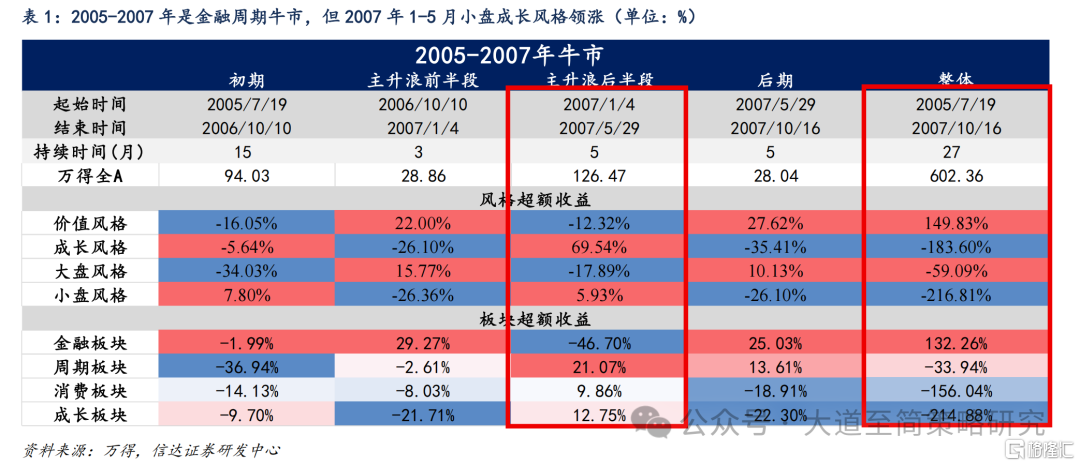
Core Insights - The article discusses the tendency for non-mainstream sectors to lead in bull markets, particularly during the latter stages of market uptrends, influenced by capital inflows and valuation considerations [1][13]. Group 1: Historical Context - In the 2005-2007 financial cycle bull market, small-cap growth stocks outperformed in the latter half of the bull market, with sectors like textiles, environmental protection, and pharmaceuticals leading the gains [2][3]. - The 2013-2015 TMT bull market saw a significant style shift in late 2014, where large-cap value stocks, particularly in non-bank financials, construction, and steel, outperformed while the TMT sector lagged [8][9]. Group 2: Market Dynamics - The shift in market style during bull markets often occurs when incremental capital flows accelerate, leading to a focus on undervalued sectors with high safety margins, rather than performance-driven sectors [1][13]. - Non-mainstream sectors may experience a temporary surge in performance due to factors such as low valuations and the presence of catalysts like mergers and acquisitions [3][13]. Group 3: Current Market Outlook - The current market is expected to continue its upward trend, driven by policy expectations and potential increases in retail investor participation, particularly in low-valuation sectors [15][18]. - Financial sectors, including banks and non-bank financials, are anticipated to benefit from style shifts and may see increased performance in the fourth quarter [17][18].

私募施展“平衡术”:仓位高企 频频调研
Shang Hai Zheng Quan Bao· 2025-10-19 12:31
Core Insights - Private equity funds are maintaining high positions despite market adjustments, with an average position of 78% as of the end of September, indicating a slight increase in the proportion of funds with high positions [1][2] - The market sentiment is expected to shift towards structural opportunities in A-shares and Hong Kong stocks, focusing on technology, innovative pharmaceuticals, and traditional sectors like cyclical and consumer industries [1][2] Positioning and Strategy - As of the end of September, 94.1% of subjective long-biased private equity funds had positions above 50%, with 24.7% fully invested or leveraging, reflecting a stable investment approach [2] - The intention to increase positions is high, with a plan index value of 111.76 for October, indicating that 2.4% of fund managers plan significant increases, while 26.3% intend to increase positions [3] Market Trends and Focus - The focus of private equity research has shifted from technology to sectors such as electronics, communications, new energy, and non-ferrous metals, suggesting a broader investment strategy for the fourth quarter [4][5] - The ongoing economic recovery and supportive policies are expected to enhance corporate profitability, leading to a new cycle of earnings growth that will drive market performance [3][5]
策略定期报告:轻伤不下线
Guotou Securities· 2025-10-19 11:33
Group 1 - The report indicates that the A-share market is currently experiencing a structural style shift, with a notable transition from growth to value styles, particularly in the context of the upcoming Fourth Plenary Session and the 14th Five-Year Plan [1][2][4] - The report emphasizes the importance of monitoring the outcomes of the Fourth Plenary Session and the 14th Five-Year Plan, as historical data suggests that such events can positively influence market sentiment and sector performance [2][39] - The analysis of the U.S.-China trade conflict suggests that recent developments, including Trump's comments on tariffs, have shifted market sentiment from panic selling to cautious optimism, indicating a potential for negotiation and stabilization [3][4][32] Group 2 - The report highlights that the upcoming APEC meeting at the end of October could serve as a critical turning point for U.S.-China relations, with expectations for a potential easing of trade tensions [4][30] - The report notes that the A-share market is likely to see significant movements in response to the outcomes of the Fourth Plenary Session and the 14th Five-Year Plan, with a focus on sectors such as technology, new energy, and defense [39][44] - The report identifies that the current market environment is characterized by a high degree of differentiation within the technology sector, with certain sub-sectors experiencing significant capital inflows while others lag behind [69][71]


策略周报:牛市中非主线行业何时领涨?-20251019
Xinda Securities· 2025-10-19 08:32
Core Conclusions - In a bull market, the style is relatively stable in the early and late stages, but it tends to fluctuate in the mid-stage. Non-mainstream sectors may lead in the later stages of the bull market, influenced significantly by capital flow rather than performance realization, typically lasting 1-2 quarters [2][10][28] Historical Cases - During the 2005-2007 financial cycle bull market, from January to May 2007, small-cap growth stocks surged, with non-mainstream sectors like textiles, environmental protection, and pharmaceuticals leading the gains. This was attributed to accelerated capital inflow and a shift in market focus towards previously underperforming sectors [3][11][14] - In the 2013-2015 TMT bull market, the fourth quarter of 2014 saw large-cap value stocks outperform, with non-bank financials, construction, banking, and steel sectors leading. This shift was driven by significant inflows of retail capital and a change in focus from performance to valuation [19][21][27] Market Dynamics - Non-mainstream sectors tend to lead in the later stages of a bull market due to increased capital inflow, as mainstream sectors often reach high valuation levels, leading investors to seek undervalued sectors with high safety margins [3][28] - The performance of non-mainstream sectors may be supported by earnings growth, as seen in the textiles sector in early 2007, but there can also be instances where performance realization remains weak despite leading gains, such as in the construction and steel sectors in late 2014 [30][28] Current Market Outlook - The report suggests that the current market may be entering a main upward trend, with potential for style switching towards low-value sectors, particularly in banking and non-bank financials, as well as in low-valued electric equipment and cyclical stocks [37][38] - The financial sector is highlighted as having low overall valuations, with potential for rebound due to style switching and regulatory support for long-term capital inflows [39]

资金情绪持续谨慎市场出现风格切换迹象
Zhong Guo Zheng Quan Bao· 2025-10-17 20:19
Market Overview - On October 17, the A-share market experienced a broad decline, with major indices such as the Shanghai Composite Index, Shenzhen Component Index, and ChiNext Index falling by 1.95%, 3.04%, and 3.36% respectively [2][4] - The total market turnover was 1.95 trillion yuan, marking a slight increase of 57 billion yuan from the previous trading day, but it has been below 2 trillion yuan for two consecutive days [2][4] - A total of 602 stocks rose, while 4,783 stocks fell, indicating a significant market downturn [2] Sector Performance - The sectors leading the decline included power equipment, electronics, and machinery, with respective drops of 4.99%, 4.17%, and 3.69% [3][5] - Defensive sectors such as banking, coal, and public utilities showed relative strength, with the banking sector seeing stocks like Xiamen Bank and Qingdao Bank rising over 2% [3][5] - The technology growth sector faced significant selling pressure, with notable declines in electronic, media, and automotive industries, which fell by 7.14%, 6.27%, and 5.99% respectively [5] Capital Flow - The market has shown signs of style rotation, with dividend-paying sectors gaining strength while technology growth stocks have been under pressure [5][8] - Main capital outflows were observed, with over 790 billion yuan leaving the market on October 17 alone, and a total of 5 consecutive days of net outflows [5][7] - The A-share market's total market capitalization decreased by 2.56 trillion yuan to 113.02 trillion yuan as of October 17 [7] Market Sentiment and Future Outlook - Analysts attribute the market's adjustment to a combination of external shocks, internal concerns, and technical factors, with global market conditions, particularly in the U.S., impacting investor sentiment [4][8] - Despite short-term volatility, the core drivers of the market remain unchanged, with expectations of continued favorable liquidity trends [8] - The upcoming disclosure of Q3 earnings reports is anticipated to create opportunities for valuation adjustments and structural rebalancing in the market [8]




中证A500ETF大跌2.32%,科创板100ETF大跌3.87%点评
Sou Hu Cai Jing· 2025-10-17 10:48
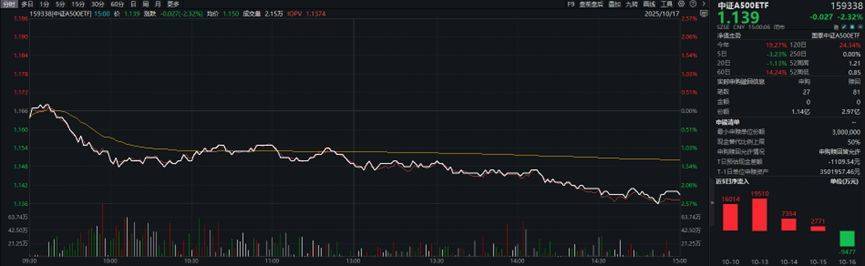
Core Viewpoint - The A-share market experienced a collective decline, with major indices falling significantly, indicating a cautious market sentiment ahead of important events [1][3]. Market Performance - As of the close on October 17, the Shanghai Composite Index fell by 1.95%, the Shenzhen Component Index by 3.04%, and the ChiNext Index by 3.36%. The total market turnover reached 1.95 trillion yuan, an increase of 5.7 billion yuan compared to the previous trading day [1]. Reasons for Decline - The market's decline is attributed to several factors, including profit-taking ahead of significant events and a shift in market style from growth to value. Investors are cautious as key meetings and policy announcements approach, leading to short-term selling pressure [3]. - Historical patterns suggest that investors often choose to realize profits and reduce positions before major events, which can trigger temporary market adjustments [3]. - Since October, there has been a noticeable shift from growth stocks to value stocks, with the relative advantage of growth styles diminishing. The transition from small-cap growth sectors to large-cap value sectors is becoming more pronounced [3]. Market Outlook - The current market adjustment reflects a combination of risk aversion and structural switching pressures, without indicating a trend reversal. Attention should remain on the latest policy statements and the progress of style switching [5]. - The trend of structural switching is expected to continue, with limited downside potential for the market. The strong performance of the yuan this year has positively influenced market risk appetite [6][7]. - The upcoming important meetings and the Federal Reserve's recent shift to a rate-cutting cycle may lead to further foreign capital inflows into the A-share market, potentially boosting market sentiment [8]. Investment Focus - Given the ongoing style switch, investors are encouraged to focus on balanced large-cap indices and dividend products, such as the China Securities A500 ETF and the Shanghai Composite Index ETF, as well as dividend-focused ETFs [10].
刚刚!股市全线走弱,发生了什么?
券商中国· 2025-10-17 03:53
Market Overview - The market is entering a risk-averse mode, with major Asia-Pacific stock markets experiencing significant declines, particularly in Japan and Australia, which both fell nearly 1% [1] - The Hong Kong market saw even larger drops, with the Hang Seng Technology Index down over 2%, while the A-share market also faced widespread declines, with the Shanghai Composite Index down 1% and the ChiNext Index down 2.46% [1][2] Sector Performance - In the Hong Kong market, semiconductor stocks were notably weak, with ZTE Corporation dropping over 7% and Horizon Robotics down 5%. Other significant declines included SMIC and ASMPT [2] - The A-share market also showed collective weakness, with nearly 4,100 stocks declining, particularly in sectors like electric grid equipment, semiconductor chips, and renewable energy [2] Regional Stock Movements - Despite the overall market weakness, certain regional stocks showed strength, such as the Fujian Haixi sector, which saw significant gains, including a 20% increase in Haixia Innovation [3] - The Hainan sector also performed well, with stocks like Hainan Airport showing positive movement [3] Market Variables - Two major variables affecting the market include the unstable trade environment leading to valuation corrections in high-valued stocks and the increasing fragility of the U.S. financial system, which is impacting global capital market expectations [4] - Recent performance of dividend assets, such as Agricultural Bank of China reaching new highs, indicates a shift in market sentiment, with funds favoring these assets over previously strong growth indices [4] U.S. Banking Sector Concerns - Recent significant declines in U.S. regional banks, such as Zions Bancorp and Western Alliance Bancorp, have raised concerns about the credit market, with Zions reporting a $50 million loan write-off related to fraudulent activities [5] - The KBW Bank Index experienced its largest drop in six months, reflecting growing credit concerns following recent bankruptcies in related sectors [5]