关税政策

Search documents
IMF与美国财政部意见相反,特朗普关税真能扭转美国赤字危局?
Di Yi Cai Jing· 2025-10-23 10:01
Core Insights - The U.S. public debt is projected to rise from 122% of GDP in 2024 to 143% by 2030 under current fiscal policies [1] - The U.S. Treasury and the IMF have differing views on the outlook for the U.S. fiscal deficit [1][4] - The U.S. budget deficit for FY 2025 is estimated at approximately $1.8 trillion, a decrease of about $41 billion from the previous fiscal year [1][3] Fiscal Trends - The U.S. Treasury reports a significant slowdown in government spending, with a year-over-year increase of only 0.2% in Q2 and a decrease of 2.5% in Q3 [3] - Cumulative deficit from April to September was $468 billion, the lowest level since 2019, down nearly 40% from the same period last year [3][4] - The Treasury attributes the improvement in fiscal conditions to increased tariff revenues and a slowdown in spending growth [1][3] Revenue Projections - Trump's tariff policy is expected to generate $300 billion in revenue this year, potentially rising to $400 billion next year [4] - The CBO predicts that the "Big and Beautiful Act" will increase the deficit by $4.1 trillion, countering the optimistic revenue forecasts [4] - The IMF warns that despite potential revenue from tariffs, the fiscal deficit is expected to widen further due to stimulative policies [4] Debt and Interest Payments - U.S. national debt has surpassed $38 trillion, increasing by $1 trillion in just over two months [5] - Interest payments on U.S. debt have reached approximately $1 trillion annually, becoming the fastest-growing item in the federal budget [5] - Over the past decade, total interest payments have amounted to $4 trillion, projected to balloon to $14 trillion over the next decade [5] Government Shutdown Impact - The ongoing government shutdown exacerbates fiscal challenges, with past shutdowns leading to significant increases in federal spending [6] - The Treasury warns that the U.S. is on an "unsustainable fiscal path," with current policies deemed unsustainable [6] - Compared to previous economic crises, the pace of deficit reduction is significantly lagging [6]

集运日报:挺价情绪强,乐观情绪持续,盘面持续小幅上行,不建议加仓,设置好止损。-20251023
Xin Shi Ji Qi Huo· 2025-10-23 06:21
1. Report Industry Investment Rating - Not provided in the given content 2. Core Viewpoints of the Report - The sentiment of price support is strong, and the optimistic sentiment persists. The market continues to rise slightly. It is not recommended to increase positions, and stop - loss should be set [2]. - The tariff issue has shown a marginal effect, and the current core is the trend of spot freight rates. The main contract may be in the process of bottom - building. It is recommended to participate with a light position or wait and see [3]. - The short - term strategy suggests that risk - preferring investors try to build positions below 1500 for the EC2512 contract, pay attention to the subsequent market trend, not hold losing positions, and set stop - loss [3]. - For the arbitrage strategy, in the context of international situation turmoil, each contract still follows the seasonal logic with large fluctuations. It is recommended to wait and see temporarily or try with a light position [3]. - For the long - term strategy, it is recommended to take profit when the contracts rise, wait for the callback to stabilize, and then judge the subsequent direction [3]. 3. Summary by Related Content SCFIS and NCFI Freight Rate Index - On October 20, the Ningbo Export Container Freight Index (NCFI, comprehensive index) was 956.45 points, up 16.79% from the previous period; the Shanghai Export Container Settlement Freight Index (SCFIS, European route) was 1140.38 points, up 10.5%; the NCFI (European route) was 803.21 points, up 14.96%; the SCFIS (US West route) was 863.46 points, up 0.1%; the NCFI (US West route) was 1254.46 points, up 48.56% [4]. - On October 17, the Shanghai Export Container Freight Index (SCFI) was 1310.32 points, up 149.90 points from the previous period; the China Export Container Freight Index (CCFI, comprehensive index) was 973.11 points, down 4.1%; the SCFI European route price was 1145 USD/TEU, up 7.2%; the CCFI (European route) was 1267.91 points, down 1.5%; the SCFI US West route was 1936 USD/FEU, up 31.9%; the CCFI (US West route) was 725.47 points, down 6.7% [4]. Economic Data - The eurozone's September manufacturing PMI preliminary value was 49.5, back below the boom - bust line, lower than analysts' expectations and the previous value of 50.7. The service PMI preliminary value rose from 50.5 to 51.4, exceeding the expected 50.5. The eurozone's September composite PMI preliminary value was 51.2, exceeding analysts' expectations. The eurozone's September Sentix investor confidence index was - 9.2, with an expected - 2 and a previous value of - 3.7 [4]. - In August, China's manufacturing PMI was 49.4%, up 0.1 percentage points from the previous month, and the manufacturing prosperity level improved. The composite PMI output index was 50.5%, up 0.3 percentage points from the previous month, remaining above the critical point, indicating that the overall expansion of Chinese enterprises' production and business activities accelerated [4]. - The preliminary value of the US September S&P Global manufacturing PMI was 52 (the final value in August was 53); the service PMI preliminary value was 53.9 (the final value in August was 54.5); the composite PMI preliminary value was 53.6 (the final value in August was 54.6) [4]. Contract Information - On October 22, the main contract 2512 closed at 1788.3, up 2.25%, with a trading volume of 28,600 lots and an open interest of 29,000 lots, an increase of 574 lots from the previous day [4]. - The daily limit for contracts 2508 - 2606 was adjusted to 18% [4]. - The company's margin for contracts 2508 - 2606 was adjusted to 28% [4]. - The daily opening limit for all contracts 2508 - 2606 was 100 lots [4]. Geopolitical Events - On the evening of October 21, Iraqi Prime Minister Sudani had a phone call with US Secretary of State Rubio, discussing issues such as Iraq - US relations, security and military cooperation, and the upcoming November national parliamentary elections in Iraq [4]. - On October 21, Turkish Foreign Minister Fidan and National Intelligence Agency Director Kallen met with the chairman of the negotiation committee of the Islamic Resistance Movement (Hamas) and members of the organization's Politburo in Doha, Qatar, exchanging views on the current situation in Gaza and the implementation of the first - stage cease - fire agreement on the ground [4].
美国汽车创新联盟敦促特朗普政府放弃机器人关税,警告将推高新车价格
Zhi Tong Cai Jing· 2025-10-23 05:48
Core Viewpoint - The Alliance for Automotive Innovation urges the Trump administration not to impose new tariffs on factory robots and machinery, warning that such tariffs could increase production costs and lead to vehicle shortages, further driving up new car prices, which are already at historical highs [1] Group 1: Industry Concerns - The Alliance represents nearly all major automakers, including General Motors, Toyota, Volkswagen, and Hyundai, and submitted comments following a national security investigation initiated by the U.S. Department of Commerce [1] - The organization highlighted that approximately 40% of all new robots and industrial machinery installed in the U.S. in 2024 will be used in automotive production facilities [1] - Automakers request that any tariffs imposed should exempt robots and equipment actually used in U.S. production [1] Group 2: Additional Industry Voices - Tesla, not a member of the Alliance, also called on the Trump administration to avoid imposing tariffs, stating that such tariffs could weaken investment and slow down the construction of new factories or upgrades to existing ones [2] - Various foreign governments, including China, Canada, Japan, Switzerland, and the EU, have submitted opinions opposing the proposed tariffs [4] Group 3: Broader Economic Implications - The American Retail Federation warned that tariffs and potential equipment shortages could raise business costs and consumer prices, noting that its members widely use robotic technology in stores, warehouses, and distribution centers [5] - The U.S. Chamber of Commerce indicated that some critical machinery is only produced abroad, including extreme ultraviolet lithography equipment used in semiconductor manufacturing, and that tariffs could undermine efforts to build domestic semiconductor manufacturing capabilities [5]


【百利好指数专题】内忧外患冲击 美股战战兢兢
Sou Hu Cai Jing· 2025-10-23 03:17
然而,10月10日盘中,特朗普在社交媒体平台发布对华强硬言论后,美股迅速转跌,市场预期急剧恶化。加征100%关税意味着 中美贸易可能再度陷入停滞,美国民众与企业将承受更重的税负。据估算,美国消费者最终将承担55%的关税成本,企业或将 承担约22%,这可能进一步推升通胀压力。今年以来,美国关税政策已带动核心个人消费支出上涨0.44%,预计至12月通胀率将 升至3%。 美联储可能加速降息 自美国政府停摆以来,美股三大股指的走势明显趋于谨慎,任何风吹草动都可能引发市场的剧烈波动。特别是在10月10日新一 轮关税政策公布后,美股遭遇"黑色星期五",道琼斯工业指数暴跌878.82点,跌幅达1.9%;纳斯达克指数重挫820.20点,跌幅高 达3.56%;标普500指数下跌182.60点,跌幅为2.71%。政府停摆加剧了市场的观望情绪,而关税升级则直接引发了恐慌。然而, 这些因素也可能促使美联储加快降息步伐,从而对美股形成长期支撑。当前的短期回调,或许将创造出极佳的买入机会。 停摆难阻股市,关税才是关键 从实际走势看,美国政府停摆并未对股市造成严重冲击。自10月1日以来,道琼斯指数最大涨幅超过2%,纳斯达克指数最大涨 幅超 ...

美联储“数据盲飞”纸黄金震荡
Jin Tou Wang· 2025-10-23 03:09
摘要今日周四(10月23日)亚盘时段,纸黄金目前交投于932元附近,截至发稿,纸黄金暂报935.14元/ 克,涨幅1.05%,最高触及942.43元/克,最低下探921.69元/克。目前来看,纸黄金短线偏向震荡走势。 今日周四(10月23日)亚盘时段,纸黄金目前交投于932元附近,截至发稿,纸黄金暂报935.14元/克, 涨幅1.05%,最高触及942.43元/克,最低下探921.69元/克。目前来看,纸黄金短线偏向震荡走势。 【要闻速递】 美联储本已在应对一场异常艰巨的战役:既要引导变幻莫测的经济穿越劳动力市场疲软与顽固通胀的双 重夹击,又要化解政府停摆给这场战役带来的额外压力。 短线展望:在美联储利率决议出炉前,预计市场将维持谨慎。纸黄金大概率将继续在917元/克至950元/ 克的区间内进行震荡整理。投资者应密切关注美国政界关于结束政府停摆的任何进展,一旦数据流恢 复,市场波动性将可能迅速放大。 为了决定利率政策和其他有助于经济复苏的决策,美联储十分依赖政府收集并发布的官方经济统计数 据。自10月初以来,政府停摆实际上切断该数据的访问——从失业率到零售额。 距离美联储下一次利率决议只剩一周时间,但8月以来 ...
《有色》日报-20251023
Guang Fa Qi Huo· 2025-10-23 01:08
1. Report Industry Investment Ratings No industry investment ratings are provided in the reports. 2. Core Views of the Reports Copper - Copper prices were volatile yesterday. High prices are suppressing demand, but terminal demand remains resilient. The supply shortage of copper ore supports the price bottom. It is expected that the domestic refined copper production in October may decline month - on - month. Attention should be paid to the marginal changes in demand and the Sino - US tariff negotiations. The main contract is expected to find support between 84,000 - 85,000 yuan/ton [1]. Aluminum - The alumina market is weak, with supply pressure and weak demand. It is expected that the spot price of alumina will continue to be under pressure in the short term, with the main contract oscillating between 2,750 - 2,950 yuan/ton. Aluminum prices were slightly stronger yesterday. The supply is stable, and the demand shows resilience in the peak season. It is expected that Shanghai aluminum will maintain a high - level oscillation in the short term, with the main contract in the range of 20,700 - 21,300 yuan/ton [3]. Aluminum Alloy - Casting aluminum alloy prices were slightly stronger, with cost support. The supply is restricted by raw materials and policies, and the demand is moderately recovering. The inventory has started to decline slowly. It is expected that the ADC12 price will maintain a slightly stronger oscillation in the short term, with the main contract in the range of 20,200 - 20,800 yuan/ton [5]. Zinc - Due to concerns about a short squeeze in the LME zinc market, the Shanghai zinc price rebounded after hitting the bottom. The supply is abundant, but the increase in domestic zinc smelters in the second half of the year may be limited. The macro - economic environment with high probability of interest rate cuts supports the zinc price. The demand is not exceeding expectations. It is expected that Shanghai zinc will maintain an oscillation in the short term, with the main contract in the range of 21,800 - 22,800 yuan/ton [9]. Tin - The supply of tin ore is tight, and the supply side is strong. The demand is weak, and the new demand cannot make up for the decline in traditional consumption. The tin price continues to oscillate at a high level. Attention should be paid to the macro - economic changes and the supply recovery in Myanmar in the fourth quarter [11]. Nickel - The Shanghai nickel market had a narrow - range oscillation. The macro - economic risk has increased, and the ore end has some positive factors. The refined nickel production remains high, and the inventory is accumulating. It is expected that the market will oscillate in the short term, with the main contract in the range of 120,000 - 126,000 yuan/ton [13]. Stainless Steel - The stainless - steel market had a narrow - range oscillation. The macro - economic environment has some positive factors, but the nickel - iron price is under pressure, and the demand in the peak season is not strongly boosted. It is expected that the market will oscillate weakly in the short term, with the main contract in the range of 12,400 - 12,800 yuan/ton [16]. Lithium Carbonate - The lithium carbonate futures market was strong. The supply - demand gap remains after entering the peak season. The downstream demand is optimistic. The inventory is declining. It is expected that the market will run strongly in the short term, with the main contract in the range of 76,000 - 80,000 yuan/ton [18][20]. 3. Summaries According to Relevant Catalogs Copper - **Price and Basis**: SMM 1 electrolytic copper was at 84,955 yuan/ton, down 0.90% from the previous day. The refined - scrap price difference decreased by 6.66% to 3,145 yuan/ton [1]. - **Monthly Spread**: The 2511 - 2512 spread was - 40 yuan/ton, down 20 yuan/ton from the previous day [1]. - **Fundamental Data**: In September, the electrolytic copper production was 112.10 million tons, down 4.31% month - on - month; the import volume was 33.43 million tons, up 26.50% month - on - month [1]. Aluminum - **Price and Spread**: SMM A00 aluminum was at 20,980 yuan/ton, up 0.05% from the previous day. The average price of alumina in Shandong was 2,820 yuan/ton, down 0.35% [3]. - **Monthly Spread**: The 2511 - 2512 spread was - 5 yuan/ton, up 5 yuan/ton from the previous day [3]. - **Fundamental Data**: In September, the alumina production was 760.37 million tons, down 1.74% month - on - month; the electrolytic aluminum production was 361.48 million tons, down 3.16% month - on - month [3]. Aluminum Alloy - **Price and Spread**: SMM aluminum alloy ADC12 was at 21,100 yuan/ton, unchanged from the previous day. The refined - scrap price difference in Foshan for broken primary aluminum increased by 1.12% to 1,809 yuan/ton [5]. - **Monthly Spread**: The 2511 - 2512 spread was - 90 yuan/ton, unchanged from the previous day [5]. - **Fundamental Data**: In September, the regenerated aluminum alloy ingot production was 66.10 million tons, up 7.48% month - on - month; the primary aluminum alloy ingot production was 28.30 million tons, up 4.43% month - on - month [5]. Zinc - **Price and Basis**: SMM 0 zinc ingot was at 21,900 yuan/ton, down 0.18% from the previous day. The import loss was - 6,123 yuan/ton, down 760.42 yuan/ton from the previous day [9]. - **Monthly Spread**: The 2511 - 2512 spread was - 15 yuan/ton, down 10 yuan/ton from the previous day [9]. - **Fundamental Data**: In September, the refined zinc production was 60.01 million tons, down 4.17% month - on - month; the import volume was 2.27 million tons, down 11.61% month - on - month [9]. Tin - **Spot Price and Basis**: SMM 1 tin was at 281,000 yuan/ton, down 0.11% from the previous day. The LME 0 - 3 spread was - 56.00 US dollars/ton, up 50.00% from the previous day [11]. - **Monthly Spread**: The 2511 - 2512 spread was - 370 yuan/ton, up 11.90% from the previous day [11]. - **Fundamental Data**: In September, the tin ore import was 8,714 tons, down 15.13% month - on - month; the SMM refined tin production was 10,510 tons, down 31.71% month - on - month [11]. Nickel - **Price and Basis**: SMM 1 electrolytic nickel was at 122,100 yuan/ton, down 0.33% from the previous day. The 1 Jinchuan nickel premium was 2,500 yuan/ton, up 2.04% from the previous day [13]. - **Monthly Spread**: The 2512 - 2601 spread was - 180 yuan/ton, down 30 yuan/ton from the previous day [13]. - **Supply - Demand and Inventory**: In September, the Chinese refined nickel production was 32,200 tons, up 1.26% month - on - month; the import volume was 17,010 tons, down 3.00% month - on - month [13]. Stainless Steel - **Price and Basis**: SMM 304/2B (Wuxi Hongwang 2.0 coil) was at 13,000 yuan/ton, unchanged from the previous day. The Philippine laterite nickel ore 1.5% (CIF) average price was 58 US dollars/wet ton, up 1.75% from the previous day [16]. - **Monthly Spread**: The 2512 - 2601 spread was - 30 yuan/ton, up 45 yuan/ton from the previous day [16]. - **Fundamental Data**: In September, the Chinese 300 - series stainless - steel crude steel production was 182.17 million tons, up 0.38% month - on - month; the import volume was 12.03 million tons, up 2.70% month - on - month [16]. Lithium Carbonate - **Price and Basis**: SMM battery - grade lithium carbonate average price was 74,350 yuan/ton, up 0.34% from the previous day. The lithium spodumene concentrate CIF average price was 857 US dollars/ton, up 0.35% from the previous day [18]. - **Monthly Spread**: The 2511 - 2512 spread was - 340 yuan/ton, down 160 yuan/ton from the previous day [18]. - **Fundamental Data**: In September, the lithium carbonate production was 87,260 tons, up 2.37% month - on - month; the demand was 116,801 tons, up 12.28% month - on - month [18].
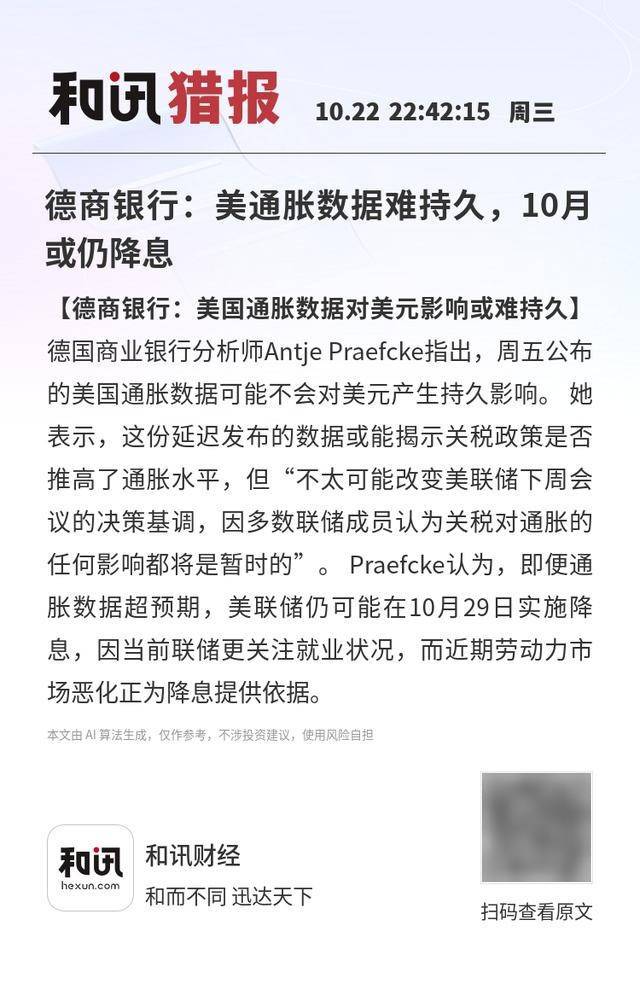
德商银行:美通胀数据难持久,10月或仍降息
Sou Hu Cai Jing· 2025-10-22 15:43
Core Viewpoint - The recent US inflation data is unlikely to have a lasting impact on the US dollar, according to Deutsche Bank analyst Antje Praefcke [1][2]. Summary by Relevant Sections - **Inflation Data Impact** The delayed release of US inflation data may reveal whether tariff policies have increased inflation levels, but it is "unlikely to change the decision-making tone" of the Federal Reserve's upcoming meeting, as most Fed members believe any impact from tariffs on inflation will be temporary [1][2]. - **Federal Reserve's Interest Rate Decision** Even if the inflation data exceeds expectations, the Federal Reserve may still implement a rate cut on October 29, as the current focus is on employment conditions, with recent deterioration in the labor market providing justification for a rate cut [1][2].

关税政策致美失去德最大贸易伙伴地位
Xin Hua She· 2025-10-22 15:20
Core Insights - The United States has lost its position as Germany's largest trading partner, with China taking the lead as of the first eight months of 2025 [1] Trade Data Summary - Germany's exports to the U.S. for the first eight months of this year amounted to €101 billion, reflecting a year-on-year decline of 6.5% [1] - In August alone, exports to the U.S. were €10.9 billion, showing a month-on-month decrease of 2.5% and a year-on-year drop of 20.1%, marking the lowest level since November 2021 [1] - Germany's imports from the U.S. during the same period totaled €63.4 billion [1] Trade with China - In the first eight months of 2025, Germany's exports to China reached €55 billion [1] - Imports from China increased by 9%, totaling €111.3 billion, solidifying China's position as Germany's largest source of imports [1] Market Dynamics - Dirk Jandura, President of the German Wholesale and Foreign Trade Association, indicated that U.S. tariff policies are a significant factor contributing to the decline in German exports to the U.S. [1] - There has been a noticeable decrease in demand in the U.S. market for traditional German export goods such as automobiles, machinery, and chemical products [1]
【财经分析】从“影响有限”到“阴云密布”:美关税放大土耳其汽车产业焦虑
Xin Hua Cai Jing· 2025-10-22 13:44
Core Viewpoint - The U.S. tariff policy has limited short-term impact on Turkey's automotive industry but has heightened potential risks and industry anxiety, leading to increased supply chain costs and inflationary pressures that could weaken export competitiveness and elevate long-term risks [1][4]. Group 1: Current Industry Situation - The automotive sector is Turkey's largest export industry, with exports growing by 6.3% year-on-year to $37.2 billion last year [2]. - The U.S. maintains a 25% special tariff on Turkish automobiles and parts, creating uncertainty that amplifies anxiety across the supply chain [2][4]. - Rising costs are eroding profits, with suppliers facing direct pressure on margins due to increased global costs driven by U.S. tariffs [2]. Group 2: Impact on Exports and Contracts - The rising costs may lead to renegotiation of contracts with European buyers, as the EU is Turkey's largest automotive market [3]. - Exporters may need to manage cash flow more flexibly due to potential adjustments in delivery terms stemming from increased global costs [3]. - Some overseas importers are shifting towards alternative markets like Mexico and Eastern Europe to avoid tariff costs, which could lead to some Turkish suppliers exiting the global value chain [3]. Group 3: Long-term Industry Challenges - The uncertainty from U.S. tariffs is casting a shadow over global trade, potentially leading to order fluctuations and production disruptions [4]. - Input inflation from rising prices of imported components and raw materials is expected to erode consumer purchasing power, contributing to a downward trend in the automotive market [4][5]. - The automotive industry faces dual challenges from EU regulatory changes and U.S. tariffs, with a projected 10% decline in exports this year [6]. - The industry is at a critical turning point, where failure to adapt to opportunities in new energy and smart technology could lead to a rapid loss of existing competitive advantages [6].
美国硬抗关税也得买,“每天从中国进口额仍有10亿美元”
Guan Cha Zhe Wang· 2025-10-22 09:39
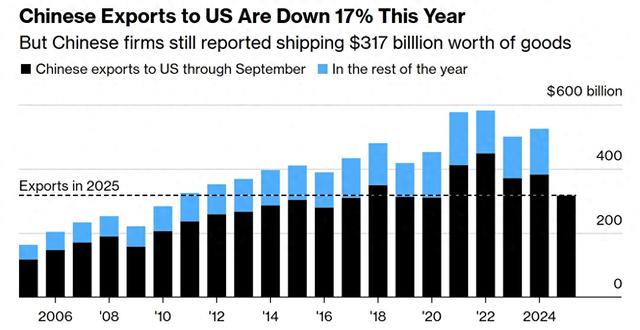
Core Insights - The article highlights the resilience of Chinese exports despite ongoing trade tensions with the U.S., suggesting that many Chinese products remain indispensable to the U.S. market, thereby enhancing China's bargaining power in upcoming trade negotiations [1][4]. Trade Performance - Chinese exports to the U.S. reached over $100 billion in Q3 2023, contributing to a trade surplus of nearly $67 billion, despite an overall decline in trade volume [1][4]. - In September, China's exports grew by 8.3% year-on-year, surpassing economists' expectations, indicating a robust export performance [9][11]. Product-Specific Insights - Certain products, such as electric bicycles and refined copper, saw significant export growth, with electric bicycle exports valued at over $500 million and refined copper exports rising to $270 million [4][5]. - The export of smartphones, laptops, and computer components to the U.S. amounted to nearly $8 billion, despite being less than half of the previous year's figures [5]. Market Dynamics - The article notes that the U.S. tariffs have had limited impact on the import of certain Chinese goods due to their critical role in global supply chains, particularly in sectors like rare earths and electronics [1][4]. - Analysts suggest that the restructuring of supply chains to replace Chinese goods would take time, indicating a continued reliance on Chinese products [1][8]. Future Outlook - There is speculation that the U.S. and China may seek to ease trade tensions in the coming weeks, with both sides potentially making concessions [11]. - The Chinese government emphasizes the need for continued efforts to stabilize foreign trade amid a complex external environment [11].