反内卷

Search documents
ETF日报|日美“靴子”落地,A+H集体上涨!超13亿资金埋伏就绪,港股互联网ETF(513770)后市反弹可期?
Jin Rong Jie· 2025-12-22 09:46
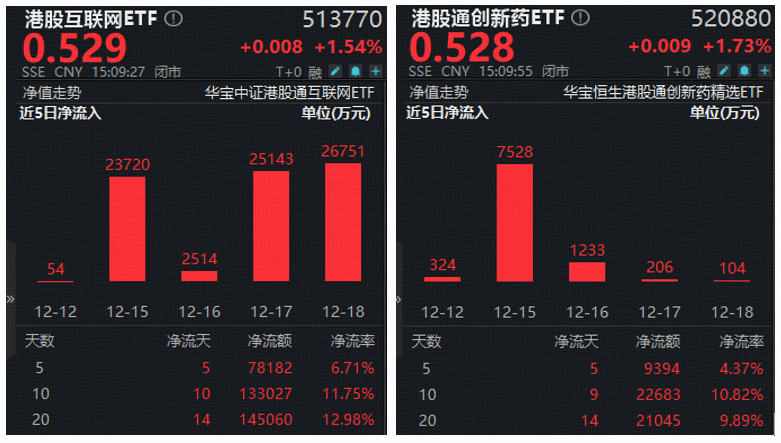
Market Overview - A-shares experienced a collective rise with nearly 4,500 stocks closing in the green, and the trading volume reached 1.73 trillion yuan, an increase of 704 billion yuan from the previous day [1] - The Shanghai Composite Index has shown three consecutive days of gains, recovering the 10-day and 20-day moving averages, with a key resistance level at approximately 3,912 points [1] - Analysts noted that the recent U.S. employment and CPI data, along with Japan's interest rate hike, have reduced external uncertainties for A-shares, shifting market focus to internal factors [1] Sector Performance - The "anti-involution" theme continues to perform well, with the Chemical ETF (516020) and the Precious Metals ETF (159876) seeing price increases of 1.75% and 1.64% respectively [1] - The Chemical ETF attracted 228 million yuan in a single day, indicating strong investor confidence in the chemical sector's future performance [1] Hong Kong Market Insights - The Hong Kong market is expected to rebound as the U.S. CPI data boosts market confidence and expectations for a Fed rate cut in January increase [1] - The Hong Kong Internet ETF (513770) has seen a net inflow of 1.33 billion yuan over the past ten days, while the Hong Kong Innovation Drug ETF (520880) has experienced nine consecutive days of net subscriptions, reaching a record high of 4.178 billion shares [1] Chemical Industry Outlook - China’s chemical industry is anticipated to see a bottoming out and gradual recovery, with improvements in supply-demand dynamics expected by 2025 [6] - The current valuation of the chemical sector is at a historical low, with the Chemical ETF (516020) trading at a price-to-book ratio of 2.4, indicating strong long-term investment potential [6][8] AI and Technology Sector Developments - The Hong Kong AI sector is experiencing a rebound, with major companies like Tencent and Meituan making significant advancements in AI technology [11] - The AI application market is expected to thrive, with the launch of new models and applications driving demand, particularly in the light of increasing AI-related hardware needs [15][16] Investment Strategies - Analysts recommend focusing on the "technology + cyclical" dual-driven strategy, highlighting opportunities in sectors such as defense, AI applications, and renewable energy [3] - The Chemical ETF (516020) is suggested as an efficient vehicle for gaining exposure to the chemical sector, given its diversified holdings in leading companies [8][9]





“1+N+AI”多层次科技战略深入推进 韵达股份11月快递服务业务收入达46.98亿元
Quan Jing Wang· 2025-12-22 09:34
Core Viewpoint - Yunda Co., Ltd. reported a revenue of 4.698 billion yuan from its express delivery services in November 2025, marking a year-on-year increase of 2.17% with a total business volume of 2.175 billion parcels and an average revenue per parcel of 2.16 yuan, up 6.40% [1] Group 1: Company Performance - Yunda's express delivery service revenue reached 4.698 billion yuan in November 2025, with a business volume of 2.175 billion parcels [1] - The average revenue per parcel increased to 2.16 yuan, reflecting a growth of 6.40% year-on-year [1] - The company aims to enhance its operational quality and service levels through a focus on high-quality development and technological innovation [1][2] Group 2: Industry Trends - The express delivery industry in China has seen its annual business volume exceed 180 billion parcels for the first time, setting a new record [1] - The "anti-involution" policy is expected to boost industry profitability and rationalize pricing, contributing to a potential increase in average parcel prices [4] - The ongoing digital transformation and the implementation of a multi-layered technology strategy ("1+N+AI") are enhancing operational efficiency and service quality across the industry [2][4] Group 3: Strategic Initiatives - Yunda has established a comprehensive service network covering all provinces and major cities in China, with 71 transit centers nationwide [2] - The company is advancing its "comprehensive digitalization" strategy, focusing on business digitization and the integration of AI technologies to improve operational efficiency [2] - Yunda is actively promoting the use of unmanned vehicles and drones in various regions to enhance service delivery [2] Group 4: Seasonal Performance - During the current peak season, Yunda is leveraging advanced logistics facilities and smart technology to enhance customer experience and ensure efficient operations [3] - The company is committed to providing high-quality services during the peak season, focusing on safety, efficiency, and customer satisfaction [3] - Yunda is utilizing big data and AI for real-time analysis and resource allocation to maintain smooth operations during the busy season [3]

【公募基金】外部担忧缓解,延续震荡格局——公募基金权益指数跟踪周报(2025.12.15-2025.12.19)
华宝财富魔方· 2025-12-22 09:04
Core Viewpoint - The article discusses the current state of the equity market, highlighting a mixed performance with a focus on domestic demand expansion and structural differentiation in market trends [2][11][13]. Group 1: Market Overview - The equity market experienced high volatility, with the Shanghai Composite Index rising by 0.03% and the CSI 300 Index falling by 0.28% during the week of December 15-19, 2025 [2][11]. - The average daily trading volume across the market was 17,465 billion, showing a decrease compared to the previous week [11]. - The financial and consumer sectors performed relatively well, while growth sectors lagged behind [11][13]. Group 2: Domestic Demand Expansion - A significant emphasis was placed on expanding domestic demand, as highlighted by President Xi Jinping's article in "Qiushi" magazine, which elevated the strategy to a national level [13]. - Continuous policy support is expected to stimulate consumption, optimize new policy implementations, and address unreasonable restrictions in the consumption sector [13]. - The potential introduction of national subsidy policies post-New Year is anticipated to further boost consumption [13]. Group 3: Hong Kong Market Dynamics - The Hang Seng Index fell by 1.10%, and the Hang Seng Tech Index dropped by 2.82%, with most sectors experiencing a pullback due to concerns over rising U.S. Treasury yields and potential interest rate hikes by the Bank of Japan [14]. - Short-term pressures on the Hong Kong market are expected to persist, but there remains a valuation advantage for Hong Kong stocks if short-term factors dissipate [14]. Group 4: Fund Performance Tracking - The Active Equity Fund Selection Index rose by 0.09% last week, achieving a cumulative excess return of 16.68% since inception [4]. - The Value Equity Fund Selection Index increased by 1.02%, with a cumulative excess return of 3.56% since inception [5]. - The Growth Equity Fund Selection Index fell by 1.02%, but has recorded a cumulative excess return of 13.05% since inception [6].

公募基金权益指数跟踪周报(2025.12.15-2025.12.19):外部担忧缓解,延续震荡格局-20251222
HWABAO SECURITIES· 2025-12-22 09:03
Report Summary 1. Report's Investment Rating for the Industry No information provided regarding the report's investment rating for the industry. 2. Core View of the Report - The market continued its high - level oscillation last week (2025.12.15 - 2025.12.19), with the Shanghai Composite Index rising 0.03% and the CSI 300 falling 0.28%. The value style outperformed the growth style. In the short term, the market is expected to continue its structurally differentiated market, and broad - based indices may maintain high - level oscillations. In the long term, industrial innovation changes and long - term capital inflows are still expected to support the market [3][12][13]. - Domestic policies are focused on boosting domestic demand and consumption. There may be continuous policies in the future to optimize the implementation of relevant policies, clear unreasonable restrictions in the consumption field, and release the potential of service consumption. Attention should also be paid to whether the expanded national subsidy policy will be introduced after New Year's Day to further boost consumption [5][13]. - The Hong Kong stock market was under pressure last week due to factors such as the rise of US bond yields and concerns about the reversal of yen carry - trades. In the short term, market risk appetite may be under pressure, but it still has certain valuation advantages if short - term suppressing factors are eliminated [5][14]. 3. Summary by Relevant Catalogs 3.1 Equity Market Review and Observation - **Market Performance**: The market continued high - level oscillation last week, with the Shanghai Composite Index up 0.03% and the CSI 300 down 0.28%. The value style was stronger than the growth style. The financial and consumption sectors performed relatively well, while the growth sector was weak. The average daily trading volume of the whole market was 17,465 billion yuan, a decrease from the previous week [12]. - **Overseas Market**: After the concern about the Bank of Japan's interest rate hike was alleviated and the US non - farm payrolls report and inflation data were weaker than expected, the risk appetite of the financial market was restored, and overseas technology assets rebounded from oversold conditions. However, there are still concerns about US re - inflation, and US bond yields remained strong [12]. - **Domestic Market**: Benefiting from the elevation of domestic demand expansion to a strategic level, various ministries and official media have continuously emphasized domestic demand expansion and consumption promotion. The market has switched to cyclical sectors dominated by service consumption. Since December, there have been many market hotspots but no clear main line [12][13]. - **Domestic Demand Policy**: The core of the policy is to adhere to the strategic base point of domestic demand expansion, promote the in - depth integration of people's livelihood improvement and consumption promotion, and stimulate market vitality. There may be continuous policies in the future, and attention should be paid to whether the national subsidy policy will be expanded after New Year's Day [13]. - **Hong Kong Stock Market**: The Hang Seng Index fell 1.10% and the Hang Seng Tech Index fell 2.82% last week. Most sectors pulled back. The rise of US bond yields and concerns about the reversal of yen carry - trades suppressed the liquidity of the Hong Kong stock market. In the short term, market risk appetite may be under pressure, but it has certain valuation advantages in the long run [14]. 3.2 Active Equity Fund Index Performance Tracking | Index Classification | Last Week (2025.12.15 - 2025.12.19) | Last Month (2025.11.19 - 2025.12.19) | Since the Beginning of This Year (2025.01.02 - 2025.12.19) | Since Inception | | ---- | ---- | ---- | ---- | ---- | | Strategy Theme: Active Stock Fund Preferred | 0.09% | 1.95% | 39.19% | 40.32% | | Investment Style: Value Stock Fund Preferred | 1.02% | 0.67% | 19.97% | 20.06% | | Investment Style: Balanced Stock Fund Preferred | - 0.11% | 0.32% | 30.61% | 27.74% | | Investment Style: Growth Stock Fund Preferred | - 1.02% | 1.61% | 52.89% | 39.15% | | Industry Theme: Pharmaceutical Stock Fund Preferred | - 2.04% | - 2.88% | 33.86% | 15.96% | | Industry Theme: Consumption Stock Fund Preferred | 0.03% | - 0.33% | 11.14% | 3.98% | | Industry Theme: Technology Stock Fund Preferred | - 1.45% | 1.21% | 45.92% | 48.21% | | Industry Theme: High - end Manufacturing Stock Fund Preferred | - 3.24% | - 2.33% | 30.77% | 24.46% | | Industry Theme: Cyclical Stock Fund Preferred | 1.68% | 2.82% | 29.40% | 20.26% | [15] - **Active Stock Fund Preferred**: Each period selects 15 funds with equal - weight allocation. The core positions select active equity funds based on performance competitiveness, style stability, etc., and balance the style distribution according to the CSI Active Stock Fund Index. The performance benchmark is the Active Stock Fund Index (930980.CSI) [16]. - **Value Stock Fund Preferred**: Selects 10 funds of deep - value, quality - value, and balanced - value styles. The performance benchmark is the CSI 800 Value Index (H30356.CSI) [18]. - **Balanced Stock Fund Preferred**: Selects 10 funds of relatively balanced and value - growth styles. The performance benchmark is the CSI 800 (000906.SH) [20]. - **Growth Stock Fund Preferred**: Selects 10 funds of active - growth, quality - growth, and balanced - growth styles. The performance benchmark is the 800 Growth Index (H30355.CSI) [22][23]. - **Pharmaceutical Stock Fund Preferred**: Selects 15 funds based on the intersection market value ratio of the fund's equity holdings and the constituent stocks of the representative index (CITIC Pharmaceutical). The performance benchmark is the pharmaceutical theme fund index (fitted by Huabao Fund Research and Investment Platform) [23][27]. - **Consumption Stock Fund Preferred**: Selects 10 funds based on the intersection market value ratio of the fund's equity holdings and the constituent stocks of the representative index (CITIC Automobile, Home Appliances, etc.). The performance benchmark is the consumption theme fund index (fitted by Huabao Fund Research and Investment Platform) [27]. - **Technology Stock Fund Preferred**: Selects 10 funds based on the intersection market value ratio of the fund's equity holdings and the constituent stocks of the representative index (CITIC Electronics, etc.). The performance benchmark is the technology theme fund index (fitted by Huabao Fund Research and Investment Platform) [32]. - **High - end Manufacturing Stock Fund Preferred**: Selects 10 funds based on the intersection market value ratio of the fund's equity holdings and the constituent stocks of the representative index (CITIC Construction, etc.). The performance benchmark is the high - end manufacturing theme fund index (fitted by Huabao Fund Research and Investment Platform) [34]. - **Cyclical Stock Fund Preferred**: Selects 5 funds based on the intersection market value ratio of the fund's equity holdings and the constituent stocks of the representative index (CITIC Petroleum and Petrochemical, etc.). The performance benchmark is the cyclical theme fund index (fitted by Huabao Fund Research and Investment Platform) [34][35].
资金持续加码创业板50ETF(159949),近5日净流入6.6亿元!机构:2026年聚焦AI与“反内卷”主线
Xin Lang Cai Jing· 2025-12-22 08:17
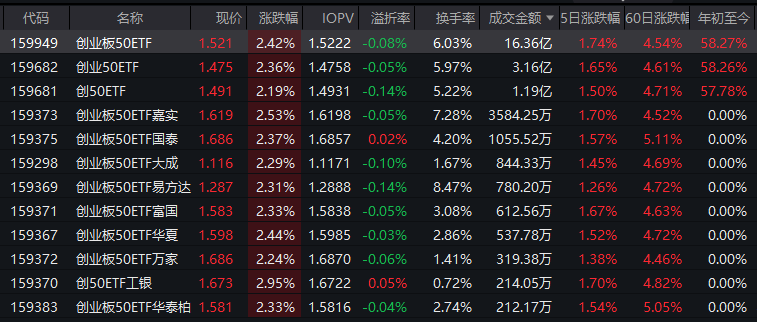
12月22日消息,A股市场高开高走,截至收盘,沪指上涨0.69%收复3900点关口,创业板指涨超2%。受此影 响,创业板50ETF(159949)涨2.42%报1.521元,换手率6.03%,成交额16.36亿元,居同类标的ETF首位。 | 代码 | 名标 | 现价 | 涨跌幅 IOPV 溢折率 | 换手率 | | 成交金额 ▼ 5日涨跌幅 60日涨跌幅 年初至今 | | | | --- | --- | --- | --- | --- | --- | --- | --- | --- | | 159949 | 创业板50ETF | 1.521 | 2.42% 1.5222 -0.08% | 6.03% | 16.36亿 | 1.74% | 4.54% 58.27% | | | 159682 | CON 50ETF | 1.475 | 2.36% 1.4758 -0.05% | 5.97% | 3.16亿 | 1.65% | 4.61% | 58.26% | | 159681 | @50ETF | 1.491 | 2.19% 1.4931 -0.14% | 5.22% | 1.19亿 | 1.50% | 4.71 ...

铜行业快评:铜精矿长单加工费基准降为零,促使冶炼行业“反内卷”
Guoxin Securities· 2025-12-22 07:53
证券研究报告 | 2025年12月22日 铜行业快评 铜精矿长单加工费基准降为零,促使冶炼行业"反内卷" | 行业研究·行业快评 | | | 有色金属 | 投资评级:优于大市(维持) | | --- | --- | --- | --- | --- | | 证券分析师: | 刘孟峦 | 010-88005312 | liumengluan@guosen.com.cn | 执证编码:S0980520040001 | | 证券分析师: | 焦方冉 | 021-60933177 | jiaofangran@guosen.com.cn | 执证编码:S0980522080003 | 事项: 12 月 19 日左右,智利矿业公司安托法加斯塔和国内某头部铜冶炼厂达成协议,将 2026 年铜精矿加工精炼 费用 Benchmark 分别定为 0 美元/吨和 0 美分/磅,低于 2025 年的 21.25 美元/吨和 2.125 美分/磅。 国信金属观点:长单加工费降为零,除了铜矿-铜冶炼供需错配,还因为副产品和回收率收益都处于历史 最好水平。中国铜冶炼厂工艺水平、成本控制全球领先,副产品消纳顺畅,在铜冶炼低迷期竞争 ...
【财经分析】2026年尿素市场展望:供需宽松格局难改 迎反转需借“反内卷”东风
Xin Hua Cai Jing· 2025-12-22 07:18
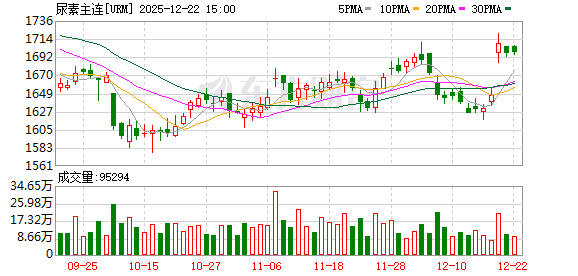
Core Viewpoint - The domestic urea market is experiencing a weak trend due to supply growth significantly outpacing demand growth, leading to low prices and high inventory levels [2][3][4]. Supply and Demand Dynamics - Urea prices in the domestic market are expected to decline in 2025, with a "V" shaped trend observed, peaking at 1931 CNY/ton in the first half and dropping to a five-year low of 1577 CNY/ton in the second half [3]. - The average price of domestic urea as of December 18 is 1712.58 CNY/ton, reflecting a year-on-year decrease of 5.88% [3]. - The supply growth rate is projected to exceed demand growth, with urea production capacity expected to reach 80.8 million tons in 2025, a 4.65% increase from 2024 [3][4]. Inventory Levels - Urea production companies' inventory levels have increased, with a total of 979,000 tons reported as of December 18, marking a 0.72% increase from the previous period [4]. - The average annual inventory level is expected to rise to 1.11 million tons, a 76% increase compared to 2024 [4]. Future Production and Consumption - Urea production is forecasted to reach approximately 71.71 million tons in 2025, a year-on-year increase of 10.88%, while consumption is expected to grow by 9.06% to 62.2 million tons [4][6]. - Agricultural consumption is anticipated to be the main driver for urea demand, supported by increased planting areas and agricultural projects [6]. Price Trends and Market Outlook - The urea market is expected to remain in a low-price range in early 2026, with prices projected to fluctuate around 1650 ± 200 CNY/ton [7]. - Initial price suppression is expected at the beginning of 2026, followed by a potential rebound due to downstream purchasing activities for spring farming [7]. Policy Impact and Export Dynamics - Recent policies aimed at stabilizing supply and prices have shown positive effects, with urea exports increasing significantly, reaching 4.62 million tons in the first 11 months of the year, a year-on-year increase of 1687.3% [8][9]. - The 2026 urea export quota is set at 3.3 million tons, but exports are crucial for alleviating domestic supply pressure, with estimates suggesting a potential increase to 5-6 million tons under conservative scenarios [9].
财信证券:2026年度宏观策略展望 破局谋新,迈向新平衡
Xin Lang Cai Jing· 2025-12-22 07:14
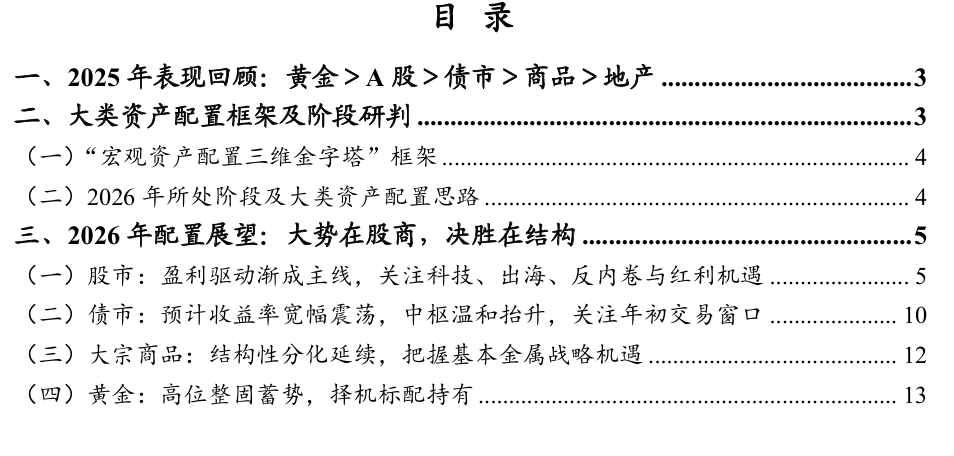
Group 1 - In 2025, major asset performance showed significant differentiation driven by three forces: financial cycle downturn, global order restructuring, and deepening industrial revolution. Gold prices surged over 60%, A-shares entered a structural bull market, while the bond market faced fluctuations and real estate prices continued to adjust [1][75]. Group 2 - The macro asset allocation framework for 2026 indicates a complex transition period. The strategic layer suggests maintaining a defensive stance due to the ongoing financial cycle downturn. The tactical layer anticipates a combination of economic recovery and financial easing, providing opportunities in commodities and equities [2][76]. Group 3 - The outlook for 2026 suggests that the stock market may experience a profit-driven rally supported by improved economic fundamentals and ample liquidity. Key focus areas include technology sectors like AI and semiconductors, high-quality export sectors, and renewable energy benefiting from anti-involution policies [3][77]. Group 4 - The bond market is expected to see a wide range of fluctuations with a moderate upward trend in yields, projected to be between 1.6% and 2.1%. The key factors influencing this include a rebound in PPI and alleviation of the "asset shortage" issue, with potential trading opportunities arising from small rate cuts early in the year [3][43][77]. Group 5 - In the commodities market, structural differentiation is expected to continue, with basic metals like copper and aluminum benefiting from global fiscal expansion and liquidity easing. Traditional energy sources like oil may perform relatively poorly due to the financial cycle downturn and supply pressures [3][59][77]. Group 6 - Gold is anticipated to enter a phase of high-level consolidation, with long-term support from weakened dollar credit and central bank gold purchases. However, short-term volatility may arise from price corrections and geopolitical factors [3][68][77].
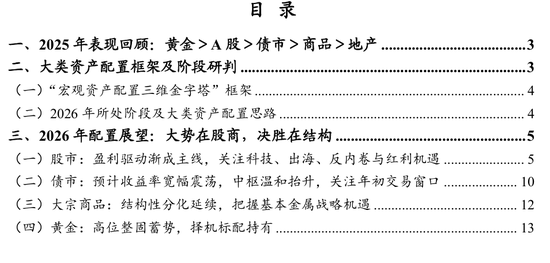
电力设备及新能源行业2026年策略:“反内卷”背景下景气度回升,关注各环节景气链出海机遇
Dongxing Securities· 2025-12-22 07:14
Group 1: Lithium Battery Industry - The lithium battery industry has emerged from a cyclical bottom, with demand maintaining unexpectedly high growth, leading to price stabilization and profit recovery in various segments [4][19] - In 2025, the domestic new energy vehicle sales are expected to reach 16.5 million units, a year-on-year increase of 28%, driven by policies and market demand [19][20] - The battery segment is anticipated to see price increases and a cyclical upturn in 2026, benefiting from unexpected growth in energy storage demand and new technologies [4][48] Group 2: Photovoltaic Industry - The photovoltaic industry is undergoing a "de-involution" process, optimizing the supply side and driving high demand for energy storage, with significant growth expected in 2026 [6][28] - The integration of energy storage and photovoltaic systems is expected to enhance the economic viability of storage solutions, leading to sustained high growth in the energy storage sector [6][36] - Key beneficiaries in the photovoltaic sector include leading companies in silicon materials and integrated component manufacturers, such as Tongwei Co., Ltd. [6][28] Group 3: Wind Power Industry - The domestic wind power installation is expected to remain high, with the "de-involution" orders stabilizing prices and improving overall industry profitability [7][8] - The global offshore wind power market is entering an expansion phase, driven by technological advancements and supportive policies, creating growth opportunities for domestic manufacturers [7][8] - Companies that have successfully entered overseas markets and secured significant orders are expected to see strong performance in the coming years [7][8] Group 4: Investment Strategies - Investment opportunities in the lithium battery sector should focus on companies with strong pricing power and profitability, such as Guoxuan High-Tech and other related beneficiaries [4][5] - In the photovoltaic sector, investment should target companies benefiting from the "de-involution" process and those involved in energy storage solutions, such as Sungrow Power Supply [6][28] - For the wind power industry, attention should be given to companies with established overseas operations and strong product profitability, particularly in offshore wind components [7][8]
宏观策略 | 破局谋新,迈向新平衡——2026年度宏观策略展望(策略篇)
Sou Hu Cai Jing· 2025-12-22 06:59
Group 1 - In 2025, major asset performance showed significant differentiation, with gold prices rising over 60%, A-shares experiencing a structural bull market, and the bond market entering a phase of volatility [1][6] - The driving forces behind these trends include a domestic financial cycle downturn, a restructuring of the global economic order, and a deepening industrial revolution led by AI [6][7] - The bond market faced challenges due to the "asset shortage" logic weakening and economic rebalancing policies entering a phase of turbulence [6][7] Group 2 - For 2026, the market is expected to be in a complex transitional phase, with a strategic focus on defensive positioning while tactically seeking structural opportunities in commodities and equities [2][10] - The stock market is anticipated to see a profit-driven rally supported by improved economic fundamentals, ample liquidity, and reasonable valuations, particularly in sectors like AI and semiconductors [3][15] - The bond market is projected to experience a wide fluctuation in yields, with the ten-year government bond yield expected to range between 1.6% and 2.1% [3][47] Group 3 - The commodity market is expected to continue structural differentiation, with basic metals like copper and aluminum benefiting from global fiscal expansion and industrial upgrade demands [3][63] - Gold is anticipated to undergo a phase of high-level consolidation, supported by weakened dollar credit and central bank purchases, while facing short-term volatility [3][74] - The investment logic for commodities is shifting from traditional economic cycles to a focus on strategic scarcity and essential resources, particularly in the context of global security and industrial needs [3][64][66]