外汇储备

Search documents
中国央行,连续第14个月增持黄金
Di Yi Cai Jing Zi Xun· 2026-01-07 08:28
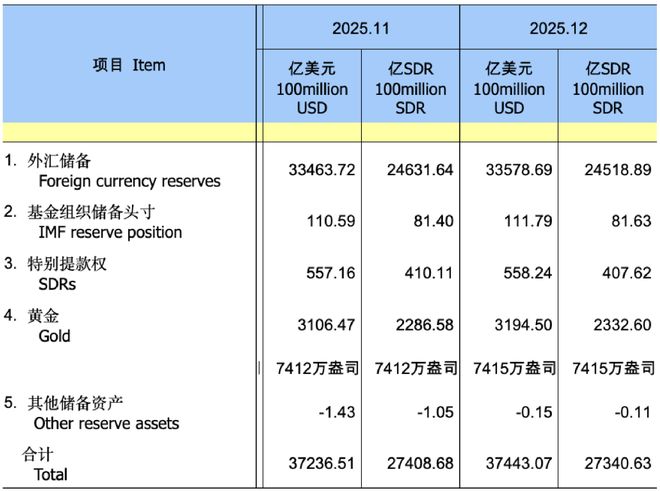
Core Insights - The People's Bank of China reported that as of the end of December, the country's gold reserves reached 74.15 million ounces, marking an increase of 30,000 ounces and representing the 14th consecutive month of gold accumulation [1]. Group 1: Gold Reserves - China's gold reserves stood at 74.15 million ounces at the end of December, reflecting a month-on-month increase of 30,000 ounces [1]. - This increase in gold reserves indicates a sustained strategy of accumulation by the People's Bank of China over the past 14 months [1]. Group 2: Foreign Currency Reserves - As of December, China's foreign currency reserves amounted to approximately 33,578.69 billion USD, showing a slight increase from 33,463.72 billion USD in November [2]. - The IMF reserve position rose from 110.59 billion USD in November to 111.79 billion USD in December [2]. - Special Drawing Rights (SDRs) increased marginally from 557.16 billion USD to 558.24 billion USD during the same period [2]. Group 3: Other Reserve Assets - Other reserve assets showed a minor improvement, with a change from -1.43 billion USD in November to -0.15 billion USD in December [2]. - The total reserves, including all categories, increased from 37,236.51 billion USD in November to 37,443.07 billion USD in December [2].

美元下跌 金属涨幅普遍回落 沪镍、双焦涨停 氧化铝涨近5%
Sou Hu Cai Jing· 2026-01-07 08:17
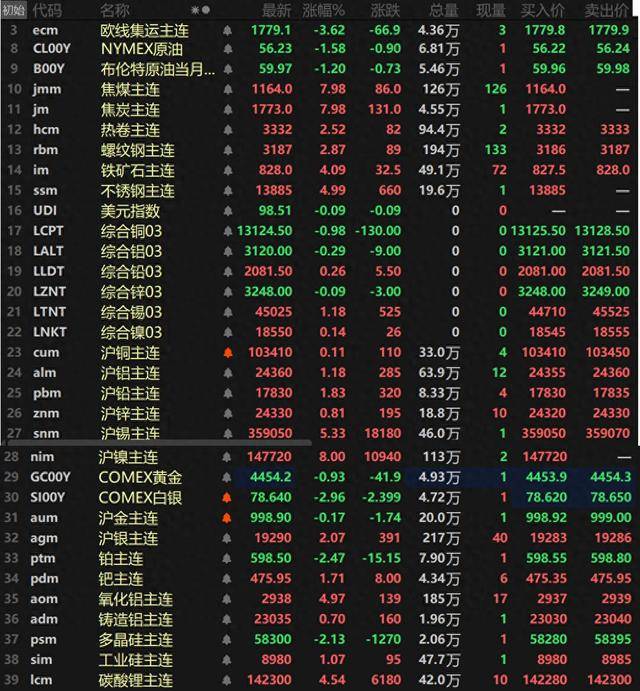
Metal Market - Domestic base metals collectively rose, with nickel closing at a limit-up of 8%, reaching 147,720 yuan/ton, the highest since June 2024 [1] - Tin increased by 5.33%, while aluminum and lead both rose over 1%, with aluminum up 1.18% and lead up 1.83% [1] - Alumina and casting aluminum also saw gains, with alumina rising by 4.97% and casting aluminum by 0.7% [1] - Lithium carbonate increased by 4.54%, and industrial silicon rose by 1.07%, while polysilicon fell by 2.13% [1] - In the black metal sector, stainless steel rose by 4.99%, iron ore by 4.09%, rebar by 2.87%, and hot-rolled coil by 2.52% [1] - Coking coal and coke both hit limit-up with a rise of 7.98%, priced at 1,164 yuan/ton and 1,773 yuan/ton respectively [1] - As of 15:07, foreign base metals showed mixed results, with London nickel's growth narrowing to 0.14% and copper down by 0.98% [1] - Precious metals saw COMEX gold down by 0.93% and silver down by 2.96%, while domestic gold fell by 0.17% and silver rose by 2.07% [1][2] Macro Environment - The central bank conducted a net withdrawal of 5,002 billion yuan through reverse repos, with a 7-day reverse repo operation of 286 billion yuan at a rate of 1.40% [5] - The US dollar index fell by 0.09% to 98.51, amid mixed signals from Federal Reserve officials regarding future monetary policy [6] - Upcoming economic data releases include China's foreign exchange reserves and gold reserves for December, as well as various US economic indicators [7] Oil Market - As of 15:07, both US and Brent crude oil prices fell, with US oil down by 1.58% and Brent by 1.2% [8] - Morgan Stanley analysts estimate a potential oversupply in the oil market of up to 3 million barrels per day in the first half of 2026 due to weak demand growth and increased supply from OPEC and non-OPEC countries [8] - API reported a decrease in US crude oil inventories by 2.77 million barrels, while gasoline and distillate inventories increased [8]
本周热点前瞻20260107
Qi Huo Ri Bao Wang· 2026-01-07 01:40
Group 1 - China's foreign exchange reserves and gold reserves data for December 2025 will be released on January 7 at 16:00 [1] - The Eurozone's preliminary CPI for December 2025 is expected to be 2.0%, slightly down from the previous value of 2.1% [1] - The Eurozone's core harmonized CPI for December 2025 is expected to remain stable at 2.4% [1] Group 2 - The ADP employment change for the US in December 2025 is anticipated to show an increase of 50,000 jobs, a recovery from the previous decrease of 32,000 jobs [2] - If the ADP employment figures exceed expectations, it may positively impact the prices of non-ferrous metals and crude oil [2] Group 3 - The Eurozone's unemployment rate for November 2025 is expected to remain unchanged at 6.4% [2] Group 4 - The US initial jobless claims for the week ending January 3, 2025, are projected to be 195,000, slightly down from 199,000 [3] - A lower than expected jobless claims figure may support non-ferrous metals and crude oil prices [3] Group 5 - China's CPI for December 2025 is expected to grow by 0.90%, up from the previous 0.70%, while the PPI is expected to decline by 2.05%, a slight improvement from the previous decline of 2.20% [4] - A higher CPI and a lower PPI could positively influence industrial product futures while potentially suppressing stock index and government bond futures [4] Group 6 - The US non-farm payroll report for December 2025 is expected to show a seasonally adjusted increase of 53,000 jobs, down from 64,000 [5] - The unemployment rate is projected to decrease to 4.5% from 4.6%, and average hourly earnings are expected to rise by 3.6% year-on-year [5] - A lower non-farm payroll figure could reduce expectations for a Federal Reserve rate cut in January 2026 [5] Group 7 - The preliminary consumer confidence index for January 2026 from the University of Michigan is expected to be 53.2, slightly up from 52.9 [5] - A higher consumer confidence index may support non-ferrous metals and crude oil prices while potentially suppressing precious metals prices [5]
中经资料:巴基斯坦证券市场一周回顾(2025.12.29-2026.01.02)
Zhong Guo Jing Ji Wang· 2026-01-05 07:31
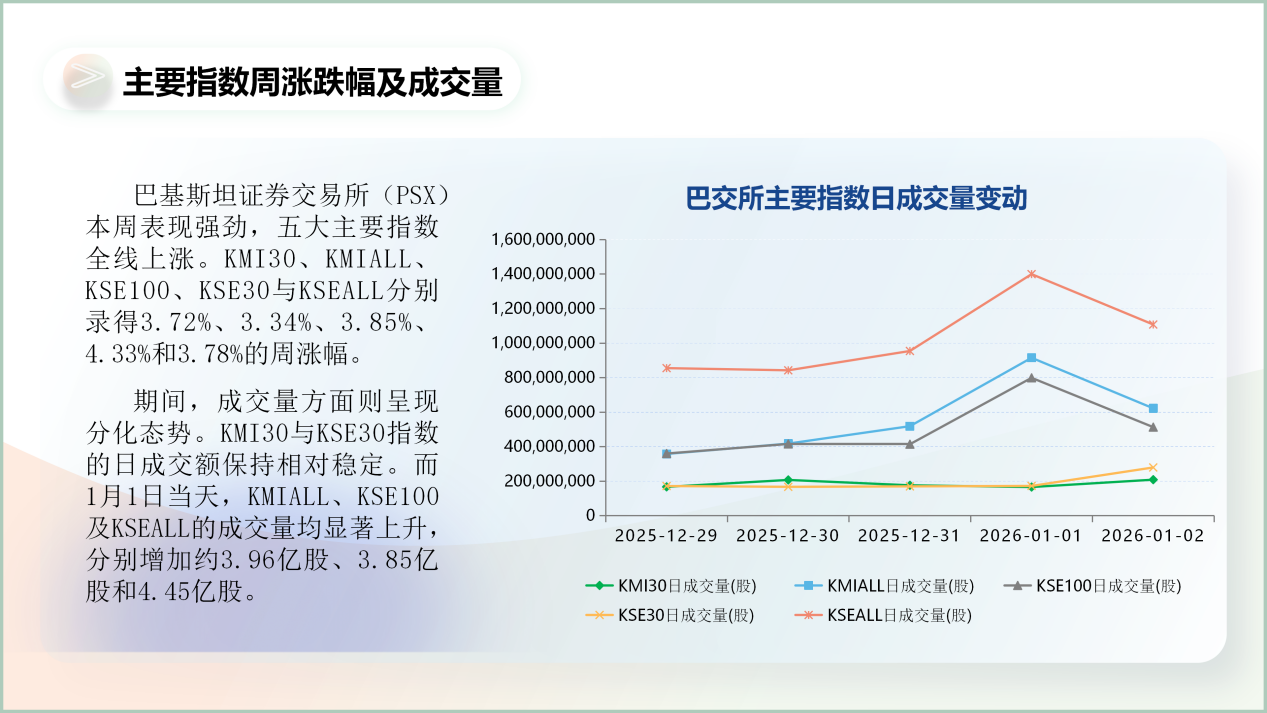
Group 1 - Pakistan's top three export destinations for the first five months of the fiscal year 2025-2026 are the United States, China, and the United Kingdom, with total exports to the US amounting to $2.639 billion, a year-on-year increase of 5.0%, while exports to China decreased by 6.8% to $983 million, and exports to the UK decreased by 3.2% to $905 million [8] - In 2025, gold and stocks emerged as the best-performing asset classes in Pakistan, with gold achieving a return of 73% and the KSE-100 index rising by 48% from January 1 to December 24 [9] - Pakistan is preparing to issue panda bonds for the first time before the Chinese New Year, which is seen as a significant step in strengthening financial and economic ties between China and Pakistan [9] - The GDP growth rate for the first quarter of the fiscal year 2025-2026 is reported at 3.71%, an increase of 2.15 percentage points compared to the same period last year, with industrial growth rising from 0.12% to 9.38% [9] Group 2 - The inflation rate based on the Consumer Price Index (CPI) in Pakistan for December 2025 is reported at 5.6%, down from 6.1% in November 2025 but higher than 4.1% in December 2024 [10] - Pakistan's foreign exchange reserves increased by $4.2 billion in 2025, reaching $15.9 billion by the end of December, although the growth in the second half of the year was only $1.4 billion [10] - For the first six months of the fiscal year 2025-2026, Pakistan's total exports amounted to $15.184 billion, a decrease of 8.70% compared to the previous fiscal year, while imports increased by 11.28% to $34.388 billion, resulting in a trade deficit of $19.204 billion, an increase of 34.57% year-on-year [11]
1月财经日历来了,请查收!
Xin Lang Cai Jing· 2026-01-01 00:15
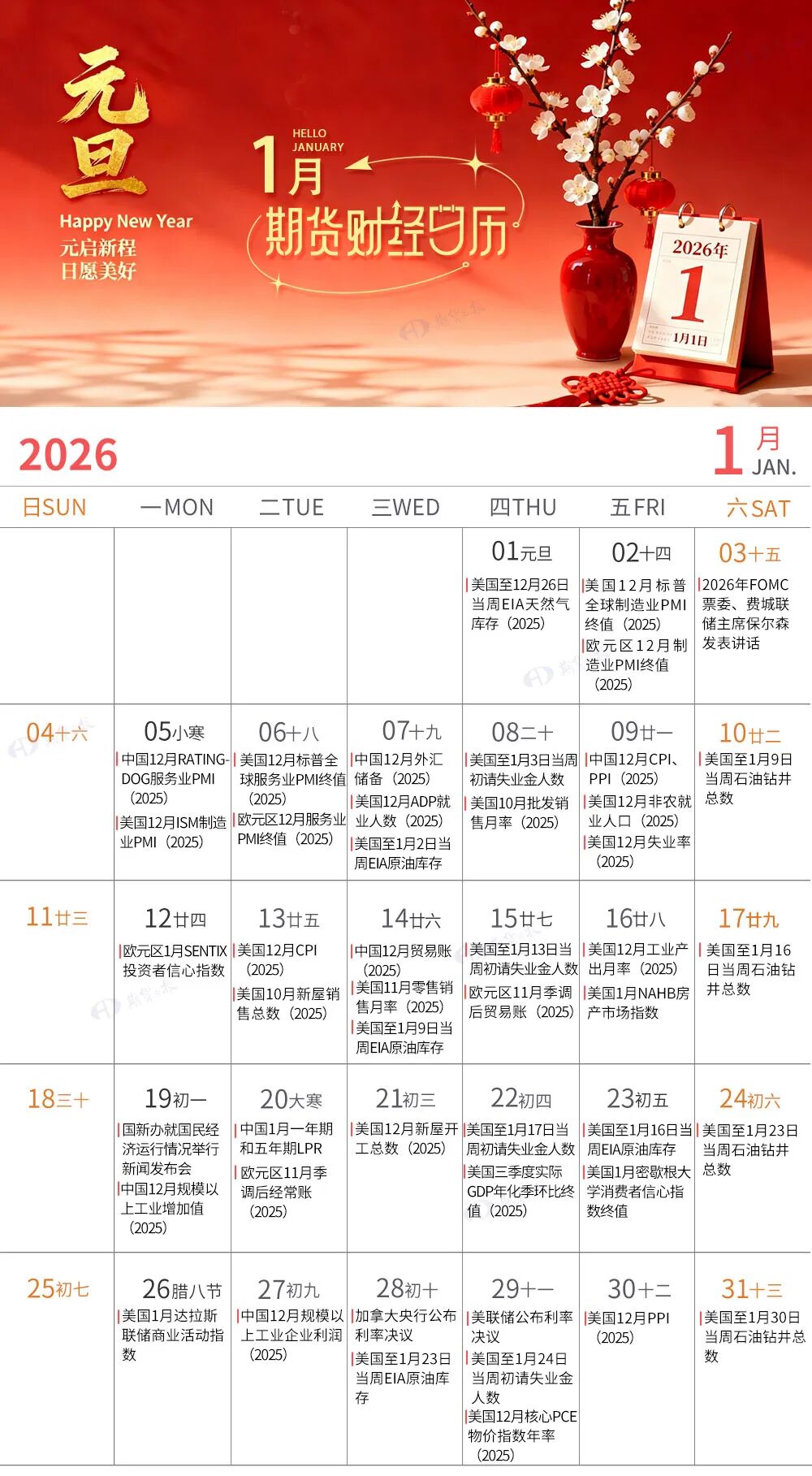
Group 1 - The article discusses various economic indicators and events scheduled for the upcoming weeks, including the release of manufacturing and service sector PMIs in both the US and Eurozone [2] - Key dates include the US EIA natural gas inventory report and the final value of the global manufacturing PMI for December [2] - The article highlights the importance of the US non-farm payroll report and unemployment rate data, which are critical for assessing the labor market [2] Group 2 - The article mentions the upcoming release of China's December trade balance and industrial production data, which are essential for understanding the country's economic performance [3] - It notes the significance of the US Federal Reserve's interest rate decision and the implications for monetary policy [3] - The article also references the Canadian central bank's announcement, indicating a broader focus on North American economic conditions [3]
中经资料:巴基斯坦证券市场一周回顾(2025.12.22 - 2025.12.26)
Zhong Guo Jing Ji Wang· 2025-12-29 07:17
一、市场表现 5、据巴基斯坦媒体《论坛快报》12月24日报道,巴铁路部长阿巴西(Muhammad Hanif Abbasi)表示,该国铁路部门在2025年7月至12月收入预计达到500亿卢 比,因此在2025至2026财年(2025年7月至2026年6月)有望实现1000亿卢比的收入目标。阿巴西表示,铁路部门近年来一直面临较大财政压力,由于采取了有 针对性的行政及运营措施,目前正朝着财务稳定的方向发展。 6、据巴基斯坦联合通讯社报道,12月25日,巴基斯坦与亚洲开发银行(ADB)签署了两项重大融资协议,总金额7.3亿美元,旨在加强巴电力基础设施并推进 公共部门改革。巴经济事务部发布的新闻稿显示,相关协议涵盖了3.3亿美元的第二期输电强化项目以及4亿美元的国有企业加速转型计划。 7、据巴基斯坦媒体《商业记录报》报道,巴全国粮食保障和研究部长侯赛因(Rana Tanveer Hussain)12月26日在拉合尔工商会(LCCI)发表讲话时指出,今年7 月至11月巴基斯坦粮食出口下降至19.5亿美元,低于去年同期的31.5亿美元,下降幅度达到38%,其原因包括亩产量低、研发投资不足、农产品走私、农产 品囤积以及政府 ...
美债接盘侠现身,中国第二英国第三,这国狂卖4000亿,被日本吞下
Sou Hu Cai Jing· 2025-12-27 06:23
Core Viewpoint - The article discusses Japan's significant investment in U.S. Treasury bonds amidst a global trend of selling, highlighting the implications for Japan's economy and its relationship with the U.S. [2][4][8] Group 1: Japan's Investment in U.S. Treasuries - Japan has become the largest holder of U.S. Treasury bonds, currently holding $1.2 trillion, and has increased its holdings for ten consecutive months [4][8] - In contrast, other countries like China, Canada, and the UK are reducing their holdings, with China selling $11.8 billion in October, bringing its total to a 17-year low of $688.7 billion [2][4] - The total amount of U.S. Treasuries held by foreign investors is $9.24 trillion, which has increased by 6.3% compared to the previous year [4][6] Group 2: Implications of Japan's Strategy - Japan's purchase of U.S. Treasuries is seen as a political strategy to secure economic benefits and stability, acting as a "financial umbrella" [6][8] - The relationship between Japan and the U.S. is deepening, with Japan's investments potentially influencing U.S. policy and negotiations [8][11] - Japan's actions may lead to a shift in how other allies view their foreign exchange reserves, potentially redefining economic cooperation with the U.S. [11][13] Group 3: Broader Economic Context - The article suggests that Japan's strategy could lead to a reconfiguration of global supply chains, as financial ties may drive industrial collaboration [13] - The dependency on U.S. policies could pose risks for Japan, as it may limit its strategic autonomy [13][15] - The dynamics of U.S. Treasury holdings reflect broader geopolitical interests and the evolving global order [15]
美联储现在巴不得中国能早点抛售美债?为啥他们一直不降息,因为他们很清楚,中国迟早会卖掉手里那7800亿美元的美债。市场上能接过这么大一笔美债的,恐怕只有美联储自己,所以他们一直在等这个机会。 先说说中国为啥买这么多美债。 其实道理很简单,中国这么多年贸易顺差,赚了不少外汇,这些钱得...
Sou Hu Cai Jing· 2025-12-24 04:10
Group 1 - The Federal Reserve is waiting for China to sell its $780 billion in U.S. Treasury bonds, as it may need to step in as a buyer to stabilize the market [1][11][12] - China has accumulated a significant amount of U.S. debt due to trade surpluses, seeking a safe and profitable place to store its foreign exchange reserves [2][3][4] - However, holding U.S. debt carries risks, particularly with the increasing U.S. national debt nearing $38 trillion, which raises concerns about the dollar's credibility [6][15] Group 2 - If China were to sell its U.S. bonds, it could create market volatility, prompting other countries to follow suit, which would negatively impact the U.S. financial market [9][10][21] - The Federal Reserve's role is to maintain economic stability, and while it may see an opportunity in buying the bonds, it would also face increased debt pressure and interest rate risks [8][15][16] - China is likely to reduce its U.S. bond holdings gradually, considering the impact on its own economy and the importance of U.S. debt in its foreign exchange reserves [17][19][20]
毛里塔尼亚经济与发展部长预测2025年通胀率低于2%
Shang Wu Bu Wang Zhan· 2025-12-19 04:41
Core Viewpoint - The report highlights the resilience of Mauritania's economy, projecting a strong growth rate of 6.3% for 2024 and a low inflation rate of below 2% for 2025, driven by effective macroeconomic policies and ongoing reforms aimed at diversifying the economy [1] Group 1: Economic Outlook - Mauritania's economy is expected to grow by 6.3% in 2024, reflecting a strong performance despite global uncertainties and geopolitical tensions [1] - The inflation rate is projected to be below 2% in 2025, attributed to the implementation of macroeconomic policies and the central bank's efforts to absorb excess liquidity [1] Group 2: Policy and Reform - The Minister of Economy and Development praised the ongoing reforms aimed at building a strong, diversified, inclusive, and sustainable economic foundation [1] - The central bank's measures to enhance market transparency and the effectiveness of monetary policy through a competitive interbank platform for the determination of the ouguiya exchange rate were emphasized [1] Group 3: Foreign Exchange and Reserves - The exchange rate volatility is expected to stabilize at 1.6% for 2024-2025, indicating a stable foreign exchange environment [1] - Foreign exchange reserves are nearing $2 billion, showcasing the effectiveness of monetary policies implemented since the end of 2023 [1]
没有商量的余地,我国继续抛售美债,美新发1.8万亿美债谁敢接盘
Sou Hu Cai Jing· 2025-12-17 17:28
Core Viewpoint - China is gradually reducing its holdings of US Treasury bonds, reflecting a shift in its foreign exchange reserve strategy and raising concerns about the implications for global economic stability [1][3][4]. Group 1: China's Actions - China, as the largest holder of US Treasury bonds, has been decreasing its holdings over the past few years, indicating a clear trend despite the decline not being drastic [3][4]. - The reasons for China's decision to sell US Treasuries include declining yields, currency risk associated with a depreciating dollar, and a desire for greater economic independence and strategic signaling to the US [4][6][8]. - The reduction in US Treasury holdings is part of China's broader strategy to diversify its foreign exchange reserves and establish a payment system based on the renminbi [7][10]. Group 2: US Treasury Situation - The US government announced the issuance of $1.8 trillion in new bonds to finance its substantial annual expenditures, which include military spending, social welfare, and infrastructure [6][8]. - The US public debt has surpassed its GDP, raising concerns about the sustainability of its debt levels and the reliability of the US government's creditworthiness [6][8]. - The challenge for the US is finding buyers for the new bonds, as traditional buyers, including foreign central banks and domestic investors, are becoming hesitant due to the increasing debt burden and declining attractiveness of US Treasuries [7][8]. Group 3: Global Implications - The issues surrounding US Treasuries are not only a concern for the US but also for the global economy, as many countries hold significant amounts of US debt in their foreign exchange reserves [7][10]. - There is a trend among various countries to reassess their foreign exchange reserve structures, with some increasing gold reserves and seeking alternative currencies for investment [7][10]. - The ongoing situation with US Treasuries could lead to broader changes in the global financial system, as trust in the US government and the dollar is being reevaluated [10].