杠铃策略

Search documents
上证180ETF指数基金(530280)自带杠铃策略,近一周业绩同类第1
Xin Lang Cai Jing· 2025-09-01 05:52
Group 1 - The market is experiencing short-term fluctuations, but the long-term trend remains a slow bull market. Dividend and technology assets are expected to yield excess returns in the long run, with a barbell strategy gaining attention [1] - The Shanghai Stock Exchange 180 Index (000010) employs a barbell strategy of 90% dividend and 10% technology, making it a good choice for equity market allocation. This index not only focuses on dividend investments but also includes a certain proportion of technology assets, benefiting from rapid technological development [1] - As of September 1, 2025, the Shanghai 180 Index has risen by 0.52%, with notable increases in constituent stocks such as Zijin Mining (601899) up 8.52% and WuXi AppTec (603259) up 7.26% [1] Group 2 - The Shanghai 180 ETF Index Fund (530280) closely tracks the Shanghai 180 Index, which selects 180 securities with large market capitalization and good liquidity from the Shanghai stock market, reflecting the overall performance of core listed companies [2] - As of July 31, 2025, the top ten weighted stocks in the Shanghai 180 Index include Kweichow Moutai (600519) and Ping An Insurance (601318), accounting for a total of 25.4% of the index [2] - The Shanghai 180 ETF Index Fund has various off-market connections, including Ping An's Shanghai 180 ETF Connect A (023547) and C (023548) [2]
长盛沪深300LOF: 长盛沪深300指数证券投资基金(LOF)2025年中期报告
Zheng Quan Zhi Xing· 2025-08-29 11:29
Fund Overview - The fund is named Changsheng CSI 300 Index Securities Investment Fund (LOF) and is managed by Changsheng Fund Management Co., Ltd. [2] - The fund aims to track the CSI 300 Index through index-based investment strategies, with a target tracking error of less than 0.35% on a daily basis and an annualized tracking error of less than 4% [2][3]. - The fund operates as an open-ended contract type and has been in effect since August 4, 2010 [2]. Financial Performance - As of June 30, 2025, the total net asset value of the fund was approximately RMB 415.97 million, an increase from RMB 359.73 million at the end of the previous year [16]. - The fund's realized income for the reporting period was RMB 3.38 million for Class A and RMB 471,403 for Class C [3]. - The net asset value per share for Class A was RMB 1.5676, with a net value growth rate of 0.62%, while Class C had a net asset value of RMB 1.5647 and a growth rate of 0.53% [10][16]. Investment Strategy - The fund employs a sampling replication strategy to construct its investment portfolio, considering factors such as market capitalization, liquidity, industry representation, and volatility [2]. - The fund's investment strategy aims to maintain a close correlation with the performance of the CSI 300 Index, which includes stocks with high liquidity and strong representation in the A-share market [3]. Management and Governance - Changsheng Fund Management Co., Ltd. was established on March 26, 1999, and is one of the first ten fund management companies in China [4]. - The fund management company has a registered capital of RMB 206 million and manages a total of 73 open-ended funds as of June 30, 2025 [4]. - The fund management adheres to strict compliance with relevant laws and regulations, ensuring fair treatment of all investment portfolios [7][8]. Market Outlook - The outlook for the second half of 2025 suggests a gradual recovery in the A-share market, driven by low interest rates and high household savings, which may attract sustained inflows of new capital [11]. - The report indicates potential growth opportunities in sectors related to new technologies, such as artificial intelligence, which may emerge as key investment themes [11].


国联民生(601456):并表民生证券 叠加自营实现高收益 经营业绩大幅提升
Xin Lang Cai Jing· 2025-08-29 04:28
Core Viewpoint - The company has shown significant growth in revenue and net profit, driven by the consolidation of Minsheng Securities and strong investment returns, outperforming the market index [1][2]. Financial Performance - In the first half of 2025, the company achieved a total revenue of 42.5 billion yuan, a year-on-year increase of 269.4%, with a net profit attributable to shareholders of 11.3 billion yuan, up 1185.2% [1]. - The second quarter alone saw revenue of 24.5 billion yuan, a year-on-year increase of 168.4% and a quarter-on-quarter increase of 56.7%, with net profit reaching 7.5 billion yuan, up 145.1% year-on-year and 99.7% quarter-on-quarter [1]. Brokerage and Investment Banking - The brokerage business revenue surged over 200%, with 9.0 billion yuan in revenue for the first half of 2025, a year-on-year increase of 223.8%, accounting for 22.6% of total revenue [1]. - Investment banking revenue also saw a significant increase, reaching 5.3 billion yuan, up 214.1% year-on-year, with equity underwriting totaling 13.1 billion yuan, a 160.2% increase [2]. Asset Management and Investment Returns - Asset management revenue grew steadily, reaching 3.6 billion yuan, a year-on-year increase of 14.4%, with total assets under management at 296.5 billion yuan, up 137.5% [2]. - Investment income, including fair value, reached 21.0 billion yuan, a year-on-year increase of 458.8%, with a strategy focusing on dividend value stocks and growth stocks [2]. Profit Forecast and Valuation - The company has revised its profit forecast upwards, expecting net profits of 21.6 billion yuan, 21.0 billion yuan, and 22.1 billion yuan for 2025-2027, with corresponding year-on-year growth rates of +444%, -3%, and +5% [3]. - The current market capitalization corresponds to a price-to-book (PB) ratio of 1.33x, 1.29x, and 1.25x for the respective years [3].

高盛交易台:回调只是中场休息,一场"慢而可控的牛市"
Zhi Tong Cai Jing· 2025-08-28 10:42
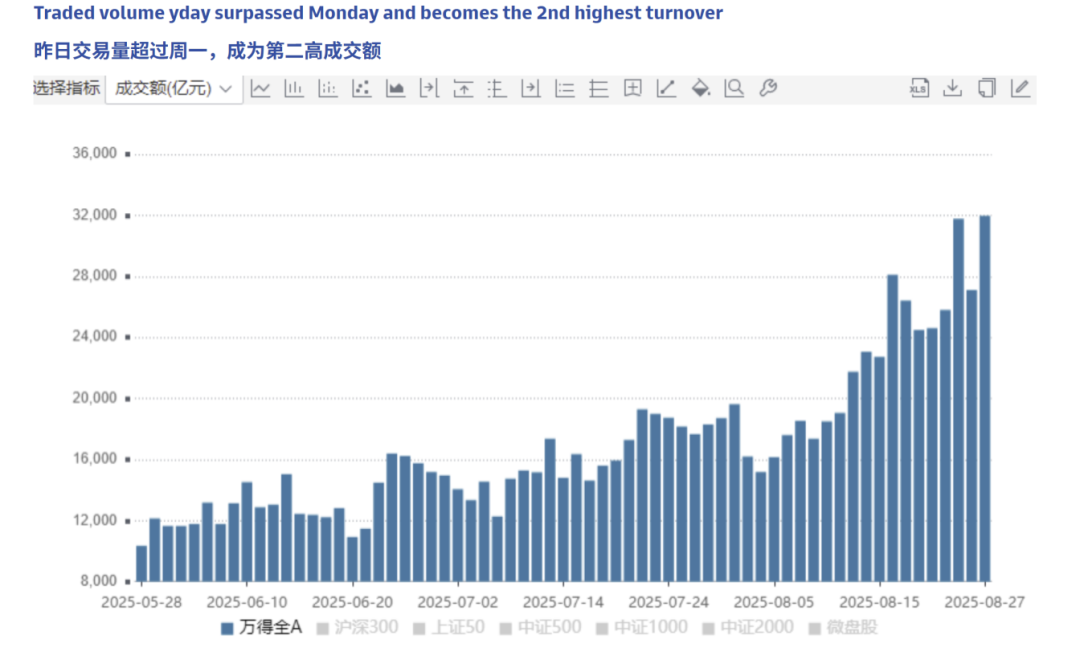
Core Viewpoint - The Chinese stock market has experienced a significant pullback, raising concerns about potential further adjustments, with trading volume reaching 3.2 trillion RMB, the second-highest on record [1] Group 1: Market Activity - The trading volume on the 27th reached 3.2 trillion RMB, marking the second-highest record, following a previous high of 3.17 trillion RMB earlier in the week, which is now the third-highest [1] - The micro-cap index saw its largest single-day change, with micro-cap stocks declining by 3.7%, erasing six days of gains, while the CSI 2000 index fell by 2.3%, reducing five days of gains [7] Group 2: Investor Sentiment - Despite the pullback, local investors generally believe that this correction is a reasonable consolidation after several weeks of strong performance and does not necessarily indicate the end of the bull market [7] - Conversations with experienced investors suggest that temporary pullbacks during a bull market are normal, and it is premature to declare the end of the bull market [8] Group 3: Regulatory Environment - There are speculations that local brokers have started to reduce margin requirements for retail and institutional clients, possibly due to some form of guidance from regulatory authorities, although no official confirmation has been reported [8] - The regulatory stance appears to favor a "slow and controlled bull market" rather than a "fast and uncontrolled bull market," reflecting a consistent approach observed in previous bull markets [9] Group 4: Economic Context - The stock market is increasingly viewed as a wealth creation tool for Chinese households, especially in the current economic environment where property prices have declined and the economy is in the early stages of recovery [11] - Retail account openings have remained relatively stable, indicating ongoing interest from individual investors [12]

中加基金固收周报︱科技主线带动牛市前进
Xin Lang Ji Jin· 2025-08-28 07:56
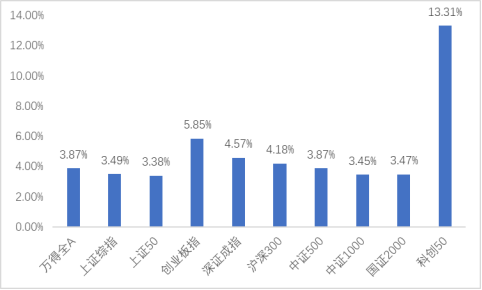
Market Overview - A-shares major indices rose last week, with trading volume remaining high [1] - Among 31 Shenwan first-level industries, communication, electronics, and comprehensive sectors performed relatively well [1] Macroeconomic Data Analysis - In July, national general public budget revenue reached 20,273 billion yuan, a year-on-year increase of 2.6%, with central and local revenues growing by 2.2% and 3.1% respectively, marking the highest monthly growth this year [3] - Government fund revenue in July increased by 8.9% year-on-year, while government fund expenditure growth was 42.4% [3] - The first account revenue showed positive tax revenue growth for four consecutive months, while non-tax revenue declined [3] - Land transfer revenue continued to grow positively, linked to local governments actively selling quality land [3] - Overall, broad fiscal expenditure maintained positive year-on-year growth supported by government debt, with net financing close to 8 trillion yuan in the first half of the year, an increase of 4.3 trillion yuan year-on-year [3] Stock Market Strategy Outlook - The market showed strong fluctuations last week, with liquidity remaining ample and a bullish trend supported by technology leaders [7] - Despite some concerns about economic data and stimulus expectations, favorable factors are outweighing these worries, with a supportive monetary policy environment [7] - The market is expected to maintain upward momentum without significant adjustments in August, with attention shifting to macro catalysts and trading indicators in September [7] Industry Insights - For defensive dividend sectors, it is recommended to reduce allocation or adjust the structure in the short term, favoring cyclical sectors with expected rebounds [9] - Focus on dividend stocks with catalysts, as well as stable and defensive attributes in Hong Kong stocks, financials, utilities, and precious metals [9] - In offensive sectors, technology remains a key focus, with opportunities arising from domestic policy stability and U.S. policy fluctuations [9] - Opportunities in domestic demand, technology, and overseas expansion are highlighted, with a focus on undervalued index-weighted stocks for potential capital inflows [8][9]
怕追高又怕错过,A股十年新高后怎么“上车”?
天天基金网· 2025-08-26 11:26
Core Viewpoint - The A-share market has entered a trend-driven rally since the tariff impact in April, with the Shanghai Composite Index recently surpassing 3800 points, a level not seen in a decade [3]. Market Valuation - The market capitalization of A-shares has exceeded 100 trillion yuan, with the current PE-TTM of the Shanghai Composite Index at 16.13 times, which is at the 87th percentile over the past 15 years, indicating relatively high valuation [4]. - However, when viewed from a longer-term perspective since the index's base date in December 1990, the valuation percentile is around 39%, still below the median [4]. - The ChiNext Index, a leading index in this rally, has a valuation percentile of 27%, suggesting it still has room to rise [5]. Historical Market Performance - Since 2010, each market rally has been accompanied by valuation increases, with the current valuation uplift being relatively comfortable compared to previous cycles [8]. - The analysis of market performance from 2010 onwards shows varying degrees of valuation uplift across different periods, with the current rally showing a 27% increase in valuation [8]. Fund Flows and Market Dynamics - Recent data indicates a significant shift in fund flows, with a notable increase in non-bank deposits and a decrease in household deposits, suggesting a "migration" of funds into the stock market [9]. - The ratio of household deposits to A-share market capitalization is currently around 1.7, indicating potential for further inflows into equities [9]. Industry Valuation Insights - Many industries have seen valuation increases, with half of the sectors having valuation percentiles above 50%, while some sectors like agriculture, food and beverage, and utilities remain undervalued [10]. - Specific industries such as computer, steel, and electronics are at historical high valuation percentiles, indicating strong investor interest [11][13]. Growth and Stability Sectors - High-growth sectors such as defense and TMT (Technology, Media, and Telecommunications) are characterized by high PE ratios (e.g., defense at 91 times) but also exhibit strong revenue growth rates [15]. - Stable sectors like food and beverage and home appliances have lower PE ratios and stable ROE, making them attractive for conservative investors [18]. Dividend Yield Sectors - Sectors such as banking, oil and gas, and coal have the highest dividend yields (3.92%, 4.37%, and 5.14% respectively) and are considered defensive investments with lower valuations [20]. - These dividend-paying sectors are expected to remain attractive as companies increase their dividend payouts [21]. Additional Opportunities - Other sectors benefiting from the market rally include non-bank financials, steel, chemicals, and innovative pharmaceuticals, all of which present unique investment narratives [25].

大额存单转让市场热度飙升
Qi Lu Wan Bao· 2025-08-25 23:33
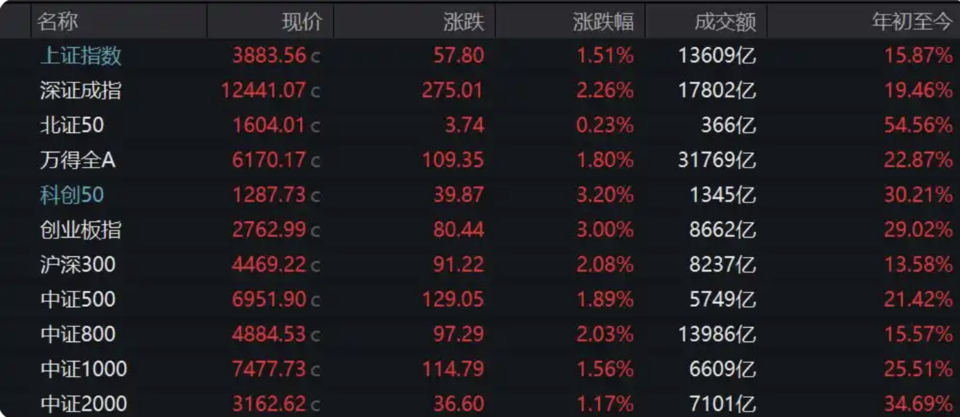
Core Viewpoint - The A-share market is experiencing a significant rise, with the Shanghai Composite Index approaching 3900 points, indicating a strong investor sentiment and increased trading activity in the market [1] Group 1: Market Performance - On August 25, the Shanghai Composite Index closed at 3883.56 points, up 1.51% for the day, with trading volume exceeding 3 trillion yuan, setting a new record for the year [1] - The surge in the stock market has led to a notable increase in the trading of large-denomination certificates of deposit (CDs), with many holders selling their CDs at slight discounts shortly after purchase [2] Group 2: Large-Denomination CD Market - Investors are actively participating in the CD transfer market, with some selling CDs they held for only a few days, often at a higher yield than newly issued products [2] - For example, a CD originally yielding 1.55% was sold with an effective yield of approximately 2.54% due to the seller's willingness to offer a discount [2] - The transfer market has seen CDs with yields exceeding 2.4%, with some reaching as high as 4.65%, significantly above the new issuance rates [2][3] Group 3: Diversified Fund Flows - The trend of transferring large-denomination CDs reflects a broader diversification of fund flows, with some investors reallocating their funds into safer investment vehicles such as insurance products and wealth management products [4] - Recent data from the central bank indicates a decrease in household deposits by 1.1 trillion yuan in July, while non-bank deposits increased by 2.14 trillion yuan, suggesting a shift in investment strategies [4] Group 4: Investor Behavior and Recommendations - Analysts note that while some funds may flow into the stock market due to improved market conditions, the low-risk nature of bank wealth management products will likely maintain their popularity [5] - Experts advise investors to rationally plan their investments and avoid following trends blindly, emphasizing the importance of aligning investment choices with individual risk tolerance and financial goals [6][7]
剑指4000点!
Datayes· 2025-08-25 10:43
Core Viewpoint - The Chinese asset market is experiencing a comprehensive rise, with significant increases in stocks, bonds, and currency, driven by ample domestic liquidity and positive market sentiment [1][2]. Market Performance - The Shanghai Composite Index is projected to reach 3900 points soon, with a target of 4000 points by the end of the week, as per HSBC's revised forecasts [2]. - HSBC has raised its end-2025 targets for major indices: Shanghai Composite from 3700 to 4000, CSI 300 from 4300 to 4600, and Shenzhen Component from 11500 to 13000, indicating a potential upside of 5-7% [2][3]. Sector Analysis - The market is seeing strong performance in sectors such as non-ferrous metals, real estate, and consumer goods, with significant inflows from foreign investors [4][8]. - The dividend yields for major indices are as follows: Shanghai Composite at 2.8%, CSI 300 at 2.6%, and Shenzhen Component at 2.1% [3]. Profit Growth Projections - Estimated net profit growth for 2025 is 9.4% for the Shanghai Composite, 8.6% for CSI 300, and 38.7% for Shenzhen Component, with further growth expected in 2026 [3]. Investment Trends - There is a notable increase in trading volume, with the total market turnover exceeding 31.77 billion yuan, marking a historical high [8]. - The real estate sector is reacting positively to anticipated policy changes, with companies like Vanke seeing significant stock price increases [7]. Foreign Investment Dynamics - Northbound capital transactions reached 404.54 billion yuan, with major purchases in stocks like ZTE Corporation and Kweichow Moutai [21][23]. Valuation Insights - Current PE ratios in sectors such as agriculture, food and beverage, and non-bank financials are at historical low percentiles, indicating potential undervaluation [30].





大额存单转让潮再现,是都投向火热的股市了吗?
Qi Lu Wan Bao Wang· 2025-08-25 09:55
Market Performance - The A-share market continued to rise, with the Shanghai Composite Index approaching 3900 points, closing at 3883.56 points, up 1.51% [1] - The market turnover exceeded 3 trillion yuan, setting a new record for the year [1] - Year-to-date performance of major indices includes: - Shanghai Composite Index: up 15.87% - Shenzhen Component Index: up 19.46% - ChiNext Index: up 29.02% [2] Large Certificate of Deposit (CD) Transfer Market - The large CD transfer market has seen a surge in activity, with many CDs being listed for transfer at slight discounts shortly after purchase [3] - Some CDs, held for only about 10 days, are being transferred with annualized yields exceeding 2.4%, significantly higher than newly issued products [3][4] - This trend has raised discussions about potential large capital inflows into the stock market [4] Diversified Fund Flows - Investors are diversifying their fund flows, with a significant portion reallocating funds to insurance and wealth management products rather than solely focusing on the stock market [5] - Recent data shows a decrease of 1.1 trillion yuan in household deposits, while non-bank deposits increased by 2.14 trillion yuan [5] - The average annualized yield of wealth management products rose by 14.18% year-on-year to 2.12% [5] Investor Behavior and Recommendations - Investors are advised to rationally plan their investments in light of the large CD transfer trend and diversified fund flows, avoiding blind following of market trends [7] - Experts suggest a "barbell strategy" for asset allocation, balancing high-risk and safe assets to mitigate risks [7] - Caution is advised when purchasing transferred CDs, as some may have potential legal disputes or restrictions [8]
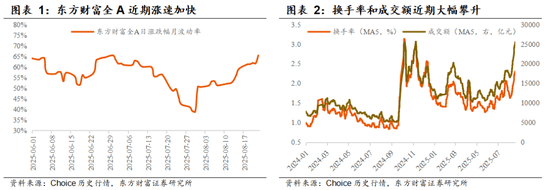
东方财富陈果:增量资金或推动A股牛市第二阶段加速演绎!本轮牛市较近2轮牛市高点仍有明显距离
Sou Hu Cai Jing· 2025-08-25 04:00
Group 1 - The core viewpoint of the article indicates that the Shanghai Composite Index has surged past the 3700 and 3800 points, reaching a 10-year high, driven by a recovery in risk appetite and a rebalancing of valuation between stocks and bonds [1][5][8] - The market is experiencing a second phase of a bull market, with significant participation from retail investors, private equity, and foreign capital, leading to increased liquidity and trading volume [2][5][12] - The shift from a "barbell strategy" to a more balanced investment approach is confirmed, as sectors like technology and domestic semiconductor industries gain traction [5][10][22] Group 2 - Recent behavior of different types of incremental capital shows that retail investors are increasingly optimistic about the bull market, with a notable rise in discussions and investments in ETFs [14][17] - The Federal Reserve's signals regarding potential interest rate cuts have improved the liquidity environment, particularly benefiting Hong Kong stocks, which are now seen as more attractive compared to A-shares [3][26] - The current bull market is still in its second phase, with many indicators suggesting that there is significant room for growth compared to previous bull market peaks [4][25][27]