
首发经济

Search documents
全聚德跌2.06%,成交额8157.39万元,主力资金净流出716.71万元
Xin Lang Zheng Quan· 2026-01-20 03:19
Group 1 - The core stock price of Quanjude has decreased by 2.06% to 12.35 CNY per share, with a total market capitalization of 3.79 billion CNY as of January 20 [1] - The company has seen a year-to-date stock price increase of 4.84%, with a 3.69% rise over the last five trading days, a 0.56% decline over the last 20 days, and a 7.67% increase over the last 60 days [2] - Quanjude's main business revenue composition includes 78.53% from catering services, 19.34% from product sales, and 2.13% from leasing [2] Group 2 - As of September 30, 2025, Quanjude reported a total operating revenue of 958 million CNY, a year-on-year decrease of 11.62%, and a net profit attributable to shareholders of 26.17 million CNY, down 62.85% year-on-year [2] - The company has distributed a total of 830 million CNY in dividends since its A-share listing, with no dividends paid in the last three years [3] - The number of shareholders increased by 18.19% to 37,000 as of September 30, 2025, while the average circulating shares per person decreased by 15.39% to 8,281 shares [2]

来之不易成绩单彰显经济韧性活力
Ren Min Ri Bao· 2026-01-20 01:57
Core Insights - China's economy demonstrates strong resilience and vitality, with significant progress expected in innovation, industrial quality improvement, digital empowerment, and green transformation by 2025 [1][2] Supply Quality Improvement - China becomes the first country with over 5 million valid domestic invention patents, with R&D expenditure reaching 39,262 billion yuan, maintaining the second position globally [2] - The added value of high-tech manufacturing and equipment manufacturing accounts for 17.1% and 36.8% of the total industrial added value, respectively [2] - The production of civil drones and industrial robots increases by 37.3% and 28% year-on-year [2] Green Leadership - Clean energy generation from hydropower, nuclear, wind, and solar grows by 8.8%, with non-fossil energy consumption rising by approximately 2 percentage points compared to 2024 [3] - The industrial added value reaches 41.7 trillion yuan, growing by 5.8% year-on-year, contributing 35% to economic growth [3] Consumption Trends - The total retail sales of consumer goods exceed 50 trillion yuan, growing by 3.7% compared to 2024, with final consumption contributing 52% to economic growth [4] - Service retail sales increase by 5.5%, outpacing goods retail sales, with service consumption accounting for 46.1% of per capita consumption expenditure [4] - Online retail sales grow by 8.6%, driven by e-commerce and digital technologies [4] Policy Effectiveness - The number of household cars reaches 52.9 per hundred households, an increase of 1.7 from 2024 [6][7] - Policies promoting consumption upgrades lead to a 4.1% increase in retail sales of six categories of goods [7] Technological and Industrial Innovation - The added value of smart unmanned aerial vehicle manufacturing and smart vehicle-mounted equipment manufacturing grows by 57% and 26.2%, respectively [8] - The core CPI rises by 1.2% year-on-year, while the decline in industrial producer prices narrows [8] Positive Economic Trends - The economic foundation remains solid, with over 36 trillion yuan added to the economy during the 14th Five-Year Plan [9] - The manufacturing purchasing managers' index returns to expansion territory, indicating positive growth trends [9] - New production forces and reform benefits continue to emerge, with significant advancements in artificial intelligence and digital economy [9] Supportive Development Environment - More proactive macro policies are expected to ensure stable economic operations, with a focus on key project implementations [10]
2025年主要发展目标任务顺利实现 来之不易成绩单彰显经济韧性活力
Ren Min Ri Bao· 2026-01-20 00:57
Economic Resilience and Growth - China's economy is expected to achieve significant progress in innovation, industrial quality improvement, digital empowerment, and green transformation by 2025, marking a successful conclusion to the "14th Five-Year Plan" [1][2] - The total value of industrial output reached 41.7 trillion yuan, with a year-on-year growth of 5.8%, contributing 35% to economic growth, an increase of 1.8 percentage points from 2024 [3] Innovation and Technology - China has become the first country to possess over 5 million valid domestic invention patents, with R&D expenditure reaching 39,262 billion yuan, maintaining the second position globally [2] - The manufacturing value added in high-tech sectors accounted for 17.1% of total industrial output, with significant growth in smart manufacturing and green energy sectors [2] Consumer Market Dynamics - The total retail sales of consumer goods exceeded 50 trillion yuan, growing by 3.7% compared to 2024, with final consumption contributing 52% to economic growth, an increase of 5 percentage points [4] - Service consumption is gaining momentum, with service retail sales growing by 5.5%, outpacing goods retail sales [4] Policy Impact - Macro policies are being implemented to support economic stability and high-quality development, including measures to boost employment and investment [7] - The policy of replacing old products with new ones has led to a 4.1% increase in retail sales of related goods, contributing to overall retail growth [7] Green Energy and Sustainability - The construction of a clean, low-carbon, and efficient energy system is accelerating, with renewable energy generation increasing by 8.8% [3] - Non-fossil energy sources accounted for a larger share of total energy consumption, rising by approximately 2 percentage points from 2024 [3] Future Outlook - The economic foundation is solid, with significant growth in economic strength and technological capabilities during the "14th Five-Year Plan" period [9] - Positive trends in economic indicators, such as the manufacturing purchasing managers' index returning to expansion territory, suggest a favorable economic outlook for 2026 [9][10]
北京东城离境退税商店总数超300家
Xin Lang Cai Jing· 2026-01-19 23:20
Group 1 - The core theme of the news is the promotion of consumption and economic growth in Beijing's Dongcheng District, with a target of over 300 tax refund stores by 2025 [1] - Dongcheng District plans to establish a consumption promotion system with a "1+2+5+N" matrix, aiming to host over 200 consumption events annually to stimulate market activity [1] - The district has implemented a "buy and refund" tax refund service at major shopping malls, achieving a coverage rate of 98% for foreign card payments [1] Group 2 - By 2026, Dongcheng District aims to expand the "buy and refund" service in large shopping malls, positioning itself as a preferred international shopping destination [2] - The district plans to introduce at least 30 high-quality flagship stores and host events like the Wangfujing Forum and the 10th Wangfujing International Brand Festival to enhance consumer engagement [2] - The focus will be on developing first-time launches and experiences, supported by measures to enhance consumption quality and promote diverse service consumption scenarios [2]
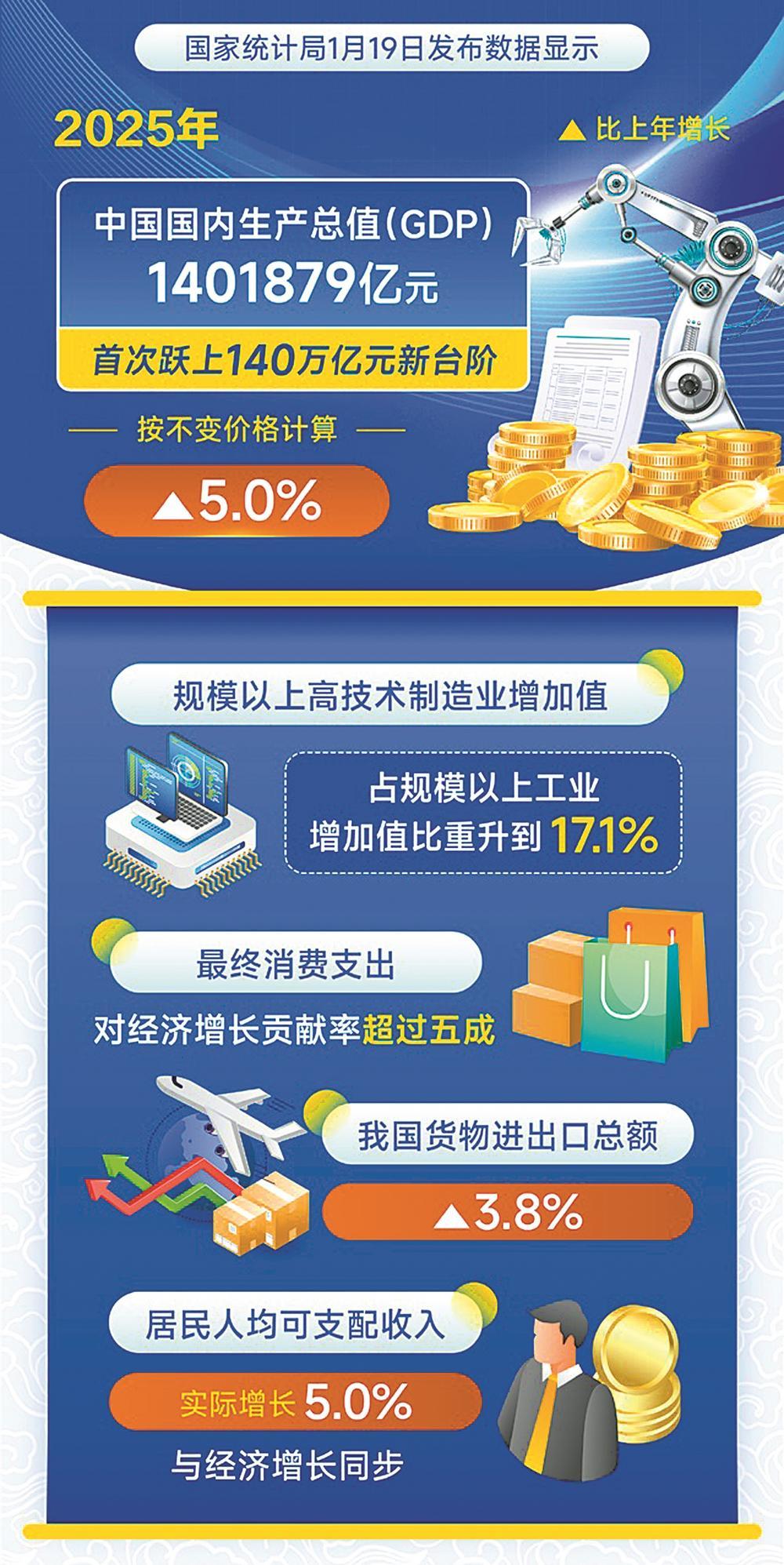
140万亿元! 中国经济再上新台阶
Xin Lang Cai Jing· 2026-01-19 18:12
Economic Growth - China's GDP reached 140 trillion yuan in 2025, marking a significant milestone with a year-on-year growth of 5.0% at constant prices, achieving a "four consecutive jumps" during the 14th Five-Year Plan period [4] - The contribution rate of China to global economic growth is expected to be around 30%, making it the most stable and reliable source of global economic growth [4] Production and Industry - China's grain production has stabilized at 1.4 trillion jin for two consecutive years, and the manufacturing value added has remained the highest in the world for 16 years [5] - The service sector's value added has increased to 57.7% of GDP, supported by the world's largest and most comprehensive network infrastructure [5] - During the 14th Five-Year Plan period, China's average annual economic growth is projected to be 5.4%, significantly surpassing the global average [5] Innovation and Technology - China has entered the top ten in global innovation index rankings, with R&D expenditure intensity reaching 2.8%, exceeding the OECD average for the first time [5] - Significant technological advancements include successful launches of the "Nine Sky" drone and the Tianwen-2 mission, as well as the commissioning of the first electromagnetic aircraft carrier [5] Emerging Industries - New energy vehicles accounted for over 50% of domestic new car sales, with production of civilian drones and industrial robots increasing by 37.3% and 28% respectively [6] - Continuous investment and expansion in high-end equipment, green energy, and smart manufacturing are driving the integration of technological and industrial innovation [6] Consumer Market - The total retail sales of consumer goods surpassed 50 trillion yuan, with a year-on-year growth of 3.7%, reflecting new retail experiences and the integration of digital technologies [7] - The per capita disposable income of residents increased by 5.0%, and the urbanization rate reached 67.89%, indicating positive progress in social welfare sectors [7]

连续五年破万亿,广州“万亿消费”如何炼成?
2 1 Shi Ji Jing Ji Bao Dao· 2026-01-19 16:14
Core Viewpoint - Guangzhou has become the third city in China to achieve a "double trillion" in consumption and foreign trade, with specific growth targets set for GDP, fixed asset investment, and total retail sales by 2026 [1][2]. Economic Growth Targets - The GDP growth target for Guangzhou is set at around 5% by 2026, with fixed asset investment, total retail sales, and total import-export value also targeted to grow by 5% [1]. - The total retail sales of social consumer goods are expected to exceed 1.1 trillion yuan, growing by 5.5% by 2025, while total import-export value is projected to exceed 1.2 trillion yuan, with a growth rate of 10.4% [1]. Consumption as Economic Driver - Consumption is highlighted as a key driver for economic recovery, with Guangzhou's retail sales exceeding 1 trillion yuan for five consecutive years since 2021 [1]. - The city aims to explore both domestic and international demand potential as a primary task this year [1]. Policy Initiatives - Guangzhou has introduced a series of policy measures, including 33 initiatives to boost consumption, 23 to promote service trade, and 33 for high-quality development of business districts [2]. - The city is focusing on creating a vibrant and competitive consumer market by enhancing retail innovation and optimizing the consumption environment [2]. Cultural and Tourism Integration - The cultural and tourism sectors are seen as vital for enhancing consumer spending, with suggestions to integrate cultural scenes with technology to create new attractions [5]. - The government emphasizes the importance of developing cultural tourism as a means to stimulate consumer willingness to spend [4]. International Consumption Center - Guangzhou is working towards becoming an international consumption center, with plans to implement consumption upgrade initiatives and enhance the international consumption environment [6]. - The city aims to leverage its cultural heritage and modern commercial projects to create unique shopping experiences [3]. Event-Driven Consumption - The city plans to host numerous large-scale concerts and events, with 53 major concerts scheduled this year, featuring popular artists [7]. - There is a focus on developing event-driven economies, including sports and entertainment, to enhance consumer engagement [7]. Trade and Investment Strategies - Guangzhou aims to stabilize foreign trade and investment, with plans to enhance the influence of the Canton Fair and promote integrated development of domestic and foreign trade [8]. - The city is also looking to expand its international trade capabilities and support innovative enterprises in attracting foreign investment [8].
时尚消费有望在“十五五”期间达到万亿级别
Bei Jing Shang Bao· 2026-01-19 15:29
Group 1 - The core viewpoint is that China is experiencing a structural expansion from goods consumption to service consumption, with service consumption growth consistently outpacing goods consumption, becoming the main engine for economic growth [2] - By 2025, over 20 million new consumer goods categories are expected to emerge in China, with a notable increase in fashion-related categories [2] - Fashion consumption is projected to become a trillion-yuan-level growth point during the 14th Five-Year Plan period, extending beyond clothing and accessories to encompass a broader range of lifestyle products and services [2] Group 2 - The fashion consumption scale in China is anticipated to exceed 2 trillion yuan, showing three major trends: from niche to mass appeal, from single categories to cross-border integration, and from goods consumption to lifestyle extension [2] - Cities like Beijing are becoming global innovation hubs for fashion consumption due to their ability to gather innovative resources, advanced communication systems, and international consumer demographics [3] - The development of a "first-release economy" is identified as a key strategy to promote fashion consumption, utilizing formats like first stores, first launches, and first exhibitions to introduce innovative products and experiences to the market [3]
2025年中国消费“账单”呈现新趋势
Zhong Guo Xin Wen Wang· 2026-01-19 14:09
Core Insights - In 2025, China's retail sales of consumer goods reached 50.12 trillion yuan, marking a 3.7% increase from the previous year, with final consumption expenditure contributing 52.0% to economic growth, up by 5 percentage points from the previous year [2][6] Group 1: Retail Sales Growth - The total retail sales of consumer goods surpassed 50 trillion yuan for the first time, indicating a significant expansion in market sales [2] - The growth rate of retail sales accelerated by 0.2 percentage points compared to 2024, positioning China among the top global retail markets [2] Group 2: Service Consumption - Service consumption showed a notable upward trend, with service retail sales growing by 5.5%, outpacing goods retail sales by 1.7 percentage points [3] - Service consumption accounted for 46.1% of per capita consumer spending, reflecting a shift towards a balanced consumption model between goods and services [3] Group 3: New Consumption Trends - Online retail sales increased by 8.6%, driven by e-commerce and live-streaming sales, while new retail models like unmanned stores and warehouse membership stores experienced double-digit growth [4] - The production and sales of new energy vehicles exceeded 16 million units, with their market share surpassing 50%, indicating a growing trend towards green consumption [4] Group 4: Policy Impact - The implementation of the "old for new" policy contributed to a significant increase in retail sales of cultural office supplies, furniture, and home appliances, with growth rates of 17.3%, 14.6%, and 11% respectively [5] - The upcoming "national subsidy" policy for 2026 aims to further stimulate consumer demand and support durable goods consumption [5] Group 5: Consumer Confidence and Future Outlook - Despite a slowdown in December, with retail sales growth at 0.9%, the overall consumer market is expected to stabilize in 2026 due to supportive policies and recovering consumer confidence [6] - The focus on boosting consumption among middle and low-income groups is essential for stimulating demand and enhancing overall economic stability [7]
跃上140万亿!2025年中国经济“新”在哪儿?
Sou Hu Cai Jing· 2026-01-19 13:37
Economic Overview - In 2025, China's GDP reached 140,187.9 billion yuan, marking a 5.0% increase from the previous year, achieving a significant milestone in economic growth [1][2] - The economic growth during the "14th Five-Year Plan" period has consistently crossed major thresholds of 110 trillion, 120 trillion, 130 trillion, and now 140 trillion yuan [2] Growth Characteristics - The year 2025 showcased a distinct "new direction" in the economy, evident in sectors such as consumption, investment, and exports, with emerging trends like the silver economy, ice and snow economy, and first-release economy becoming new growth points [1][8] - High-tech industries, particularly in information services, saw double-digit investment growth, indicating a shift towards advanced manufacturing and innovation [3][7] Manufacturing Sector - The added value of the manufacturing industry grew by 6.4%, significantly outpacing mining (5.6%) and electricity, heat, gas, and water production (2.3%), highlighting manufacturing as the core driver of industrial economic growth [5][6] - In 2025, the added value of high-tech manufacturing increased by 9.4%, with a notable contribution from equipment manufacturing, which grew by 9.2% [4][5] Consumption and Investment - Total retail sales of consumer goods surpassed 50 trillion yuan, growing by 3.7%, with online retail sales increasing by 8.6% [8] - Investment in high-tech industries, such as information services and aerospace manufacturing, rose by 28.4% and 16.9%, respectively, despite an overall decline in total investment by 3.8% [8] Export Performance - The total value of goods imports and exports reached 454,687 billion yuan, reflecting a 3.8% increase, with high-tech product exports rising by 13.2% [8] Future Outlook - Looking ahead to 2026, the focus will be on stabilizing domestic demand and enhancing the role of high-tech manufacturing to counteract potential external pressures on trade [9][10] - The government aims to maintain a stable growth trajectory while addressing structural adjustments to ensure quality development [9]
上海“十五五”:增强内需主动力、壮大服贸优势
Di Yi Cai Jing· 2026-01-19 12:45
Core Viewpoint - Shanghai aims to strengthen its role as a "key node in the global city network" during a period of globalization headwinds by enhancing domestic consumption and service engines while improving its discourse power in trade and shipping rules [1][2] Economic Development Goals - The "15th Five-Year Plan" outlines major goals for Shanghai's economic and social development, emphasizing high-quality development, new leaps in urban core functions, breakthroughs in high-level reform and opening up, and significant improvements in social civilization [3] - The plan highlights the importance of building an international consumption center and enhancing domestic demand as the main driver of economic growth [3] Service Sector Expansion - Shanghai plans to expand service consumption, focusing on cultural, tourism, sports, and health services, while promoting green and smart consumption [4] - The city encourages innovation in consumption models and formats, integrating online and offline consumption, and enhancing the international influence of large consumption events [4] Policy Measures - Recent policies include the "Measures to Promote the Quality Improvement and Consumption Expansion of the Service Industry," which proposes 28 initiatives aimed at optimizing supply and expanding consumption [5] - The focus is on quality competition in the service sector, shifting from scale expansion to value enhancement [5][6] Trade and Shipping Enhancements - Shanghai's "15th Five-Year Plan" emphasizes the enhancement of trade hub functions and the optimization of trade structures, aiming to strengthen global supply chain management [7][8] - The city plans to promote high-value product exports and develop knowledge-intensive service trade, including cultural and technical trade [7] Foreign Trade Performance - In 2025, Shanghai's foreign trade is projected to reach 4.51 trillion yuan, with exports growing by 10.8% and imports by 1.8%, outperforming national averages [8] - The export of high-end manufacturing products, particularly electric vehicles and industrial robots, has shown significant growth, indicating a shift towards "Shanghai Intelligent Manufacturing" [9] Maritime and Shipping Development - Shanghai aims to solidify its position as a global maritime hub by developing modern shipping services and promoting digital and green transformations in the shipping industry [9] - Plans include establishing a world-class shipping exchange and enhancing the global service network of shipping insurance institutions [9]