资产配置

Search documents
量化点评报告:十月配置建议:价值股的左侧信号
GOLDEN SUN SECURITIES· 2025-10-09 06:10
- The "ERP and DRP standardized equal-weight calculation model" is used to compute A-share odds, which as of September end, declined to 0.2 standard deviations, indicating a neutral level[10] - The "macro victory rate scoring card model" synthesizes asset victory rates based on factors like credit and PMI pulses, which recently bottomed out, pushing A-share victory rates to 19%[10] - The "bond odds model" is constructed using the expected yield difference between long and short bonds, with recent bond odds retreating to -0.9 standard deviations, reflecting valuation risks for long bonds[11] - The "bond victory rate model" integrates credit and growth expansion data, showing a decline to -6%, indicating low victory rates[11] - The "AIAE indicator model" for US stocks is at 54%, its historical peak, corresponding to 2.4 standard deviations, signaling high pullback risks[15] - The "Federal Reserve liquidity index model" combines quantity and price dimensions, showing a tightening liquidity index at 20%, a medium-high level[15] Model Backtesting Results - ERP and DRP model: A-share odds at 0.2 standard deviations, victory rate at 19%[10] - Bond odds model: -0.9 standard deviations, victory rate at -6%[11] - AIAE indicator model: 54% historical peak, 2.4 standard deviations[15] - Federal Reserve liquidity index: 20% medium-high level[15] Factor Construction and Evaluation - Value factor: High odds (0.9 SD), medium trend (-0.3 SD), low crowding (-1.4 SD), comprehensive score 3, recommended for focus[19][22] - Small-cap factor: Medium odds (-0.2 SD), strong trend (1.6 SD), medium-low crowding (-0.5 SD), comprehensive score 2.2, configuration value improved[20][23] - Quality factor: High odds (1.4 SD), weak trend (-1.2 SD), medium-low crowding (-0.5 SD), comprehensive score 0.6, recommended for long-term attention[24][26] - Growth factor: Medium-high odds (0.8 SD), medium trend (0.1 SD), high crowding (1.0 SD), comprehensive score 0.1, recommended for standard allocation[27][28] Factor Backtesting Results - Value factor: Odds 0.9 SD, trend -0.3 SD, crowding -1.4 SD, score 3[19][22] - Small-cap factor: Odds -0.2 SD, trend 1.6 SD, crowding -0.5 SD, score 2.2[20][23] - Quality factor: Odds 1.4 SD, trend -1.2 SD, crowding -0.5 SD, score 0.6[24][26] - Growth factor: Odds 0.8 SD, trend 0.1 SD, crowding 1.0 SD, score 0.1[27][28] Strategy Construction and Evaluation - "Odds-enhanced strategy" allocates assets based on odds indicators under volatility constraints, achieving annualized returns of 6.6%-7.5% and maximum drawdowns of 2.4%-3.0% since 2011[39][41] - "Victory rate-enhanced strategy" uses macro victory rate scoring to allocate assets, achieving annualized returns of 6.3%-7.7% and maximum drawdowns of 2.3%-2.8% since 2011[42][44] - "Odds + victory rate strategy" combines risk budgets from both strategies, achieving annualized returns of 7.0%-7.6% and maximum drawdowns of 2.7%-2.8% since 2011[45][47] Strategy Backtesting Results - Odds-enhanced strategy: Annualized returns 6.6%-7.5%, max drawdowns 2.4%-3.0%[39][41] - Victory rate-enhanced strategy: Annualized returns 6.3%-7.7%, max drawdowns 2.3%-2.8%[42][44] - Odds + victory rate strategy: Annualized returns 7.0%-7.6%, max drawdowns 2.7%-2.8%[45][47]
资产配置的信仰挪移,深圳国庆楼市与黄金消费演绎冰与火之歌
Hua Xia Shi Bao· 2025-10-09 02:56
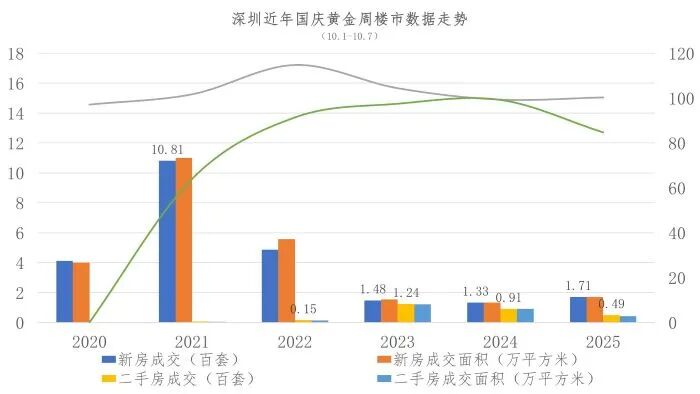
国庆假期的深圳,正在上演资产配置的冰与火之歌。 双节长假期间,市场期待新政后的"银十"似乎又再次缺席。仔细算来,今年已是连续第4年缺席,新房 成交量虽未延续同比下滑态势,但市场观望情绪依然浓厚。 与之形成鲜明对比的是,水贝黄金市场因国际金价持续攀升而呈现购销两旺的景象,"水贝黄金"在国庆 消费的热度飙升。 10月8日,COMEX黄金价格突破4069美元/盎司历史高位,直指4100美元,而距离突破4000美元关口仅 时隔两日。 这种资产偏好的转变在消费端表现得尤为明显,南山某项目销售表示长假期间居民更倾向于安排出行而 非集中看房,加上近年来房产市场的降温,这些因素都很大程度稀释了市场热度。 "四年前挤满售楼处的人群,现在正涌向水贝的黄金柜台。"该销售说道。 上述销售进一步透露道,其客户群体中已出现趁着九月新政窗口期,处置非核心房产,转而增配黄金等 避险资产的情况。 "金九银十"褪色 深圳楼市以价换量冲刺年终 进入四季度,房企面临资金回笼与高库存的双重压力。在传统销售旺季"十一"黄金周,开发商不再强调 热销氛围,而是将"打折让利"作为最直接的破局手段。 昔日铺天盖地的成交喜报被各类促销方案取代,价格调整也呈现结构 ...

资产配置的信仰挪移,深圳国庆楼市与黄金消费演绎冰与火之歌丨华夏双节观察
Sou Hu Cai Jing· 2025-10-08 19:57
Core Viewpoint - The real estate market in Shenzhen is experiencing a significant downturn, with new home sales failing to meet expectations during the National Day holiday, marking the fourth consecutive year of disappointing performance in the "Golden September and Silver October" sales period. In contrast, the gold market, particularly in the Shui Bei area, is thriving due to rising international gold prices, indicating a shift in asset preference among consumers [2][9][10]. Real Estate Market Summary - During the National Day holiday, new home transactions in Shenzhen saw a slight increase, with 171 units sold, representing a nearly 30% year-on-year rise. However, the overall market sentiment remains cautious, with developers resorting to discounts and promotional strategies to stimulate sales [9][4]. - Developers are implementing various pricing strategies, including "fixed price," "special price houses," and "zero down payment" offers to attract buyers. For instance, specific projects are offering significant cash rebates and discounts on larger units [5][6][7]. - The second-hand housing market is struggling, with transaction volumes dropping by 46% and total area sold decreasing by 54% compared to the previous year, indicating a stark contrast to the new home market [9]. Gold Market Summary - The international gold price has been on a steady rise, surpassing $4,069 per ounce during the holiday, which has led to increased consumer interest in gold purchases, particularly in the Shui Bei market [10][11]. - The Shui Bei gold market has seen a surge in activity, with prices reaching a record high of 926 yuan per gram, driven by both traditional wedding jewelry demand and investment purchases [11][13]. - Promotional activities in gold stores have intensified, with discounts ranging from 10% to 12% being offered, further boosting consumer enthusiasm during the holiday period [16].

若不出意外,2026年,国内或将爆发这5大变化,提前了解不吃亏
Sou Hu Cai Jing· 2025-10-08 19:29
Group 1: Population Trends - The birth rate in China is projected to decline significantly, with an expected 8.25 million births in 2024, down by 430,000 from 2023, and potentially dropping to around 7.5 million by 2026, indicating a long-term low fertility rate trend [2][5] - Factors contributing to this trend include rising costs of housing, education, and healthcare, changing values among young people prioritizing personal development, and increased educational and career aspirations among women [2][3] Group 2: Economic Environment - Deposit interest rates have been on a downward trend, with the one-year fixed deposit rate falling to 1.5% in June 2025, down from 2.5% in 2015, leading to a near-zero or negative real interest rate when adjusted for inflation [4] - The proportion of bank deposits in urban households fell below 45% for the first time in early 2025, while investment products rose to 32%, indicating a shift in asset allocation strategies among residents [4] Group 3: Entrepreneurship and Rural Development - The number of returnees starting businesses in rural areas reached 8.76 million in 2024, a 17.3% increase year-on-year, with growth accelerating to 22.1% in the first half of 2025 [8][9] - Improved rural infrastructure, increased internet coverage, and the rise of digital economy models like e-commerce are facilitating this trend, making rural entrepreneurship more viable [8][9] Group 4: Real Estate Market Dynamics - The real estate market is experiencing a rational adjustment, with national sales area down by 6.3% and sales value down by 8.2% in the first half of 2025, indicating a shift away from the expectation of continuously rising prices [14] - The market is expected to continue this rational trend into 2026, with significant differentiation between first-tier cities and those experiencing population outflows [14][15] Group 5: Employment Landscape - The job market is becoming increasingly competitive, particularly for individuals over 35, with the preference for candidates under 35 rising from 37% in 2020 to 52% in 2025 [19] - The average interview success rate for job seekers over 35 is 23.7% lower than for younger candidates, highlighting the challenges faced by older workers in the current job market [19][20]
投资者“双节”把钱放在哪儿? 老中青理财偏好大画像
Zheng Quan Ri Bao· 2025-10-08 16:05
Group 1 - The article highlights the diverse investment preferences across different age groups in China, showcasing how life stages and responsibilities influence investment strategies [1][7] - Z generation investors prefer low-threshold, flexible, and engaging investment options, often starting with small amounts and exploring new financial products [2][3] - Middle-aged investors focus on balancing returns and risk, aiming for stable asset growth to meet family financial needs while diversifying their portfolios [4][5] - The silver-haired demographic prioritizes capital preservation and retirement planning, favoring traditional, low-risk investment vehicles such as government bonds and fixed deposits [6] Group 2 - Z generation's investment behavior is characterized by a willingness to experiment with new investment avenues, reflecting their adaptability and openness to innovative financial products [2][3] - Middle-aged investors tend to engage in active asset management, seeking detailed information about investment products and strategies to optimize their family asset allocation [4][5] - The silver-haired group shows a strong preference for safety and certainty in their investments, often seeking advice on pension planning and wealth transfer strategies [6]
国际黄金期价创历史新高 机构提示风险加大
Zheng Quan Ri Bao· 2025-10-08 16:05
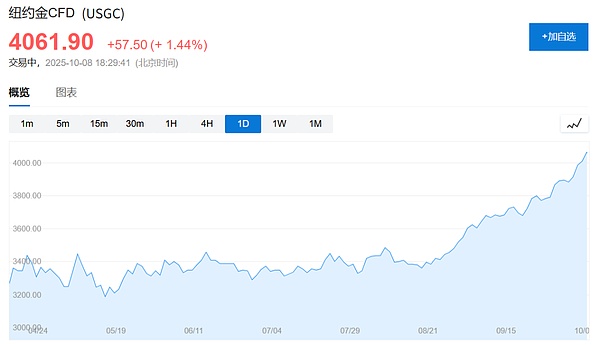
Core Insights - International gold prices reached a historic high during China's "Double Festival" period, with COMEX gold futures hitting $4061.2 per ounce, driven by heightened risk aversion in overseas markets due to the U.S. government shutdown and suspension of economic data releases [1][2] Group 1: Market Performance - COMEX gold futures for December closed at $4060 per ounce, while London spot gold prices remained above $4000 per ounce during the "Double Festival" [1] - COMEX silver prices also reached a nearly 13-year high, reflecting strong demand for safe-haven assets amid inflation and economic risk concerns [2] Group 2: Investment Trends - The Shanghai Futures Exchange's gold futures for the main contract reached a high of 880 yuan per gram, marking the highest point since its listing, with significant capital inflow of nearly 200 billion yuan on that day [2] - Gold-themed funds demonstrated strong capital attraction, with a total scale of 246.9 billion yuan as of October 8, an increase of nearly 130 billion yuan since the beginning of the year [3] Group 3: Fund Performance - Several gold-themed funds reported substantial growth, with some individual products, like the Huaan Gold ETF, increasing to nearly 60 billion yuan, reflecting a net value growth rate exceeding 80% this year [3] - The overall performance of gold-themed funds is attributed to macroeconomic conditions, risk aversion, and adjustments in monetary policy expectations [3]
“现在就像70年代!” ——达利欧:买更多黄金
Hua Er Jie Jian Wen· 2025-10-08 12:19
Group 1: Investment Strategy - Bridgewater Associates founder Ray Dalio suggests that investors should allocate up to 15% of their portfolios to gold, viewing it as a superior hedge compared to the US dollar, especially in the current economic climate reminiscent of the 1970s [1][2][6] - Gold prices have surged over 50% this year, reaching approximately $4,000 per ounce, with futures hitting $4,071 this week [2][4] - Dalio emphasizes that gold serves as a strong store of value amid rising government debt, geopolitical tensions, and declining confidence in fiat currencies [6] Group 2: Market Observations - Dalio expresses caution regarding the recent surge in US stock markets, indicating that speculation around artificial intelligence (AI) exhibits typical bubble characteristics, similar to past market innovations [7] - Despite concerns about valuations, Dalio refrains from shorting large tech companies, indicating a belief in the potential for AI to generate returns through efficiency improvements [7] - Wall Street analysts are bullish on gold, with predictions for gold prices to rise to $4,900 by December 2026, driven by continued ETF inflows and central bank purchases [8]
“现在就像70年代!” 达利欧:买更多黄金
Hua Er Jie Jian Wen· 2025-10-08 11:31
Core Viewpoint - Bridgewater Associates founder Ray Dalio suggests that investors should allocate up to 15% of their portfolios to gold, likening the current economic environment to the 1970s when inflation and government debt were high, making gold a superior hedge compared to the dollar [2][9]. Group 1: Gold Investment - Dalio emphasizes that gold is an excellent diversification asset, especially when traditional assets underperform [3][9]. - Gold prices have surged over 50% this year, reaching approximately $4,000 per ounce, with futures hitting $4,071 [3][6]. - Dalio argues that in the current economic climate, characterized by rising government debt and geopolitical tensions, gold serves as a strong store of value [9][10]. Group 2: Economic Context - The U.S. fiscal deficit is widening, and global tensions are escalating, prompting investors to seek safe-haven assets [6]. - The dollar has weakened against all major currencies, experiencing its largest depreciation since the 1970s, following uncertainties triggered by former President Trump's policies [6][9]. - Dalio compares the current situation to the early 1970s, when high inflation and significant government spending led to a loss of confidence in paper assets and fiat currencies [9]. Group 3: Technology and AI Concerns - Dalio expresses caution regarding the recent surge in U.S. stock prices, suggesting that speculation around artificial intelligence (AI) exhibits typical bubble characteristics [10]. - Despite concerns about valuations, Dalio sees opportunities in companies leveraging AI for efficiency and those providing AI platforms [10]. - He refrains from shorting large tech companies, indicating a cautious but optimistic stance on the sector [10]. Group 4: Market Predictions - Goldman Sachs has raised its gold price forecast for December 2026 from $4,300 to $4,900, citing continued inflows into ETFs and central bank purchases [11]. - Some analysts suggest that while gold is a strong investment, there may be short-term pullback risks due to the rapid price increase [11].
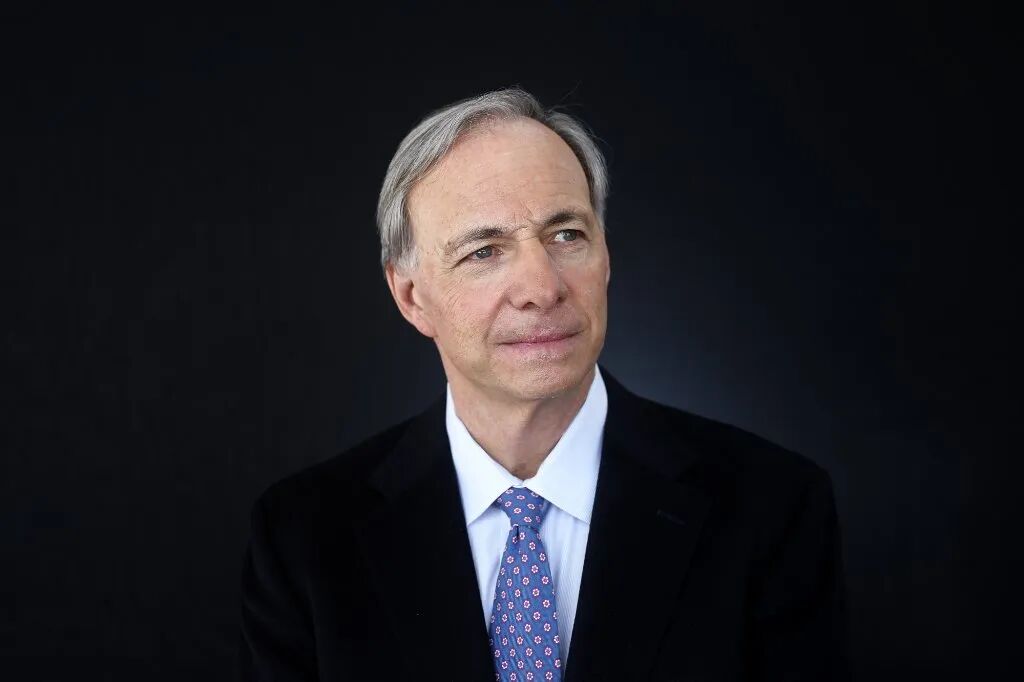
桥水达利欧呼应格里芬:黄金“无疑”是比美元更可靠的避险资产
智通财经网· 2025-10-08 10:52
Group 1 - Ray Dalio, founder of Bridgewater Associates, asserts that gold is a more reliable safe-haven asset than the US dollar, with current gold prices reaching historical highs similar to the 1970s during high inflation and economic turmoil [1][2] - Since the end of July, gold prices have surged over 20%, currently around $4000 per ounce, driven by expectations of a government shutdown and potential interest rate cuts by the Federal Reserve [1] - Dalio recommends allocating about 15% of investment portfolios to gold as a strategic asset allocation move [1][3] Group 2 - Dalio highlights the attractiveness of gold as a store of value amid rising government debt, geopolitical tensions, and declining confidence in currency stability [2] - He expresses concerns about the overheated stock market, particularly regarding the potential bubble in the AI sector, drawing parallels to historical speculative bubbles [3] - Despite valuation concerns, Dalio remains optimistic about investment opportunities in the AI sector, particularly in companies that enhance efficiency through AI and those providing platform support [3] Group 3 - Dalio maintains a positive outlook on the Chinese market while noting that investments in the US are currently larger, acknowledging the unique challenges and advantages of both markets [3]
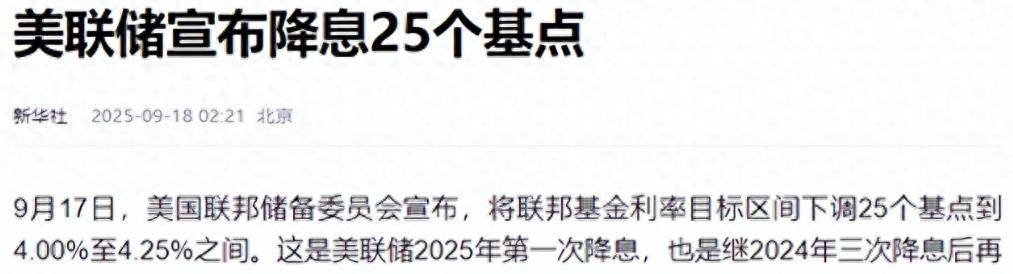
美联储降息25个点!贷款便宜了,积蓄却缩水,普通人仍被割韭菜?
Sou Hu Cai Jing· 2025-10-08 10:38
Group 1 - The Federal Reserve announced a 25 basis point cut in the federal funds rate target range to 4.00%-4.25%, marking the first rate adjustment in nine months and aligning with market expectations [1][2] - The core motivation for the rate cut is the significant cooling of the U.S. job market, with recent employment data showing stagnation and unemployment claims reaching a near four-year high [2][5] - The decision reflects a balancing act between stabilizing employment through accommodative policies while managing inflation, which remains above the 2% target [2][5] Group 2 - The Federal Open Market Committee (FOMC) showed strong unity, with 11 out of 12 members supporting the 25 basis point cut, indicating a more cohesive decision-making process than anticipated [5] - The median rate forecast suggests one more rate cut next year, with some members indicating the possibility of two additional cuts this year, though uncertainty remains [5][7] - The Fed's economic growth outlook has improved slightly, with upward revisions to GDP growth forecasts for 2025, 2026, and 2027, alongside a downward adjustment in unemployment rate expectations [7] Group 3 - The Fed's rate cut creates favorable conditions for the People's Bank of China to implement its own easing measures, such as rate cuts and reserve requirement ratio reductions [9] - Market expectations indicate a potential further reduction of 20-30 basis points in the 5-year LPR, which could lower mortgage rates and stimulate demand in the real estate market [9][10] - The depreciation of the dollar post-rate cut puts upward pressure on the RMB, potentially leading to a short-term appreciation that could lower import costs but also impact export competitiveness [10][11] Group 4 - The narrowing interest rate differential enhances the attractiveness of RMB assets, leading to increased foreign capital inflows into the Chinese market [13] - However, the influx of capital may heighten market volatility and create potential asset bubble risks, necessitating stronger macro-prudential management [13] - Sectors sensitive to interest rates, such as technology and innovative pharmaceuticals, are expected to benefit from the Fed's easing cycle, while traditional industries face increased pressure to adapt [13][15] Group 5 - The Fed's rate cut is expected to provide a relatively loose external environment for the Chinese economy, potentially boosting foreign capital return and market confidence [17] - Long-term challenges include managing imported inflation, currency fluctuations, and the need for industrial transformation [17] - By enhancing industrial upgrades and financial regulation, China aims to convert external opportunities into internal growth drivers, fostering stable development amid global economic adjustments [17]