
货币政策

Search documents
【UNforex财经事件】贸易逆差大幅回落 关税裁决与货币政策变量叠加
Sou Hu Cai Jing· 2026-01-09 04:13
Group 1 - The core point of the article highlights a significant reduction in the U.S. trade deficit in October, dropping to $29.4 billion, which is the lowest level since 2009, deviating from market expectations and adding uncertainty to the macroeconomic environment [1][2][3] - The reduction in trade deficit is attributed to a notable decline in imports and stable exports, indicating a shift in trade flows and corporate behavior following the implementation of tariff policies [1][2] - The improvement in trade data is not comprehensive but concentrated in specific categories, such as increased exports of gold and other metals, while a significant decrease in pharmaceutical imports also contributed to lowering the overall deficit [2] Group 2 - Despite the reduction in trade deficit alleviating some concerns about the "backlash effect" of tariffs, uncertainties regarding trade policies remain, particularly with the U.S. Supreme Court set to rule on the government's authority to impose additional tariffs under the International Emergency Economic Powers Act [2] - Discussions around monetary policy are also sensitive, with U.S. Treasury Secretary Mnuchin indicating that President Trump may finalize the next Federal Reserve Chair selection soon, which could impact market expectations regarding interest rates [2] - Overall, the narrowing trade deficit provides a temporary reference for the effects of tariff policies, but underlying structural changes and policy expectations continue to create uncertainty in the market [3]
【UNforex财经事件】贸易结构短期修复 关税裁决与利率预期再成焦点
Sou Hu Cai Jing· 2026-01-09 04:07
Group 1 - The core point of the article highlights a significant reduction in the U.S. trade deficit in October, dropping to $29.4 billion, which is the lowest level since 2009, providing new insights into macroeconomic conditions amid ongoing tariff discussions [1][2]. - The trade deficit narrowed by nearly 40% compared to the previous month, driven by a notable decline in imports and relatively stable exports, indicating adjustments in trade flows and corporate behaviors following the implementation of tariff policies [2][3]. - The improvement in trade data is not broad-based but concentrated in specific categories, particularly with a significant increase in gold and other metal exports, while pharmaceutical imports decreased, reflecting short-term adjustments in response to high tariffs [3]. Group 2 - Despite the positive trade data, uncertainties regarding tariff policies remain, as the U.S. Supreme Court is set to rule on whether the government can continue imposing tariffs under the International Emergency Economic Powers Act, which could influence future trade policies [4]. - Discussions around monetary policy are also intensifying, with expectations that the next Federal Reserve chair will be announced soon, and current interest rates are perceived to be above neutral levels, indicating potential for policy adjustments [4]. - Overall, while the significant narrowing of the trade deficit provides a temporary validation of tariff effects, the underlying structural changes and policy expectations suggest that market conditions may continue to fluctuate based on these uncertainties [5].
【UNFX财经事件】美国贸易逆差创多年新低 关税效应显现但政策博弈升温
Sou Hu Cai Jing· 2026-01-09 04:07
Group 1 - The core point of the article highlights a significant reduction in the U.S. trade deficit, which fell to $29.4 billion in October, the lowest level since 2009, and a nearly 40% decrease from the previous month, defying market expectations [1][2] - The improvement in the trade deficit is attributed to a notable decline in imports and resilient exports, indicating a rare simultaneous improvement in both areas [1] - The recent trade data reflects adjustments in trade flows due to tariff policies, with companies accelerating the reconfiguration of supply chains and export structures under cost and policy pressures [1][2] Group 2 - The improvement in the trade deficit is not broad-based but concentrated in a few categories, such as a significant increase in gold and other metal exports, while imports of pharmaceutical products decreased, contributing to the lower deficit [2] - Market analysts suggest that the changes observed are more indicative of temporary behavior rather than a fundamental shift in trade trends [2] - The uncertainty surrounding trade policies remains, with the U.S. Supreme Court set to rule on whether the government can impose tariffs under the International Emergency Economic Powers Act, which could impact import pressures [2] Group 3 - In addition to trade factors, monetary policy expectations are also in a sensitive phase, with the U.S. Treasury Secretary indicating that President Trump may finalize the next Federal Reserve Chair selection soon [3] - The current interest rate levels are still significantly above neutral, suggesting an openness to further easing, although most Federal Reserve officials prefer to maintain a wait-and-see approach until more inflation and employment data are available [3] - Overall, the significant narrowing of the trade deficit provides a temporary validation of tariff policy effects, but it is accompanied by structural changes in categories and corporate behavior adjustments, while uncertainties in monetary policy and personnel decisions continue to create market volatility [3]
货币政策预计将保持连续性、稳定性兼顾灵活性丨第一财经首席经济学家调研
Di Yi Cai Jing· 2026-01-09 03:57
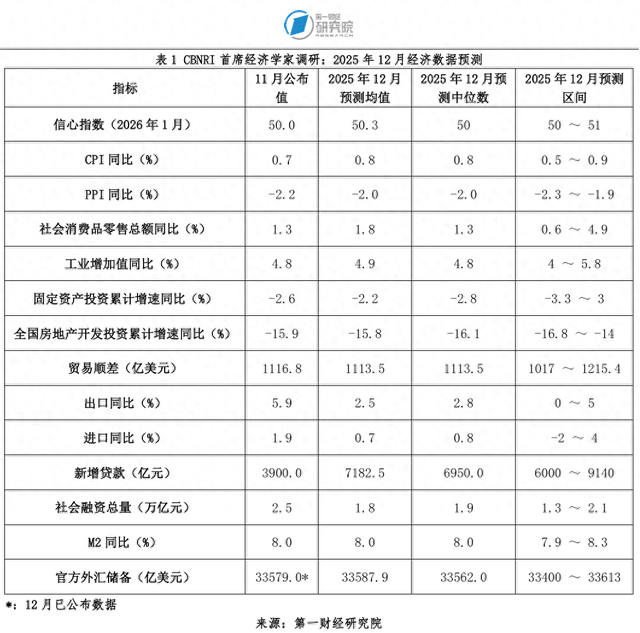
Core Viewpoint - The economic outlook for China in 2025 is expected to show steady progress, with a focus on high-quality development and structural optimization, as indicated by the Chief Economist Confidence Index of 50.32 for January 2026, reflecting a recovery from the previous month [1][4]. Economic Indicators - The average forecast for December 2025 CPI year-on-year growth is 0.8%, slightly higher than the previous month's 0.7% [8][10]. - The average forecast for December 2025 PPI year-on-year growth is -2.0%, an improvement from -2.2% in the previous month [8][10]. - The average forecast for December 2025 industrial added value year-on-year growth is 4.9%, up from 4.8% in November [13]. - The average forecast for December 2025 fixed asset investment cumulative year-on-year growth is -2.2%, an improvement from -2.6% in November [14]. - The average forecast for December 2025 social retail sales year-on-year growth is 1.8%, with a range from 0.6% to 4.9% [10][11]. - The average forecast for December 2025 trade surplus is $1113.5 billion, slightly lower than the previous month's $1116.8 billion [17]. - The average forecast for December 2025 new loans is 7182.5 billion yuan, a significant increase from the previous month's 3900 billion yuan [19]. - The average forecast for December 2025 total social financing is 1.8 trillion yuan, down from 2.5 trillion yuan in November [21]. - The average forecast for December 2025 M2 year-on-year growth is 8%, consistent with the previous month's figure [21][23]. - As of December 2025, China's foreign exchange reserves are expected to be $33579 billion, reflecting a slight increase from the previous month [23]. Policy Outlook - The macroeconomic policy for 2026 is expected to be more proactive, with an increase in fiscal deficit and government debt issuance to support economic growth [25][27]. - Monetary policy is anticipated to remain accommodative, with potential interest rate cuts and reserve requirement ratio reductions to ensure liquidity and lower financing costs [26][27].

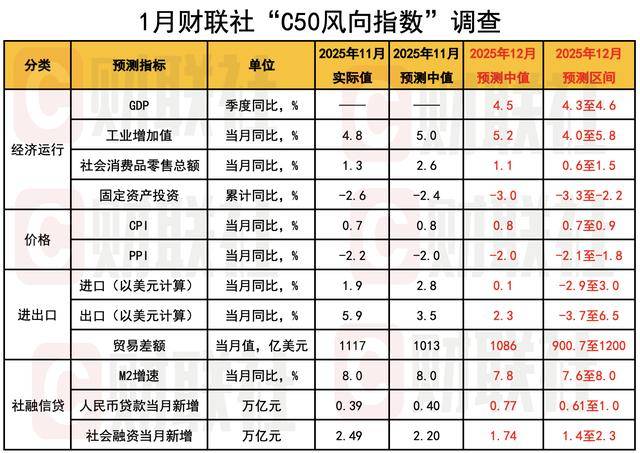
财联社C50风向指数调查:2025年12月社融增速或继续回落,M2与M1剪刀差走扩
Sou Hu Cai Jing· 2026-01-09 03:41
Group 1: Loan and Social Financing Trends - The median forecast for new RMB loans in December 2025 is 0.77 trillion yuan, representing a year-on-year decrease of 0.22 trillion yuan compared to 0.99 trillion yuan in December 2024 [2] - The median forecast for new social financing in December 2025 is 1.74 trillion yuan, down 1.12 trillion yuan from 2.86 trillion yuan in December 2024 [6][9] - High-frequency data indicates that the manufacturing and construction PMIs in December are above the threshold, recorded at 50.1% and 52.8% respectively, suggesting potential support for corporate loans [4] Group 2: Consumer Price Index (CPI) and Producer Price Index (PPI) - The CPI for December 2025 increased by 0.8% year-on-year, aligning with market expectations, while the PPI decreased by 1.9%, showing a smaller decline than anticipated [12][16] - Food prices rose by 1.1%, while non-food prices increased by 0.8%, contributing to the overall CPI increase [15] - The PPI decline was less severe than in previous months, indicating a potential stabilization in industrial prices [16][17] Group 3: Economic and Financial Conditions - The M1 growth rate is expected to continue its downward trend, while M2 growth is projected to slightly decline, leading to an expansion of the M2-M1 gap [10][11] - The pressure on local finances due to hidden debt becoming visible is expected to persist, affecting credit availability [5] - The overall economic environment remains cautious, with businesses likely to prioritize efficiency in capital usage amid uneven recovery in profits and cash flows [10]
突尼斯央行决定下调基准利率至7%
Shang Wu Bu Wang Zhan· 2026-01-09 02:46
突尼斯媒体报道,时隔9个月,突尼斯中央银行决定再次下调基准利率,从7.5%下调至7%,自2026年1 月7日起生效,相应的银行贷款和存款利率分别调整至8%和6%,以确保利率范围的一致性,并保证货 币政策方向能够有效地传导至市场。 ...
第三篇钟才平,来了
Ren Min Wang· 2026-01-09 01:50
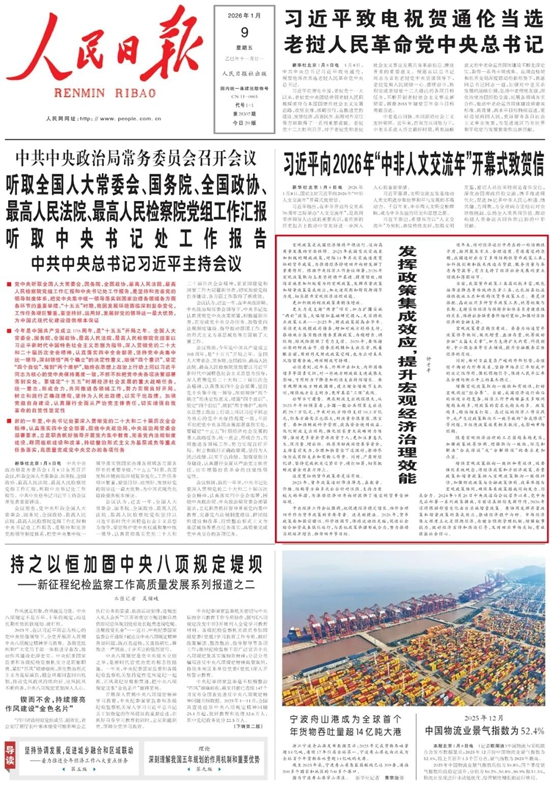
Core Viewpoint - The article emphasizes the importance of integrated macroeconomic policies to enhance governance effectiveness and support China's economic stability and high-quality development [3][4]. Group 1: Macroeconomic Policy - Macroeconomic policies are crucial for maintaining stable economic operations and achieving high-quality development in China [3]. - In 2025, China will implement a more proactive fiscal policy and a moderately loose monetary policy for the first time in 14 years, which will significantly aid in economic recovery [3][4]. - The 2026 macroeconomic policy will focus on stability and quality improvement, continuing to implement proactive policies and enhancing counter-cyclical and cross-cyclical adjustments [3][4]. Group 2: Fiscal Policy - The fiscal policy in 2025 will increase the deficit ratio and issue a larger scale of government bonds, supporting local governments and addressing hidden debt replacement policies [4]. - There is a need to enhance local fiscal capacity and establish mechanisms for increasing revenue and reducing expenditure to ensure basic public services [4][5]. - The total public budget expenditure for 2025 is projected to reach 29.7 trillion yuan, with 1.03 trillion yuan allocated for transfers to local governments [5]. Group 3: Monetary Policy - The monetary policy in 2025 will include timely reductions in reserve requirements and interest rates, providing a favorable financial environment for economic recovery [6]. - The central economic work conference highlights the importance of stabilizing economic growth and ensuring reasonable price recovery as key considerations for monetary policy [6]. - A variety of monetary policy tools will be utilized flexibly to support the real economy while maintaining financial system health [6][7]. Group 4: Policy Coordination - Effective macroeconomic governance requires a focus on the consistency and effectiveness of policies, integrating economic and non-economic policies [8][9]. - There is a need to strengthen the coordination between fiscal and monetary policies to ensure that various measures work in concert to stabilize the economy [9]. - The article stresses the importance of managing expectations and enhancing narrative capabilities to boost social confidence in the economy [9].
格林大华期货早盘提示:国债-20260109
Ge Lin Qi Huo· 2026-01-09 01:32
1. Report Industry Investment Rating - Not provided in the report 2. Core Viewpoints - The 12 - month Chinese manufacturing PMI in 2026 returned to the expansion range after eight consecutive months below the boom - bust line, with production and new order indices also in the expansion range, while the service industry business activity index remained below the boom - bust line. The 2026 People's Bank of China work conference emphasized the implementation of a moderately loose monetary policy. Treasury bond futures may fluctuate in the short term, and the impact of the stock market should be continuously monitored. Traders are advised to conduct band operations [1][2] 3. Summary by Directory 3.1 Market Review - On Thursday, the main contracts of treasury bond futures opened higher across the board. By the close, the 30 - year treasury bond futures main contract TL2603 rose 0.37%, the 10 - year T2603 rose 0.15%, the 5 - year TF2603 rose 0.09%, and the 2 - year TS2603 rose 0.02%. The Wande All - A Index opened slightly lower, fluctuated narrowly throughout the day, and closed up 0.08% compared to the previous trading day, with a trading volume of 2.83 trillion yuan, a slight decrease from the previous trading day's 2.88 trillion yuan [1][2] 3.2 Important Information - **Open Market**: On Thursday, the central bank conducted 990 million yuan of 7 - day reverse repurchase operations with no reverse repurchase maturities, resulting in a net investment of 990 million yuan. It also conducted 1.1 trillion yuan of买断式 reverse repurchase operations with a 3 - month (90 - day) term, and 1.1 trillion yuan of such operations matured on the same day, achieving a full offset [1] - **Funding Market**: On Thursday, the overnight interest rate in the inter - bank funding market remained low. The weighted average of DR001 was 1.27% throughout the day, the same as the previous trading day; the weighted average of DR007 was 1.47%, up from 1.46% in the previous trading day [1] - **Cash Bond Market**: On Thursday, the closing yields of inter - bank treasury bonds mostly declined compared to the previous trading day. The yield of 2 - year treasury bonds remained flat at 1.44%, the 5 - year yield decreased by 1.22 basis points to 1.66%, the 10 - year yield decreased by 1.14 basis points to 1.89%, and the 30 - year yield decreased by 1.55 basis points to 2.32% [1] - **US Unemployment Data**: The number of initial jobless claims in the US last week was 208,000, slightly lower than the forecast of 210,000 and higher than the previous value of 199,000. The number of continued claims for unemployment benefits increased by 56,000 to 1.914 million, indicating an increasing difficulty for the unemployed to find new jobs and an accumulating long - term unemployment risk [1] - **US Supreme Court Decision**: The US Supreme Court has set this Friday (Eastern Time) as the day to issue an opinion on the legality of Trump's comprehensive tariff plan. Analysts generally expect that if the court rules the tariffs illegal, the stock market may be boosted due to improved corporate profit expectations, while the US bond market may face selling pressure due to renewed concerns about fiscal deficits and a more complex subsequent policy path of the Federal Reserve [1] 3.3 Market Logic - The December 2026 Chinese manufacturing PMI was 50.1%, returning to the expansion range after eight consecutive months below the boom - bust line. The production index was 51.7%, and the new order index was 50.8%, indicating that both manufacturing production and demand entered the expansion range. The service industry business activity index was 49.7%, remaining below the boom - bust line. The 2026 People's Bank of China work conference emphasized the implementation of a moderately loose monetary policy, aiming to promote high - quality economic development and a reasonable recovery of prices, and to use various monetary policy tools such as reserve requirement ratio cuts and interest rate cuts flexibly and efficiently to maintain sufficient liquidity. In December 2025, the central bank made a net investment of 5 billion yuan through open - market treasury bond trading operations, which was the third consecutive month of such operations [1][2] 3.4 Trading Strategy - Traders should conduct band operations [2]
基本面变化不大 纯碱上方空间有限
Qi Huo Ri Bao· 2026-01-09 00:42
Core Viewpoint - After the New Year, the mainstream region's soda ash spot prices have gradually stabilized, with an increase in export volume in November 2025, but domestic demand remains weak, keeping prices low [1] Group 1: Supply and Production - In 2025, the national soda ash production reached 37.857 million tons, a year-on-year increase of 2.2%, with December production rising to 3.18 million tons [2] - The operating rate of domestic ammonia-soda plants was 79.2% as of January 2, 2026, a decrease of 4.1 percentage points month-on-month and 7.3 percentage points year-on-year; the operating rate of the soda-lime process was 72.7%, down 1.1 percentage points month-on-month and 8.5 percentage points year-on-year [2] - Two new production units are planned to be commissioned in the first quarter of 2026, adding a total capacity of 3.7 million tons per year, bringing the total domestic soda ash capacity to 44.6 million tons per year [2] - Domestic soda ash companies have been depleting inventory for two consecutive weeks, with inventory dropping to 1.4083 million tons as of January 2, a decrease of 30,200 tons week-on-week and 40,000 tons year-on-year, although the absolute inventory level remains high [2] Group 2: Export and Demand - In November 2025, soda ash exports totaled 189,400 tons, a decrease of 25,100 tons month-on-month; the total export volume from January to November 2025 was 1.9612 million tons, an increase of 922,500 tons year-on-year [2] - The increase in export volume is primarily due to domestic soda ash prices being at a low point, leading to increased export orders; however, future export growth remains uncertain with rising spot prices [2] - As of January 2, 2026, the daily melting volume of float glass nationwide was 153,300 tons, a decrease of 0.9% month-on-month and 3.3% year-on-year; the daily melting volume of photovoltaic glass in December 2025 was 73,500 tons, an increase of 4.2% month-on-month and 2.2% year-on-year [3] - The demand structure for heavy soda indicates that float glass accounts for 35%-40% and photovoltaic glass for 10%-15%; float glass production decreased by 6.5% year-on-year, while photovoltaic glass production fell by 9.3% year-on-year [3] - Light soda demand has increased due to the recovery in the lithium carbonate industry, while the demand for alumina and detergents remains stable; overall, the short-term supply-demand balance for soda ash is unlikely to change significantly [3]
发挥政策集成效应,提升宏观经济治理效能
Ren Min Ri Bao· 2026-01-08 22:47
Core Viewpoint - The macroeconomic policy is crucial for maintaining stable economic operations and advancing high-quality development in China, with a focus on implementing more proactive fiscal and monetary policies in 2025 and 2026 [1] Fiscal Policy - In 2025, the fiscal policy will increase the deficit ratio and arrange a larger scale of government bonds, enhancing local transfer payments to support growth, structural adjustments, and risk prevention [2] - The fiscal expenditure for 2025 is projected to reach 29.7 trillion yuan, with central government transfers to local governments amounting to 10.3 trillion yuan, indicating significant fiscal pressure [3] - There is a need to address local fiscal difficulties by establishing mechanisms for increasing revenue and reducing expenditure, ensuring the basic financial security for grassroots services [2] Monetary Policy - The monetary policy in 2025 will adopt a flexible approach, including timely reductions in reserve requirements and interest rates to create a favorable financial environment for economic recovery [4] - The emphasis will be on maintaining liquidity and promoting low financing costs while addressing structural economic issues through targeted monetary policy tools [4] - A diverse toolbox of monetary policy instruments will be utilized to balance short-term and long-term goals, supporting the real economy while ensuring the health of the financial system [4] Policy Coordination - There is a strong emphasis on the need for precise and effective macroeconomic policies, focusing on enhancing the transmission mechanism of monetary policy and supporting key areas such as domestic demand and technological innovation [5] - The coordination of fiscal and monetary policies is essential to prevent inconsistencies that could undermine market expectations and policy effectiveness [6] - The government aims to strengthen the consistency and effectiveness of macro policies, ensuring that various measures work in concert to stabilize the economy [6]