
美国例外论

Search documents
从“MAGA”到“TACO” 金融市场交易策略自“特朗普2.0”以来不断演变
智通财经网· 2025-05-31 05:06
Group 1 - The article discusses the emergence of various acronyms in financial markets that reflect the volatility and uncertainty since Donald Trump's return to the presidency, with strategies linked to his economic and trade policies [1][2][3] - Acronyms like MAGA (Make America Great Again) and YOLO (You Only Live Once) were popular during the initial phase of Trump's presidency, driving significant market movements, but have since lost favor due to concerns over economic policies and market stability [2][3] - The TACO (Trump Always Chickens Out) strategy has gained traction among traders, betting on Trump's tendency to backtrack on aggressive policies, leading to market rebounds after initial declines [3][4] Group 2 - MEGA (Make Europe Great Again) has resurfaced as European markets outperform U.S. markets, driven by increased interest in European equities and military spending in response to U.S. policies [5][6] - The MAGA variant, "Make America Go Away," reflects a growing sentiment among foreign investors to avoid U.S. markets due to concerns over inflation and the erosion of confidence in U.S. assets [6][7] - FAFO (Fuck Around and Find Out) describes the chaotic market conditions resulting from Trump's policy decisions, highlighting the risks of frequent trading in response to market volatility [7]
美国关税,还加吗?
Yin He Zheng Quan· 2025-05-29 09:00
Group 1: Court Ruling and Implications - The U.S. International Trade Court ruled to suspend the tariff policy announced by the Trump administration on April 2, citing it as unconstitutional under the IEEPA[2] - The court's decision mandates the Trump administration to cancel these tariffs within 10 days of the ruling[4] - The ruling specifically affects tariffs imposed under the IEEPA, while tariffs under Section 232 of the Trade Expansion Act remain unaffected[4] Group 2: Economic Outlook - If the court's ruling stands, the current tariff strategy of the Trump administration may be deemed a failure, leading to a reduced probability of significant tariff increases in Q2 and Q3[6] - The expected average CPI growth for 2025 is projected to remain below 3% due to reduced demand shocks from tariffs[6] - The Federal Reserve may consider lowering interest rates sooner, with a potential first cut in September, as inflationary pressures ease[6] Group 3: Scenarios and Market Reactions - Three scenarios are considered: (1) the ruling is upheld, (2) a temporary stay is granted, or (3) the ruling is overturned[5] - In the event of a ruling upholding the suspension, the U.S. economy may see a slowdown to 1.5% or lower for the year[7] - Following the court's decision, gold prices fell, while U.S. stock index futures rose, indicating a mixed market reaction[7]
普徕仕:“美国例外论”面临挑战 但仍最看好美股
Zhi Tong Cai Jing· 2025-05-29 02:52
Group 1 - The core viewpoint emphasizes that despite recent challenges to the "American exceptionalism," the U.S. stock market remains the most favorable investment option due to its free market structure, liquidity, sound financial regulation, and transparency [1] - The S&P 500 index has shown strong performance, with approximately 90% of companies reporting first-quarter earnings, revealing an average revenue growth of 5% and earnings per share growth of 14%, significantly exceeding the market expectation of 7% [1] - Current economic indicators, including credit card spending and unemployment claims, remain robust, supporting strong consumer spending [1] Group 2 - A major concern is the U.S. deficit consistently exceeding 6% of GDP, which could lead to market skepticism regarding U.S. credit reliability and potentially push the 10-year Treasury yield above 5%, putting pressure on stock valuations [2] - While the deficit raises investor concerns, it has not undermined the core systems that support the U.S. "exceptionalism," suggesting that the U.S. is likely to continue providing attractive long-term investment opportunities [2]
瑞银揭示富人资金流:高净值客户加码另类资产 备战市场动荡与滞胀
智通财经网· 2025-05-28 07:15
Core Viewpoint - UBS's wealthy clients are increasingly seeking to diversify their investment portfolios by significantly increasing allocations to alternative assets amid market volatility and global trade uncertainties [1][2] Group 1: Alternative Assets Demand - UBS's Asia-Pacific President Iqbal Khan noted a strong and growing demand for alternative assets among clients, indicating a shift in investment strategies to mitigate risks [1] - Alternative assets, which include private equity, private credit, hedge funds, real estate, and collectibles, are characterized by lower liquidity and lower correlation with traditional assets, making them valuable during market turmoil [1] Group 2: Interest Rate Outlook and Stagflation Risks - Khan anticipates a continued decline in benchmark interest rates and an increasing likelihood of a stagflation environment, particularly in the U.S. [2] - The recent geopolitical tensions and aggressive U.S. policies have raised concerns among investors about potential stagflation or deep recession risks, contributing to the weakening of dollar assets [2] Group 3: Leadership Changes and Integration Progress - As part of a leadership restructuring in 2024, Khan has been appointed to oversee UBS's Asia-Pacific operations, while Rob Karofsky will manage U.S. operations [3] - UBS has faced challenges following its acquisition of Credit Suisse, including significant layoffs and cost-cutting measures, with a goal of achieving $13 billion in synergies [3] Group 4: Regulatory Challenges - UBS executives express concerns that excessive regulation could undermine Switzerland's competitiveness in the global financial market, with potential implications for the bank's headquarters location [4]

对冲基金们真金白银押注“下一个新台币”:韩元,就你了
Zhi Tong Cai Jing· 2025-05-27 03:08
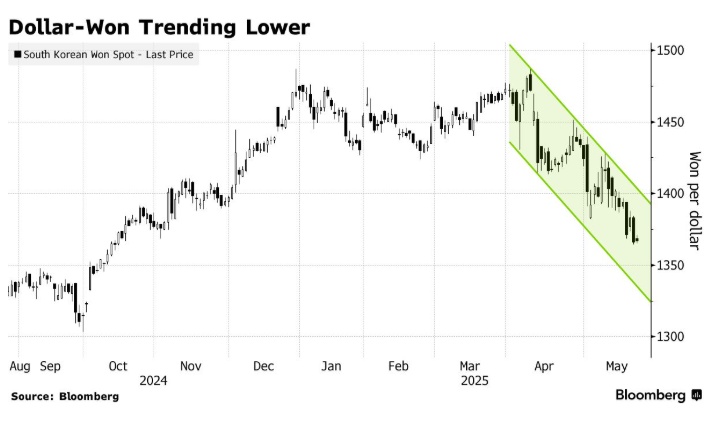
Core Viewpoint - Global hedge funds are heavily betting on the options market, believing that the long-underestimated South Korean won will replicate the recent record appreciation trend of the New Taiwan dollar against the US dollar [1][4]. Group 1: Market Dynamics - There has been a significant increase in demand for bearish options on the USD/KRW pair, with a put-to-call ratio of 3:2, indicating a strong bearish sentiment towards the dollar and bullish outlook for the won [1][5]. - The trading volume of USD/KRW options surged to its highest level of the year, reflecting market speculation on the potential direction of the won amid discussions between South Korea and the US regarding currency negotiations [4][5]. - The optimism surrounding global trade dynamics, particularly the easing of tensions between the US and China, has led investors to believe that the South Korean authorities may tolerate a stronger currency [4][6]. Group 2: Investment Sentiment - The recent substantial appreciation of the New Taiwan dollar has reshaped investor expectations for Asian currency exchange rates, positioning the won as a likely candidate to follow suit [4][6]. - Hedge funds are increasingly interested in which currencies might replicate the New Taiwan dollar's sharp gains, leading to a notable demand for both digital and vanilla put options on the USD/KRW pair [4][6]. - The risk reversal indicator, which measures the cost of hedging against a decline in the USD/KRW exchange rate, approached a 21-year high last week, further emphasizing the market's bearish outlook on the dollar [5]. Group 3: Economic Implications - The Trump administration's trade policies and potential acceptance of a weaker dollar could significantly impact the USD/KRW exchange rate, as many investors view the won as a proxy for changes in trade dynamics between the US and Asia [6][7]. - Analysts from major banks, including JPMorgan and Deutsche Bank, maintain a bearish stance on the dollar, suggesting that the current rebound in the dollar index may be temporary and that a prolonged dollar bear market is beginning [7]. - The erosion of the "American exceptionalism" narrative is seen as a contributing factor to the declining confidence in dollar assets, with market participants increasingly skeptical of the US's economic policies [7].

“特朗普经济学2.0”重创美元 属于欧元的黄金时代即将开启?
智通财经网· 2025-05-26 23:37
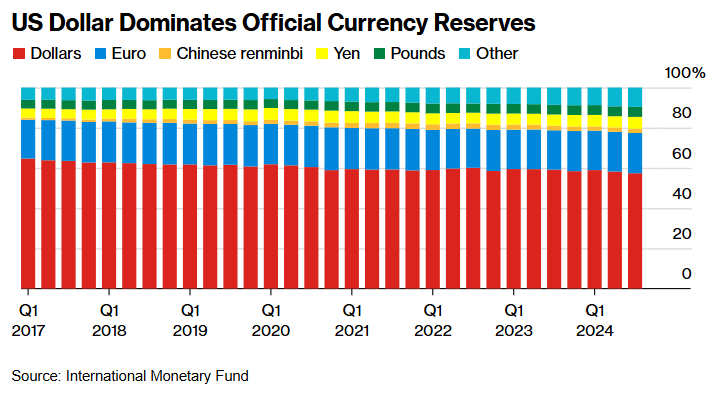
Core Viewpoint - The return of Donald Trump to the White House has created an opportunity for the euro to enhance its international role, potentially allowing the Eurozone to enjoy monetary privileges previously held only by the US [1][2]. Group 1: Euro's Rise - The euro has been steadily appreciating against the dollar since Trump's return, leading to optimism from major banks like Goldman Sachs and Deutsche Bank regarding the euro's future [1]. - Lagarde emphasized that the current policy environment presents a unique opportunity for Europe to assert its monetary influence, but it requires proactive efforts from European leaders [5][8]. Group 2: Trump's Economic Policies - Trump's "America First" approach continues to dominate, with aggressive policies aimed at re-industrialization and reducing trade deficits, which have led to significant volatility in the financial markets [2][6]. - The chaotic nature of Trump's administration has undermined confidence in the dollar, contributing to a potential long-term bear market for the currency [6][7]. Group 3: Eurozone's Strategic Goals - Lagarde outlined three key areas for enhancing the euro's global standing: maintaining a commitment to open trade, completing the single market, and increasing joint financing for security measures [8][9]. - The need for a robust legal and institutional framework in Europe was highlighted to ensure investor confidence in the euro's long-term value [9].
【财经分析】获多家投行看好 欧洲股市今年有望跑赢美股
Xin Hua Cai Jing· 2025-05-22 13:55
Core Viewpoint - Investors are shifting from the US stock market to European markets due to concerns over US economic prospects and favorable conditions in Europe, leading to predictions of strong performance for European stocks this year [1][2][3]. Group 1: US Market Analysis - The S&P 500 index has decreased by 0.8% since January, while the Nasdaq index has fallen by 0.5% [2]. - The dollar index has dropped by 8% since January 2025, indicating a loss of confidence in the US economy among investors [3]. - 40% of economists predict a recession in the US this year, contributing to reduced investment in US stocks [3]. - Funds flowing into US stock ETFs have decreased by 20% compared to the same period last year [3]. Group 2: European Market Outlook - The Stoxx 600 index has risen by 9% since the beginning of the year, with the CAC40 and DAX indices increasing by 7% and 21%, respectively [2]. - European stock ETFs have seen a 24% increase in inflows since the beginning of the year [4]. - 35% of fund managers are overweight on European stocks, while allocations to US stocks have reached a two-year low [4]. - The MSCI Europe index constituents reported a 5.3% profit growth in Q1, significantly exceeding the expected decline of 1.5% [4]. Group 3: Economic and Political Factors - The European Central Bank is expected to continue its interest rate cuts, which will support economic growth [4]. - Germany announced a €1.5 trillion investment plan for infrastructure and defense, while the EU has initiated an €800 billion "rearmament of Europe" plan [4]. - Concerns related to the Russia-Ukraine conflict are adding pressure to European stocks, with a risk premium estimated to affect the Stoxx 600 index's P/E ratio by 1 to 2 percentage points [5].
美债风暴阴影再度笼罩,渣打预计美联储将托底!
Jin Shi Shu Ju· 2025-05-22 08:16
渣打银行(Standard Chartered Bank)高级投资策略师Foo Ken Yap表示,尽管市场对美国财政赤字的担 忧加剧,但美联储可能实施的降息举措或帮助缓冲债券市场受到的冲击,并支撑股市。 "(债券)收益率一直在攀升,"Foo Ken Yap指出,过去一个月市场预期的转变显著。"市场此前预计年 底前将有三次以上降息,而现在……很多情况已改变。" 渣打预计,受经济增速放缓及美联储最终行动的推动,美国10年期国债收益率将在12个月内从当前的约 4.59%降至4%-4.25%。 Foo Ken Yap表示:"我们确实预期随着经济放缓,降息将在后期落地以支撑增长。" Foo Ken Yap对未来12个月的美国股市持建设性态度,并预计美联储最终将介入以支持经济增长,从而 推动债券收益率下降。 "'美国例外论'……暂时停顿,但我们认为其并未消失。增长仍在,人工智能(AI)仍在,"他指出,强 劲的企业投资和韧性的盈利预期是支撑因素。 他还重申了对黄金的长期乐观看法,称其为通胀和衰退风险中的有效对冲工具。"我们对黄金的12个月 目标价为3500美元,"Foo Ken Yap表示。 他补充称,尽管美国国会围绕支 ...
橡树资本马克斯:仍然相信“美国例外论”,但立场不再那么坚定
news flash· 2025-05-21 19:55
橡树资本管理公司联席董事长、全球杰出投资者之一霍华德·马克斯(Howard Marks)表示,美国仍然 是投资者的首选目的地。"如今,'美国例外论'这个词挂在每个人嘴边。过去80到100年里,美国确实在 世界上占据了主导地位,这得益于其充满活力的经济、对自由市场体系的尊重、对法治、资本市场的尊 重、创新精神等等。这些因素至今仍未消失。我认为美国仍然是投资者的首选目的地。"他说道。 ...
4月外资净增持境内债券109亿美元
Mei Ri Jing Ji Xin Wen· 2025-05-21 15:25
在前述华尔街投资基金经理看来,4月美国出台"对等关税"政策,不但冲击全球贸易格局,还影响全球 资本的债券配置策略。 一位华尔街投资基金经理通过微信采访向记者分析说,4月海外资金持续青睐中国境内债券,很大程度 是受到月初美国出台"对等关税"政策的影响——在美国出台"对等关税"政策后,美国金融市场多次出现 股债汇"三杀"状况,令全球投资机构纷纷质疑"美国例外论",转而加快资产分散化配置步伐。 债券配置策略为何变了? "4月以来,越来越多海外机构都在质疑美国例外论。"他向记者透露。所谓美国例外论,是指近年在全 球地缘政治风险升级等因素的影响下,全球主要经济体都遭遇不同程度的经济周期波动,但美国经济 则"独善其身",始终保持较好增长。 4月,全球贸易环境骤变之际,海外资本愈加青睐中国人民币资产。 近日,国家外汇管理局副局长李斌表示,外资配置人民币资产意愿持续向好,4月外资净增持境内债券 109亿美元,处于较高水平;4月下旬外资投资境内股票转为净买入。 今年一季度,中国国内生产总值同比增长5.4%,延续去年以来持续稳中向好、稳中回升的态势,为外 资构建了稳定可靠的投资环境。 中国宏观经济运行整体回升向好,令人民币债券价 ...