
货币宽松

Search documents
布局2026:五大具备强逻辑的行业赛道
Di Yi Cai Jing· 2025-11-19 08:44
Core Viewpoint - The global capital markets are undergoing complex changes, with uneven economic recovery, frequent geopolitical disturbances, and an imminent shift in monetary policy, making investment strategies more challenging. Focusing on high-quality sectors characterized by "strong logic, high barriers, and stable demand" is essential for institutional investors to navigate macroeconomic fluctuations [3]. Group 1: Non-ferrous Metals - The Shenwan Non-ferrous Metals Index has increased by 77.71% since 2025, leading all primary industries, driven by a combination of monetary environment, demand structure, and supply rigidity [4]. - The onset of a monetary easing cycle and the deepening trend of de-dollarization are reshaping global asset allocation, with gold's strategic significance as a "anti-dollar" asset becoming more pronounced [5]. - Copper is benefiting from the green transition and digital economy, with a projected global copper supply-demand gap expected to widen from 2025 to 2027 [6]. - Supply rigidity is evident as global mining capital expenditure has lagged behind demand growth, leading to insufficient production capacity [7]. - The non-ferrous metals sector, particularly precious metals, rare earths, and industrial metals, is expected to remain a core investment focus due to sustained demand and constrained supply [8]. Group 2: Power Equipment - The Shenwan Power Equipment Index has risen by 51.14% since 2025, positioning it third among industries, with expectations for a full economic cycle in 2026 driven by the recovery of the energy storage and midstream electric vehicle sectors [10]. - The domestic energy storage market is experiencing significant growth, with a projected 220GWh of new installations in 2026, a year-on-year increase of approximately 47% [11]. - China dominates the global energy storage manufacturing sector, holding over 93% of the market share in energy cells and 76% in systems [12]. - The midstream electric vehicle sector is expected to see a recovery in profitability, with global lithium battery shipments projected to grow by 20%-25% [13]. - Global grid investment is anticipated to reach $390 billion in 2024, with significant growth expected in the Southeast Asia and Middle East regions [14]. Group 3: Aerospace - The aerospace industry is entering a strategic opportunity period driven by domestic demand, foreign trade expansion, and civil-military integration [15]. - Domestic demand is supported by a stable 7.2% growth in defense budgets over three years, focusing on advanced weaponry and AI-enabled systems [16]. - China's special equipment is rapidly expanding into international markets due to significant cost advantages amid rising global military expenditures [17]. - The integration of cutting-edge military technology is creating new growth opportunities, with the commercial aerospace sector entering a phase of rapid application [18]. Group 4: Biopharmaceuticals - The biopharmaceutical sector is expected to present a dual-track investment opportunity in 2026, characterized by innovation-driven internationalization and improved domestic demand [19]. - The internationalization of innovative drugs is accelerating, with a 77% year-on-year increase in License-out transactions in 2025 [20]. - Global pharmaceutical R&D investment is projected to grow at a compound annual growth rate of 9.4%, indicating a recovery in the CXO sector [21]. - The medical device sector is witnessing breakthroughs in brain-computer interfaces and high-end equipment, with domestic companies increasing their market penetration [22]. - Domestic policy optimization and diversified payment structures are providing a safety net for the biopharmaceutical market [23]. Group 5: AI Hardware - The AI hardware industry is entering a new phase of growth driven by the AI computing revolution and terminal innovation [25]. - The demand for AI computing chips is accelerating domestic production, with significant growth in the storage chip sector [26]. - The server market is experiencing explosive growth, with a 10-fold increase in computing power per cabinet driven by large model training [27]. - AI glasses are projected to become a major market highlight, with global shipments expected to exceed 10 million units in 2026 [28]. - The commercialization of L3-level autonomous driving systems is approaching a critical point, with significant advancements in key components [29]. Conclusion - The five highlighted sectors are expected to exhibit clear investment logic in 2026, driven by industrial cycles, policy support, and technological breakthroughs. These sectors not only hold annual allocation value but also represent the core of China's transition from "scale expansion" to "high-quality development" [30][31].


全球外汇市场要闻速递:主要央行政策动向引关注
Sou Hu Cai Jing· 2025-11-19 07:28
Group 1 - The Federal Reserve plans to significantly reduce the scope of regulatory oversight on bank safety and soundness, raising market concerns [1] - Trump hinted that the selection of the next Federal Reserve Chair has been determined, expressing frustration over the resistance faced in dismissing Powell [1] - Treasury Secretary Mnuchin indicated that Trump may announce the nomination for the next Federal Reserve Chair before Christmas [1] Group 2 - Richmond Fed President Barkin supports Powell's view that a rate cut in December is not a foregone conclusion [3] - Fed Governor Barr expressed concerns that loosening regulations could lead to risk accumulation, potentially setting the stage for future crises [3] - Political uncertainty in the UK has increased, with nearly half of Labour Party voters wanting leader Starmer to step down before the next election, according to a Times poll [3] Group 3 - The Chief Economist of the Bank of England, Pill, emphasized that persistent inflation above target should not be overlooked, with expectations for inflation to gradually decline [3] - The Monetary Policy Committee believes that the neutral interest rate level is between 2% and 4% [3] - Japanese government economic strategy advisors indicated that the Bank of Japan is unlikely to raise interest rates before March next year [3] - Bank of Japan Governor Ueda and other officials held a meeting to discuss economic policy, with Ueda suggesting a gradual approach to adjusting monetary easing [3]

贵金属有色金属产业日报-20251118
Dong Ya Qi Huo· 2025-11-18 11:59
1. Report Industry Investment Rating No relevant content provided. 2. Core Views of the Report - For precious metals, although central bank gold purchases and growing investment demand will push up the price center in the long - term, the unclear prospect of interest rate cuts in December and short - term technical weakness suggest a possible short - term adjustment. Attention should be paid to the retracement of the 200 - day moving average [3]. - For copper, as the delivery date approaches, the registered warrant volume has rapidly increased. The spot price of electrolytic copper has declined, the premium has strengthened, and the purchasing sentiment has increased but not significantly. The futures price has shown narrow - range fluctuations and lacks driving forces [15]. - For aluminum, the expected tightening of overseas electrolytic aluminum supply has given rise to a bullish sentiment among funds, leading to an influx of capital into Shanghai aluminum futures and an increase in prices. However, downstream demand may not support such high prices, so Shanghai aluminum is expected to fluctuate at a high level. Alumina has seen price - increasing orders due to environmental production restrictions and short - covering, but it still follows an oversupply logic. Cast aluminum alloy has strong follow - up characteristics with Shanghai aluminum and has strong downside support [33][34]. - For zinc, the expectation of interest rate cuts has cooled down, and the smelting sector's willingness to reduce or halt production in November has increased due to intense competition for ores and a significant decline in TC. The impact needs to be observed through inventory changes in November. There is a possibility of inventory reduction if demand remains stable. Currently, there are significant differences between bulls and bears, and the bottom space can be observed at the end of the month [57]. - For nickel, the expectation of interest rate cuts in December is uncertain, and the progress of Sino - US tariffs has affected risk preferences. Nickel ore prices may remain strong in the short term due to the approaching rainy season in the Philippines and the impact of typhoons on production and shipping. The prices of nickel - iron and stainless steel have declined due to weak downstream demand, and both are experiencing inventory accumulation [73]. - For tin, although there has been some resumption of production in Yunnan, the supply is still weaker than demand due to the under - expected resumption of production in Wa State and a sharp reduction in concentrate imports. Shanghai tin is expected to maintain a high - level oscillation, with support predicted around 276,000 yuan [88]. - For lithium carbonate, the price has far exceeded expectations, and downstream buyers have no intention to replenish inventory. There is an expectation of a decline in production in December. Technically, the price has broken through the 90,000 - yuan mark and reached 95,000 yuan, posing a high risk for chasing the price. There is an over - rising sentiment, and the risk of chasing the price should be vigilant [104]. - For the silicon industry chain, the supply - demand pattern of industrial silicon is generally weak, and it is expected to have wide - range fluctuations. The polysilicon industry chain is experiencing production cuts and inventory accumulation, with a weak fundamental outlook and wide - range weak fluctuations [115]. 3. Summaries by Related Catalogs Precious Metals - **Price Outlook**: Short - term adjustment possible, long - term upward trend supported by central bank purchases and investment demand [3]. - **Market Data**: Included price trends of SHFE and COMEX gold and silver, their ratios, and relationships with the US dollar index, US Treasury real interest rates, and long - term fund holdings [4][8][11]. Copper - **Spot Market**: Spot prices of copper have declined, with different degrees of decline in various regions. The premium has also decreased [18]. - **Futures Market**: Futures prices have declined, and the trading volume and open interest have shown certain trends. The registered warrant volume has increased significantly [16][19][29]. - **Import and Processing**: Copper import losses have increased, and the TC of copper concentrates has remained unchanged [24]. - **Scrap - to - Refined Spread**: The scrap - to - refined spread has decreased, indicating a reduced price advantage of scrap copper [28]. Aluminum - **Futures Prices**: The prices of Shanghai aluminum, alumina, and aluminum alloy futures have declined to varying degrees [35]. - **Price Spreads**: There are differences in price spreads between different contracts of aluminum and alumina, as well as between aluminum and alumina [38][40]. - **Spot Market**: Spot prices of aluminum in different regions have declined, and the basis has also changed [44]. - **Inventory**: The inventory of Shanghai aluminum and LME aluminum has changed, and the alumina warehouse receipt inventory has remained stable [51]. Zinc - **Futures Prices**: The prices of Shanghai zinc futures have generally declined, except for the second - consecutive contract which has increased slightly [58]. - **Spot Market**: Spot prices of zinc have declined, and the premium has changed significantly [66]. - **Inventory**: The inventory of Shanghai zinc and LME zinc has increased [70]. Nickel - **Futures Market**: The prices of Shanghai nickel and LME nickel have declined, and the trading volume has increased while the open interest has decreased. The warehouse receipt volume has increased [74]. - **Downstream Market**: The prices of nickel - iron and stainless steel have declined, and the downstream demand is weak. Both are experiencing inventory accumulation [73]. Tin - **Futures Market**: The prices of Shanghai tin and LME tin have changed slightly, with Shanghai tin showing a slight decline [89]. - **Spot Market**: The spot prices of tin and tin concentrates have declined slightly, and the prices of solder products have remained stable [93]. - **Inventory**: The inventory of Shanghai tin has increased, while the LME tin inventory has decreased [99]. Lithium Carbonate - **Futures Prices**: The prices of lithium carbonate futures have generally increased compared to the previous week, but there has been a slight decline on the day [105]. - **Spot Market**: The prices of various lithium - related products have increased, and the price differences between different grades have also changed [109]. - **Inventory**: The warehouse receipt inventory of the Guangzhou Futures Exchange and the social inventory of lithium carbonate have decreased [113]. Silicon Industry Chain - **Industrial Silicon**: The spot prices of industrial silicon in different regions have changed slightly, and the basis has increased. The futures prices have declined [115]. - **Polysilicon and Downstream Products**: The prices of polysilicon, silicon wafers, battery chips, and components have shown certain trends, and the inventory of polysilicon has increased [123][133].
4000点会拉锯到啥时候?关注核心宽基中证A500ETF(159338)
Sou Hu Cai Jing· 2025-11-17 02:10
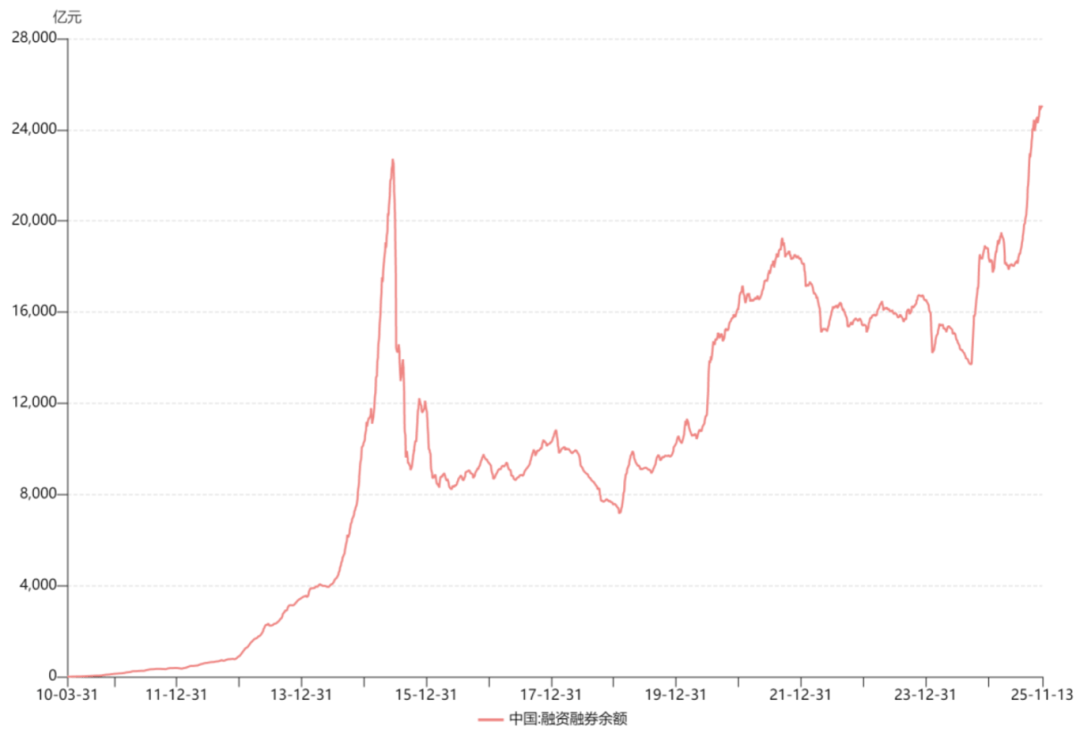
Market Overview - The market remains in a volatile pattern, with the Shanghai Composite Index fluctuating around the 4000-point mark. Last week, the index showed strong performance on Monday and Thursday but failed to maintain upward momentum, falling below 4000 points on Friday due to a significant drop in global markets. The cyclical sectors performed actively, while the ChiNext and STAR 50 indices both declined over 3% [1] Economic Data - In October, new RMB loans amounted to 220 billion, a decrease of 280 billion year-on-year. The new social financing scale was 815 billion, down 597 billion year-on-year. Overall, the social financing data showed weakness, with both new credit and social financing scale falling short of expectations and seasonal norms. The household sector's credit contracted again, indicating a "de-leveraging" trend, while corporate credit growth relied heavily on bill financing [2] - Industrial value-added in October grew by 4.9% year-on-year, down from 6.5% previously. Retail sales increased by 2.9%, slightly up from 3%. From January to October, fixed asset investment decreased by 1.7%, with real estate investment down 14.7% [2] Economic Outlook - The economic data for October indicates a slowdown in total output, with key metrics such as industrial, service, investment, retail sales, exports, and real estate sales growth all falling below previous values. However, achieving the annual GDP growth target of around 5% remains likely, as only a 4.4% growth in the fourth quarter is needed to meet this goal. This suggests that while short-term policies may intensify, the focus will be more on planning for the next year [3] - The A-share market continues to show an upward trend in margin trading balances, with the balance stabilizing above 2.5 trillion, reflecting market confidence and risk appetite. Additionally, southbound capital inflows reached 24.77 billion, indicating ongoing support for Hong Kong stocks [3] International Developments - The U.S. government has taken a significant step towards ending its longest shutdown by passing a temporary funding bill, which will provide funding for most government agencies until January 30, 2026. This development is expected to restore government operations [5] - The absence of key economic data in the U.S. has increased uncertainty regarding the Federal Reserve's interest rate decisions in December, with the probability of a rate cut now below 50% [5] Investment Opportunities - To effectively break through the 4000-point barrier, a combination of mainline logic and profit-making effects is necessary. Despite risks such as economic fundamentals lagging and external market volatility, the trend of economic stabilization and supportive policies remains unchanged, suggesting that the A-share bull market's certainty is gradually strengthening. The core broad-based index, the CSI A500 ETF, is highlighted as a strategic investment opportunity to capture the long-term recovery of the Chinese economy [6]
大佬们也恐高?华尔街对冲基金Q3集体调仓 大幅减持“七巨头”
智通财经网· 2025-11-15 06:39
Core Insights - Major hedge funds on Wall Street reduced their holdings in the "Big Seven" U.S. stocks during Q3 while increasing investments in software, e-commerce, and payment sectors [1] - The shift in strategy comes after a period of optimism regarding large tech stocks, which saw inflated valuations due to AI hype, but these valuations have since begun to decline [1] - The S&P 500 index rose nearly 8% and the Nasdaq 100 index increased by approximately 9% during the third quarter, indicating overall market growth [1] Fund Adjustments - **Bridgewater Associates**: - Significantly cut its Nvidia (NVDA.US) holdings by nearly two-thirds to 2.5 million shares and halved its Google (GOOGL.US) position to 2.65 million shares [1][2] - Reduced Amazon (AMZN.US) holdings by 9.6% to about 1.1 million shares and cut Broadcom (AVGO.US) shares by approximately 27% to 845,391 shares [1] - Increased exposure in software and payment sectors by adding positions in Adobe (ADBE.US), Dynatrace (DT.US), and Etsy (ETSY.US) [2] - **Discovery Capital**: - Established new positions in Google, Cleveland-Cliffs (CLF.US), Cigna (CI.US), and Elevance Health (ELV.US) during Q3 [3] - Cleared out positions in several energy exploration companies while increasing holdings in Baker Hughes (BKR.US) and Ramaco Resources (METC.US) [4] - **Berkshire Hathaway**: - Reported holding Google shares valued at $43 and further reduced its Apple (AAPL.US) holdings [5] - **Balyasny Asset Management**: - Increased its Apple holdings significantly while reducing Amazon shares by about 41% [7] - Added positions in American International Group (AIG.US) and Allstate (ALL.US), and established a new position in American Tower (AMT.US) [7] - **Tiger Global Management**: - Substantially reduced its Meta (META.US) holdings to 2.8 million shares valued at approximately $2.1 billion and cleared out positions in Eli Lilly (LLY.US) and CrowdStrike (CRWD.US) [8] - Initiated new positions in Netflix (NFLX.US) and Klarna (KLAR.US) [8] - **Coatue Management**: - Followed the trend of reducing Nvidia holdings by 14.1% to 9.9 million shares and also cut positions in Tesla (TSLA.US), Amazon, CoreWeave (CRWV.US), and Arm (ARM.US) [9] - Increased investments in Microsoft (MSFT.US), Meta, and maintained a strong position in Alibaba (BABA.US) [9]



债市日报:11月14日
Xin Hua Cai Jing· 2025-11-14 08:46
Core Viewpoint - The bond market is experiencing a period of consolidation with limited fluctuations in both futures and cash bonds, as market participants remain cautious following recent significant news and events [1] Market Performance - The closing prices for government bond futures showed minimal changes, with the 30-year main contract up by 0.03% to 116.16, while the 10-year and 5-year contracts remained flat at 108.415 and 105.875 respectively [2] - The interbank bond market displayed slight differentiation, with the yield on the 10-year government bond "25附息国债16" rising by 0.25 basis points to 1.805%, while the yield on the 10-year policy bank bond "25国开15" fell by 0.15 basis points to 1.8745% [2] International Bond Market - In North America, U.S. Treasury yields increased across the board, with the 10-year yield rising by 5.18 basis points to 4.121% [3] - Japanese government bond yields also rose, with the 10-year yield up by 0.4 basis points to 1.699% [4] - In the Eurozone, yields on 10-year bonds increased, with French bonds rising by 3.9 basis points to 3.415% and German bonds up by 4.4 basis points to 2.686% [4] Primary Market - The Ministry of Finance reported weighted average yields for 10-year and 30-year government bonds at 1.78% and 1.81% respectively, with a bid-to-cover ratio of 3.67 for both [5] - The China Export-Import Bank's 3-year floating rate bond had a winning rate of 1.6579% with a bid-to-cover ratio of 7.72 [6] Liquidity Conditions - The central bank conducted a 7-day reverse repo operation totaling 212.8 billion yuan at an interest rate of 1.40%, resulting in a net injection of 71.1 billion yuan for the day [7] - The Shibor rates showed mixed movements, with the overnight rate rising by 4.8 basis points to 1.363% [7] Institutional Perspectives - Institutions suggest that the likelihood of a comprehensive rate cut is low, with the central bank favoring a mix of liquidity management tools rather than standalone rate cuts [9] - The anticipated window for interest rate cuts is expected to open between Q4 of this year and Q1 of next year, with the bond market likely to price in expectations of monetary easing in advance [9]
银河证券货币政策展望:2026年货币政策将延续适度宽松的基调 但宽松的路径发生改变
Zheng Quan Shi Bao Wang· 2025-11-14 00:25
Core Viewpoint - The monetary policy outlook for 2026 indicates a continuation of a moderately accommodative stance, with a shift in the path of easing measures [1] Economic Outlook - China's economy is expected to maintain stable growth in 2026, with a moderate recovery in prices [1] - The RMB exchange rate is projected to show a steady appreciation [1] Monetary Policy Goals - The primary objectives of monetary policy will focus on full employment and financial stability [1] Easing Pathways - The pathways for monetary easing will revolve around three main lines: stabilizing expectations, preventing risks, and coordinating with fiscal policy [1] - A reduction in policy interest rates by 10-20 basis points is anticipated for the year [1] - There will be an enhancement in the efficiency of monetary policy transmission, leading to a simultaneous decrease in deposit and loan rates [1] - A 50 basis point reserve requirement ratio (RRR) cut is expected to reduce bank costs [1] Central Bank Actions - The central bank has resumed purchasing government bonds, which is expected to be the most significant pathway for implementing monetary easing in 2026 [1] - The central bank's balance sheet is projected to show steady expansion in 2026 [1]

贵金属中长期看多逻辑未变
Qi Huo Ri Bao· 2025-11-13 23:26
Core Viewpoint - The Federal Reserve's recent interest rate cut of 25 basis points has led to increased market expectations for further rate cuts due to evident signs of economic slowdown in the U.S. [1] Economic Indicators - A series of data indicates a clear slowdown in the U.S. economy, prompting market speculation about additional rate cuts by the Federal Reserve [1] - The potential resolution of the U.S. government "shutdown" crisis is expected to improve overseas liquidity [1] Gold Market Dynamics - Strong physical demand for gold persists, with central banks continuing to purchase gold, providing long-term support for gold prices [1] - Short-term gold and silver prices may continue to rebound, influenced by upcoming economic data releases [1] Monetary Policy Outlook - The U.S. monetary policy remains in a loose cycle, which may exacerbate stagflation risks [1] - The expansion of U.S. government debt could negatively impact the global dollar credit system, maintaining the long-term investment value in precious metals [1]
黄金狂飙至4200美元!是消费良机还是投资陷阱?
Sou Hu Cai Jing· 2025-11-13 06:20
Core Insights - The recent surge in gold prices, with international gold reaching over $4200 per ounce and a year-to-date increase of nearly 50%, is primarily driven by strong market expectations for a Federal Reserve interest rate cut in December [1] - Domestic gold jewelry prices have also risen, with brands like Chow Tai Fook increasing their prices to 1313 yuan per gram, reflecting the overall upward trend in the gold market [1] Market Dynamics - The expectation of a 66% probability for a Federal Reserve rate cut is influencing investor behavior, as lower interest rates typically lead to increased demand for safe-haven assets like gold [1] - Additional factors contributing to the rise in gold prices include growing global economic uncertainty and heightened geopolitical risks, which further enhance the demand for gold as a safe-haven asset [1] Consumer vs. Investor Strategies - Consumers looking to purchase gold jewelry are encouraged to act decisively, as the primary function of jewelry is for adornment, and price fluctuations have minimal impact on its use value [2] - In contrast, investors considering gold bars should exercise caution due to the recent volatility in gold prices and the evolving interpretations of market regulations, suggesting a more measured approach is necessary [2] Rational Response - The current gold market presents both opportunities and challenges; consumers can take advantage of rising prices for jewelry, while investors should avoid impulsive decisions based on short-term price movements [3] - A rational analysis and long-term planning are essential for both consumers and investors to navigate the gold market effectively and capitalize on genuine opportunities without being swayed by market emotions [3]
美联储停止缩表+政府停摆结束:黄金上涨的“两大引擎”重启?
Qi Huo Ri Bao· 2025-11-13 05:56
Core Viewpoint - The recent fluctuations in gold prices are influenced by the potential end of the U.S. government shutdown, easing geopolitical tensions, tightening dollar liquidity, and profit-taking by long positions. Gold prices have rebounded as market expectations for a Federal Reserve rate cut in December increase, stabilizing investment demand [2][11]. Group 1: U.S. Government Shutdown and Dollar Liquidity - The U.S. government shutdown has led to significant selling pressure on gold, with COMEX gold futures dropping below $4000 per ounce, reaching a low of $3901.3 per ounce [2]. - The Federal Reserve's announcement to halt balance sheet reduction in December is expected to alleviate the low reserve issue in the U.S. banking system, where bank reserves fell below the "ample liquidity" threshold of $3.1 trillion, reaching $2.85 trillion by November 5 [3]. - The U.S. Congress passed a temporary funding bill on November 9, which is expected to end the government shutdown and reduce the fiscal liquidity siphoning effect [3]. Group 2: Economic Indicators and Rate Cut Expectations - Economic indicators suggest a slowdown, with October's job cuts reaching the highest level for that month in nearly 20 years, increasing by 175.3% year-over-year [5]. - October's inflation data showed a mild increase, with the CPI rising 0.3% month-over-month, which is below market expectations and previous months, reinforcing the market's anticipation of a Federal Reserve rate cut [5][6]. - The Supreme Court's ruling on IEEPA tariffs may exacerbate the U.S. debt issue, potentially forcing the Federal Reserve to consider rate cuts [5]. Group 3: Gold Market Dynamics - Central bank gold purchases are on the rise, with a reported 220 tons bought in Q3 2025, a 28% increase from the previous quarter, reversing earlier declines [7]. - Global gold demand reached a record high of 1313 tons in Q3 2025, with total demand valued at $146 billion, driven by significant inflows into gold ETFs, which saw a historic high of $26 billion [7][8]. - The SPDR gold ETF's holdings rebounded to 1042.06 tons by November 10, after a drop to 1036.05 tons in late October due to selling pressure [8]. Group 4: Market Outlook and Trading Strategies - The easing of dollar liquidity concerns and the potential for a Federal Reserve rate cut have shifted the macro narrative towards optimism, reducing the selling pressure on gold [11]. - Investors are advised to monitor COMEX gold options to hedge against increased volatility, with trading volumes reaching a historical high of 175,000 contracts [11].
