硬科技

Search documents
媒体视点 | 开市六周年——科创板成长为资本市场改革“示范田”
Jing Ji Ri Bao· 2025-08-01 08:45
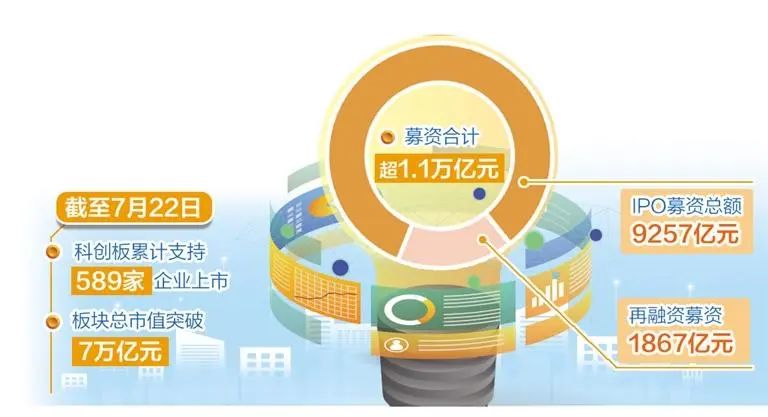
Core Viewpoint - The Sci-Tech Innovation Board (STAR Market) has evolved into a significant platform for supporting "hard technology" enterprises in China, contributing to the development of strategic emerging industries and enhancing the country's technological self-reliance since its inception six years ago [2][3][4]. Group 1: Support for "Hard Technology" Enterprises - As of July 22, the STAR Market has supported 589 companies to go public, raising a total of 925.7 billion yuan through IPOs and 186.7 billion yuan through refinancing, exceeding 1.1 trillion yuan in total [3]. - The total market capitalization of the STAR Market has surpassed 7 trillion yuan, with ten leading companies, including Haiguang Information and SMIC, accounting for nearly 1.47 trillion yuan, representing over 20% of the total market cap [3]. - The STAR Market has facilitated the transformation of technology companies from "catching up" to "leading," significantly contributing to breakthroughs in key technologies and supporting the development of a modern industrial system [3][4]. Group 2: Reform and Innovation - The STAR Market has effectively served as a "testing ground" for reforms, implementing a registration-based IPO system and establishing a flexible and inclusive listing framework [5][6]. - It has supported 54 unprofitable companies and 8 with special share structures, with 22 of these unprofitable companies achieving profitability post-listing [6]. - The recent "1+6" policy reform aims to expand the listing standards to include fields like artificial intelligence and commercial aerospace, enhancing financing channels for cutting-edge technology firms [6][7]. Group 3: R&D Investment and Market Dynamics - In 2024, the STAR Market's R&D investment is projected to reach 168.1 billion yuan, more than three times the net profit attributable to shareholders, with a median R&D investment-to-revenue ratio of 12.6% [8]. - Approximately 90% of STAR Market companies received venture capital investment before going public, indicating a strong trend towards early-stage investment in hard technology [8]. - The STAR Market has established a comprehensive index system with 30 indices, and the total scale of products tracking these indices has reached nearly 260 billion yuan, with the STAR 50 index becoming a flagship for hard technology investments [8]. Group 4: Investor Returns and Future Outlook - 509 companies have disclosed plans for quality improvement and return actions for 2025, covering 87% of the total, with over 60% of companies proposing cash dividend plans for 2024, totaling 38.8 billion yuan [9]. - The STAR Market aims to enhance its ecosystem by optimizing listing standards, improving transparency, and providing differentiated support for technology companies at various development stages [9]. - Future initiatives include expanding financing channels and promoting cross-border technology cooperation to strengthen the global competitiveness of Chinese technology firms [9].

帮主郑重:牛回头好上车!震荡是黄金试金石
Sou Hu Cai Jing· 2025-08-01 06:58
Core Viewpoint - The current fluctuations in the A-share market are seen as a natural adjustment within a bull market, rather than a sign of a market downturn [3][4]. Group 1: Market Dynamics - Historical data indicates that bull markets often experience significant pullbacks; for instance, the 2007 bull market saw four instances of over 5% declines, with the largest being over 20% [3]. - Recent trading volume has decreased by nearly 150 billion, indicating a temporary pause in the market after a sustained period of high trading activity [3]. - The financing balance has reached 1.97 trillion, a ten-year high, suggesting increased leverage in the market which can amplify volatility [3]. Group 2: Investment Opportunities - There are three key areas where funds are being redirected: 1. Low valuation sectors, with 66.7% of industries still at historical midpoints, while high valuation sectors like military and real estate are in the minority [4]. 2. Companies with strong overseas performance, such as those in computer equipment and agricultural chemicals, which have over 40% of their revenue from international markets [4]. 3. Hong Kong stocks, particularly in technology, are undervalued compared to their A-share counterparts, with catalysts like AI applications and new energy driving potential growth [4]. Group 3: Long-term Investment Strategies - A shift towards long-term holding strategies is recommended, moving away from short-term trading which has been prevalent in recent years [5]. - Key investment themes include: 1. Hard technology breakthroughs, particularly in AI and related applications, with the ChiNext index showing a low valuation percentile of 12.79% [5]. 2. Companies in home goods and general equipment that are managing to increase profits despite trade tensions [5]. 3. Policy-driven opportunities in sectors like family planning and the aging economy, with recent successes in the film industry indicating potential for growth [5]. Group 4: Monitoring Market Indicators - Key indicators to watch include trading volume, valuation levels, and market sentiment: - A trading volume consistently above 1 trillion is seen as a positive sign for market health [6]. - Valuation levels should be assessed by sector, with banking showing a PE ratio at the 95th percentile, indicating caution, while agriculture is at 1.91%, suggesting potential for investment [6]. - Monitoring margin financing levels is crucial; as they approach 2 trillion, it may be wise to reduce exposure to speculative stocks and increase positions in undervalued leaders [6].
有国资LP出资子基金的限制更多了
母基金研究中心· 2025-07-31 08:55
Core Viewpoint - The article discusses the increasing restrictions on state-owned limited partners (LPs) in China regarding their investments in sub-funds, highlighting a shift towards favoring state-owned general partners (GPs) over private ones due to performance and compliance concerns [1][2][3]. Group 1: Investment Restrictions - State-owned LPs have implemented new limitations on the number of sub-funds they can invest in, alongside restrictions on investment ratios and single-transaction amounts [1]. - There is a growing trend among LPs to collaborate primarily with state-owned GPs, as they are perceived to have better performance and compliance, making them more attractive in the current market environment [1][2]. Group 2: Market Conditions - The private equity investment market in China has seen a significant decline, with the number of newly established funds dropping by 44.1% year-on-year in 2024, and the total fundraising amount decreasing by nearly 40% [4]. - The average size of newly established funds has fallen to 1.338 billion yuan, marking a ten-year low, while the number of registered private equity fund managers has decreased significantly [4][5]. Group 3: Challenges for Private GPs - Private GPs are facing intensified competition and difficulties in fundraising, with many unable to meet their fundraising targets, leading to potential deregistration of their management qualifications [5]. - The current market environment has created a "bottleneck" for fundraising, as state-owned investors require a certain proportion of market-oriented funds, complicating the establishment of new private funds [5]. Group 4: New Opportunities - Recent policy changes, such as the introduction of technology innovation bonds, aim to alleviate fundraising challenges for private GPs by providing low-cost, long-term financing options [8][9]. - The issuance of technology innovation bonds has gained momentum, with several equity investment institutions announcing plans to issue bonds totaling over 200 billion yuan [9].

西部研究月度金股报告系列(2025年8月):宏观情绪升温,8月如何布局?-20250731
Western Securities· 2025-07-31 06:12
Group 1 - The report highlights that the "anti-involution" trend is driving a super cycle in commodities, particularly benefiting upstream resources and midstream materials, with the true focus being on the midstream sector [2][14] - The report suggests that the "anti-involution" phenomenon is a precursor to debt reduction, indicating that future demand-side policies will be crucial following the recent supply-side adjustments [3][15] - The ROIC-WACC metric is identified as a key indicator for measuring "involution," with industries like coking coal and photovoltaic equipment being classified as "true involution" sectors that are poised for growth [4][16] Group 2 - The report recommends a stock portfolio for August 2025, including companies such as Dingjie Zhizhi (computing), Yuandong Biological (pharmaceuticals), and BYD (automotive), among others [6][11] - The report emphasizes the importance of monitoring demand-side policy implementation and potential liquidity pressures from overseas markets [5][13] - The report notes that the strong exchange rate is expected to support continued export strength, which may exceed market expectations [5][13]
跟踪指数长期领跑港股科技赛道的港股通科技30ETF(159636)年内份额增长超120亿份,机构:港股科技或正处于景气修复与估值低位交汇窗口
2 1 Shi Ji Jing Ji Bao Dao· 2025-07-31 04:10
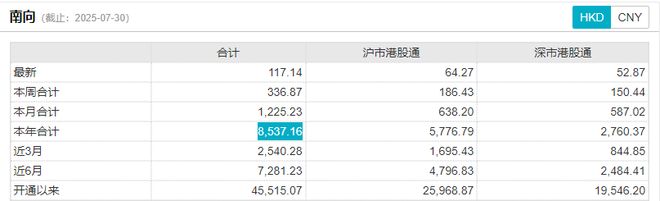
Wind数据显示,截至7月30日收盘,港股通科技30ETF(159636)已连续16个交易日获资金净流入;拉 长时间线来看,在近21个交易日中(7月2日至7月30日),该ETF累计20日获资金净流入,累计净流入 额超26亿元;该ETF最新流通份额、流通规模分别为197.83亿份、270亿元;其中,该ETF流通份额创上 市以来新高,年内份额增长超122.59亿份,涨幅达162.93%。 除港股通科技30ETF之外,港股市场今年以来整体获南向资金净流入。Wind数据显示,7月30日,南向 资金净流入超110亿港元,连续五个交易日净流入。Wind数据显示,截至7月30日,今年以来南向资金 累计净流入超8500亿港元,创年度净流入额历史新高,超过2024年净流入的8078.69亿港元。 | 田回(截止:2025-07-30) | | | HKD | CNY | | --- | --- | --- | --- | --- | | | 合计 | 沪市港股通 | 深市港股通 | | | 最新 | 117.14 | 64.27 | | 52.87 | | 本周合计 | 336.87 | 186.43 | | 150.44 | ...
数说公募港股基金2025年二季报:加仓医药非银,减持零售社服,“抱团度”下降
SINOLINK SECURITIES· 2025-07-31 01:20
1. Report Industry Investment Rating No relevant information provided. 2. Core View of the Report In Q2 2025, the Hong Kong stock market showed a V-shaped trend of sharp decline followed by recovery. The returns of various types of Hong Kong stock funds were positive, and the scale and share of Hong Kong stock funds increased. The stock positions and Hong Kong stock positions of Hong Kong stock funds increased slightly. In terms of heavy - position sectors, there were increases in medicine, finance, and technology, and a decrease in consumption. Among heavy - position stocks, pharmaceutical stocks showed obvious increases, while some Internet platform leaders declined. The scale of some fund companies increased significantly [3]. 3. Summary According to the Table of Contents 3.1 Hong Kong Stock Fund Performance and Scale Development - **Performance**: In Q2 2025, among the main indices tracked by Hong Kong stock funds, the Hang Seng Index and Hang Seng China Enterprises Index rose by 4.42% and 1.9% respectively, outperforming the CSI 300. The Hang Seng Technology Index fell by - 1.70%. The leading indices in terms of gains were the China Securities Hong Kong Stock Connect Innovative Drug Index (25.6%) and the China Securities Hong Kong Stock Connect Non - Banking Financial Index (21.8%). The average returns of various types of Hong Kong stock funds were positive, with "Hong Kong QDII - Active" leading with an average increase of 10.22% [3]. - **Scale and Share**: As of the end of Q2, the total scale of Hong Kong stock funds was 619.134 billion yuan, a quarter - on - quarter increase of 13.54 pct; the total share was 623.83 billion shares, a quarter - on - quarter increase of 7.45 pct. In Q2, the number of newly issued funds was 28, an increase from the previous quarter, but the newly issued scale was 7.517 billion yuan, lower than the previous quarter [3]. 3.2 Hong Kong Stock Fund Positioning Characteristics - **Stock and Hong Kong Stock Positions**: In Q2, the average stock position was 92%, a slight increase from the previous quarter. The stock position of index funds was higher than that of actively managed funds. The average Hong Kong stock position was 85%, an increase from the previous quarter, and the gap between index funds and actively managed funds narrowed in Q2 [3]. - **Heavy - Position Sector Allocation**: Technology (39%) and consumption (25%) ranked first and second in terms of proportion. The sectors with more increases were medicine (+2.27 pct), finance (+2.25 pct), and technology (+1.67 pct), while consumption (-5.97 pct) was significantly reduced [3]. - **Heavy - Position Stock Industry Distribution**: Media ranked first for four consecutive quarters, with a quarter - on - quarter increase of 0.66 pct in Q2; Commerce and Retail ranked second for four consecutive quarters, with a quarter - on - quarter decrease of 3.5 pct; Electronics became the third for two consecutive quarters, with a quarter - on - quarter increase of 0.88 pct. The sector with the highest quarter - on - quarter increase was Medicine and Biology, accounting for 12.42% and a quarter - on - quarter increase of 2.27 pct [3]. - **Individual Stock Level**: The "herding effect" of funds on leading stocks decreased. In terms of the number of funds holding heavy - position stocks, Xiaomi rose one place to become the third, and Sino Biopharmaceutical and Pop Mart entered the top 10 for the first time in four quarters. The concentration of heavy - position stocks decreased, and the proportion of large - cap stocks with a market value of over 80 billion yuan rose to 90% [3]. 3.3 Hong Kong Stock Fund Company Analysis - **Scale Ranking**: In Q2, the top 5 fund companies in terms of scale were Huaxia, E Fund, Fullgoal, GF, and ICBC Credit Suisse, and their total scales increased to varying degrees compared with the previous quarter. Huaxia's Hong Kong stock product scale exceeded 10 billion yuan, and ICBC Credit Suisse's scale increased by 35.45 pct quarter - on - quarter. Among the top 20, the most obvious expansion was by Huatai - PineBridge, with a quarter - on - quarter increase of 91.13 pct, rising four places to the seventh [3]. 3.4 Performance - Oriented Hong Kong Stock Fund Positioning Display and Quarterly Report Views - **Positioning Display**: Some actively managed Hong Kong stock funds in Q2 2025 held stocks that were among the top 50 in terms of gains, such as Rongchang Biologics, Sino Biopharmaceutical, and Innovent Biologics [54]. - **Quarterly Report Views**: Fund managers generally expressed optimism about the development prospects of sectors such as innovative drugs, new consumption, and technology Internet, and adjusted their investment strategies according to market conditions [57][58].





科创成长层助硬科技企业穿越周期
Sou Hu Cai Jing· 2025-07-30 20:45
Core Viewpoint - The recent establishment of the Sci-Tech Innovation Board's growth tier and the reactivation of the fifth listing standard for unprofitable companies signal a significant shift in the capital market, allowing unprofitable "hard tech" enterprises to pursue IPOs more effectively [1][4]. Group 1: Unprofitable Companies' IPO Activities - A number of unprofitable companies are actively pursuing IPOs following the announcement of the growth tier and the fifth listing standard, which has reignited their financing needs [2]. - Wuhan Heyuan Biotechnology Co., Ltd. is leading the charge with its IPO approval from the CSRC on July 18, 2023, despite not having any approved drugs or profits yet [2]. - Shenzhen Beixin Life Technology Co., Ltd. also submitted its IPO registration shortly after, indicating a trend among medical device companies to capitalize on the new regulations [2]. Group 2: Regulatory Changes and Support for Technology - The fifth listing standard, initially aimed at supporting pharmaceutical companies, has been broadened to include a wider range of high-growth technology sectors such as artificial intelligence and commercial aerospace [4]. - The reactivation of the fifth standard is seen as a crucial measure to alleviate the financing bottlenecks faced by hard tech companies, which often struggle with long R&D cycles and high initial investments [4][5]. - The establishment of the growth tier is viewed as a precise upgrade to the Sci-Tech Innovation Board's system, addressing market pressures faced by companies unable to achieve short-term profitability [5]. Group 3: Investor Protection and Risk Management - The introduction of the growth tier includes measures to enhance investor protection, such as a special identifier "U" for unprofitable companies, which aims to improve risk awareness among investors [6][7]. - Regulatory bodies are implementing a three-tiered mechanism for risk management, which includes enhanced information disclosure rules and stricter delisting criteria to support rational pricing and risk mitigation for unprofitable enterprises [7].
大盘午后走强,A500ETF易方达(159361)、沪深300ETF易方达(510310)等聚焦A股核心资产
Mei Ri Jing Ji Xin Wen· 2025-07-30 19:19
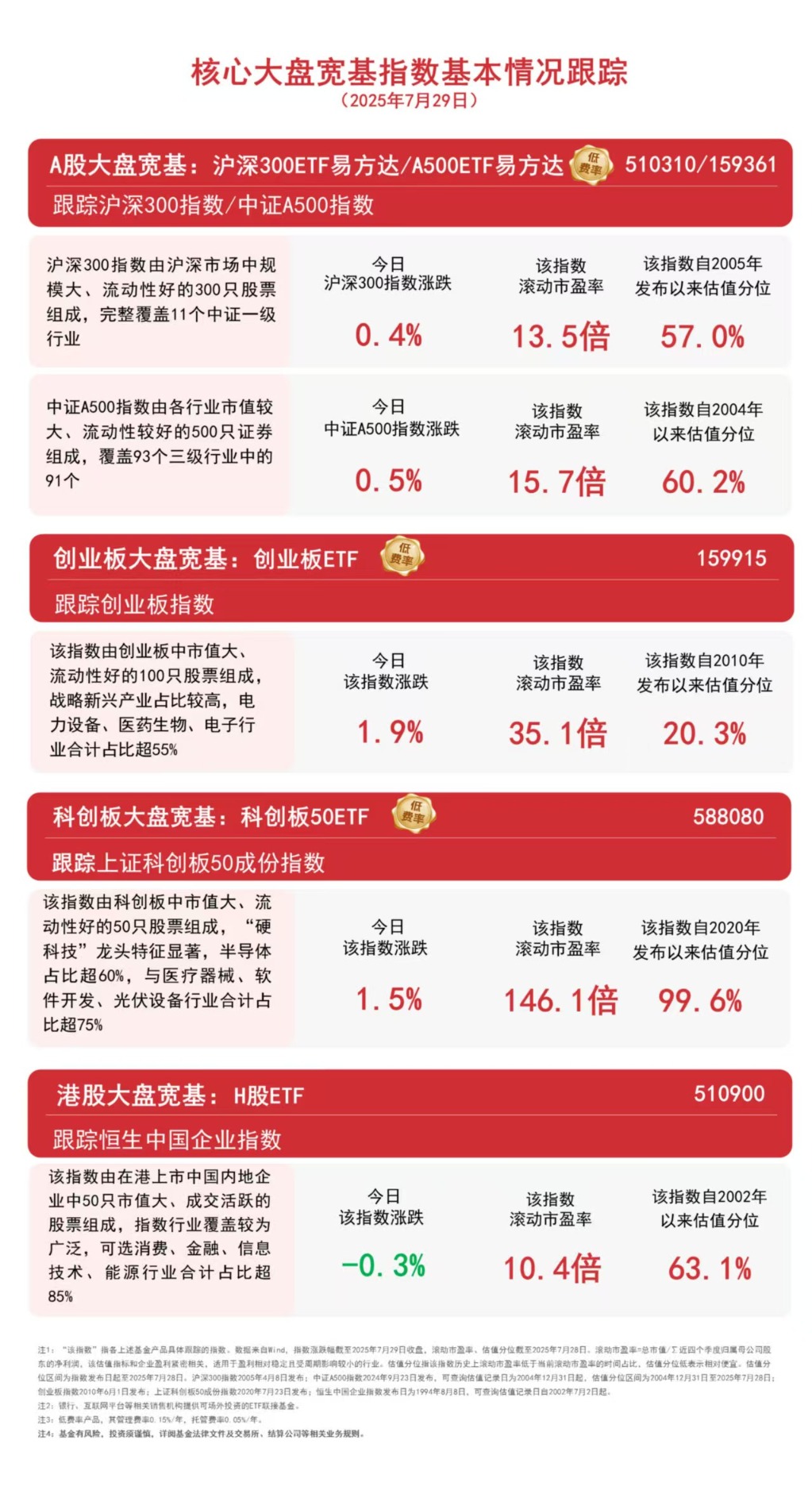
Market Performance - The market saw an afternoon rise with sectors such as CRO, special steel, and super hydropower gaining, while banking, insurance, and pork sectors adjusted [1] - By the close, the CSI A500 index rose by 0.5%, the CSI 300 index increased by 0.4%, the ChiNext index surged by 1.9%, and the STAR Market 50 index climbed by 1.5%, while the Hang Seng China Enterprises Index fell by 0.3% [1] Index Details - The CSI 300 index, composed of 300 large and liquid stocks from the Shanghai and Shenzhen markets, had a rolling P/E ratio of 13.5 times, with a valuation percentile of 57.0% since its inception in 2005 [2] - The CSI A500 index, made up of 500 stocks with good liquidity across various industries, recorded a daily increase of 0.5% and a rolling P/E ratio of 15.7 times, with a valuation percentile of 60.2% since 2004 [2] - The ChiNext index, tracking 100 large and liquid stocks in the ChiNext market, rose by 1.9% with a rolling P/E ratio of 35.1 times, and a valuation percentile of 20.3% since its launch in 2010 [2] - The STAR Market 50 index, consisting of 50 large and liquid stocks from the STAR Market, increased by 1.5% with a rolling P/E ratio of 146.1 times, and a valuation percentile of 99.6% since its inception in 2020 [2] Hang Seng Index - The Hang Seng China Enterprises Index, which includes 50 large and actively traded stocks listed in Hong Kong, saw a decline of 0.3% and has a rolling P/E ratio of 10.4 times, with a valuation percentile of 63.1% since 2002 [3]
耐心资本重塑创投逻辑 全链条协同成破局关键
Zheng Quan Shi Bao· 2025-07-30 19:09
Group 1: Market Trends - The fundraising market is in a recovery phase, with a projected decline of 20.8% in 2024, narrowing to 2.9% in Q1 2025, indicating a gradual restoration of market confidence [2] - Patient capital is becoming a significant trend, with long-term funds like banks and insurance companies accelerating their entry into the venture capital space, exemplified by the establishment of 9 financial asset investment companies (AIC) with a total scale of 150 billion yuan [2][3] - The shift in the role of state-owned guiding funds from "招商思维" (investment attraction mindset) to "产业构建思维" (industry construction mindset) is notable, focusing on matching industrial elements rather than short-term metrics [2] Group 2: Exit Strategies - Innovation in exit strategies is crucial, with a focus on balancing DPI (Distributions to Paid-In) and IRR (Internal Rate of Return) as a core challenge for venture capital institutions [3] - The adoption of diverse exit channels is showing initial success, with S funds becoming a significant part of investment strategies, providing a new exit route for general partners (GPs) [3] - The current IPO market in Hong Kong is viewed as a "first aid channel" rather than a "golden channel," with differing opinions on its long-term stability [4] Group 3: Industry Collaboration - Emphasizing long-termism and value investing is seen as essential for overcoming industry challenges, with a focus on high IRR to support overall fund DPI [5] - Full-chain collaboration is becoming a key strategy for many state-owned enterprises, leveraging mother funds to attract social capital and focusing on critical nodes in the industrial chain [5] - Suggestions for future industry development include structural problem-solving, embracing change while maintaining core principles, and deepening engagement in hard technology sectors [5]
无人机、卫星通信车抢修 密云、怀柔、延庆等地部分基站恢复通信
Xin Jing Bao· 2025-07-30 18:03
Core Viewpoint - The article highlights the response of telecommunications companies in Beijing to severe flooding, detailing their efforts to restore communication services using advanced technologies like drones and satellite communication systems [1][4]. Group 1: Emergency Response and Recovery Efforts - As of July 28, China Telecom deployed 334 personnel, 6 satellite communication vehicles, and 30 emergency repair vehicles to restore communication in affected areas [2]. - China Unicom reported the deployment of over 320 personnel and various emergency equipment, including 10 satellite base station vehicles and 34 satellite phones, with significant restoration of base stations in multiple districts [2][3]. - Beijing Mobile utilized 5 emergency communication vehicles and 2 drones to establish communication in key areas, successfully sending emergency messages and enabling communication for local government command points [2][4]. Group 2: Impact of Severe Weather - The average rainfall in Beijing reached 165.9 mm, with the maximum recorded at 543.4 mm, leading to significant infrastructure damage, including 31 road damages and 1825 disabled base stations [1]. - Communication facilities suffered extensive damage, with 62 fiber optic cables destroyed and 136 villages experiencing power outages [1]. Group 3: Technological Innovations in Communication - The use of drone base stations has been pivotal, providing emergency communication services to several villages and sending nearly 1 million emergency messages [4][5]. - Satellite communication vehicles and portable satellite stations were deployed to ensure connectivity in remote areas, demonstrating the effectiveness of "hard technology" in disaster response [4]. Group 4: Community Support and Services - Telecommunications companies provided temporary services such as free calls and charging stations for disaster-affected individuals, with China Telecom sending out 19.65 million risk warning messages [5]. - Beijing Unicom offered 100G of free data to users in affected areas, while Beijing Mobile provided essential services like drinking water and temporary shelter at key locations [5].