
关税政策

Search documents
Jobs report will be most important market event next week, says Vital Knowledge's Adam Crisafulli
Youtube· 2025-09-26 21:46
Economic Indicators - The ISM reports will provide an early look at September's economic performance and will not be affected by the government shutdown [1] - The ADP employment report is expected to gain importance due to recent uncertainties surrounding government labor statistics, serving as an alternative source of information [3][4] Earnings Reports - Key earnings reports to watch include Carnival on Monday and Nike on Tuesday, with the jobs report being the most significant event of the week [2] Trade and Tariffs - The White House is increasing Section 232 investigations and tariffs to strengthen its trade agenda amid scrutiny of existing tariffs [5] - There is speculation that the Supreme Court may strike down AIPA tariffs, which would shift the burden to Section 232 tariffs, creating uncertainty for corporate America [6] Market Reactions - Recent tariff announcements did not significantly impact markets, but there is relief regarding pharmaceutical tariffs, although uncertainty remains [7] - Energy stocks have performed well, influenced by rising crude oil prices and geopolitical tensions related to the Ukraine conflict [8][9] Federal Reserve Expectations - Higher job openings could lead to doubts about the Federal Reserve's plans for rate cuts, particularly affecting small-cap stocks [10] - A strong jobs report may lead to upward pressure on yields and alter Fed expectations, potentially resulting in a more cautious approach to rate cuts [11][12]
特朗普宣布:加征100%关税!业内:对中国企业没什么影响,“欧洲受影响较大”
Mei Ri Jing Ji Xin Wen· 2025-09-26 16:47
Core Viewpoint - The recent announcement by former President Trump regarding new tariffs on various imported products, including a 100% tariff on branded and patented pharmaceuticals, is expected to have limited impact on Chinese pharmaceutical companies, while European pharmaceutical firms may face more significant challenges [1][3][4]. Group 1: Impact on Chinese Pharmaceutical Companies - The new tariffs do not apply to generic drugs, and the number of innovative Chinese drugs sold in the U.S. is limited, resulting in minimal impact on Chinese pharmaceutical firms [3][4]. - China's pharmaceutical export value is relatively small, ranking 10th globally with an export value of $54.56 billion, which is only 17.8% of the U.S. total [4]. - The branded drugs targeted by the tariffs have a low export volume from China to the U.S., with most brand-name drugs consumed in the U.S. coming from European countries [4][5]. Group 2: European Pharmaceutical Industry Challenges - The European pharmaceutical industry is facing direct impacts from the new U.S. tariff policies, with a projected 13.5% increase in pharmaceutical exports to the U.S. in 2024 [6]. - Ireland is a key hub for European pharmaceuticals, with exports to the U.S. expected to reach €44.4 billion in 2024, accounting for over 60% of its exports to the U.S. [6]. - Major pharmaceutical companies are increasing investments in U.S. manufacturing to mitigate tariff impacts, with significant commitments from companies like Merck, Pfizer, and Novartis to invest billions in U.S. infrastructure [7].

关税冲击有限!美国8月核心PCE稳住2.9%,10月降息稳了?
Sou Hu Cai Jing· 2025-09-26 16:15
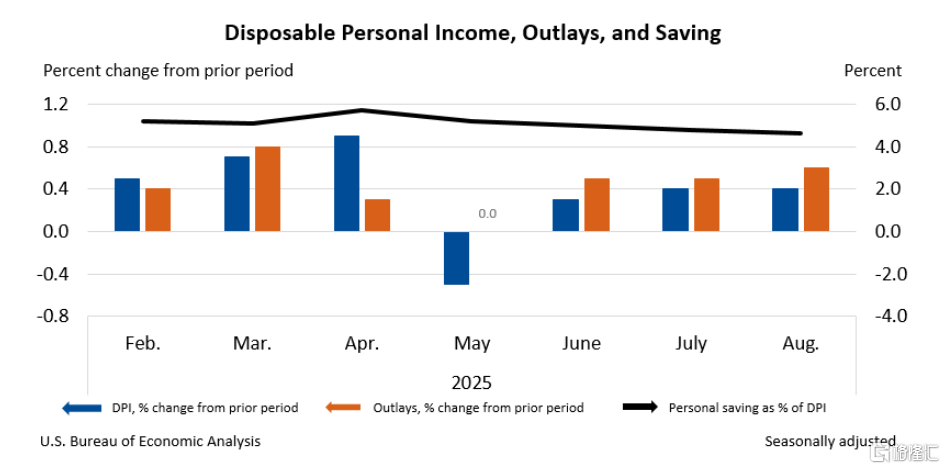
Core Insights - The Federal Reserve's inflation target remains at 2%, but recent data is not expected to alter the policymakers' path, with expectations for a 25 basis point rate cut by year-end [5][6] Economic Data Summary - The U.S. August PCE price index increased by 2.7% year-on-year, matching expectations, and rose by 0.3% month-on-month, also in line with market predictions [2] - The core PCE price index for August remained stable at 2.9% year-on-year and increased by 0.2% month-on-month, consistent with July's figures [2] - Personal income grew by 0.4% and personal consumption expenditure increased by 0.6% in August, both exceeding expectations by 0.1 percentage points [2] Consumer Behavior Insights - Despite the impact of tariffs, consumer spending has shown resilience, with a personal savings rate rising to 4.6%, an increase of 0.2 percentage points [5] - Economic uncertainty caused by tariffs initially led to reduced consumer spending, but a rebound was observed during the summer months [5] Market Expectations - Market expectations for a Federal Reserve rate cut on October 29 are strong, with a probability of 87.7%, while the likelihood of a subsequent cut in December is around 65% [6][7]
特朗普“关税大棒”砸向建材家具
第一财经· 2025-09-26 15:13
Core Viewpoint - The article discusses the recent announcement by U.S. President Trump regarding new tariffs on various imported products, which is expected to escalate global trade tensions and impact the home building materials industry, particularly in Southeast Asia and China [3]. Group 1: Tariff Impact - Starting from October 1, the U.S. will impose a 50% tariff on kitchen cabinets and bathroom sinks, and a 30% tariff on imported furniture [3]. - Previous tariff rounds did not significantly affect sales to the U.S., but the rise of Southeast Asian factories has pressured prices [3]. - In April and May, China's furniture exports saw a decline of 7% and 9% year-on-year due to tariffs, but by June, exports rebounded with a growth of 1.25% year-on-year as trade tensions eased [3]. Group 2: Market Dynamics - Companies in the home goods export sector are adjusting to tariff policies, with some shifting focus to markets in Europe, the Middle East, and Southeast Asia [4]. - Despite tariffs, the price of Chinese-made bathroom products may still be lower than U.S.-made alternatives, as demonstrated by a case where a Chinese showerhead priced at $129 would cost $239 if manufactured in the U.S. due to increased production costs [4]. - The U.S. is heavily reliant on imports for finished furniture, with Vietnam and China being the primary sources [6]. Group 3: Export Data - In 2024, China's sanitary ceramics exports reached 110 million units, totaling $15.64 billion, with the U.S. being the largest export destination [5]. - In the first half of 2025, China's furniture exports amounted to $34.92 billion, with the U.S. accounting for $8.04 billion, representing 23% of total exports [5]. - The U.S. furniture import market is significant, with total imports projected at $27.14 billion for the 2023-2024 fiscal year, with Vietnam leading in market share [5].

Tariff Announcement Gives PACCAR Stock a Lift
Schaeffers Investment Research· 2025-09-26 15:06
Company Overview - PACCAR Inc, a Texas-based trucking stock, is experiencing a rise of 5% to $100.35, with a peak of $102.30, driven by recent tariff updates [1] - The company owns notable heavy truck manufacturers, Peterbilt and Kenworth, which are set to benefit from a 25% tariff on imported heavy trucks starting October 1 [1] Market Performance - Despite today's increase, PACCAR's stock is down 3.8% year-to-date, although it has been trading within an ascending channel since April [2] - The stock has recently surpassed key moving averages at the $99 level, including the 20-, 50-, and 200-day trendlines [2] Analyst Sentiment - Among 18 brokerages covering PACCAR, 12 have a "hold" or worse rating, indicating a cautious outlook [4] - The 12-month consensus price target for PACCAR is $104.11, representing a modest 4.1% premium over current stock levels [4]

Paccar is a big winner of Trump's tariff on heavy trucks, but so are some non-U.S. companies
MarketWatch· 2025-09-26 14:31
Core Viewpoint - Shares of Paccar Inc. experienced a significant increase as investors reacted positively to President Donald Trump's announcement of a 25% tariff on heavy trucks imported from outside the U.S. [1] Company Summary - Paccar Inc. saw a surge in its stock price following the tariff announcement, indicating strong investor confidence in the company's prospects in the heavy truck market [1]. Industry Summary - The imposition of a 25% tariff on heavy trucks is expected to impact the competitive landscape of the heavy truck industry, potentially benefiting domestic manufacturers like Paccar Inc. [1].

特朗普宣布对进口家具征收高额关税,Wayfair(W.US)等股下跌
Zhi Tong Cai Jing· 2025-09-26 13:38
Group 1 - President Trump announced a 30% to 50% tariff on all imported cabinets, bathroom vanities, and upholstered furniture, significantly impacting Wayfair, RH, and Williams Sonoma, with stock prices dropping by 5% before market opening [1] - The tariffs, effective from October 1, are aimed at protecting domestic manufacturing against foreign imports, with specific rates of 30% on certain furniture and cabinets and 50% on home improvement materials [1] - Wayfair's direct-to-consumer model and RH's reliance on imports from Vietnam and China (72% by 2024) present unique challenges, while Williams Sonoma imports 67% of its products from 48 different countries, increasing pressure to find new suppliers [1] Group 2 - Williams Sonoma's CEO Laura Alber acknowledged the challenges posed by the new tariffs, stating that revenue growth will be affected by these additional costs, with tax rates having doubled since the first quarter [2] - Home Depot and Lowe's may also face impacts on their home improvement businesses, but their extensive domestic supplier networks may mitigate the effects [2] - The recent developments could reverse Wayfair's 120% stock price increase over the past six months and Williams Sonoma's 19% rise, while RH's stock has decreased by 16% during the same period [2]
铜季报:宏观利多+供应紧缺上行空间仍在
Zhong Hang Qi Huo· 2025-09-26 11:21
1. Report Industry Investment Rating No information provided on the report's industry investment rating. 2. Core Viewpoints of the Report - The copper market will remain in a pattern of "favorable macro - environment + supply shortage" in the fourth quarter. Despite weak traditional demand, the supply - side bottleneck is difficult to ease. With the support of domestic and foreign policies, the copper price has strong downside support and still has upward potential, likely to operate in the range of 78,000 - 85,000 yuan. A strategy of buying on dips is recommended, and attention should be paid to the US tariff policy, the Fed's interest - rate cut path, and the sustainability of domestic demand policies [46]. 3. Summary by Directory 3.1 Market Review - In Q3 2025, copper prices showed a range - bound pattern. The main contract of Shanghai copper fluctuated between 77,570 - 83,090 yuan/ton. In early July, the US unexpectedly announced a 50% tariff on copper imports, causing copper prices to fall under pressure. Subsequently, the market digested the news, and the focus returned to the structural shortage of global copper mine supply and the Fed's interest - rate cut expectations. At the end of the quarter, due to mine - end disturbances, copper prices broke through the range, reaching a maximum of 83,090 yuan/ton [7]. 3.2 Macroeconomic Aspects - **Tariff Policy**: Trump's repeated signals of imposing tariffs on copper imports in 2025 have led to a continuous widening and repeated record - highs of the price difference between COMEX and LME copper. The price - difference change is divided into three stages. The impact of the tariff policy is gradually easing, but macro - uncertainty remains high during Trump's tenure. Attention should be paid to the progress of Sino - US trade negotiations in November [11][12]. - **Inflation**: China's CPI in August 2025 decreased year - on - year, mainly due to the high base of the previous year and lower - than - seasonal food prices. The PPI decline narrowed, and the price of some energy and raw material industries rebounded. The implementation of the "anti - involution" policy may lead to a stable recovery of inflation in the future [17]. 3.3 Fundamentals - **Supply Side** - **Copper Concentrate**: In Q3 2025, the spot TC of copper concentrate remained deeply negative. Although there was a rebound in mid - August, it returned to around - 40 US dollars due to frequent mine - end disturbances. The long - term TC/RC has also reached a historical low, indicating a "strong mine, weak smelting" pattern. In Q4, the spot TC may continue to be deeply negative [21]. - **Refined Copper Production**: In August 2025, China's refined copper production increased year - on - year. However, in September, the number of smelters undergoing maintenance increased, and the production decline was more significant. In Q4, the number of domestic smelters undergoing maintenance will increase, and production may be affected [24][26]. - **Scrap Copper Imports**: In August 2025, China's scrap copper imports decreased month - on - month, mainly due to import losses, extreme weather affecting transportation, and a decrease in overseas scrap copper exports [28]. - **Demand Side** - **Real Estate**: In August 2025, the real estate market continued to decline, with sales, investment, new construction, and completion areas all showing negative growth. Although first - tier cities have introduced policies to support the market, investment and construction are still under pressure [34]. - **Automobile Industry**: In August 2025, the production and sales of traditional cars increased year - on - year, while the proportion of fuel - powered cars decreased. The new - energy vehicle industry maintained strong momentum, with high production and sales growth rates and a large market share [39]. - **Home Appliances**: In August 2025, the production of household refrigerators and air - conditioners increased year - on - year, but the air - conditioner sales decreased slightly. In Q4, the home - appliance sector may face pressure of slowing growth due to the advance of demand by the "trade - in" policy and potential export pressure [42]. - **Inventory**: Since February 2025, the copper inventories of the three major exchanges have shown a divergent trend, with LME copper inventory hitting a record low. As of September 26, the US copper inventory exceeded the sum of LME and SHFE copper inventories. In Q4, the inventory accumulation of COMEX may slow down, and the non - US copper inventory may rebound [45]. 3.4 Future Outlook - **Macroeconomic**: The Fed is likely to cut interest rates twice more this year, which will drive the recovery of the manufacturing industry. The impact of tariffs is gradually easing, and attention should be paid to the trade negotiations in November [47]. - **Copper Market**: The copper market will remain in a pattern of "favorable macro - environment + supply shortage" in Q4. The copper price is likely to operate in the range of 78,000 - 85,000 yuan, and a strategy of buying on dips is recommended [46].
南华镍、不锈钢产业风险管理日报-20250926
Nan Hua Qi Huo· 2025-09-26 11:03
Report Information - Report Title: Nanhua Nickel & Stainless Steel Industry Risk Management Daily [1] - Date: September 25, 2025 [1] - Research Team: Nanhua New Energy & Precious Metals Research Team [1] Industry Investment Rating - Not provided in the report Core Viewpoints - The nickel and stainless steel markets showed a strong and volatile trend. The nickel ore supply was unstable due to sanctions on mining companies in Indonesia and the approaching quota approval in October. The cobalt price was expected to rise, driving up the prices of MHP and nickel salts. The nickel iron price decreased due to stainless - steel demand constraints, and the stainless - steel market was also strong but with weak spot trading. The decline of the US dollar in the macro - level led to an upward movement in the non - ferrous metals market [3] - There were both positive and negative factors in the market. Positive factors included the proposed revision of the HPM formula in Indonesia, the shortening of the nickel ore quota period, continuous de - stocking of stainless steel, and the takeover of some nickel - producing areas. Negative factors included high pure nickel inventory, tariff disturbances, and weak stainless - steel spot trading [5] Summary by Related Catalogs Price and Volatility Forecast - **Nickel**: The predicted price range of Shanghai nickel was 118,000 - 126,000 yuan/ton, with a current 20 - day rolling volatility of 15.17% and a historical percentile of 3.2% [2] - **Stainless Steel**: The predicted price range of stainless steel was 12,500 - 13,100 yuan/ton, with a current 20 - day rolling volatility of 6.95% and a historical percentile of 0.3% [2] Risk Management Strategies Nickel - **Inventory Management**: When the product sales price declined and inventory had impairment risk, it was recommended to sell Shanghai nickel futures (NI main contract) at a 60% hedging ratio and sell call options (over - the - counter/on - exchange options) at a 50% hedging ratio [2] - **Procurement Management**: When the company had future production procurement needs and was worried about rising raw material prices, it was recommended to buy Shanghai nickel forward contracts (far - month NI contracts) according to the production plan, sell put options (on - exchange/over - the - counter options), and buy out - of - the - money call options (on - exchange/over - the - counter options) [2] Stainless Steel - **Inventory Management**: When the product sales price declined and inventory had impairment risk, it was recommended to sell stainless - steel futures (SS main contract) at a 60% hedging ratio and sell call options (over - the - counter/on - exchange options) at a 50% hedging ratio [3] - **Procurement Management**: When the company had future production procurement needs and was worried about rising raw material prices, it was recommended to buy stainless - steel forward contracts (far - month SS contracts) according to the production plan, sell put options (on - exchange/over - the - counter options), and buy out - of - the - money call options (on - exchange/over - the - counter options) [3] Market Data Nickel | Indicator | Latest Value |环比差值 |环比 | Unit | | --- | --- | --- | --- | --- | | Shanghai Nickel Main Contract | 122,990 | 0 | 0% | yuan/ton | | Shanghai Nickel Continuous 1 | 122,990 | 1,540 | 1.27% | yuan/ton | | Shanghai Nickel Continuous 2 | 123,160 | 1,530 | 1.26% | yuan/ton | | Shanghai Nickel Continuous 3 | 123,350 | 1,460 | 1.26% | yuan/ton | | LME Nickel 3M | 15,240 | - 195 | - 1.20% | US dollars/ton | | Trading Volume | 177,030 | 0 | 0.00% | lots | | Open Interest | 99,642 | 0 | 0.00% | lots | | Warehouse Receipts | 25,153 | 48 | 0.19% | tons | | Main Contract Basis | - 505 | 185 | - 26.8% | yuan/ton | [5] Stainless Steel | Indicator | Latest Value |环比差值 |环比 | Unit | | --- | --- | --- | --- | --- | | Stainless Steel Main Contract | 12,930 | 0 | 0% | yuan/ton | | Stainless Steel Continuous 1 | 12,930 | 35 | 0.27% | yuan/ton | | Stainless Steel Continuous 2 | 12,970 | 30 | 0.23% | yuan/ton | | Stainless Steel Continuous 3 | 13,030 | 35 | 0.27% | yuan/ton | | Trading Volume | 129,897 | 0 | 0.00% | lots | | Open Interest | 109,896 | 0 | 0.00% | lots | | Warehouse Receipts | 87,505 | - 298 | - 0.34% | tons | | Main Contract Basis | 640 | - 35 | - 5.19% | yuan/ton | [5] Inventory Data | Inventory Type | Latest Value | Change from Previous Period | | --- | --- | --- | | Domestic Social Inventory of Nickel | 41,484 tons | + 429 tons | | LME Nickel Inventory | 230,586 tons | 0 tons | | Stainless Steel Social Inventory | 909 tons | + 11.8 tons | | Nickel Pig Iron Inventory | 28,652 tons | - 614.5 tons | [6] Positive and Negative Factors - **Positive Factors**: The Indonesian APNI planned to revise the HPM formula, the nickel ore quota period was shortened from three years to one year, stainless steel had been de - stocking for several weeks, and the Indonesian forestry working group took over part of the nickel - producing area of PT Weda Bay [5] - **Negative Factors**: The pure nickel inventory was high, there were still tariff disturbances between China and the US, the EU stainless - steel import tariff was uncertain, the anti - dumping duty on Chinese stainless - steel thick plates in South Korea was implemented, and the stainless - steel spot trading was weak [5]

螺纹钢市场周报:市场情绪低迷,螺纹期价承压回落-20250926
Rui Da Qi Huo· 2025-09-26 09:57
Report Industry Investment Rating - Not mentioned in the provided content Core Viewpoints of the Report - The macro - level presents tariff disturbances. In the industry, the production of rebar remains low, demand increases, inventory decreases again, and apparent demand rises. The long - term bullish sentiment is not high, and the cost - side support weakens. Before the holiday, the game between bulls and bears intensifies, and the market may fluctuate. It is recommended to consider low - buying and high - selling in the range of 3075 - 3170 yuan/ton for the RB2601 contract, with a stop - loss of 30 yuan/ton [7]. - Given that the resumption of blast furnaces in steel mills increases and the expectation of supply growth strengthens, but rebar production remains low and inventory pressure is not significant, after the price adjustment, there is still a possibility of a rebound. It is suggested to buy out - of - the - money call options opportunistically [57]. Summary by Relevant Catalogs 1. Week - to - Week Summary 1.1 Market Review - As of September 26, the closing price of the rebar main contract was 3114 yuan/ton, a decrease of 58 yuan/ton; the spot price of Hangzhou Zhongtian rebar was 3320 yuan/ton, an increase of 20 yuan/ton [5]. - Rebar production remained at a low level, with a weekly output of 206.46 million tons, an increase of 0.01 million tons week - on - week and 1 million tons year - on - year [5]. - Apparent demand continued to increase, with a current apparent demand of 220.44 million tons, an increase of 10.41 million tons week - on - week and a decrease of 35.02 million tons year - on - year [5]. - Both factory and social inventories decreased. The total rebar inventory was 6.363 billion tons, a decrease of 0.1398 billion tons week - on - week and an increase of 2.2084 billion tons year - on - year [5]. - The profitability rate of steel mills was 58.01%, a decrease of 0.86 percentage points week - on - week and an increase of 39.40 percentage points year - on - year [5]. 1.2 Market Outlook - **Macro - level**: Overseas, Mexico plans to raise import tariff rates on products from non - FTA partners, and the US may impose a 25% tariff on all imported heavy - duty trucks. Domestically, five ministries including the Ministry of Industry and Information Technology jointly issued a steel industry growth plan, aiming for an average annual growth of about 4% in the steel industry's added value in the next two years [7]. - **Supply - demand**: Rebar weekly production remained low, with a capacity utilization rate of 45.26% and a continuous decline in the EAF steel operating rate. Terminal demand recovered, inventory declined again, and apparent demand rebounded [7]. - **Cost**: Iron ore futures prices fluctuated and corrected, with high - level hot metal production, but increased arrivals and port inventories. Coking coal and coke futures prices first rose and then fell. There was pre - holiday restocking demand from downstream, but the capacity utilization rate of coking coal mines increased for three consecutive weeks, with an expected increase in supply [7]. - **Technical**: The RB2601 contract adjusted downward, breaking through the key support of the MA20 moving average. In the short term, it may test the support around 3100/3075. The MACD indicator showed that DIFF and DEA were below the 0 - axis, and the red bars shrank [7]. - **Strategy**: Considering the macro - level tariff disturbances, the industry - level low rebar production, increased demand, decreased inventory, and improved apparent demand, along with weakening cost - side support, it is recommended to consider low - buying and high - selling in the range of 3075 - 3170 yuan/ton for the RB2601 contract, with a stop - loss of 30 yuan/ton [7]. 2. Futures and Spot Markets 2.1 Futures Price Trends - This week, the RB2601 contract fluctuated weakly. The RB2510 contract was stronger than the RB2601 contract. On the 26th, the price difference was - 92 yuan/ton, an increase of 2 yuan/ton week - on - week [13]. 2.2 Warehouse Receipts and Positions - On September 26, the Shanghai Futures Exchange's rebar warehouse receipts were 278,350 tons, an increase of 16,197 tons week - on - week. The net short position of the top 20 futures contract holders was 221,167 lots, an increase of 39,455 lots compared to the previous week [19]. 2.3 Spot Price and Basis - On September 26, the spot price of Hangzhou's third - grade 20mm HRB400 rebar was 3320 yuan/ton, an increase of 20 yuan/ton week - on - week; the national average price was 3302 yuan/ton, an increase of 3 yuan/ton week - on - week. This week, the spot price of rebar was stronger than the futures price. On the 26th, the basis was 206 yuan/ton, an increase of 78 yuan/ton week - on - week [25]. 3. Upstream Markets 3.1 Raw Material Prices - On September 26, the price of 61% Australian Macfayden iron ore powder at Qingdao Port was 851 yuan/dry ton, an increase of 1 yuan/dry ton week - on - week. The spot price of first - grade metallurgical coke at Tianjin Port was 1620 yuan/ton, an increase of 50 yuan/ton week - on - week [30]. 3.2 Iron Ore Arrivals and Inventories - From September 15 - 21, 2025, the total arrivals at 47 ports in China were 2.7504 billion tons, an increase of 0.3581 billion tons month - on - month; the total arrivals at 45 ports were 2.675 billion tons, an increase of 0.3127 billion tons month - on - month; the total arrivals at the six northern ports were 1.29 billion tons, an increase of 0.045 billion tons month - on - month. This week, the total inventory of imported iron ore at 47 ports was 14.55068 billion tons, an increase of 0.169 billion tons week - on - week; the daily average port clearance volume was 3.5141 billion tons, an increase of 0.0038 billion tons [34]. 3.3 Coking Plant Conditions - This week, the capacity utilization rate of coking plants decreased, and coke inventory decreased. The capacity utilization rate of 230 independent coking enterprises was 75.31%, a decrease of 0.04%; the daily coke output was 531,200 tons, a decrease of 200 tons; coke inventory was 395,400 tons, a decrease of 26,700 tons; the total coking coal inventory was 8.5623 billion tons, an increase of 0.5306 billion tons; the available days of coking coal were 12.1 days, an increase of 0.76 days [38]. 4. Industry Conditions 4.1 Supply - side - **Crude Steel Production**: In August 2025, China's crude steel production was 77.37 million tons, a year - on - year decrease of 0.7%. From January to August, the cumulative crude steel production was 671.81 million tons, a year - on - year decrease of 2.8% [42]. - **Rebar Production**: On September 25, the weekly rebar production of 139 building material production enterprises was 2.0646 billion tons, an increase of 0.01 million tons week - on - week and 1 million tons year - on - year. The capacity utilization rate was 45.26%, an increase of 0.001% week - on - week and 0.22% year - on - year [44][48]. - **EAF Steel Operating Rate**: On September 26, the average operating rate of 90 independent EAF steel mills was 67.36%, a decrease of 3.27 percentage points week - on - week and an increase of 3.54 percentage points year - on - year. The operating rates in the East and South China regions decreased slightly, while the rest remained flat [48]. - **Rebar Inventory**: On September 25, the in - factory inventory of rebar in sample steel mills was 1.6441 billion tons, a decrease of 0.66 million tons week - on - week and an increase of 36.28 million tons year - on - year. The social inventory of rebar in 35 cities was 4.7189 billion tons, a decrease of 13.32 million tons week - on - week and an increase of 184.56 million tons year - on - year. The total rebar inventory was 6.363 billion tons, a decrease of 13.98 million tons week - on - week and an increase of 220.84 million tons year - on - year [51]. 4.2 Demand - side - **Real Estate**: From January to August 2025, national real estate development investment was 6.0309 trillion yuan, a year - on - year decrease of 12.9%. The floor area under construction was 6.43109 billion square meters, a year - on - year decrease of 9.3%; the new construction area was 398.01 million square meters, a decrease of 19.5%; the completed area was 276.94 million square meters, a decrease of 17.0% [54]. - **Infrastructure**: From January to August 2025, infrastructure investment (excluding electricity, heat, gas, and water production and supply) increased by 2.0% year - on - year. Among them, investment in water transportation increased by 15.9%, investment in water conservancy management increased by 7.4%, and investment in railway transportation increased by 4.5% [54]. 5. Options Market - Given the increase in blast furnace resumptions in steel mills and the strengthening expectation of supply growth, but with low rebar production and relatively low inventory pressure, there is a possibility of a rebound after price adjustment. It is recommended to buy out - of - the - money call options opportunistically [57].