去美元化

Search documents
特朗普批准重大制裁法案,中国印度巴西敢买俄油将加税500%
Sou Hu Cai Jing· 2026-01-13 01:51
Group 1 - The core of the new sanctions bill S.1241 is that it imposes a 500% tax on any country purchasing Russian oil, which is a strategic move in geopolitical economic negotiations [1][3] - The bill includes a "presidential determination" trigger mechanism, allowing the U.S. President to impose sanctions based on specific actions by Russia, such as refusing peace talks with Ukraine or violating agreements [1][3] - The bill aims to leverage market access as a bargaining chip to pressure countries like China, India, and Brazil, which together account for over half of Russia's oil exports [3][4] Group 2 - China imports over 2 million barrels of Russian oil daily, while India imports 1.5 million barrels, indicating a significant reliance on Russian oil that complicates U.S. sanctions [3][4] - India faces a dilemma between U.S. pressure and its energy needs, as Russian oil is cheaper than alternatives, which could lead to domestic inflation if it complies with U.S. demands [4][6] - Brazil's situation is more variable, as it has recently signed long-term contracts with Russia for oil, and could easily find alternative markets for its agricultural exports if faced with U.S. tariffs [6][8] Group 3 - The potential outcome of the sanctions could lead to a significant reduction in Russian oil revenues if major buyers like China, India, and Brazil are forced to cut back on imports [6][8] - The U.S. risks its own inflation rising if the 500% tax is implemented, as Russian oil still constitutes 7% of U.S. gas station prices [6][8] - The sanctions reflect a broader U.S. strategy to reshape the global energy order, potentially accelerating the de-dollarization process as countries seek alternative payment mechanisms [8]


早间评论-20260113
Xi Nan Qi Huo· 2026-01-13 01:50
1. Report Industry Investment Ratings No relevant content provided. 2. Core Views of the Report - The macro - economic recovery momentum is still to be strengthened, with the current national debt yield at a relatively low level. The national debt futures are expected to face certain pressure, and it is advisable to remain cautious [6][7]. - The domestic economic situation is stable, but the recovery momentum is weak. However, due to the low - level domestic asset valuations and China's economic resilience, along with the warming market sentiment and inflow of incremental funds, the volatility center of stock index futures is expected to gradually move up, and investors can consider going long at an appropriate time [9][10]. - Given the complex global trade and financial environment, the trend of "de - globalization" and "de - dollarization" is beneficial to the allocation and hedging value of gold, and central bank gold - buying supports its price. But due to the significant recent rise in precious metals and the heating up of speculative sentiment, market volatility is expected to increase significantly, and investors are advised to exit long positions and wait and see [11][12]. - For steel products like rebar and hot - rolled coil, in the medium - term, the price is dominated by industrial supply - demand logic. The demand is weak, but the supply pressure is relieved. The price may continue the weak shock. Investors can pay attention to the opportunity of going long on pullbacks and manage positions carefully [13]. - The supply - demand pattern of iron ore is expected to strengthen, and it may continue to be strong in the short - term. Investors can pay attention to the opportunity of going long on pullbacks and manage positions carefully [15]. - For coking coal and coke, the futures have rebounded strongly. The cost support for coke is strengthening, and the demand is increasing. Investors can pay attention to the opportunity of buying at low levels and manage positions carefully [17][18]. - The overall over - supply pressure of ferroalloys continues. But considering the limited downward space of costs and the reduction of short - term supply, investors can consider long positions in the low - level range [20]. - The INE crude oil has risen significantly. With geopolitical factors and changes in supply - demand data, the crude oil price is expected to continue rising. Investors can focus on the opportunity of going long on the main crude oil contract [21][22][23]. - The fuel oil price is affected by multiple factors. With the increase in crude oil prices, it is expected to strengthen. Investors can focus on the opportunity of going long on the main fuel oil contract [25][26]. - The demand in different segments of polyolefin products is uneven, showing a more prominent differentiation pattern. Investors can focus on the opportunity of going long [27][28]. - The synthetic rubber market is expected to be mainly in a strong shock, and investors should pay attention to factors such as raw material prices and downstream demand [29][30]. - The natural rubber market is expected to show a wide - range shock, with supply, demand, and inventory factors interacting [31][32]. - The PVC market may be in a strong shock in the short - term due to policy expectations, and the supply - demand situation may improve in the medium - term. However, the uncertainty of the demand side should be vigilant [33][36]. - The urea price is expected to remain in a strong shock in the short - term, driven by export demand and cost support [37][38]. - The PX market may be in a shock adjustment in the short - term, with stable spreads and profits, and support from rising crude oil prices. Investors should be cautious and pay attention to external market fluctuations [39][40]. - The PTA market may be in a shock operation in the short - term. The processing fee has rebounded, and the supply - demand situation has changed little. The long - term supply - demand expectation is good, and investors can consider cautious operation on pullbacks [41]. - The ethylene glycol market is expected to have an increase in supply and pressure on port inventory. It may fluctuate more due to macro - sentiment, and investors are advised to wait and see carefully [42][43]. - The short - fiber market may follow the raw material price in shock operation. The supply is at a relatively high level, and the terminal is digesting raw material inventory. The low inventory may provide bottom support [44]. - The bottle - chip market may follow the cost side in shock operation. There is an expected reduction in supply around the Spring Festival, and the export growth rate is increasing. However, the raw material price is uncertain, and investors should participate cautiously on pullbacks [45][46]. - The soda ash market shows off - season characteristics, but the downward space is limited. It is advisable to operate within a range in the short - term [47]. - The glass market has limited improvement in fundamentals, and the profit is low. However, the main 05 contract corresponds to the traditional real - estate peak season, and investors should pay attention to the short - term driving force from real - estate policies [48][49]. - The caustic soda market shows significant seasonal characteristics, with high production, low demand, high inventory, and low profit. It is expected to be weak in the short - term, and investors can operate within a range [50]. - The pulp market has no substantial improvement in supply - demand fundamentals, and the inventory is at a relatively high level. The futures price may return to the spot price, and investors can pay attention to short - selling opportunities at high levels [51]. - The lithium carbonate market may be in a strong shock, with a pattern of strong supply and demand, and a reduction in social inventory. External geopolitical factors also support the price [52][53]. - The copper market may be in a high - level shock, with long - term supply concerns supporting the price, but high prices suppressing short - term consumption [54][55]. - The aluminum market may be in a high - level adjustment. The supply is difficult to increase significantly, but high prices suppress demand, and inventory is accumulating [56][58]. - The zinc market may be in a shock adjustment. The supply is tightening, but demand is seasonally weak, and inventory is increasing [59][60]. - The lead market is in a tight - balance pattern with low inventory, continuing the range - bound shock [61][62]. - The tin market is expected to be strong, with tight supply and certain resilience in demand, and a reduction in refined tin inventory [63][64]. - The nickel market is in an oversupply pattern, with high inventory. Although the cost may rise, the real consumption is not optimistic, and investors should pay attention to Indonesian policies [65]. - For soybean oil and soybean meal, the supply of soybeans is relatively loose, the cost support is adjusted downward, and the demand is improving. Investors can consider long positions in the low - cost support range for soybean meal and long positions in low - level call options for soybean oil [66][67][68]. - The palm oil market may have an opportunity to go long after a pullback, with increasing export demand and expected weakening production [69][71]. - For rapeseed meal and rapeseed oil, investors can consider the opportunity to widen the spread between soybean meal and rapeseed meal, and soybean oil and rapeseed oil, depending on the change in import policies [72][73]. - The cotton price is expected to be strong in the short - and long - term, with positive factors from the USDA report, tight supply expectations, and resilient demand. Investors can go long in batches on pullbacks [74][76][77]. - The upward space of the sugar price is limited in the long - term, with increasing domestic supply and strong expected production in India [78][80][81]. - The apple price is expected to be strong in the long - term, with low inventory and reduced production in the new season [82][84][85]. - The pig price is facing supply pressure in the first quarter, and investors are advised to wait and see for changes in market capital structure [86][88]. - For eggs, the supply is relatively high in January, but the supply side is improving marginally. Considering the low valuation of off - season contracts, investors can consider positive spread strategies [89][90]. - The corn and corn starch market: The domestic corn is basically in balance between production and demand, and there may be a peak of grain sales before the Spring Festival. Corn starch may follow the corn market, and investors should wait for the release of supply pressure [91][92][93]. - The log market is expected to be in a bottom - shock pattern, with relatively sufficient supply, shrinking demand, and limited downward space [94][95]. 3. Summary by Related Catalogs 3.1 Fixed - Income 3.1.1 Treasury Bonds - On the previous trading day, most treasury bond futures closed higher. The central bank conducted 86.1 billion yuan of 7 - day reverse repurchase operations, with a net investment of 36.1 billion yuan. The macro - economic recovery momentum needs to be strengthened, and the national debt futures are expected to face pressure [5][6]. 3.2 Equity 3.2.1 Stock Index Futures - On the previous trading day, stock index futures showed mixed trends. The number of new margin trading accounts in 2025 reached a record high. The domestic economic recovery momentum is weak, but the market sentiment is warming up. The volatility center of stock index futures is expected to move up [8][9]. 3.3 Commodities 3.3.1 Precious Metals - On the previous trading day, gold and silver futures rose. The global trade and financial environment is complex, and central bank gold - buying supports the price. However, due to strong speculative sentiment, the market may be volatile [11]. 3.3.2 Base Metals - **Rebar and Hot - Rolled Coil**: On the previous trading day, they rebounded slightly. The demand is weak, but the supply pressure is relieved. The price may be in a weak shock [13]. - **Iron Ore**: On the previous trading day, it fluctuated at a high level. The supply - demand pattern is expected to strengthen, and it may continue to be strong in the short - term [15]. - **Coking Coal and Coke**: On the previous trading day, they rebounded strongly. The cost support for coke is strengthening, and the demand is increasing [18]. - **Ferroalloys**: On the previous trading day, manganese - silicon and silicon - iron futures rose. The overall over - supply pressure continues, but short - term supply may decrease [20]. - **Copper**: On the previous trading day, the Shanghai copper futures rose. Long - term supply concerns support the price, but high prices suppress short - term consumption [54]. - **Aluminum**: On the previous trading day, the Shanghai aluminum futures rose slightly, while the alumina futures fell. The supply is difficult to increase significantly, but high prices suppress demand, and inventory is accumulating [56]. - **Zinc**: On the previous trading day, the Shanghai zinc futures rose. The supply is tightening, but demand is seasonally weak, and inventory is increasing [59]. - **Lead**: On the previous trading day, the Shanghai lead futures fell slightly. The market is in a tight - balance pattern with low inventory [61]. - **Tin**: On the previous trading day, the Shanghai tin futures rose sharply. The supply is tight, and demand has certain resilience [63]. - **Nickel**: On the previous trading day, the Shanghai nickel futures fell slightly. The market is in an oversupply pattern, with high inventory [65]. 3.3.3 Energy - **Crude Oil**: On the previous trading day, the INE crude oil rose significantly. Geopolitical factors and supply - demand data changes may drive the price up [21]. - **Fuel Oil**: On the previous trading day, it fell significantly. Affected by multiple factors, it is expected to strengthen with the increase in crude oil prices [24][25]. 3.3.4 Chemicals - **Polyolefins**: The market sentiment is boosted, and the demand in different segments is uneven [27]. - **Synthetic Rubber**: The futures rose slightly. It is expected to be in a strong shock, and factors such as raw material prices and downstream demand should be noted [29]. - **Natural Rubber**: The futures rose. It is expected to show a wide - range shock, with supply, demand, and inventory factors interacting [31]. - **PVC**: The futures rose. It may be in a strong shock in the short - term, and the supply - demand situation may improve in the medium - term [33]. - **Urea**: The futures rose slightly. It is expected to remain in a strong shock in the short - term, driven by export demand and cost support [37]. - **PX**: The futures rose. It may be in a shock adjustment in the short - term, with support from rising crude oil prices [39]. - **PTA**: The futures rose. It may be in a shock operation in the short - term, with a rebound in processing fees and little change in supply - demand [41]. - **Ethylene Glycol**: The futures rose. The supply is expected to increase, and port inventory is under pressure [42]. - **Short - Fiber**: The futures rose slightly. The supply is at a relatively high level, and the terminal is digesting raw material inventory [44]. - **Bottle - Chip**: The futures rose. It may follow the cost side in shock operation, with an expected reduction in supply around the Spring Festival [45]. - **Soda Ash**: The futures rose. It shows off - season characteristics, but the downward space is limited [47]. - **Glass**: The futures fell slightly. The fundamentals have limited improvement, and the profit is low [48]. - **Caustic Soda**: The futures fell. It shows significant seasonal characteristics, with high production, low demand, high inventory, and low profit [50]. - **Pulp**: The futures fell. The supply - demand fundamentals have no substantial improvement, and the inventory is at a relatively high level [51]. 3.3.5 Agricultural Products - **Soybean Oil and Soybean Meal**: The futures rose slightly. The supply of soybeans is relatively loose, the cost support is adjusted downward, and the demand is improving [66]. - **Palm Oil**: The Malaysian palm oil rose. It may have an opportunity to go long after a pullback, with increasing export demand and expected weakening production [69]. - **Rapeseed Meal and Rapeseed Oil**: The Canadian rapeseed fell. Investors can consider the opportunity to widen the spread depending on the change in import policies [72]. - **Cotton**: The domestic cotton futures recovered after reaching a low point. The price is expected to be strong in the short - and long - term, with positive factors from the USDA report [74]. - **Sugar**: The Zhengzhou sugar futures were in a weak shock. The upward space is limited in the long - term, with increasing domestic supply and strong expected production in India [78]. - **Apple**: The domestic apple futures fluctuated. The price is expected to be strong in the long - term, with low inventory and reduced production in the new season [82]. - **Pig**: The national average pig price rose slightly. The supply is under pressure in the first quarter, and investors are advised to wait and see [86]. - **Egg**: The egg price rose. The supply is relatively high in January, but the supply side is improving marginally. Positive spread strategies can be considered [89]. - **Corn and Corn Starch**: The futures rose. The domestic corn is basically in balance between production and demand, and there may be a peak of grain sales before the Spring Festival [91]. - **Log**: The futures fell slightly. It is expected to be in a bottom - shock pattern, with relatively sufficient supply, shrinking demand, and limited downward space [94].
金价暴涨至1400元新人直呼难承受
Sou Hu Cai Jing· 2026-01-13 00:47
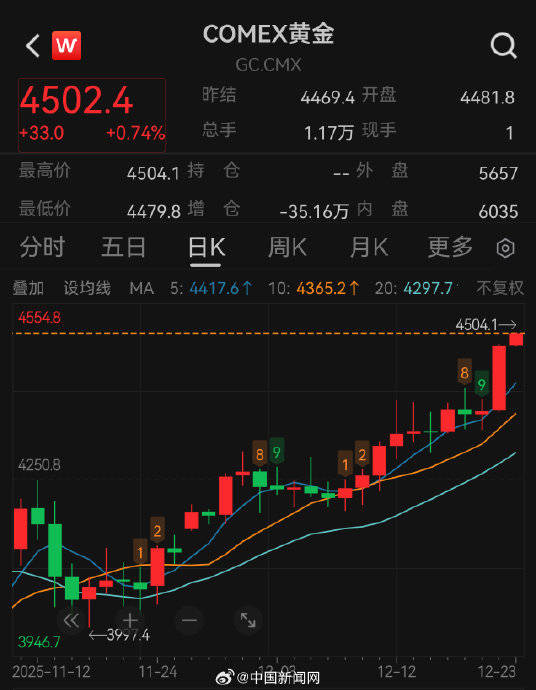
Core Dynamics and Data - Historical Breakthrough: On December 23, 2025, COMEX gold futures first broke $4500/oz, reaching a peak of $4555.1; London spot gold also surged to $4525.83/oz, with a year-to-date increase exceeding 70%, marking the largest annual gain since 1979 [2] - Consumer Transmission: Major brands like Chow Tai Fook and Chow Sang Sang saw a daily increase of 36 yuan in gold jewelry prices, with a reported price of 1411 yuan/gram on December 24, totaling a two-day increase of 44 yuan. The cost of 60 grams of wedding "three golds" skyrocketed from under 40,000 yuan at the beginning of the year to over 80,000 yuan, leading some couples to consider rentals or "gold-plated silver" alternatives [2] Driving Forces Behind the Surge - Monetary Easing Expectations: The Federal Reserve is expected to cut rates by 75 basis points cumulatively in 2025, with the market betting on further cuts in 2026. The decline in U.S. Treasury yields diminishes the dollar's attractiveness, while lower real interest rates reduce the cost of holding gold [3] - Surge in Safe-Haven Demand: - Geopolitical Risks: U.S. sanctions on Venezuelan oil tankers and tensions in the Middle East have heightened risk aversion [4] - De-dollarization: Central banks globally purchased a net 634 tons of gold in the first three quarters, with China increasing its gold reserves for 13 consecutive months, leading to a decrease in the dollar's share of foreign exchange reserves to 56.32% [4] - Technical Buying Pressure: The gold price broke through the resistance level of $4380 set in October, triggering algorithmic trading, with gold ETFs experiencing net inflows for five consecutive weeks [4] Market Divergence and Risk Alerts - Bullish Camp: Central bank gold purchases and an ongoing rate-cut cycle support a bullish outlook, with Goldman Sachs predicting $4900 and JPMorgan forecasting $5055 [5] - Cautious Camp: Concerns over short-term overbought conditions and policy fluctuations, with Citigroup warning of a pullback to $4280-$4300 and economist Guan Qingyou cautioning that rapid price increases may not be beneficial [5] - Historical Lessons: In October, gold prices twice touched $4380 before experiencing a single-day drop of nearly $200 (a 6.3% decline), with the current RSI indicating overbought conditions in the 74-80 range [5] Practical Advice for Ordinary Users - Consumer Pitfalls: - Wedding essentials should prioritize gold jewelry priced by weight in markets like Shenzhen's Shui Bei, avoiding brand premiums of around 30% [6] - Consider refurbishing old gold or opting for "gold-plated silver" alternatives, which are priced at only one-fifth of solid gold [6] - Investment Allocation: - Tools: Gold ETFs (with fees <0.5%) and bank gold savings should be preferred, avoiding high-leverage futures due to frequent liquidations at 80x leverage in October [7] - Strategy: Maintain positions at ≤10% of liquid assets, employing dollar-cost averaging to mitigate high-price risks and avoid chasing prices [7] Future Trend Core Contradictions - Upward Momentum: The erosion of the dollar's credit system is transforming gold from an "anti-inflation tool" to the "ultimate asset against sovereign credit risk," with Morgan Stanley predicting gold prices could challenge $7000-$8000 by 2030 [8] - Downward Risks: If the Federal Reserve's independence is restored or if global economic recovery exceeds expectations, a prolonged bear market for gold similar to the 1980-2000 period could re-emerge [8]


持续看好战略金属投资机遇 | 券商晨会
Sou Hu Cai Jing· 2026-01-13 00:47
Group 1 - The core viewpoint of the reports indicates that the market may exhibit characteristics of a bottom lift and active main lines in the first quarter and beyond, with China's economy expected to enter a recovery phase by 2026 under a policy framework of "stabilizing growth" and "strengthening technology" [1] - The transition from old to new driving forces is showing initial effectiveness, with a number of high-tech listed companies moving from "policy-driven" to "performance verification," providing necessary conditions for medium to long-term capital participation and continuous pricing [1] - The technology sector is anticipated to become a long-term focus for capital markets, driven by increasing market confidence and capital inflow, with long-term funds supporting the market and maintaining active trading under policy promotion [1] Group 2 - The "14th Five-Year Plan" period will see China's economy enter a transformation phase dominated by new productive forces, with investment focusing on four main lines: technology self-reliance, green transition, silver economy driven by aging population, and strategic resource layout under development and security [2] - A dual-peak asset allocation strategy is recommended, with defensive investments in high-dividend assets (such as hydropower, telecom operators, and state-owned banks) for stable cash flow, and offensive investments in hard technology growth assets (like semiconductor equipment, industrial software, and humanoid robots) to capture excess returns from domestic substitution and industrial upgrades [2] Group 3 - There is a sustained optimism regarding investment opportunities in strategic metals characterized by resource scarcity and rigid supply, which often leads to a natural "bullish option" due to high geographical concentration of resources [3] - The demand for strategic metals is expected to benefit from significant changes in industries and national strategic reserves, as they are essential for developing new productive forces, with a new cycle of demand driven by new energy, new materials, and artificial intelligence [3] - Global resource supply security is under threat, prompting countries to increase acceptable inventory levels to mitigate potential supply disruption risks, particularly for metals used in the military industry [3]


持续看好战略金属投资机遇
Mei Ri Jing Ji Xin Wen· 2026-01-13 00:44
Group 1 - The core viewpoint of the reports indicates that the market may exhibit characteristics of a bottom lift and active main lines in the first quarter and beyond, with China's economy expected to enter a recovery phase by 2026 [1] - The macro environment is supported by policies focusing on "stabilizing growth" and "strengthening technology," which will favor technology-related sectors through sustained institutional support and fiscal resources [1] - The transition from old to new driving forces is showing initial effectiveness, with several high-tech listed companies moving from "policy-driven" to "performance verification," providing necessary conditions for medium to long-term capital participation [1] Group 2 - The asset allocation strategy suggested by the company is a dual-peak strategy, focusing on defensive high-dividend assets for stable cash flow and offensive hard technology growth assets to capture excess returns from domestic substitution and industrial upgrades [2] - The report emphasizes that during the "14th Five-Year Plan" period, China's economy will enter a transformation phase led by new productive forces, with investment focusing on technology self-reliance, green transition, silver economy due to aging population, and strategic resource layout [2] Group 3 - The company maintains a positive outlook on strategic metal investment opportunities characterized by resource scarcity and supply rigidity, which can create a "bullish option" due to their inherent supply vulnerabilities [3] - Strategic metals are essential for developing new productive forces and are expected to see increased demand due to significant changes in demand structure driven by global technological revolutions [3] - The report highlights that global resource supply security is under threat, prompting countries to increase strategic reserves, particularly for metals used in the military industry [3]
鲍威尔遭刑事调查引央行独立性危机
Sou Hu Cai Jing· 2026-01-13 00:36
Group 1 - The core issue revolves around a politically motivated judicial investigation against Federal Reserve Chairman Powell, which is perceived as a tactic to pressure for interest rate cuts by the Trump administration [2][3] - The investigation is based on alleged perjury related to the Federal Reserve headquarters renovation project, which saw its budget increase from $1.9 billion to $2.5 billion [2] - Powell's public rebuttal emphasizes the investigation as an extension of government pressure, questioning the independence of the Federal Reserve in setting interest rates based on economic realities rather than political coercion [4] Group 2 - There is a notable division within the Republican Party, with some senators publicly opposing the investigation, labeling it as political coercion, which could jeopardize Trump's Federal Reserve nominations [5] - A historic joint statement from former Federal Reserve Chairs and Treasury Secretaries condemns the investigation, warning that such actions undermine central bank independence [6] Group 3 - Market reactions include a sell-off of risk assets, with the Dow futures dropping nearly 200 points (approximately 0.5%) and the dollar index falling 0.3% to 98.89, marking a six-month low [7] - Safe-haven assets surged, with spot gold rising 1.88% to surpass $4,600 per ounce, and silver increasing over 4%, indicating a shift in market sentiment towards perceived dollar credit risk [8] - Non-U.S. assets gained strength, with the Nasdaq Golden Dragon China Index soaring 4.26% and Alibaba's stock rising over 10%, alongside a peak in the offshore RMB exchange rate [9] Group 4 - The legitimacy of the judicial process is questioned, as proving perjury requires evidence of intentional false statements, and the renovation audit is incomplete, with funding sourced from the Federal Reserve's own income [11] - The incident may accelerate global de-dollarization, as it sets a precedent for criminal investigations of central bank leaders, potentially undermining trust in the Federal Reserve [12] - Long-term institutional risks arise if political interference becomes normalized, threatening the credibility of the dollar and leading to increased market uncertainty during Powell's remaining term [13]
4600美元/盎司!黄金又创新高 机构:长期看涨
Zhong Guo Jing Ying Bao· 2026-01-13 00:03
Core Viewpoint - The recent surge in gold prices, surpassing $4600 per ounce, is driven by concerns over political interference in the Federal Reserve's independence, leading to a weaker dollar and increased demand for gold as a safe-haven asset [1][2]. Group 1: Factors Supporting Gold Price Increase - Geopolitical risks are high, with U.S. military involvement in Venezuela contributing to increased market uncertainty and driving up gold prices [3]. - Rising U.S. fiscal risks, exacerbated by past government shutdowns and unsustainable debt levels, are prompting investors to seek refuge in gold, diminishing the appeal of dollar-denominated assets [3]. - Central banks globally are increasing their gold reserves as a strategic response to economic uncertainties, which is a significant factor in the rising gold prices [3][4]. - The expectation of continued interest rate cuts by the Federal Reserve, due to a cooling labor market and manageable inflation risks, is providing further support for gold prices [3]. Group 2: Future Gold Price Predictions - Morgan Stanley has raised its gold price forecast, predicting it could reach $4800 per ounce by 2026, indicating strong long-term bullish sentiment [4]. - DBS Bank anticipates gold prices will fluctuate around $4500 per ounce in the first half of 2026, with potential to reach $5100 per ounce in the latter half, driven by central bank demand and increasing investment from both institutions and retail investors [4]. - The long-term demand for gold from central banks is expected to surpass that from jewelry and ETFs, reflecting a strategic shift in asset allocation amid global monetary system changes [4][5].
中信建投:资产配置建议采用双峰型策略
Zheng Quan Shi Bao Wang· 2026-01-12 23:57
Core Viewpoint - During the "14th Five-Year Plan" period, China's economy is expected to enter a transformation phase dominated by new quality productivity, with a downward shift in growth center and intensified external geopolitical competition [1] Group 1: Investment Focus Areas - Industry investment will concentrate on four main lines: technology self-reliance driven by new quality productivity, green transformation during the carbon peak battle, the silver economy driven by an aging population, and strategic resource allocation under the coordination of development and security [1] - Non-ferrous metals are expected to maintain strong performance, with gold being a core safe-haven asset under the "de-dollarization" pricing logic, while copper and aluminum will benefit from energy transition and supply constraints [1] Group 2: Asset Allocation Strategy - The asset allocation strategy suggests a dual-peak approach: defensive allocation in high-dividend assets (such as hydropower, telecommunications operators, and state-owned banks) to secure stable cash flow returns [1] - Offensive allocation should focus on hard technology growth assets (including semiconductor equipment, industrial software, and humanoid robots) to capture excess returns from domestic substitution and industrial upgrading [1]
资金持续涌入金银资产!机构:看好长期表现,非投机过度
Shang Hai Zheng Quan Bao· 2026-01-12 23:22
Core Viewpoint - The prices of gold and silver continue to surge, reaching new historical highs, driven by multiple factors including geopolitical tensions, U.S. fiscal risks, and strong demand for safe-haven assets [1][2][3][4]. Group 1: Price Movements - On January 12, the main silver contract in Shanghai opened significantly higher at 20,881 CNY/kg, with a peak of 20,950 CNY/kg, marking a 14.07% increase [1] - COMEX silver rose over 6%, reaching 84.52 USD/oz, while London spot silver hit a high of 84.589 USD/oz, with an increase of over 5% [1] - COMEX gold reached 4,612.7 USD/oz, and the Shanghai gold main contract saw a 3.07% rise, both setting new historical highs [1] Group 2: Factors Driving Price Increases - Geopolitical risks are high, enhancing market demand for safe-haven assets like gold and silver [3] - U.S. fiscal risks are increasing due to the Trump administration's economic policies, raising concerns about the sustainability of U.S. debt and diminishing the attractiveness of dollar assets [3][4] - Central banks globally are showing a strong willingness to increase gold reserves due to economic uncertainties [3] Group 3: Investment Trends - In 2025, gold and silver saw substantial inflows, with over 5.5 billion shares of gold ETFs net purchased, and the largest gold ETF in China, Huaan Gold ETF, growing from under 30 billion CNY to over 90 billion CNY [5][6] - As of December 2025, China's central bank held 7.415 million ounces of gold, continuing a 14-month streak of increasing gold reserves [6] - In the first seven trading days of 2026, gold ETFs saw net purchases exceeding 400 million shares, with Huaan Gold ETF approaching 100 billion CNY [6] Group 4: Long-term Outlook - Analysts predict that gold and gold stocks will have significant potential in 2026, driven by ongoing monetary easing and geopolitical factors [7] - The investment logic surrounding gold has shifted from short-term economic indicators to a focus on long-term structural risk hedging [7] - Gold is increasingly viewed as a strategic long-term hedge, enhancing portfolio resilience amid policy uncertainties and fiscal vulnerabilities [7][8]
数字人民币钱包应接入应用场景
Sou Hu Cai Jing· 2026-01-12 23:16
数字人民币1.0版本局限于线上支付功能。 数字人民币2.0版本来了!日前中国人民银行发布《关于进一步加强数字人民币管理服务体系和相关金 融基础设施建设的行动方案》,称今年1月1日起正式启动实施新一代数字人民币计量框架、管理体系、 运行机制和生态体系。数字人民币推行10年后,迈向"新纪元"。 值得一提的是,新版数字人民币不再局限于移动支付功能,而是能像活期存款一样计息,同时无需网络 也能完成支付。 数字人民币是中国人民银行发行的数字形式的法定货币。 正如一位银行工作人员所说:"由于微信、支付宝的用户黏性强,导致数字人民币一直没有得到全面推 广。"那么,这次升级换代后的数字人民币能否得到更进一步的推广? 利好 余额能计付利息 提现无需手续费 据权威消息,数字人民币是中国人民银行发行的数字形式的法定货币,由指定运营机构参与运营,以广 义账户体系为基础,支持银行账户松耦合功能,与实物人民币等价,具有价值特征和法偿性。 和数字人民币1.0版本相比,对于普通消费者,数字人民币2.0有以下几点优势:首先,数字人民币钱包 余额能计付利息。日前,中国工商银行、中国建设银行、中国农业银行、中国银行、中国邮政储蓄银 行、交通银行、 ...