
稳增长

Search documents
着力拓展投资增长空间,确保稳增长
2 1 Shi Ji Jing Ji Bao Dao· 2025-12-20 00:43
Core Viewpoint - The National Development and Reform Commission emphasizes the importance of effective investment during the 14th Five-Year Plan period, focusing on expanding domestic demand and enhancing government investment to stimulate private investment and reform investment mechanisms [1][2]. Group 1: Investment Strategy - The central economic work conference identifies stabilizing investment as a key task for the upcoming year, with a focus on reversing the decline in fixed asset investment, which has decreased by 2.6% year-on-year from January to November [1][2]. - The government aims to combine investment in physical assets and human capital, enhancing infrastructure and public services while addressing the needs of new urbanization and rural revitalization [2][3]. Group 2: Funding Sources - The central economic work conference proposes a more proactive fiscal policy, including increasing central budget investment and optimizing the use of local government special bonds to enhance funding sources for investment [2][3]. - New policy financial tools are highlighted as crucial for stabilizing investment, indicating a shift towards early implementation of these tools [2]. Group 3: Project Implementation - The 15th Five-Year Plan will prioritize high-quality implementation of major national strategies and projects, focusing on infrastructure and public service development in response to demographic changes [3][4]. - The government aims to create a collaborative investment environment by enhancing the role of private enterprises in major project construction and increasing the proportion of private investment [3][4]. Group 4: Private Investment Activation - The State Council has issued measures to stimulate private investment, including 13 targeted initiatives to improve access, eliminate bottlenecks, and strengthen guarantees for private investors [4]. - The central economic work conference emphasizes the need to boost private sector confidence through improved regulations and timely payment of debts owed to enterprises, fostering a conducive environment for private investment [4].
格林大华期货消费投资不及预期,期债探底回升
Ge Lin Qi Huo· 2025-12-19 13:12
Group 1: Report Investment Rating - No information provided Group 2: Core Viewpoints - The latest macroeconomic data indicates that stabilizing growth remains the main theme of the fourth - quarter macroeconomy. The central bank's Party committee meeting points out that next year, a moderately loose monetary policy will continue to be implemented, with promoting stable economic growth and reasonable price recovery as important considerations. Treasury bond futures may fluctuate in the short term, and trading - type investors are advised to conduct band operations [36][37] Group 3: Summary by Relevant Catalogs Treasury Bond Futures Weekly Market Review - This week, the main contracts of treasury bond futures showed a pattern of bottom - hunting and recovery. The 30 - year treasury bond rose 0.02%, the 10 - year treasury bond rose 0.14%, the 5 - year treasury bond rose 0.14%, and the 2 - year treasury bond rose 0.03% [5] Treasury Bond Spot Yield Curve Changes - As of December 19th, compared with December 12th, the treasury bond spot yield curve shifted slightly downward. The 2 - year, 5 - year, 10 - year, and 30 - year treasury bond yields decreased by 2BP, 3BP, 1BP, and 2BP respectively [8] Fixed - Asset Investment - From January to November, national fixed - asset investment decreased by 2.6% year - on - year, worse than the market expectation of a 2.2% decline. Different types of infrastructure and real estate investment also showed various changes [11] New Home Sales - From January to November, the sales area of new commercial housing decreased by 7.8% year - on - year, and the sales amount decreased by 11.1% year - on - year. In November, new home sales continued to decline significantly [14] Second - Hand Residential Sales Prices - In November, the second - hand residential sales prices in first - tier cities decreased by 1.1% month - on - month, with the decline expanding by 0.2 percentage points. Second - and third - tier cities also had different degrees of decline [17] Social Consumption - In November, the total retail sales of consumer goods increased by 1.3% year - on - year, lower than the market expectation. From January to November, service retail sales increased by 5.4% year - on - year [19][22] Industrial Added Value - In November, the value - added of industrial enterprises above designated size increased by 4.8% year - on - year, lower than the market expectation. The growth rates of different industries also showed changes [24] Product Sales Rate - In November, the product sales rate of industrial enterprises above designated size was 96.5%, 0.6 percentage points lower year - on - year [27] Service Industry Production Index - In November, the national service industry production index increased by 4.2% year - on - year, hitting a new low for the year [30] Unemployment Rate - In November, the national urban survey unemployment rate was 5.1%, unchanged from the previous month [32] Capital Interest Rates - This week, overnight capital interest rates remained at a low level. The weighted average of DR001 was 1.273%, and that of DR007 was 1.443%. The average issuance interest rate of one - year AAA inter - bank certificates of deposit was 1.657% [34] Market Logic - In November, fixed - asset investment and social consumption were lower than market expectations, while export growth exceeded expectations. The inflation level remained moderate, and the short - term trend of treasury bond futures may be volatile [36] Trading Strategy - Trading - type investors are advised to conduct band operations [37]
——11月财政数据点评:年末财政有多少余粮?
Changjiang Securities· 2025-12-19 04:41
Revenue and Expenditure Trends - From January to November 2025, general public budget revenue reached 20.1 trillion yuan, a year-on-year increase of 0.8%[6] - General public budget expenditure for the same period was 24.9 trillion yuan, with a year-on-year growth of 1.4%[6] - Cumulative general fiscal revenue and expenditure for the first eleven months fell to -0.2% and 4.5%, respectively[3] Tax and Non-Tax Revenue - Tax revenue in November showed a year-on-year increase of 3.2%, marking the eighth consecutive month of positive growth, while non-tax revenue dropped significantly by 10.8% due to a high base effect[3][10] - Major tax categories such as VAT and personal income tax increased by 3.3% and 11.4%, respectively, contributing positively to overall tax revenue[3] Expenditure Analysis - November's fiscal expenditure saw a reduced year-on-year decline of 2.0%, with significant increases in technology and health spending, which grew by 20-30%[3][10] - Infrastructure-related expenditures continued to decline, with specific categories like urban community and agricultural water management showing decreases of 16.6% and 28.0%, respectively[3][10] Land Sales and Fund Expenditure - Revenue from land sales in November fell sharply by 26.5%, continuing a negative trend for four consecutive months[3][10] - Fund expenditure in November turned positive with a growth of 2.8%, attributed to accelerated fiscal spending towards year-end[3] Fiscal Surplus and Future Outlook - The year-end fiscal situation may leave a surplus, potentially supporting growth in the first half of 2026[3][10] - Cumulative new fiscal deposits reached approximately 2 trillion yuan, the highest since 2013, indicating a strong fiscal position[3][10]
债市回调,国债期货全线收涨
Hua Tai Qi Huo· 2025-12-18 03:05
Report Industry Investment Rating No information provided. Core Viewpoints The bond market is oscillating between stable growth and easing expectations. The market is influenced by factors such as macro - policies, inflation, fiscal and financial conditions, and global trade uncertainties. In the short term, attention should be paid to the policy signals at the end of the month [1][2][3]. Summary by Directory 1. Interest Rate Pricing Tracking Indicators - China's CPI (monthly) has a month - on - month change of - 0.10% and a year - on - year change of 0.70%; China's PPI (monthly) has a month - on - month change of 0.10% and a year - on - year change of - 2.20% [9]. - Social financing scale is 440.07 trillion yuan, with a month - on - month increase of 2.35 trillion yuan and a growth rate of 0.54%; M2 year - on - year is 8.00%, down 0.20% with a decline rate of 2.44%; Manufacturing PMI is 49.20%, up 0.20% with a growth rate of 0.41% [10]. - The US dollar index is 98.40, up 0.19 with a growth rate of 0.19%; The US dollar against the offshore RMB is 7.0390, up 0.001 with a growth rate of 0.02%; SHIBOR 7 - day is 1.43, unchanged with a decline rate of 0.07%; DR007 is 1.44, down 0.01 with a decline rate of 0.45%; R007 is 1.51, unchanged with a decline rate of 0.31%; The 3 - month inter - bank certificate of deposit (AAA) is 1.63, unchanged with a growth rate of 0.00%; The AA - AAA credit spread (1Y) is 0.09, unchanged with a growth rate of 0.00% [10]. 2. Overview of Treasury Bonds and Treasury Bond Futures Market - On December 17, 2025, the closing prices of TS, TF, T, and TL are 102.43 yuan, 105.84 yuan, 108.01 yuan, and 112.14 yuan respectively. The price changes are 0.01%, 0.06%, 0.10%, and 0.63% respectively [3]. - The average net basis of TS, TF, T, and TL are 0.084 yuan, - 0.076 yuan, - 0.053 yuan, and - 0.228 yuan respectively [3]. 3. Overview of the Money Market Funding Situation - From January to October 2025, the general public budget revenue increased by 0.8% year - on - year, and the general public budget expenditure increased by only 2% year - on - year [2]. - In November, the overall financial data was weak. The credit was still supported by bills and short - term loans. The medium - and long - term financing needs of residents and enterprises continued to decline, and the loans increased significantly less year - on - year. The social financing growth rate remained at 8.5%, mainly hedged by corporate bonds and off - balance - sheet financing [2]. - On December 17, 2025, the central bank conducted a 46.8 - billion - yuan 7 - day reverse repurchase operation at a fixed interest rate of 1.4% [2]. - The main term repurchase rates of 1D, 7D, 14D, and 1M are 1.275%, 1.428%, 1.471%, and 1.541% respectively, and the repurchase rates have recently declined [2]. 4. Spread Overview No specific data summary provided in the text, only mentions various spread trend charts such as the inter - period spread trend of treasury bond futures and the spread between spot bond term spreads and futures cross - variety spreads. 5. Two - Year Treasury Bond Futures - Charts show the implied interest rate of the two - year treasury bond futures main contract and the treasury bond yield to maturity, the IRR of the TS main contract and the funding rate, and the three - year basis and net basis trends of the TS main contract [37][38][45]. 6. Five - Year Treasury Bond Futures - Charts show the implied interest rate of the five - year treasury bond futures main contract and the treasury bond yield to maturity, the IRR of the TF main contract and the funding rate, and the three - year basis and net basis trends of the TF main contract [49][53]. 7. Ten - Year Treasury Bond Futures - Charts show the implied yield of the ten - year treasury bond futures main contract and the treasury bond yield to maturity, the IRR of the T main contract and the funding rate, and the three - year basis and net basis trends of the T main contract [56][58]. 8. Thirty - Year Treasury Bond Futures - Charts show the implied yield of the thirty - year treasury bond futures main contract and the treasury bond yield to maturity, the IRR of the TL main contract and the funding rate, and the three - year basis and net basis trends of the TL main contract [63][69]. Strategies - Unilateral: The repurchase rate has declined, and the treasury bond futures prices are oscillating [4]. - Arbitrage: Pay attention to the decline of the 2603 basis [4]. - Hedging: There is medium - term adjustment pressure, and short - side investors can use far - month contracts for appropriate hedging [4].
长城证券“烽火杯”火热进行中 《烽火论剑》栏目解码2026资产配置主线
Zhong Zheng Wang· 2025-12-17 11:37
Group 1 - The "Fenghuo Cup" private equity selection event organized by Changcheng Securities has attracted over 600 private equity institutions and more than 1,600 products since its launch in October 2025, covering seven core strategies including stock, index enhancement, neutral, arbitrage, CTA, bond, and combination strategies [1] - The event aims to provide ample time for participating institutions to showcase their investment capabilities, with registration open until June 2026 [1] - The initiative is part of Changcheng Securities' effort to create a supportive ecosystem for quality private equity growth, offering diverse resources and platforms for trading execution, investment support, and financing solutions [1] Group 2 - In the macroeconomic context, the current economic cycle is perceived to be in a relatively early stage, with policies aimed at supply-side reform generating positive expectations, although actual progress remains to be verified [2] - The consensus among fund managers is that there are still reasonably valued targets in the market, such as the food and beverage index's price-to-earnings ratio and the Hang Seng Index's price-to-book ratio, both at historical lows [2] - Investment opportunities in the technology sector are highlighted, particularly in AI, with a focus on hardware that has reasonable valuations and is part of new major industry chains [2] Group 3 - Looking ahead to 2026, it is anticipated that more aggressive monetary and fiscal policies will be implemented, with potential further declines in risk-free interest rates and an increase in the value of credit bond allocations [3] - The stock market outlook favors relatively undervalued sectors such as banking, food and beverage, and consumer electronics, alongside technology leaders in AI chips, semiconductor equipment, and computing power [3] - The difficulty of stock selection and timing is expected to increase, making industry ETFs a more cost-effective option for investment [3]

银河证券:证券板块估值处于历史低位
Ge Long Hui· 2025-12-17 00:22
Core Viewpoint - The policies aimed at "stabilizing growth and the stock market" and "boosting the capital market" will continue to shape the future direction of the sector, with multiple factors driving the improvement in the securities sector's prosperity [1] Group 1: Market Environment - A moderately loose liquidity environment is expected to persist, alongside an ongoing optimization of the capital market environment [1] - Investor confidence is being rebuilt, contributing to a high level of market activity [1] Group 2: Investment Trends - There is an acceleration of medium- to long-term capital entering the market, maintaining high market activity levels [1] - The capital market is exhibiting a "healthy bull" trend, indicating positive growth potential [1] Group 3: Sector Drivers - Wealth management transformation, international business expansion, and financial technology empowerment are anticipated to drive improvements in Return on Equity (ROE) for the industry [1] - The current sector valuation is at a historical low, suggesting a defensive rebound strategy that balances offense and defense [1]
12月15日大盘简评
Mei Ri Jing Ji Xin Wen· 2025-12-15 10:16
Group 1 - A-shares experienced a downward trend today, with the Shanghai Composite Index closing at 3867.92 points, down 0.55%, and the Shenzhen Component Index at 13112.09 points, down 1.10% [1] - The total trading volume in the two markets was less than 1.8 trillion yuan, a decrease from the previous trading day, indicating a market environment where declines outnumbered gains, particularly in the electronic communication sector [1] - The overall economic and policy environment for A-shares remains positive, with expectations for fiscal spending to support economic demand recovery, leading to a potential return to an upward cycle for A-shares in the medium term [1] Group 2 - The gold sector performed well today, with the Gold Fund ETF (518800) rising by 1.37% and the Gold Stock ETF (517400) increasing by 1.28% [2] - Short-term expectations include a 25 basis point rate cut by the Federal Open Market Committee (FOMC) in December, alongside ongoing geopolitical tensions and a global trend towards de-dollarization, which are expected to support gold prices [2] - The defensive demand in the market is increasing, with dividend stocks benefiting as a "safe haven," and the resource-heavy dividend index is sensitive to fluctuations in coal and oil prices [2]
11月经济数据点评:稳增长的宏观政策宜提早发力
Bank of China Securities· 2025-12-15 08:25
Economic Performance - In November, industrial added value increased by 4.8% year-on-year, which is 0.1 percentage points lower than October and 1.4 percentage points lower than the same period last year[4] - Retail sales of consumer goods grew by 1.3% year-on-year in November, marking the sixth consecutive month of decline, and was below market expectations[12] - Fixed asset investment showed a cumulative year-on-year decline of 2.6% from January to November, with private fixed asset investment down by 5.3%[21] Sector Analysis - Manufacturing investment from January to November saw a cumulative year-on-year increase of 1.9%, while infrastructure investment decreased by 1.1% and real estate investment fell by 15.9%[23] - High-tech industries maintained strong performance, with a cumulative year-on-year growth of 9.2% in industrial added value from January to November[2] - Real estate new construction area decreased by 20.5% year-on-year, with sales area down by 7.8% and sales revenue down by 11.1%[28] Consumer Behavior - The decline in retail sales was particularly pronounced in post-real estate consumption categories such as furniture and home appliances, which saw significant drops[15] - Online retail accounted for 31.7% of total retail sales, with a cumulative year-on-year growth of 9.1%[14] Policy Recommendations - The macroeconomic policy should consider early implementation to address potential uncertainties in the first quarter of 2026, especially given the late timing of the Spring Festival[32] - Short-term focus on monetary easing measures such as interest rate cuts and reserve requirement ratio reductions is recommended[32] Risks - Potential risks include a resurgence of global inflation, a faster-than-expected economic slowdown in Europe and the U.S., and increasing international geopolitical complexities[32]
越跌越买!超165亿抄底
Zhong Guo Ji Jin Bao· 2025-12-15 06:42
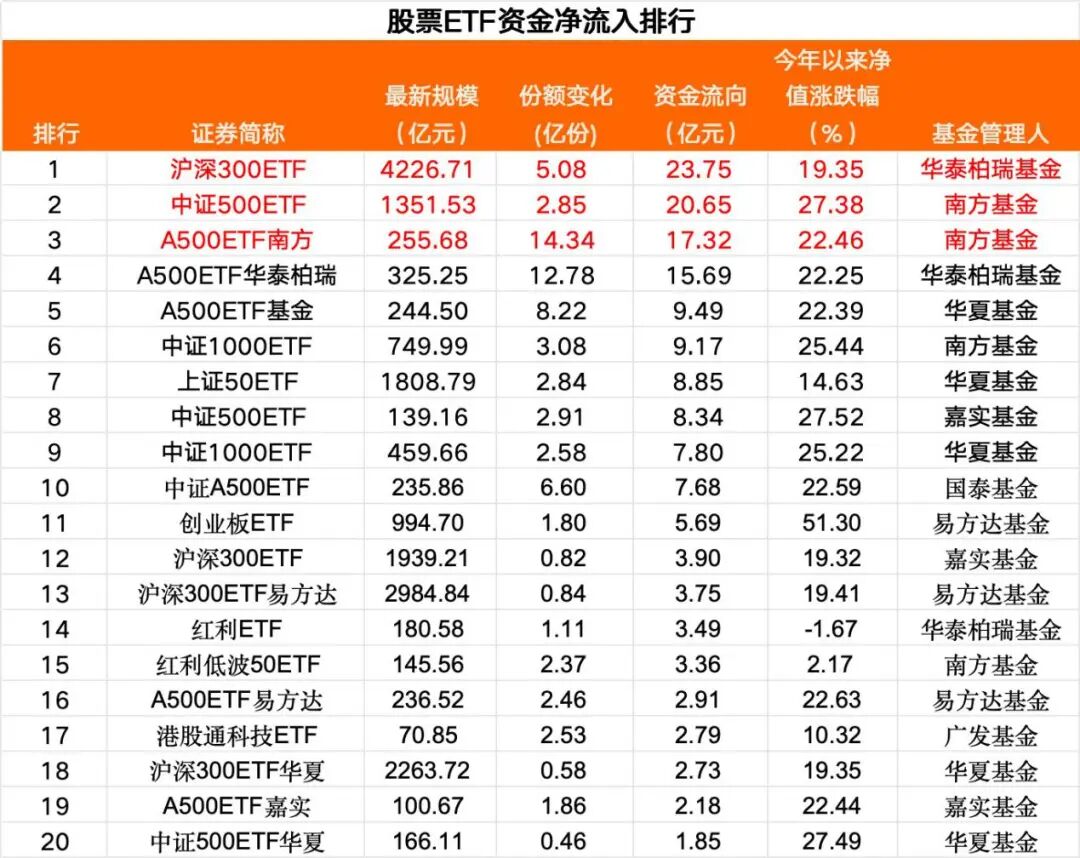
Core Viewpoint - The stock ETF market experienced significant net inflows, exceeding 16.5 billion yuan on December 12, with notable contributions from various indices, indicating strong investor interest and potential market momentum [1][3]. Group 1: Market Overview - As of December 12, the total scale of the stock ETF market reached 4.62 trillion yuan, with a total of 1,273 stock ETFs [3]. - On December 12, the market saw an increase of 796.4 million shares, with a net inflow of 16.573 billion yuan, where 41 stock ETFs had net inflows exceeding 100 million yuan [3]. - The top five sectors for fund inflows included the CSI A500 index (5.91 billion yuan), CSI 300 index (3.55 billion yuan), CSI 500 index (3.25 billion yuan), CSI 1000 index (1.81 billion yuan), and the Dividend index (1.49 billion yuan) [3]. Group 2: Fund Inflows and Outflows - The CSI A500 index ETF led the inflows with 5.9 billion yuan, while the STAR 50 index ETF saw the largest outflow of 770 million yuan [3]. - Over the past five days, the CSI A500 index ETF attracted over 9.6 billion yuan, and the Hang Seng Technology index ETF saw inflows exceeding 3 billion yuan [2][3]. - On the outflow side, seven stock ETFs experienced net outflows exceeding 1 billion yuan, particularly in sectors like technology and banking [5]. Group 3: Fund Management Insights - Leading fund companies, such as E Fund and Huaxia Fund, reported substantial net inflows in their ETF products, with E Fund's ETFs increasing by 223.5 billion yuan since 2025, including a net inflow of 60.33 billion yuan [6]. - E Fund's notable inflows on the previous trading day included 570 million yuan for the ChiNext ETF and 380 million yuan for the CSI 300 ETF [6]. - Market analysts suggest that the index may enter a "cross-year market" phase, driven by policy catalysts, with a shift from defensive to aggressive investment strategies recommended [7].

中央经济工作会议后,市场如何表现?
Soochow Securities· 2025-12-13 11:08
Core Insights - The report indicates that the 2025 Central Economic Work Conference is more focused on "structural adjustment," suggesting a potential for a structural market trend in the upcoming year [4][6][26] - Historical patterns show that years emphasizing "stabilizing growth" typically lead to stronger market performance, favoring large-cap stocks over small-cap and value stocks over growth stocks [2][10] - Conversely, years focused on "structural adjustment" tend to exhibit market volatility, with large-cap stocks remaining flat while small-cap stocks weaken [2][10] Summary by Sections Historical Performance Post-Central Economic Work Conference - The report categorizes past conferences into two themes: "stabilizing growth" and "structural adjustment," with specific years identified for each theme [1][2] - Years with a "stabilizing growth" focus include 2014, 2018, 2019, 2021, 2022, and 2024, characterized by economic slowdowns and policies aimed at maintaining stability [1][2] - Years emphasizing "structural adjustment" include 2013, 2015, 2016, 2017, 2020, and 2023, where the focus was on addressing structural issues and risks [2] Market Behavior and Style Preferences - In "stabilizing growth" years, the market index typically strengthens, with large-cap stocks outperforming small-cap stocks and value stocks outperforming growth stocks [2][10] - In "structural adjustment" years, the market tends to be more volatile, with large-cap stocks showing flat performance and small-cap stocks declining [2][10] Industry Performance Insights - The report notes that the focus of the Central Economic Work Conference influences the following year's market trends, with specific industry policies guiding investment directions [3][4] - For instance, the emphasis on "innovation-driven" policies in 2012 led to a TMT boom in 2013, while the focus on "new consumption" and "new infrastructure" in 2018 shaped market trends in 2019 [3] 2025 Conference Insights - The 2025 conference highlights a "supply strong, demand weak" scenario, indicating a need to balance supply and demand dynamics [4][6] - The report suggests that monetary policy will prioritize economic stability and reasonable price recovery, which could lead to improved corporate profitability if inflation expectations rise [6] - Expanding domestic demand is a key focus, with policies aimed at increasing consumer income and stabilizing investment to counteract previous declines in fixed asset investment growth [6] Market Outlook and Sector Allocation - The report anticipates a structural market trend in 2025, with specific sectors recommended for investment, including AI applications, semiconductor, and renewable energy sectors [7] - The report emphasizes the importance of monitoring macroeconomic conditions and policy developments to inform investment strategies in the upcoming year [7]