通胀压力

Search documents
美国银行研究报告:四分之一美家庭陷入“月光”困境
Yang Shi Xin Wen· 2025-11-13 23:09
美国银行研究所近日发布的分析报告显示,四分之一的美国家庭正过着"月光"生活。研究人员梳理了其 数百万客户的内部数据,追踪他们在食品杂货、住房、汽油、育儿和水电等必需品上的支出情况。 (文章来源:央视新闻) 研究发现,约25%的家庭将超过95%的收入用于这些必需品开支,几乎没有剩余资金用于外出就餐、度 假等额外消费,更加没有储蓄。报告指出,通胀压力超过工资增长造成中低收入家庭收支难以平衡。 ...

“应保持限制性” VS “应支持就业” 美联储地区主席对是否继续降息看法分化
智通财经网· 2025-11-13 22:18
克利夫兰联储主席哈马克表示,美联储应维持利率稳定,以继续对通胀施压,将物价增速拉回2%的目 标。她指出,尽管劳动力市场存在一定隐忧,高企的通胀依然顽固,尤其对低收入和中等收入家庭造成 持续冲击。哈马克认为,当前利率水平"几乎算不上限制性",并暗示中性利率可能高于多数政策制定者 的估计,"为了保持政策的限制性,需要让利率维持在当前水平"。 哈马克预计,通胀压力将持续到今年年底甚至延续至明年初。她提到,企业此前已吸收了部分由关税引 发的成本上涨,但如今越来越多的企业寻求将这些成本转嫁给消费者,这可能使物价压力更加顽固。 智通财经APP获悉,美联储内部对下一步政策路径的分歧愈发明显,多位地区联储主席周四先后发表讲 话,就通胀压力、劳动力市场韧性以及利率是否应继续下调提出不同看法。在最新一轮降息后,美联储 基准利率目前位于3.75%至4%区间,但决策者对于该区间是否仍具"限制性"并无共识。 相比之下,明尼阿波利斯联储主席卡什卡里则对10月的降息本身持保留态度。他在接受采访时直言,鉴 于经济表现依然强劲,他当时并不支持降息。他表示,尚未决定下月议息会议将如何投票,"取决于数 据走向,我可以支持降息,也可以支持按兵不动, ...
美联储穆萨莱姆:政策趋近中性,宽松空间有限
Sou Hu Cai Jing· 2025-11-13 19:15
Core Viewpoint - The current monetary policy is closer to neutral rather than slightly tight, indicating limited room for further easing without becoming overly accommodative [1] Group 1 - The inflation rate is currently too high at 3% [1] - There is a need to maintain pressure on inflation that exceeds the target while providing some support to the labor market [1] - Caution is advised for future actions regarding monetary policy [1]
三季度GDP仅增长0.1%!英国经济在预算案前“骤然失速”
智通财经网· 2025-11-13 09:01
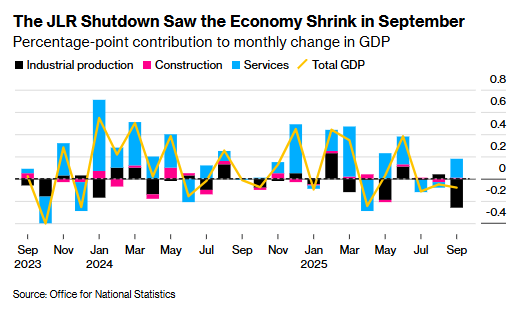
Economic Growth - The UK economy experienced minimal growth in Q3, with GDP increasing by only 0.1%, down from 0.3% in Q2 and below the forecasted 0.2% [1][3] - In September alone, the economy contracted by 0.1%, as weak growth in the services sector was offset by a sharp decline in manufacturing [1] Jaguar Land Rover Incident - A significant factor impacting September's economic performance was a cyberattack on Jaguar Land Rover, leading to a production halt of over five weeks and a nearly 30% drop in automotive manufacturing output [7] - This incident directly contributed to a 0.17 percentage point decline in GDP for September [7] Consumer and Business Sentiment - Consumer and business spending has been sluggish due to concerns over potential tax increases in the upcoming budget announcement by Chancellor Rachel Reeves [3][5] - The economic outlook is further dampened by expectations of significant tax hikes, which could reduce GDP by approximately 0.2% by 2026 [3] Trade Performance - UK exports to the US fell by 11.4% (approximately £500 million), reaching the lowest level since January 2022, largely due to tariffs imposed by the US [8][9] - Overall, UK exports decreased by 0.1% in Q3, while imports declined by 0.3% [11]

就业市场火热浇灭降息预期 澳洲联储料延长观望模式
Zhi Tong Cai Jing· 2025-11-13 06:46
Core Insights - Australia's unemployment rate decreased to 4.3% in October, down from 4.5% in September, indicating a tight labor market and supporting the Reserve Bank of Australia's (RBA) decision to maintain interest rates [1][2] - Employment increased by 42,200 jobs in October, all from full-time positions, significantly exceeding the market expectation of 20,000 [1] - The RBA's cautious stance on monetary policy is reinforced by the resilient labor market, which may reignite inflationary pressures [1][3] Labor Market and Economic Indicators - The labor market remains tight, with high job vacancy rates and a significant proportion of businesses facing recruitment difficulties [3] - Consumer confidence has improved, with optimistic respondents outnumbering pessimistic ones for the first time in four years [3] - Housing loan volumes reached a record high in Q3, driven mainly by investor loans [3] Market Reactions and Predictions - Following the employment data release, traders reduced expectations for RBA rate cuts next year, leading to a rise in the Australian dollar and a jump in three-year government bond yields [1][2] - The spread between three-year and ten-year government bond yields has narrowed due to expectations of reduced bond issuance this fiscal year [2] - The RBA forecasts the unemployment rate to remain at 4.4% over the forecast period, with employment growth expected to slow in the coming years [2]
市场主流观点汇总-20251112
Guo Tou Qi Huo· 2025-11-11 23:30
Report Overview - The report objectively reflects the research views of futures and securities companies on various commodity varieties, tracks hot varieties, analyzes market investment sentiment, and summarizes investment driving logic [1] Market Data Commodities - From November 3 to November 7, 2025, PTA rose 1.70% to 4664.00, aluminum rose 1.41% to 21625.00, and other commodities also had different changes. Gold fell 0.07% to 921.26, and some commodities like palm oil, copper, etc., declined [2] A - shares - From November 3 to November 7, 2025, the Shanghai - Shenzhen 300 rose 0.82% to 4678.79, while the CSI 500 fell 0.04% to 7327.91 [2] Overseas Stocks - From November 3 to November 7, 2025, the Hang Seng Index rose 1.29% to 26241.83, while the Nasdaq Index fell 3.04% to 23004.54 [2] Bonds - From November 3 to November 7, 2025, the yield of China's 2 - year treasury bond changed from 2.84 to 1.43, and the 10 - year treasury bond yield decreased by 0.7 bp to 1.81 [2] Foreign Exchange - From November 3 to November 7, 2025, the euro - US dollar exchange rate rose 0.25% to 1.16, and the US dollar index fell 0.18% to 99.55 [2] Commodity Views Macro - financial Sector Stock Index Futures - Strategy views: Among 9 institutions, 3 are bullish, 1 is bearish, and 5 expect a sideways trend. Bullish logic includes long - term domestic policy support, the start of the global AI cycle, improved global capital market sentiment, and the likely easing of Sino - US trade relations. Bearish logic includes better - than - expected US employment and manufacturing, decline in China's PMI, high A - share valuation, and increased risk - aversion sentiment [4] Treasury Bond Futures - Strategy views: Among 7 institutions, 2 are bullish, 0 are bearish, and 5 expect a sideways trend. Bullish logic includes weak fundamentals supporting the bond market, the stock - bond seesaw effect, and central bank net investment. Bearish logic includes inflation repair, increased government bond issuance, and potential market sentiment disturbance [4] Energy Sector Crude Oil - Strategy views: Among 8 institutions, 1 is bullish, 3 are bearish, and 4 expect a sideways trend. Bullish logic includes OPEC's suspension of production increase, short - term interruption of Russian oil, expected end - year risk - asset trading, and cost - price support. Bearish logic includes unexpected US inventory build - up, tight dollar liquidity, expected global inventory build - up, and rising production from new oil fields [5] Agricultural Products Sector Rapeseed Oil - Strategy views: Among 8 institutions, 3 are bullish, 1 is bearish, and 4 expect a sideways trend. Bullish logic includes unexpected decline in rapeseed oil inventory, low inventory and low operating rate of domestic oil mills, and un - resumed domestic rapeseed crushing. Bearish logic includes lack of Chinese demand for Canadian rapeseed, weakening aquaculture demand, expected increase in imports, and potential impact of improved Sino - Canadian relations [5] Non - ferrous Metals Sector Copper - Strategy views: Among 7 institutions, 2 are bullish, 2 are bearish, and 3 expect a sideways trend. Bullish logic includes the expected end of the US government shutdown, slow recovery of overseas copper mines, consumption boost from the "15th Five - Year Plan", and long - term demand from emerging sectors. Bearish logic includes shrinking US manufacturing PMI, rising US dollar index, increasing domestic inventory, and high copper prices suppressing traditional consumption [6] Chemical Sector Glass - Strategy views: Among 7 institutions, 0 are bullish, 4 are bearish, and 3 expect a sideways trend. Bullish logic includes decreased inventory of key enterprises, low - price valuation support, stable and slightly rising spot prices, and long - term policy support. Bearish logic includes weak terminal demand, sufficient industry capacity, high - inventory dragging down prices, and consumption - season pressure [6] Precious Metals Sector Gold - Strategy views: Among 7 institutions, 2 are bullish, 1 is bearish, and 4 expect a sideways trend. Bullish logic includes concerns about the Fed's independence and US fiscal situation, geopolitical uncertainty, increased risk - aversion due to the US government shutdown, and high probability of December interest - rate cut. Bearish logic includes eased Sino - US trade relations, hawkish Fed remarks, strong US service data, and lack of clear bullish factors [7] Black Metals Sector Iron Ore - Strategy views: Among 8 institutions, 0 are bullish, 4 are bearish, and 4 expect a sideways trend. Bullish logic includes decreased global shipments, rising basis during price decline, and increased blast - furnace operating rate. Bearish logic includes continuous over - seasonal inventory build - up at ports, significant increase in arrivals, difficult de - stocking of downstream products, decreased molten iron production, and increased negative - feedback pressure on steel mills [7]
薪资增速放缓叠加就业疲软 或促使英国央行尽早采取行动
Xin Hua Cai Jing· 2025-11-11 07:47
Group 1 - The average wage in the UK, excluding bonuses, slightly decreased to 4.6% year-on-year for the three months ending in September, indicating a weakening labor market [1] - The unemployment rate in the UK reached 5% for the three months ending in September, the highest level since February 2021, with a significant increase in jobless claims in October [1] - The Bank of England's decision to maintain interest rates at 4% reflects internal divisions, with four members advocating for a 25 basis point cut, suggesting a potential shift in monetary policy [1] Group 2 - The Bank of England has revised its policy guidance, indicating that interest rates "may continue along a gradual downward path," which has increased expectations for a rate cut in December [2] - Analysts suggest that the further slowdown in wage growth supports the rationale for a rate cut by the Bank of England, with predictions that the next cut could occur in December [2] - The British pound is expected to weaken due to the ongoing rate cut cycle of the Bank of England, contrasting with the European Central Bank's situation, and the euro is anticipated to strengthen against the pound [2]
市场担忧美国出现流动性危机,金价延续震荡调整
Dong Fang Jin Cheng· 2025-11-11 07:01
Report Industry Investment Rating - Not provided in the content Core Viewpoints - ADP employment data exceeded expectations and the market worried about a liquidity crisis in the US, causing the gold price to continue its volatile adjustment. Last Friday (November 7), the Shanghai gold futures price dropped 1.72% to 921.92 yuan/gram compared to the previous Friday, and the COMEX gold futures price fell 1.20% to 4077.20 US dollars/ounce. In the spot market, the gold T+D price declined 1.53% to 921.02 yuan/gram, and the London gold price decreased 2.65% to 4002.69 US dollars/ounce. The unexpectedly high ADP employment data and hawkish remarks from Fed officials cooled the market's expectation of interest rate cuts, pressuring the gold price. The significant rise in the US SOFR rate on October 31, announced last Monday, under the backdrop of the government shutdown and tightening bank liquidity, also triggered concerns about a liquidity crisis, putting downward pressure on the gold price. However, the subsequent sharp decline in the SOFR rate alleviated market concerns and pushed the gold price to rebound. Overall, the gold price continued its volatile adjustment last week due to the cooling of interest rate cut expectations and concerns about a liquidity crisis [3]. - This week (the week of November 10), the gold price will continue to fluctuate within a range. The US Senate planned to hold a trial vote on a new plan to end the government shutdown last Sunday (November 9), and the government is expected to resume work this week, which will ease market risk aversion and have a certain negative impact on the gold price. However, if the government shutdown ends, multiple private - sector economic indicators will be released this week, and these data are expected to remain weak, which will increase the market's expectation of interest rate cuts and be beneficial to gold. Although the long - term upward trend of the gold price remains unchanged, there are currently no clear upward factors. Given various uncertainties, the gold price is expected to continue its range - bound fluctuation this week [4]. Summary by Relevant Catalogs 1. Last Week's Market Review 1.1 Gold Spot and Futures Price Movements - Last Friday (November 7), the Shanghai gold futures price closed at 921.26 yuan/gram, down 0.66 yuan/gram from the previous Friday. The COMEX gold futures price closed at 4007.80 US dollars/ounce, continuing to decline by 5.60 US dollars/ounce. In the spot market, the gold T+D price closed at 917.64 yuan/gram, down 3.38 yuan/gram, and the London gold price closed at 4000.29 US dollars/ounce, down 2.40 US dollars/ounce [5]. - The trading data shows that the cumulative increase of the Shanghai gold futures was 0.32%, with a trading volume of 152 million and an open interest of 13.67 million, a decrease of 20,231. The COMEX gold futures had a cumulative increase of 0.28%, a trading volume of 102 million, an open interest of 31.15 million, and a decrease of 23,438. The gold T+D spot had a cumulative increase of 0.08%, a trading volume of 26.92 million, an open interest of 25.45 million, and an increase of 6,762. The London gold spot had a cumulative decrease of 0.06% [6]. 1.2 Gold Basis - Last Friday, the international gold basis (spot - futures) was - 1.10 US dollars/ounce, a significant drop of 16.90 US dollars/ounce from the previous Friday. The Shanghai gold basis was - 1.38 yuan/gram, a decline of 1.92 yuan/gram from the previous Friday [8]. 1.3 Gold Domestic - Foreign Price Difference - Last week, the decline of the foreign - market gold price was smaller than that of the domestic - market gold price. The gold domestic - foreign price difference on Friday was - 18.76 yuan/gram, a significant recovery from - 19.46 yuan/gram the previous Friday. The decline of the crude oil price was greater than that of gold, and the gold - oil ratio increased slightly. The silver price continued to rise slightly while the gold price continued to fall, causing the gold - silver ratio to decline slightly. Due to the government shutdown, the spread between the US SOFR rate and the overnight repo rate soared, triggering concerns about US dollar liquidity, reducing market risk appetite, and causing the copper price to fall more sharply than gold, leading to a significant increase in the gold - copper ratio [10]. 1.4 Position Analysis - In the spot market, the gold ETF holdings increased slightly last week. As of last Friday, the holdings of the world's largest SPRD gold ETF fund were 1042.06 tons, a slight increase of 2.86 tons from the previous week. The cumulative trading volume of domestic gold T+D continued to decrease, with a total of 269,158 kilograms last week, a 6.29% decrease from the previous week. - In the futures market, as of September 23 (the latest available data), both the long and short positions of gold CFTC asset management institutions increased, but the increase in short positions was less than that of long positions, resulting in a slight increase in the net long positions. In terms of inventory, the COMEX gold futures inventory continued to decrease last week, while the Shanghai Futures Exchange gold inventory increased by 1800 kilograms to 89,616 kilograms [14]. 2. Macroeconomic Fundamentals 2.1 Important Economic Data - The US ISM manufacturing PMI contracted for the eighth consecutive month in October. The index was 48.7, lower than the expected 49.5 and the previous value of 49.1. Among the important sub - indices, the new orders index was 49.4, higher than the previous value of 48.9. The new orders in October decreased for the second consecutive month, but the decline rate slowed down. The production index dropped 2.8 points to 48.2, indicating output contraction in two of the past three months. The employment index was 46.0, higher than the previous value of 45.3 but still in the contraction range, contracting for the ninth consecutive month. The price - paid index was 58.0, the lowest level since the beginning of this year, far lower than the expected 62.5 and the previous value of 61.9, indicating a continued reduction in inflation pressure. The supplier delivery index rose to a four - month high, indicating a longer delivery cycle. The manufacturer's inventory decreased by the largest margin in a year, and the customer inventory level remained low, suggesting that future orders may increase, supporting production activities [17]. - The US Senate failed to pass the appropriation bill, and the federal government shutdown is about to break the record. The current shutdown, which started on October 1, is likely to become the longest in US history. However, there are initial signs of a thaw in Congress, and senior lawmakers from both parties are sending cautious and optimistic signals, which eases market concerns about the US economic and political stability [18]. - The US ISM services PMI reached an eight - month high in October, and the price - paid index reached a three - year high. The index was 52.4, higher than the expected 50.8 and the previous value of 50.0. The new orders index jumped 5.8 points to 56.2, reaching a one - year high. Along with the rebound in demand, inflation pressure became more obvious, and the input price index rose to 70.0, the highest in three years, indicating that the service industry is under greater pressure from US import tariffs. The employment situation is stabilizing, and the employment index rose to a five - month high of 48.2. Although still below 50, indicating a continued decline in employment, the decline rate has slowed down. The inventory index only contracted slightly in October, and more service companies believe their inventory levels are still high relative to business activities [19]. - The US "small non - farm" ADP employment increased by 42,000 in October, exceeding expectations, but wage growth remained stagnant. The increase was mainly driven by the service industry, which added 32,000 jobs, and the commodity production industry, which added 9,000 jobs. The recruitment situation rebounded from two consecutive months of weakness, but the rebound was not widespread, mainly supported by education, healthcare, trade, transportation, and public utilities [19][20]. 2.2 Fed Policy Tracking - Last week, the divergence among Fed officials on whether to continue cutting interest rates in December increased. Chicago Fed President Goolsbee, who has a vote this year, said the government shutdown led to the lack of key inflation data, making him cautious about further rate cuts. Cleveland Fed President Mester, who will have a vote next year, said inflation is a more urgent concern than a weak labor market. She believes the current interest rate setting is "almost non - restrictive" and advocates that monetary policy should continue to put pressure on inflation. New York Fed President Williams said the era of low interest rates continues, and the neutral interest rate is estimated to be around 1%. Fed Governor Barr, who was previously the vice - chair for supervision, said the Fed must focus on "ensuring the robustness of the employment market" [29][30]. 2.3 US Dollar Index Movement - The US dollar index first rose and then fell last week, showing a slight overall decline. The rebound of the October US ISM services PMI index and the significant increase in the October ADP employment number, both exceeding market expectations, drove the dollar index up. However, due to the ongoing government shutdown, market risk sentiment cooled, causing the dollar index to decline again. As of last Friday, the dollar index fell 0.18% to 99.55 compared to the previous Friday [31]. 2.4 US TIPS Yield Movement - The US 10 - year TIPS yield increased slightly last week. Fed officials' remarks generally strengthened Powell's hawkish view that "a December rate cut is not certain", and the rebound in the October ADP employment number showed positive signs in the labor market, leading to a slight increase in the US 10 - year TIPS yield. As of last Friday, the yield rose 2bp to 1.83% [33]. 2.5 International Important Event Tracking - Russian forces continuously attacked the Ukrainian power system. Last Saturday (November 8), Russia launched a large - scale drone and missile attack on Ukraine, damaging large - scale energy facilities in three regions. Zelensky said Russia has always targeted the power system to damage heating equipment and called for corresponding sanctions. The Russian Ministry of Defense said the attacks were in response to Kiev's attacks on Russian territory [34].
澳洲联储副主席警示降息空间受限,通胀压力与产能瓶颈制约货币政策宽松
Sou Hu Cai Jing· 2025-11-10 11:23
Core Viewpoint - The Reserve Bank of Australia's Deputy Governor Andrew Hauser indicated that the current economy faces significant capacity constraints, limiting further interest rate cuts [1] Economic Conditions - Economic capacity utilization is at its highest level in the past 40 years during the recovery period [1] - Inflation pressures remain persistently above the central bank's target range, increasing the risk of continuing loose monetary policy [1] Monetary Policy - Hauser emphasized that if demand growth exceeds existing capacity limits, it will exacerbate inflationary risks [1] - Despite the RBA having implemented three interest rate cuts totaling 75 basis points, the latest data shows a rebound in inflation in the third quarter, forcing the central bank to pause further easing measures [1]
美国就业市场显露降温迹象,私人数据揭示增长动能减弱
Sou Hu Cai Jing· 2025-11-10 08:24
Group 1 - Private sector added 42,000 jobs in October, showing a slight recovery but still significantly lower than earlier this year [3] - Industries such as trade, transportation, and utilities are actively hiring, while professional services and information sectors are experiencing job losses [3] - Cumulative layoffs in 2023 have exceeded 1.1 million, a 44% increase compared to the same period last year, with technology and retail sectors being the hardest hit [4] Group 2 - The University of Michigan's consumer confidence index dropped to 50.3 in November, the lowest level since 2022, influenced by rising prices and government shutdown concerns [4] - Current employment conditions are favorable for those employed but challenging for job seekers, indicating a "very uncomfortable economic situation" [5] - Market analysts suggest that the mixed data may lead the Federal Reserve to interpret the labor market's softening as a signal for potential changes in monetary policy [5]