
慢牛

Search documents
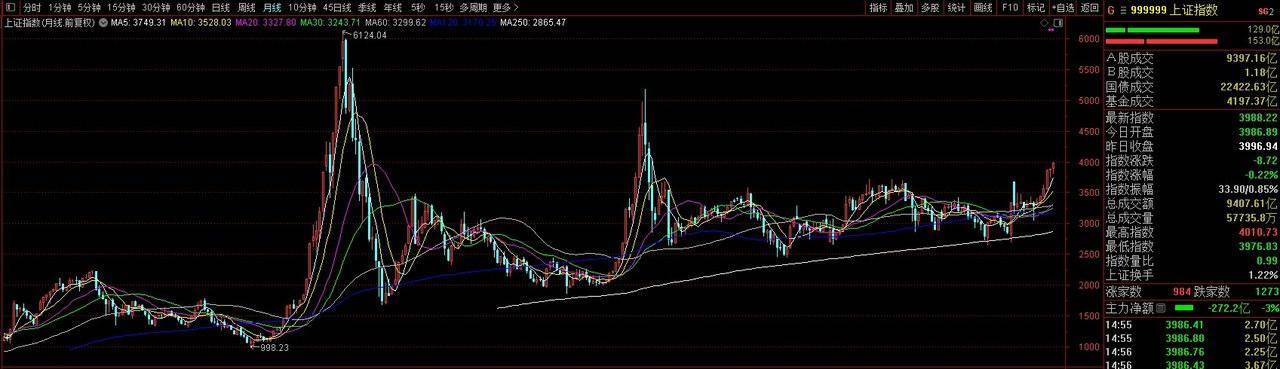
杨德龙:大盘突破4000点具有标志性意义
Xin Lang Ji Jin· 2025-10-29 09:33
Group 1 - The 10th Huashang Cultural Festival in Shangqiu has become a globally recognized cultural event, focusing on the heritage of Shang culture and supporting local economic development [1] - Shangqiu has developed distinctive industries such as chili, pear, superhard materials, refrigeration equipment, coal power, and renewable resources, achieving significant breakthroughs in new technologies and materials [2] - The introduction of chili futures on the Zhengzhou Commodity Exchange is proposed to enhance farmers' income and provide risk hedging tools for traders, indicating a strategic move towards financial empowerment of local industries [2] Group 2 - The Shanghai Composite Index has recently surpassed the 4000-point mark, marking a significant milestone and indicating the establishment of a bull market [2][4] - This bull market is expected to be more stable and prolonged, potentially lasting two to three years, driven by technological innovation, policy support, and a shift of household savings into capital markets [3] - Key sectors to watch include hard technology industries aligned with the "14th Five-Year Plan," as well as stable return sectors like banking and utilities, which are seen as valuable for long-term investment [3] Group 3 - The recent bull market is anticipated to stimulate consumption and economic recovery, acting as a fourth driver of economic growth, especially in light of the current downturn in the real estate market [4] - The transition from a real estate investment era to an equity investment era is suggested, with capital markets becoming a channel for wealth growth through quality stocks and funds [4] - There is a call for collective efforts to nurture this bull market to enhance China's economic strength and improve the attractiveness of Chinese assets on a global scale [4]
再见4000点,A股或已告别“水牛” “快牛”
Sou Hu Cai Jing· 2025-10-29 00:57
Core Viewpoint - The A-share market has seen significant changes over the past decade, with the Shanghai Composite Index (SSE) recently breaking the 4000-point mark for the first time since August 2015, raising questions about the sustainability of the current bull market and the potential for a "slow bull" market phase [1][3][5] Market Performance - The SSE reached 4000 points on October 28, 2023, marking a significant milestone after 3724 days since its last occurrence [1] - The total market capitalization of A-shares has increased from 52 trillion yuan to 107 trillion yuan over the past decade, with the number of listed stocks rising from 2662 to 5440 and the number of retail investors growing from over 93 million to more than 240 million [3] - Major indices have shown varied performance, with the STAR Market up 47% since its inception, the ChiNext Index up 21%, and the CSI 300 Index up 16%, while the SSE has seen no cumulative gain over the decade [3] Sector Performance - The food and beverage sector has seen the highest index increase of 135%, followed by electronics at 94%, and non-ferrous metals at 78% [4] - Notable individual stock performances include Zhongji Xuchuang with a 5887% increase, Shenghong Technology at 3724%, and Tianfu Communication at 2377% [4] Market Sentiment and Trends - Current market sentiment is characterized by cautious optimism, with investors exhibiting a more measured approach compared to previous bull markets, which were marked by rapid price increases and subsequent corrections [5][6] - The market is expected to transition into a "slow bull" phase, moving away from the historical patterns of "fast bull" or "water bull" markets, as the A-share market matures and institutional frameworks evolve [6][8] Future Outlook - The introduction of the "14th Five-Year Plan" is anticipated to serve as a significant milestone for the Chinese capital market, potentially catalyzing a new phase of growth from the 4000-point level [7][8] - Analysts suggest a balanced investment strategy between technology growth and dividend value, with a focus on sectors such as communication equipment, electronic components, semiconductors, and non-ferrous metals for short-term opportunities [9]

移为通信:10月28日召开董事会会议
Mei Ri Jing Ji Xin Wen· 2025-10-28 14:22
Group 1 - The core viewpoint of the article highlights that 移为通信 (Yiwai Communication) has announced its board meeting to review the Q3 2025 report, indicating ongoing corporate governance and financial oversight [1] - For the fiscal year 2024, 移为通信's revenue composition shows that the Internet of Things (IoT) accounts for 99.39% of total revenue, while other segments, including leasing, contribute only 0.61% [1] - As of the report, 移为通信's market capitalization stands at 5.5 billion yuan [1] Group 2 - The article also notes a significant market trend where the A-share market has surpassed 4000 points, marking a resurgence after a decade of stagnation, with technology leading the market's new "slow bull" pattern [1]

国家拉股市促经济不会大跌是种共识了吗?
集思录· 2025-10-28 13:49
Core Viewpoint - The article discusses the current state of the stock market, highlighting the significant increase in share reduction plans by listed companies and the implications for various industries, particularly electronics and semiconductors. Group 1: Share Reduction Plans - As of September 2025, a total of 1,979 listed companies have announced share reduction plans involving 3,597 individuals, with an expected reduction amount exceeding 380 billion [3] - The scale of share reductions in 2025 is significantly larger than the 170 billion in 2024, with over 60% of the reductions occurring during the index rise from May to July [3] - The electronics, computer, and machinery equipment sectors lead in share reduction amounts, with the electronics sector accounting for nearly 20% of total reductions in A-shares [3] Group 2: Market Valuation Comparison - The current price-to-book (PB) ratio of the Shanghai Composite Index at 4,000 points is 2.87, compared to 5 around the same index level in April 2015, indicating a substantial decrease in valuation [5] - The price-to-earnings (PE) ratio has also dropped from 67 times in 2015 to 28.11 currently, suggesting that the current market valuation is significantly lower than in the past [5] - Similar trends are observed in the CSI 500 index, where the PB ratio has decreased from 4.6 to 2.23, and the PE ratio from 50 to 24.33 [5] Group 3: Market Dynamics and Government Role - The government can provide short-term stimulation to the stock market but cannot sustain long-term growth without consistent economic growth, profit sharing through dividends, and regulatory reforms [10] - There is a consensus that the government’s intervention in the stock market is often temporary, with significant volatility following such interventions [11] - The perception of market consensus among retail investors is less critical than that of major shareholders and institutions, whose strategies and sentiments are less transparent [12]

泰鸿万立:聘任林宇航担任公司证券事务代表
Mei Ri Jing Ji Xin Wen· 2025-10-28 09:33
Company Overview - Taihong Wanli (SH 603210) announced the appointment of Lin Yuhang as the company's securities affairs representative on October 28 [1] - As of the report, Taihong Wanli has a market capitalization of 7.2 billion yuan [1] Revenue Composition - For the first half of 2025, the revenue composition of Taihong Wanli is as follows: - Structural components: 71.24% - Functional components: 18.6% - Scrap materials: 7.9% - Molds: 2.11% - Materials and others: 0.14% [1]
沪指时隔10年重上4000点!紧跟大盘趋势,锚定均衡配置行业龙头的A500指数,A500ETF龙头(563800)连续4日上涨
Sou Hu Cai Jing· 2025-10-28 04:37
Group 1 - The A-share market opened lower but rose throughout the day, with the Shanghai Composite Index breaking the 4000-point mark for the first time in 10 years, supported by sectors such as coal, rare earths, optical modules, and memory chips [1] - The CPO concept saw significant gains, with major state-owned enterprises performing strongly, creating a "leading stocks sealing the board, followed by tiered gains" pattern, effectively supporting the overall market index [1] - The People's Bank of China (PBOC) announced a commitment to a supportive monetary policy stance and plans to resume open market operations for government bonds, which is expected to stabilize long-term interest rate expectations [2] Group 2 - Morgan Stanley reported that U.S. investors' interest in Chinese stocks is at a five-year high, with over 90% of U.S. investors expressing willingness to increase exposure to the Chinese market, marking the highest level since early 2021 [2] - The "slow bull" market initiated since the "924" rally is seen as just the beginning, with a positive cycle of "stock market slow rise - confidence enhancement - capital inflow" expected to continue, driven by the recovery of investor confidence and capital market profitability [3] - The A500 ETF leader (563800) has shown a consistent upward trend, with a 4.29% increase over the past week, and key sectors include electronics, power equipment, and banking, indicating a balanced allocation of quality leading enterprises across industries [3][4]
慢牛中段的四季度 A 股 重点警惕做账卖压及美联储政策分歧
Sou Hu Cai Jing· 2025-10-27 09:20
Core Viewpoint - The A-share innovation index ended the third quarter with a 49.02% increase, but the fourth quarter faces multiple variables, including renewed US-China trade tensions, fluctuating expectations for Federal Reserve interest rate cuts, and the approaching "accounting period" for institutions, leading experts to warn of increased risks while maintaining a "slow bull" market outlook [1][2][5]. Market Trends - Experts agree that the "slow bull" market pattern remains intact, but opportunities for easy gains are diminishing, and volatility is expected to increase significantly in the fourth quarter [2][3]. Fund Flow and Market Sentiment - Current market conditions show that retail investors have not entered the market on a large scale, and institutions remain hesitant, indicating that the core logic of the slow bull market is still valid. However, the previous trend of "buying the right sectors to make big profits" is unlikely to be replicated in the fourth quarter, with faster sector rotations expected [3][4]. Macro Perspective - From a macroeconomic perspective, the underlying factors supporting the slow bull market, such as marginal improvements in corporate profits and continued policy support for new consumption and high-end manufacturing, remain unchanged. Short-term events like trade policies and Federal Reserve interest rate changes are seen as catalysts rather than trends [4][5]. Identified Risks - Two major risks for the fourth quarter have been highlighted: 1. The "accounting period selling pressure" from absolute return funds, particularly affecting high-valuation sectors like technology and new consumption [6]. 2. Increasing divergence in Federal Reserve interest rate expectations, which could impact global asset pricing and lead to volatility in A-shares and other markets [6][8]. Investment Strategies - Experts recommend a balanced approach to investment, emphasizing "long-term views with short-term actions" and a "barbell strategy" to manage risk and returns. This involves allocating to both high-valuation sectors with long-term potential and low-valuation defensive assets [9][10]. - Monthly portfolio reviews and clear definitions of acceptable drawdown limits are advised to avoid impulsive trading decisions [10]. Focus Areas for Investment - Investors are encouraged to focus on three asset categories: 1. New consumption and high-end manufacturing sectors benefiting from policy support 2. Low-valuation high-dividend assets in Hong Kong and A-share markets 3. Safe-haven assets like gold ETFs and public REITs [10][11]. Conclusion - The fourth quarter is characterized as a period of volatility within a slow bull market, requiring investors to enhance their asset allocation skills and maintain a focus on managing drawdowns while seizing structural opportunities [10][11].

机构研究周报:AH股指还有新高,黄金短期性价比不高
Wind万得· 2025-10-26 22:41
Core Viewpoints - The "15th Five-Year Plan" emphasizes high-quality economic development, focusing on technology and consumption, which is expected to drive further growth in the Chinese stock market, particularly in the A and H shares [3][5]. Economic Development Goals - The main goals for the "15th Five-Year Plan" include significant improvements in high-quality development, technological self-reliance, deepening reforms, enhancing social civilization, improving living standards, and advancing ecological progress [3]. - The transition from quantity to quality in economic growth is crucial during this period, allowing for structural reforms and a shift in growth drivers from solely GDP to a combination of actual GDP, inflation, and exchange rates [3]. Equity Market Insights - Guotai Junan Securities predicts that the "transformation bull market" in China will deepen, with a focus on advanced manufacturing, export-oriented industries, and consumer sectors [5]. - Goldman Sachs indicates that a "slow bull market" is forming in the Chinese stock market, with a potential 30% increase in key indices by the end of 2027, driven by profit growth and valuation recovery [6]. - Bosera Fund highlights that the recent rise in the Shanghai Composite Index reflects positive market sentiment and structural adjustments, suggesting a "steady foundation with moderate aggression" investment strategy [7]. Asset Performance Overview - The performance of major asset classes shows that the A-share market has seen significant gains, with the Shanghai Composite Index up 17.86% year-to-date, while the Hang Seng Index has increased by 30.41% [8]. - Gold prices are expected to enter a high volatility range, with analysts suggesting that it is no longer a high-value global asset, and a price range of $3,800 to $3,900 per ounce is seen as a fundamental support area [18]. Macro and Fixed Income - Guohai Franklin Templeton Fund anticipates a volatile bond market, with potential for continued interest rate cuts and a generally positive monetary policy environment [16]. - Bosera Fund expects monetary policy to accelerate easing, particularly if the Federal Reserve continues to lower rates, which would favor the bond market [17]. Asset Allocation Strategies - Guotai Asset Management suggests a "technology growth + high dividend" strategy for A-shares, focusing on sectors with global competitiveness like AI and semiconductors, while also including high-dividend assets for stability [20].

“超级央行周”来临;苹果等科技巨头将发财报|周末要闻速递
2 1 Shi Ji Jing Ji Bao Dao· 2025-10-26 11:56
Group 1: US-China Economic Talks - The US and China held economic consultations in Kuala Lumpur, focusing on key issues such as maritime logistics, shipbuilding industry measures, and agricultural trade [1] Group 2: State-Owned Assets - By the end of 2024, the total assets of state-owned enterprises (excluding financial enterprises) in China are projected to reach 401.7 trillion yuan, with state-owned capital equity at 109.4 trillion yuan [2] Group 3: Central Bank Operations - The People's Bank of China will conduct a 900 billion yuan MLF operation with a one-year term on October 27, 2025, to maintain ample liquidity in the banking system [3] Group 4: Advances in Lithography Technology - A research team from Peking University has made significant breakthroughs in lithography technology, which is crucial for the continuous miniaturization of integrated circuit chips [4] Group 5: Leadership Changes at Kweichow Moutai - Kweichow Moutai announced a major personnel change, appointing Chen Hua, the former director of the Guizhou Provincial Energy Bureau, as the new chairman [5] Group 6: Stock Trading Risks - Shangwei New Materials issued a risk warning regarding its stock trading, indicating that the stock price has significantly deviated from its fundamentals, which may lead to a rapid decline [6] Group 7: US-Canada Trade Tensions - President Trump announced a 10% additional tariff on Canada in response to perceived misinformation and hostile actions from the Canadian government [7] Group 8: US Core CPI Data - The US core CPI for September increased by 3% year-on-year, which was below market expectations of 3.1% [8] Group 9: Upcoming Financial Events - A "super central bank week" is anticipated, with major central banks including the Federal Reserve expected to announce interest rate decisions [10] Group 10: Market Outlook - Analysts predict a "slow bull" trend in the A-share market, with a focus on the TMT sector as a potential mid-term mainline due to liquidity-driven market conditions [16][17]