
滞胀

Search documents
黄金vs黄金股怎么选?
Zhong Guo Jing Ying Bao· 2025-10-10 06:06
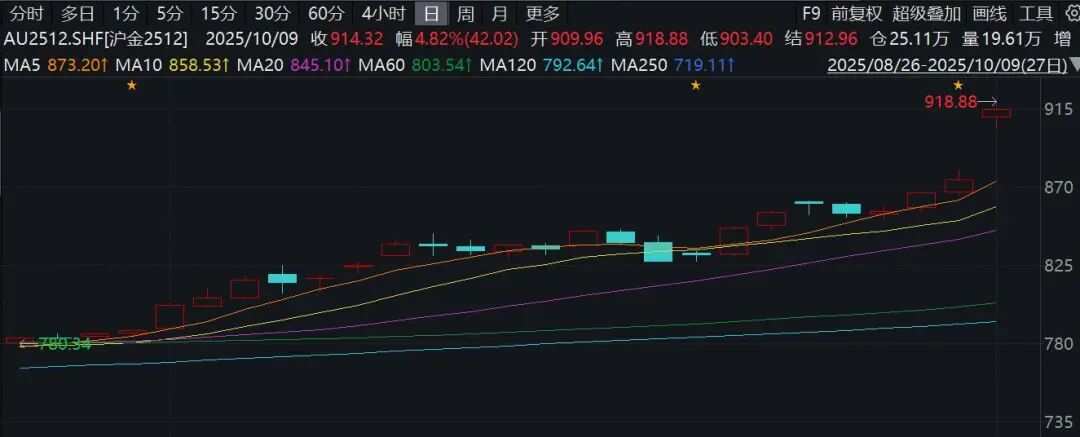
Core Viewpoint - The gold market is experiencing significant upward momentum, with both futures and spot gold prices surpassing historical highs, leading to strong performance in gold-related stocks and ETFs [2][3]. Group 1: Market Performance - On October 9, A-share gold concept stocks showed strong performance, with over ten stocks including Shandong Gold and Zhongjin Gold hitting the daily limit. Gold stock ETFs (159321.SZ and 159315.SZ) both reached their daily limit with increases of 10.03% and 10.01% respectively, while gold ETF (518880.SH) rose by 4.68% [2]. - The Shanghai gold futures main contract opened significantly higher, breaking the 900 yuan/gram mark and closing at 914.32 yuan/gram, marking a historical high [3]. Group 2: Investment Trends - Analysts suggest that the current high gold prices may limit further increases, recommending that conservative investors focus on long-term valuable gold-related products, while those seeking higher volatility and potential returns may consider gold mining stocks [2]. - The global largest gold ETF (SPDR) has surpassed 1000 tons, indicating accelerated inflows from European and American investors, driven by increased risk aversion due to the U.S. government shutdown and macroeconomic uncertainties [3]. Group 3: Industry Dynamics - The gold industry is characterized by its four attributes: financial, monetary, commodity, and safe-haven asset. The entire gold supply chain includes upstream mining, midstream processing, and downstream retail consumption [6]. - The upstream segment, which is resource-scarce and capital-intensive, has strong pricing power with profit margins typically above 20% due to the tightening global gold supply [6]. Group 4: Future Outlook - Analysts predict that gold stocks will benefit from their growth potential and favorable market sentiment, with significant valuation recovery space as major gold mining companies are projected to have an average PE of only 12-15 times by 2026, compared to a historical average of 20 times [7]. - The trend of central banks diversifying their reserves away from the dollar is expected to continue, further supporting gold demand and prices [4].



黄金周报|美国政府关门,金价突破4000
Mei Ri Jing Ji Xin Wen· 2025-10-10 05:56
Group 1: Gold Market Dynamics - As of October 8, London spot gold closed at $4040.42 per ounce, with a cumulative increase of $281.64 per ounce since September 26, representing a 7.49% rise [1] - The price of gold reached a historical high of $4059.31 per ounce during the National Day holiday, with a low of $3819.10 per ounce [1] - The ongoing U.S. government shutdown has heightened macroeconomic uncertainty, leading to increased demand for safe-haven assets like gold [1][9] Group 2: U.S. Economic Indicators - The U.S. ISM Manufacturing PMI for September was reported at 49.1, indicating resilience in manufacturing despite a decline in new orders [2] - The Atlanta Fed's GDPNow model indicates a projected annualized growth rate of 3.8% for Q3 [3] - The ADP reported a decrease of 3,200 jobs in September, falling short of market expectations, reflecting a sluggish labor market [3][4] Group 3: Political and Economic Uncertainty - The U.S. government shutdown, which began on October 1, has resulted from political disagreements over budget issues, particularly concerning healthcare subsidies [5][6] - The shutdown has led to delays in the release of key economic data, including the September non-farm payroll report, contributing to market uncertainty [7] - Political instability in France, highlighted by the resignation of Prime Minister Le Cornu, may also impact financial markets [8] Group 4: Long-term Outlook for Gold - The combination of a potential Fed rate cut cycle, increasing macroeconomic policy uncertainty, and a global trend towards "de-dollarization" is expected to support gold prices in the medium to long term [1][9] - Central banks, including China's, continue to increase gold reserves, indicating a sustained demand for gold as a safe-haven asset [11]
美国政府关门,金价突破4000
Mei Ri Jing Ji Xin Wen· 2025-10-10 01:16
Group 1: Gold Market Dynamics - As of October 8, London spot gold closed at $4040.42 per ounce, with a cumulative increase of $281.64 per ounce since September 26, representing a rise of 7.49% [1] - The recent surge in gold prices was driven by the U.S. government shutdown, which has heightened macroeconomic uncertainty and increased demand for safe-haven assets [1][9] - The ongoing geopolitical tensions, including the Israel-Palestine conflict, and the trend of "de-dollarization" globally are expected to support gold prices in the medium to long term [9][11] Group 2: U.S. Economic Indicators - The U.S. ISM Manufacturing PMI for September was reported at 49.1, indicating resilience in manufacturing, although new orders showed a decline [2] - The Atlanta Fed's GDPNow model indicates a projected annualized GDP growth rate of 3.8% for Q3, while consumer spending remains robust with a 3.2% growth forecast [3] - Job market indicators show a mixed picture, with the ADP reporting a decrease in employment of 3,200 jobs in September, below market expectations [3][4] Group 3: Political and Economic Uncertainty - The U.S. government has been shut down since October 1 due to budget disagreements, which has led to delays in key economic data releases, further contributing to market uncertainty [5][7] - Political instability in France, highlighted by the resignation of Prime Minister Le Cornu, adds to the uncertainty in European markets [8] - The ongoing political polarization in the U.S. raises concerns about fiscal sustainability and could lead to prolonged market disruptions [7][9] Group 4: Federal Reserve Outlook - Market expectations for a rate cut by the Federal Reserve have increased, with a nearly 95% probability of a cut in October, driven by the government shutdown and labor market slowdown [6][9] - Some Federal Reserve officials express concerns about potential inflationary pressures, particularly in the services sector, which may influence future monetary policy decisions [6][9] Group 5: Central Bank Gold Purchases - China's central bank continues to increase its gold reserves, reaching 7,406 million ounces by the end of September, marking the eleventh consecutive month of gold accumulation [11] - The trend of central banks purchasing gold is expected to continue, driven by the need for asset diversification amid geopolitical and economic uncertainties [11]
中金:预期9-10月中美流动性环境延续共振 继续超配A股、港股、黄金
智通财经网· 2025-10-10 00:33
Core Viewpoint - The report from CICC anticipates that the liquidity environment between China and the U.S. will continue to resonate from September to October, with the dollar in a downward cycle, benefiting various asset classes including stocks, bonds, gold, and commodities [1][28]. Group 1: Market Outlook - October is expected to remain a favorable macroeconomic period, similar to September, suggesting a high risk appetite and an overweight position in Chinese stocks [1][28]. - The dynamic price-to-earnings ratio of the CSI 300 index is close to historical averages, indicating potential for further expansion compared to previous bull market peaks [1][28]. - A-shares and Hong Kong stocks offer better relative value compared to U.S. stocks due to the easing macro liquidity environment and the diminished independence and credibility of the U.S. dollar [1][35]. Group 2: Federal Reserve's Interest Rate Outlook - The Federal Reserve's interest rate cut cycle is expected to switch between "fast-slow-fast" phases, with the first phase starting in Q4 2025 characterized by rapid rate cuts due to rising inflation and employment risks [4][28]. - The second phase in H1 2026 will see a slowdown in rate cuts as inflation continues to rise, requiring a balance between growth and inflation risks [4][28]. - The third phase in H2 2026 may see accelerated rate cuts again, particularly if a more dovish Fed chair is appointed, and tariff impacts on inflation diminish [4][28]. Group 3: Economic Indicators and Asset Allocation - The U.S. economy is currently trending towards stagflation or recession, with stagflation being more likely, but the Fed's reintroduction of easing measures may eventually lead to growth recovery [8][28]. - Key economic indicators should be monitored to predict turning points in the economy, with a focus on consumption and employment data as leading indicators [16][21]. - The report suggests maintaining a focus on A-shares and Hong Kong stocks, while also being cautious of potential volatility in the market due to previous significant price increases [28][30]. Group 4: Gold and Other Assets - Despite a rapid increase in gold prices since the beginning of the year, the report advises to downplay short-term trading value and focus on long-term allocation opportunities, suggesting to accumulate on dips [1][35]. - The report highlights that during the dollar's down cycle, gold, commodities, and non-U.S. stocks tend to outperform U.S. stocks [5][35]. - The recommendation is to maintain an overweight position in gold due to the ongoing macro liquidity easing, despite short-term risks of price corrections [1][35].
金价狂飙!金饰价格达1170元/克!后市怎么走?
Zheng Quan Shi Bao· 2025-10-09 15:12
Core Viewpoint - International gold prices have surged past $4,000 per ounce, reaching a record high of $4,059.31 during the holiday period, with a significant increase of over 4.7% over five consecutive trading days [1] Gold Market Performance - As of October 9, the Shanghai gold futures contract rose by 4.82%, hitting a peak of 918.88 yuan per gram [2] - Domestic gold jewelry prices have also increased, with Chow Sang Sang's selling price reaching 1,170 yuan per gram and Chow Tai Fook's at 1,168 yuan per gram [4] Year-to-Date Price Movement - Year-to-date, gold prices have increased by nearly 54%, making it the best-performing asset class this year [5] Market Dynamics and Influences - The rise in gold prices is attributed to various factors, including the U.S. government shutdown, which has delayed key economic data releases, amplifying market volatility and driving North American ETF investors to increase their gold holdings [5][6] - The market is experiencing a divergence in risk appetite, with some investors favoring gold and U.S. Treasury bonds for safety, while others are investing in Bitcoin and U.S. stocks for speculative gains [5] Central Bank Actions - Concerns over U.S. debt have prompted central banks and private sectors to increase their gold holdings as part of a "de-dollarization" strategy [7] - As of September, central banks' gold reserves increased to 74.06 million ounces, marking the 11th consecutive month of gold accumulation [7] Future Outlook - The resolution of the U.S. government shutdown is critical; if resolved, it may ease market risk aversion and apply downward pressure on gold prices. Conversely, prolonged shutdowns or similar future occurrences could sustain upward pressure on gold [7] - Long-term drivers for precious metal prices include concerns over "stagflation" risks in the U.S. economy, with expectations of continued support for gold prices due to anticipated Fed rate cuts [8] - Investors are advised to diversify their investments across various precious metals, including silver, platinum, and palladium, to mitigate risks associated with gold's financial attributes [8]
宽松+避险再发力 金价突破4000美元关口
Xin Hua Cai Jing· 2025-10-09 06:19
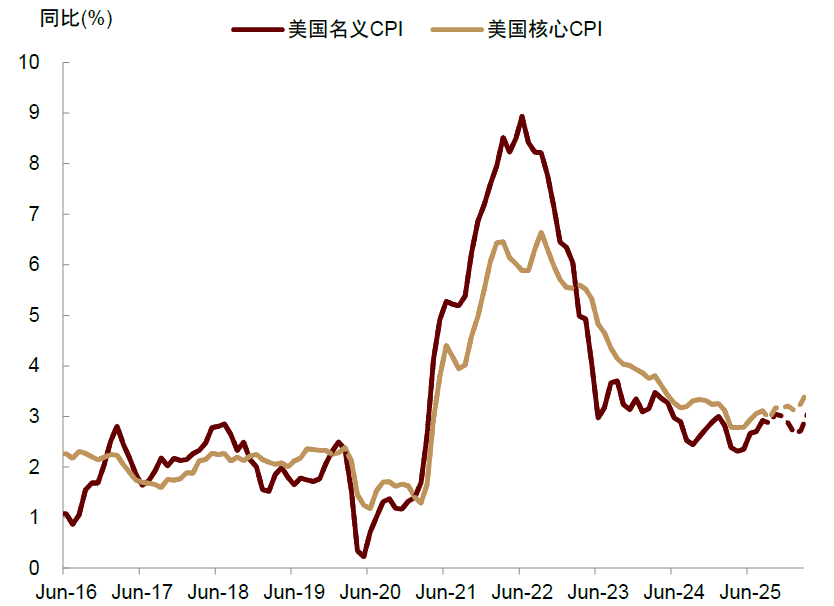
进一步,从中长期来看,贵金属价格继续上涨的主要驱动力在于宏观层面对美国经济"滞胀"风险的担 忧,当前美联储降息预期推动下,美债长端仍延续高位,期限溢价放大的背后是未来实质利率水平走弱 的担忧,并将在未来一段时期继续推升黄金价格的上涨。 不过,从当下投资操作来看,当前零售端黄金市场价格无论是在投资品还是珠宝首饰方面,价格已经远 超出普通居民的支付能力,建议谨慎对待。 (作者:曹慧,卓创资讯分析师) 编辑:吴郑思 新华财经北京10月9日电 10月以来,国际黄金市场价格持续走强并成功突破4000美元关口,再创历史新 高。宽松预期和避险需求成为短期金价大涨的主要驱动。 截至10月8日收盘,国际现货黄金价格4041.65美元/盎司,盘中创历史新高至4059.31美元,连续五个交 易日涨幅超4.7%;纽约期金价格也同步走强,并于8日创历史新高至4081美元/盎司。年初至今,黄金 价格水平较年初涨幅近54%,成为年内表现最好的大类资产。 具体分析来看,眼下的黄金价格走强一方面反映了市场对日本经济前景及货币政策预期的强化,由于日 本自民党新任总裁高市早苗的胜选,令以量化+质化宽松为代表的"安倍经济学"将再度引领日本经济政 策 ...
降息周期有色商品展望-贵金属
2025-10-09 02:00
Summary of Key Points from Conference Call Industry Overview - The discussion primarily revolves around the gold market and its dynamics in the context of macroeconomic factors and geopolitical uncertainties. Core Insights and Arguments 1. **Gold Price Trends**: Gold prices have risen significantly from approximately $3,300 to $4,000 since late August 2025, with a total increase of nearly $700. This surge is not primarily driven by Federal Reserve interest rate cuts or traditional monetary easing factors, as the dollar index and U.S. Treasury yields have not shown corresponding declines [2][3][4] 2. **Geopolitical Risks**: While geopolitical risks, such as the Russia-Ukraine conflict and Middle Eastern tensions, exist, they are not substantial enough to fully explain the recent spike in gold prices. The current rise is more likely a continuation of the upward trend observed in early 2025 [2][4] 3. **Debt Monetization**: The monetization of debt is a significant factor contributing to the rise in gold prices. Countries are issuing debt to stimulate their economies, raising concerns about the global credit monetary system, which drives investors towards gold as a safe haven [1][4][10] 4. **ETF Influence**: The increase in gold prices has been significantly supported by inflows into gold ETFs rather than direct purchases by central banks. This trend indicates a market concern regarding future debt monetization and the uncertainties surrounding the global credit system [1][15] 5. **Market Dynamics**: The recent surge in gold prices can also be attributed to technical factors, including a breakout from a long-term consolidation phase, leading to short-sellers being forced to cover their positions. This has resulted in increased liquidity and investment in gold [7][10] 6. **Inflation Risks**: Although inflation expectations remain stable, rising commodity prices and increased costs associated with AI could pose future inflation risks. The current market does not fully reflect the potential for a return to a stagflation scenario similar to the 1970s [9][12] 7. **Trump Administration's Impact**: The uncertainty surrounding the Trump administration's policies has heightened market demand for gold as a safe asset. The administration's strategies, including tariffs and withdrawal from international agreements, have contributed to this uncertainty [5][6][4] 8. **Future Price Predictions**: The future trajectory of gold prices remains uncertain. While there is potential for continued upward movement if macroeconomic conditions remain favorable, the significant increase from $2,000 to $4,000 raises the possibility of technical corrections [7][22] 9. **Dollar Stability**: Despite the ongoing trend of de-dollarization, the dollar has shown signs of temporary stabilization, supported by strong performance from U.S. tech companies and expectations of economic recovery [14][17] 10. **Long-term Asset Allocation**: The current allocation of gold in global asset portfolios is around 4.5%, significantly lower than the 15% seen in the 1970s. If this allocation were to increase, it could lead to substantial price increases for gold [22] Other Important Insights - **Market Sentiment**: There is a growing sentiment among investors that gold prices will not decline significantly, with many holding physical gold for potential gains [20] - **Indicators for Price Prediction**: Traditional indicators such as the dollar index and ETF holdings have shown a decoupling from gold prices, suggesting a need for a reevaluation of how gold price movements are predicted [21] - **Cyclical Nature of Gold**: Gold exhibits a unique cyclical behavior that is influenced by global demand and investor sentiment rather than solely by economic cycles or Federal Reserve policies [23]
张尧浠:利好因素仍未显疲态、金价多头前景或超预期
Sou Hu Cai Jing· 2025-10-08 01:42
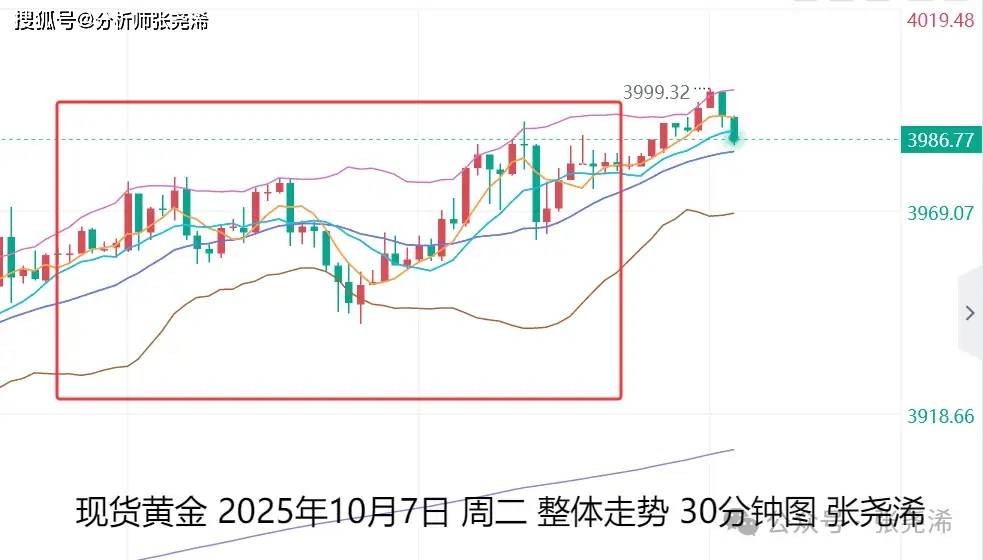
Core Viewpoint - The international gold price is showing strong bullish momentum, with expectations of reaching and potentially exceeding the $4000 mark, driven by various favorable factors that have not shown signs of weakening [1][5]. Market Performance - On October 7, gold opened at $3960.15 per ounce, fluctuated, and eventually closed at $3984.30, marking a daily increase of $24.15 or 0.61% [1]. - The price reached a daily low of $3940.72 and a high of $3990.62, with a total daily fluctuation of $49.9 [1]. Economic Indicators - The U.S. dollar index showed strength, but gold prices rebounded due to support buying, despite initial pressure from economic data and Federal Reserve officials' comments [3]. - The World Trade Organization significantly downgraded its global goods trade growth forecast for 2026, contributing to market uncertainty and increasing demand for gold as a safe haven [3]. Inflation and Interest Rates - Recent data indicated a rise in inflation expectations, which initially pressured gold prices but subsequently led to a rebound, reinforcing gold's status as a safe haven amid economic uncertainty [5]. - The ongoing U.S. government shutdown is exacerbating market fears, potentially impacting employment data and GDP, which may lead to increased expectations for interest rate cuts by the Federal Reserve [5]. Historical Context - The current market conditions are reminiscent of the 1970s, where high inflation and economic instability led to a significant rise in gold prices, which increased from $35 to $850 per ounce, a 2329% increase [3]. Technical Analysis - The gold price has consistently bounced back from key support levels, indicating a strong bullish trend, with the potential to reach higher targets [7][9]. - The price remains above the 5-day moving average and other support levels, suggesting that any pullbacks could present buying opportunities [9]. Trading Strategy - Suggested trading levels include support at $3977 or $3955 and resistance at $4015 or $4050 for gold [10].
美联储卡什卡利反对大幅降息,警告通胀反弹风险
Jin Shi Shu Ju· 2025-10-08 01:23
Group 1 - Neel Kashkari, President of the Minneapolis Federal Reserve, warns that significant interest rate cuts could lead to a rebound in inflation [1] - Current economic data shows signs of stagflation, with slowing economic growth and persistently high inflation [1][2] - Kashkari believes that large investments in AI data centers may increase borrowing costs, even if the Federal Reserve lowers short-term policy rates [1] Group 2 - Kashkari expresses skepticism that rate cuts will translate into lower mortgage rates, as funds may be redirected from residential construction to data center investments [2] - He supports a 25 basis point rate cut in September and suggests similar cuts in upcoming meetings to prevent further weakening of the labor market [2] - Historical technological innovations often take time to permeate the economy, leading Kashkari to doubt claims that AI will rapidly replace a significant number of jobs [3]
隔夜美股 | 三大指数下跌 纽约期金站稳4000美元
智通财经网· 2025-10-07 23:10
智通财经APP获悉,周二,三大指数下跌。标普500指数录得8个交易日以来的首次下跌。美国政府停摆 进入第七天。在此之前,参议院五次投票表决均未能通过众议院提出的为政府运转提供资金至11月21日 的法案,令政府于周一重新开放的希望落空。 【美股】截至收盘,道指跌91.99点,跌幅为0.20%,报46602.98点;纳指跌153.30点,跌幅为0.67%,报 22788.36点;标普500指数跌25.69点,跌幅为0.38%,报6714.59点。特斯拉(TSLA.US)跌4.4%, AMD(AMD.US)涨近4%,Strategy(MSTR.US)跌8.7%。纳斯达克中国金龙指数跌2.2%,阿里巴巴 (BABA.US)跌3%,百度(BIDU.US)跌4%。 【欧股】德国DAX30指数跌11.96点,跌幅0.05%,报24384.27点;英国富时100指数涨2.06点,涨幅 0.02%,报9481.20点;法国CAC40指数涨3.07点,涨幅0.04%,报7974.85点;欧洲斯托克50指数跌15.12 点,跌幅0.27%,报5613.60点;西班牙IBEX35指数跌51.60点,跌幅0.33%,报15521.50 ...
