
美元指数

Search documents
五矿期货贵金属日报-20250528
Wu Kuang Qi Huo· 2025-05-28 03:03
Report Industry Investment Rating - Not provided in the given content Core Viewpoints - Multiple factors drove a short - term rebound in the US dollar index, leading to weak performance in precious metal prices. The poor Japanese bond auction results and potential adjustments to Japan's bond - issuance structure caused the Japanese bond yield to fall, driving up the US dollar against the yen and strengthening the US dollar index by 0.58% to 99.57 [2]. - US real - estate and manufacturing indicators were affected in a high - interest - rate environment. The April durable - goods orders had a significant decline, and the March real - estate price index was lower than expected. The market anticipates two 25 - basis - point interest - rate cuts by the Fed in September and December. Attention should be paid to the potential negative impact of US economic recession risks on precious metal prices [3]. - For gold, it is recommended to hold existing long positions and wait for significant price corrections to buy at lower prices. The reference operating range for the main Shanghai gold futures contract is 756 - 836 yuan/gram. For silver, it is advisable to wait and see for now. Silver has strong upward momentum only when the Fed makes a clear dovish statement. The reference operating range for the main Shanghai silver futures contract is 7804 - 8545 yuan/kilogram [3]. Summary by Related Catalogs Market Price Data - On May 27, 2025, COMEX gold closed at $3299.70 per ounce, down 1.73% from the previous day; COMEX silver closed at $33.39 per ounce, down 0.76%. Shanghai gold futures (Au(T + D)) closed at 768.48 yuan/gram, down 0.70%, and Shanghai silver futures (Ag(T + D)) closed at 8189 yuan/kilogram, down 0.61% [4][6]. - The US 10 - year Treasury yield was 4.43%, and the US dollar index was 99.6147, up 0.64% [4]. Price and Volume Relationships - For COMEX gold, the trading volume increased by 22.61% to 29.20 million lots, and the open interest increased by 1.62% to 44.80 million lots. For COMEX silver, the open interest increased by 2.31% to 14.15 million lots [6]. Price Structure and Spread - On May 27, 2025, the SHFE - COMEX gold spread was 6.43 yuan/gram, and the SHFE - COMEX silver spread was 515.30 yuan/kilogram [55].
国际金融市场早知道:5月28日
Xin Hua Cai Jing· 2025-05-28 00:12
【资讯导读】 ·5月美国消费者信心指数大幅上升 ·法国5月调和CPI同比上涨0.6%,为2020年12月以来的最低水平,低于市场预期的0.9%。 ·叙利亚财政部长称,叙利亚将从6月2日开始重新开放股票市场。 ·特朗普政府正在考虑要求所有申请赴美留学的外国学生接受社交媒体审查 ·叙利亚将从6月2日开始重新开放股票市场 ·日本34年来首次失去全球最大债权国地位 【市场资讯】 ·美国3月FHFA房价指数环比降0.1%,预期升0.1%,前值从升0.1%修正为持平。美国3月S&P/CS20座大 城市未季调房价指数同比升4.1%,预期升4.5%,前值升4.5%。 ·世界大型企业联合会发布数据显示,5月美国消费者信心指数从4月的85.7大幅上升至98,高于所有经济 学家预期。 ·受商用飞机订单锐减拖累,美国4月耐用品订单超预期下滑,核心资本货物订单环比下降1.3%,创去年 10月以来最大跌幅。整体耐用品订单环比初值暴跌6.3%。 ·美国特朗普政府正在考虑要求所有申请赴美留学的外国学生接受社交媒体审查。为准备实施这一审查 要求,特朗普政府已下令美国各大使馆和领事馆停止为此类学生签证申请人安排新的面试。 ·墨西哥经济部长Mar ...
【美元指数27日上涨】5月28日讯,衡量美元对六种主要货币的美元指数当天上涨0.51%,在汇市尾市收于99.521。截至纽约汇市尾市,1欧元兑换1.1337美元,低于前一交易日的1.1381美元;1英镑兑换1.3511美元,低于前一交易日的1.3562美元。1美元兑换144.26日元,高于前一交易日的142.77日元;1美元兑换0.8272瑞士法郎,高于前一交易日的0.8208瑞士法郎;1美元兑换1.3795加元,高于前一交易日的1.3736加元;1美元兑换9.6103瑞典克朗,高于前一交易日的9.5163
news flash· 2025-05-27 20:05
Core Points - The US Dollar Index increased by 0.51% on May 27, closing at 99.521 [1] Currency Exchange Rates - 1 Euro exchanged for 1.1337 USD, down from 1.1381 USD the previous trading day [1] - 1 British Pound exchanged for 1.3511 USD, down from 1.3562 USD the previous trading day [1] - 1 USD exchanged for 144.26 Japanese Yen, up from 142.77 Yen the previous trading day [1] - 1 USD exchanged for 0.8272 Swiss Francs, up from 0.8208 Francs the previous trading day [1] - 1 USD exchanged for 1.3795 Canadian Dollars, up from 1.3736 Dollars the previous trading day [1] - 1 USD exchanged for 9.6103 Swedish Krona, up from 9.5163 Krona the previous trading day [1]
万乾论金:5.27黄金晚间行情走势分析及操作建议
Sou Hu Cai Jing· 2025-05-27 11:52
Group 1 - The international gold market experienced significant selling pressure, with spot gold prices dropping below the critical psychological level of $3300 per ounce, reaching a low of $3390 due to a rebound in the US dollar index and easing international trade tensions [2] - Despite a slight recovery to around $3308 driven by bargain buying, market attention remains focused on international trade dynamics, US fiscal policy outlook, and Federal Reserve monetary policy [2] - Short-term gold price movements are influenced by the US dollar, interest rate expectations, and economic data, with the $3300 level being crucial for market sentiment [2] Group 2 - The gold price faced downward pressure as it tested trendline resistance multiple times without breaking, leading to a decline and breaking the support level at $3320 [4] - On the daily chart, gold prices are consolidating at high levels around $3350, with MACD indicators showing bearish pressure, and the Bollinger Band's middle line support at $3287 is critical [4] - The four-hour chart indicates a shift from a five-wave to a three-wave structure, suggesting a corrective phase, with key resistance at $3320 and potential further declines towards the $3270-$3250 range [5]

STARTRADER星迈:5月27日美元指数走势分析
Sou Hu Cai Jing· 2025-05-27 07:18
Group 1 - The US dollar index experienced a V-shaped rebound, currently at 99.03, slightly up by 0.05% from the previous trading day, with a trading range of 98.5-99.2 [1] - Federal Reserve officials are signaling a cautious stance on interest rate cuts, with Atlanta Fed President Bostic stating that the potential for rate cuts this year may be limited to 25 basis points, contrasting sharply with market expectations of a 50 basis point cut [3] - Concerns about stagflation in the US economy are growing, and if the upcoming non-farm payroll data shows signs of a deteriorating job market, the dollar's safe-haven appeal may be impacted [3] Group 2 - The upcoming durable goods orders data for April is a key focus, with expectations of a significant decline to -7.9%, down from a previous growth of 9.2%, primarily due to a sharp drop in Boeing orders [4] - If the actual durable goods orders data is significantly weaker than expected, it may heighten concerns about the weakness in the US manufacturing sector, further diminishing the dollar's attractiveness [4] - Conversely, a rebound in the durable goods orders data could alleviate market worries regarding the negative impacts of tariffs, providing temporary support for the dollar [4]
美指反弹 美元兑日元短线上扬近40点
news flash· 2025-05-27 05:19
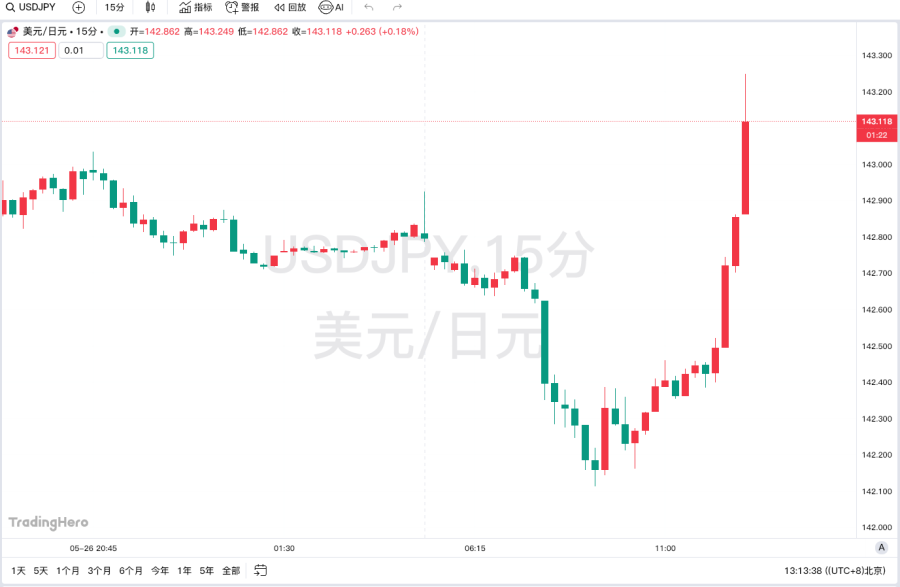
Core Viewpoint - The US Dollar Index (DXY) is experiencing a rebound, with notable movements in various currency pairs, particularly the USD/JPY which has seen a significant short-term increase [1] Currency Movements - The US Dollar Index (DXY) has risen by 10 points, currently standing at 99.16 [1] - The Euro to US Dollar (EUR/USD) has decreased by 10 points, now at 1.3729 [1] - The British Pound to US Dollar (GBP/USD) has fallen by nearly 20 points, currently at 1.3541 [1] - The US Dollar to Japanese Yen (USD/JPY) has increased by nearly 40 points, now at 143.16 [1]
人民币汇率日内升破7.17,什么原因?
21世纪经济报道· 2025-05-26 15:25
Core Viewpoint - The article discusses the recent strengthening of the Renminbi (RMB) against the US dollar, attributing it to various factors including positive developments in US-China trade talks and a general depreciation of the US dollar [1][2]. Group 1: RMB Exchange Rate Trends - On May 26, both onshore and offshore RMB exchange rates surpassed 7.17, marking the highest level since November 2024, with the onshore rate closing at 7.1843, up 52 points from the previous trading day [1]. - The RMB's midpoint rate against the US dollar was significantly raised to 7.1833, an increase of 86 points, the largest adjustment since January of the same year [1][2]. - In May, the onshore RMB appreciated by 906 basis points, while the offshore RMB rose by over 1,000 points [1]. Group 2: Factors Influencing RMB Strength - The depreciation of the US dollar has been a key driver for the appreciation of non-USD currencies, including the RMB, with the dollar index dropping by 0.84% in May [2]. - Concerns over the US fiscal health and the potential for increased government debt have contributed to the dollar's decline, particularly following the passage of Trump's fiscal bill [2]. - Domestic macroeconomic policies, such as interest rate cuts and increased fiscal spending, have bolstered the RMB's resilience against external fluctuations [2][3]. Group 3: Implications of RMB Appreciation - The appreciation of the RMB can enhance its attractiveness and reflect market confidence in the Chinese economy, potentially benefiting the stock market [3]. - However, a stronger RMB may reduce the competitiveness of Chinese exports, which could negatively impact domestic employment [3]. - It is suggested that maintaining a stable RMB exchange rate is crucial while expanding domestic demand and reducing reliance on exports [3]. Group 4: Future Outlook for RMB - Future RMB movements will largely depend on the progress of US-China trade negotiations and the trajectory of the US dollar [4]. - The article indicates that the most significant pressure for RMB depreciation may have passed, with expectations of a more stable RMB compared to other major currencies [4].
多重利好释放,离岸人民币汇率大反攻
Sou Hu Cai Jing· 2025-05-26 13:09
Core Viewpoint - The recent appreciation of the Renminbi (RMB) against the US dollar is driven by both domestic and international factors, with the RMB reaching its highest level since November 2024, reflecting market confidence in China's economic stability and growth prospects [1][3][4]. Domestic Factors - China's GDP grew by 5.4% year-on-year in the first quarter, exceeding expectations, which has bolstered investor confidence in the RMB [1][4]. - Continuous implementation of policies aimed at supporting consumption and effective investment has contributed to a stable macroeconomic environment [4][7]. - The People's Bank of China (PBOC) has maintained a moderately loose monetary policy, which supports economic recovery while managing liquidity [7][8]. International Factors - The downgrade of the US sovereign credit rating by Moody's and concerns over the US fiscal deficit have weakened the US dollar, providing room for the RMB to appreciate [1][5][6]. - Market apprehensions regarding US economic prospects, exacerbated by poor results from US Treasury auctions and trade policy disputes, have led to a decline in the dollar index [1][5][6]. Market Trends - As of May 26, the offshore RMB reached a peak of 7.1614 against the dollar, marking a 0.10% increase and a 1.45% appreciation over the past 20 days [3][4]. - The dollar index experienced a drop of approximately 0.41% on the same day, indicating a new downward trend for the dollar [5]. Future Outlook - Experts suggest that the RMB may experience short-term fluctuations around a new equilibrium, influenced by US tariff policies and domestic countermeasures [1][9]. - Long-term projections indicate that as China continues to advance its high-quality development initiatives, the RMB is expected to gain a more significant role in the global monetary system [1][9][10].

美元再度走弱、中国宏观政策支撑,人民币汇率日内升破7.17
2 1 Shi Ji Jing Ji Bao Dao· 2025-05-26 10:49
Core Viewpoint - The strong performance of the Renminbi (RMB) continues, with both onshore and offshore RMB exchange rates surpassing 7.17, marking the highest level since November 2024 [1][2]. Exchange Rate Performance - As of May 26, the onshore RMB closed at 7.1843, up 52 points from the previous trading day, with an intraday high of 7.1674. The offshore RMB reached a high of 7.1616, averaging 7.17. In May, the onshore RMB rose by 906 basis points, while the offshore RMB increased by over 1,000 points [1]. - The People's Bank of China set the RMB to USD central parity rate at 7.1833 on May 26, a significant increase of 86 points, the largest adjustment since January of this year [1]. Factors Influencing RMB Strength - The recent appreciation of the RMB is attributed to the ongoing depreciation of the US dollar, driven by concerns over the US fiscal health and the impact of proposed tariffs by the Trump administration [2][3]. - Domestic macroeconomic policies, including interest rate cuts and accelerated fiscal spending, have bolstered the resilience of the Chinese economy against external fluctuations, providing internal support for the RMB [2]. Market Dynamics - Analysts note that the appreciation of the RMB is influenced by the strengthening of other Asian currencies, such as the Korean won, and the easing of external depreciation pressures due to positive developments in US-China trade talks [3]. - The narrowing of the exchange rate gap between onshore and offshore RMB indicates strong motivation among overseas institutions to support RMB appreciation [3]. Economic Implications - Continuous RMB appreciation can enhance its attractiveness and reflect market confidence in the Chinese economy, potentially benefiting the stock market. However, it may also reduce the competitiveness of export goods, impacting domestic employment [3]. - Maintaining a stable RMB exchange rate is crucial, with a focus on expanding domestic demand and reducing reliance on exports, as excessive appreciation or depreciation could destabilize the Chinese economic fundamentals [3][4]. Future Outlook - The future trajectory of the RMB will largely depend on the progress of US-China trade negotiations and the performance of the US dollar. The complexity of resolving high tariff issues suggests that RMB fluctuations will continue, but the likelihood of sustained unilateral appreciation is low [4]. - The RMB is expected to experience a dual-directional fluctuation process against the dollar, with relatively smaller amplitude compared to other major currencies, indicating a more stable outlook [4].
欧盟关税延期提振风险敏感型外汇 美元延续跌势
智通财经网· 2025-05-26 06:29
Group 1 - The decision by President Donald Trump to delay higher tariffs on the EU has significantly boosted currencies closely tied to global trade, causing the dollar to drop to its lowest level in nearly two years against a basket of currencies [1] - The Bloomberg Dollar Spot Index fell by 0.4%, nearing its lowest level since July 2023, following Trump's announcement to extend the deadline for the 50% tariffs on the EU to July 9 [1] - The Australian dollar and New Zealand dollar saw substantial gains, with the Australian dollar rising to 0.6537 USD and the New Zealand dollar reaching 0.6032 USD, both at their highest levels since November of the previous year [1] Group 2 - The dollar index has cumulatively declined over 7% since 2025, erasing all gains from the previous year, which recorded the largest annual increase since 2015 [1] - Concerns over tariffs and the extension of tax cuts during Trump's first term have led to growing worries about the U.S. government's fiscal situation, resulting in a weakening demand for the dollar [1] - The delay in EU tariffs has provided support to G10 and emerging market currencies, with the euro rising by 0.5% against the dollar, reaching its highest level since April [1] Group 3 - The 10-year U.S. Treasury futures have declined, indicating that yields are expected to rise by more than three basis points, although global Treasury spot trading is paused due to a U.S. holiday [3]