避险资产

Search documents
分析师:伊以冲突引发的美债抛售潮或将持续
news flash· 2025-06-16 08:15
Core Viewpoint - The recent conflict between Israel and Iran is likely to lead to a sustained sell-off in U.S. Treasury bonds, particularly the 10-year bonds, as historical patterns suggest similar outcomes in past conflicts [1] Group 1: Market Reactions - Since the escalation of tensions last Friday, the yield on U.S. benchmark 10-year Treasury bonds has increased by 9 basis points, driven by rising oil prices and heightened inflation concerns [1] - Historical analysis indicates that during previous conflicts, such as the direct attack by Iran in April 2024 and the renewed conflict in October last year, U.S. Treasury yields also rose sharply and remained elevated for about 30 days [1] Group 2: Investor Behavior - Market volatility is prompting investors to seek safe-haven assets, which is contributing to the increase in oil prices and may further push up the 10-year Treasury yields [1] - Current geopolitical tensions, combined with ongoing trade wars initiated by former President Trump, are exacerbating inflation worries and worsening the U.S. debt situation [1] Group 3: Future Outlook - As tensions in the Middle East impact energy prices, market traders may continue to demand higher risk premiums, potentially leading to further increases in Treasury yields [1]
深夜反击!全球重金豪赌
Ge Long Hui· 2025-06-16 06:57
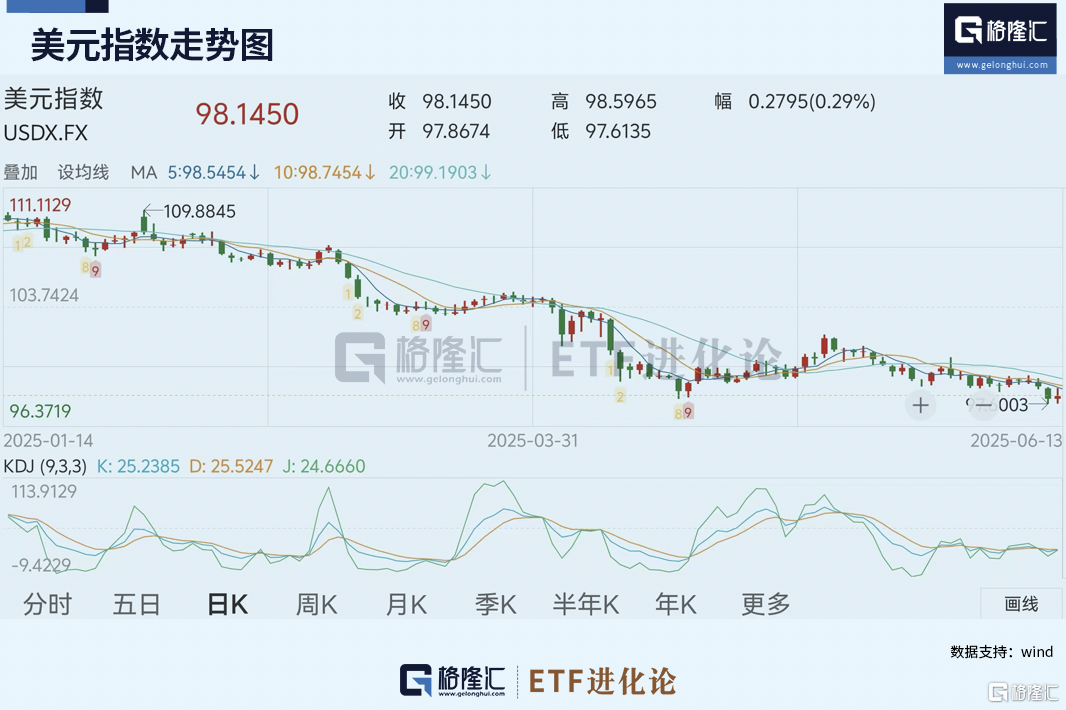
Group 1 - Iran launched a significant retaliatory attack against Israel, firing hundreds of ballistic missiles after Israel's preemptive strike on Iranian nuclear facilities, marking a new escalation in the conflict [1][2][6] - The U.S. military assisted in intercepting and shooting down Iranian missiles, indicating heightened military involvement in the region [1] - Global markets reacted negatively, with the Dow Jones dropping over 700 points and WTI crude oil prices surging by more than 13%, the largest increase since March 2022 [1] Group 2 - Israel's operation involved 200 fighter jets and over 330 munitions targeting Iranian nuclear sites, which Israeli officials described as a decisive moment in their national history [2] - The Israeli government has stated that the operation will continue for several days, indicating a prolonged military engagement [2] - Iran's military reported that at least 200 missiles entered Israeli airspace, with dozens hitting strategic targets [7][8] Group 3 - The oil market is experiencing significant volatility, with traders hesitant to short oil prices amid geopolitical uncertainty, reminiscent of the oil crisis of the 1970s [10][12] - There is speculation about Iran potentially blocking the Strait of Hormuz, a critical oil shipping route, which could severely disrupt global oil supply [11] - The demand for oil options surged, with a record number of call options being purchased, reflecting market fears of escalating conflict [13][14] Group 4 - Traditional safe-haven assets like the U.S. dollar and Treasury bonds did not exhibit the expected flight to safety, with the dollar initially declining before a slight recovery [15][18] - In contrast, gold prices surged past $3,400, and significant inflows were observed in military and gold ETFs, indicating a shift in investor sentiment towards commodities [18][20] - The global gold ETF market saw a net outflow of $1.8 billion in May, but the recent geopolitical tensions may lead to renewed interest in gold as a safe-haven asset [22]

“进击的”黄金:“避险王者”还能走多远?
Xin Hua Cai Jing· 2025-06-16 05:19
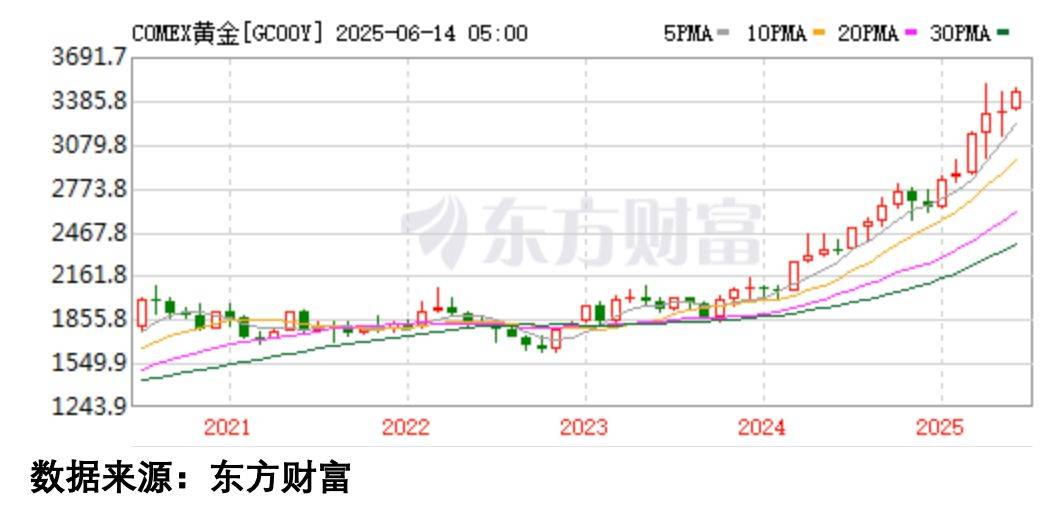
Group 1: Market Dynamics - The recent escalation of tensions between Israel and Iran has led to a renewed interest in gold as a safe-haven asset, pushing gold prices to near historical highs of $3,500 per ounce [1][2] - Analysts predict that short-term demand for gold may continue to drive prices higher, potentially breaking previous records [2][6] - The geopolitical risks have made gold an attractive alternative to dollar-denominated assets, especially in light of concerns over the freezing of dollar assets due to political factors [2][3] Group 2: Central Bank Activity - Global central banks are increasing their gold reserves at an unprecedented rate, with gold expected to surpass the euro as the second-largest reserve asset by 2024, accounting for over 20% of global demand [3][7] - Despite the increase in gold purchases, there are indications that the pace of central bank buying has slowed, with a net increase of only 12 tons in April, down from a 12-month average of 28 tons [3][4] Group 3: Economic Factors - The current economic environment, characterized by stagnation and potential currency devaluation, positions gold as a valuable asset, particularly during periods of stagflation [6][7] - The expectation of interest rate cuts by the Federal Reserve and the decline in confidence in the dollar are contributing to the attractiveness of gold as a hedge against economic uncertainty [6][7] Group 4: Future Price Predictions - Institutions maintain a positive long-term outlook for gold prices, with Morgan Stanley predicting an average price of $3,675 per ounce by Q4 2025 and Goldman Sachs forecasting a rise to $3,700 by the end of 2025 [7] - However, there are concerns that the momentum for further significant price increases may be limited due to reduced market activity and profit-taking pressures [7][8]
机构看金市:6月16日
Xin Hua Cai Jing· 2025-06-16 04:54
海通期货:弱势美元和地缘政治因素使得黄金易涨难跌 正信期货:中东地缘冲突扰动避险属性驱动金价逼近新高 申银万国期货:中东局势升级下黄金整体呈现偏强态势 剑桥皇后学院:黄金仍然是一种关键的避险资产 Zaye Capital Markets:需跟踪油价对金价的影响,如果油价继续飙升可能提振金价大幅上涨 【机构观点分析】 海通期货表示,中东地缘局势急剧升级,黄金作为避险资产上涨。美国5月CPI和PPI公布,通胀再度低 于市场预期水平。尽管关税依然可能在未来推升外生性通胀风险,但美国经济降速已导致核心CPI环比 连续4个月低于预期,内生性通胀风险显著降低。经济基本面压力之下,美元贬值趋势延续。虽然关税 交易逻辑目前暂未助推黄金进一步上涨,但弱势美元和地缘政治因素使得黄金易涨难跌。短期内,重点 关注黄金能否突破3500美元关键点位,上调COMEX黄金价格区间至3200-3600美元/盎司。 正信期货表示,短期来看,黄金创新高后再高位构筑新的震荡平台,在全球央行全面进入宽松周期后, 未来三年合理估值在2990美元/盎司附近,考虑到中期地缘避险需求仍在,俄乌问题仍有变数,中东冲 突又起,且美国关税政策仍然会反复影响市场的风 ...
以伊冲突骤然升级,资本市场遭遇地缘政治冲击波!
贝塔投资智库· 2025-06-16 04:00
以下文章来源于智通财经APP ,作者智通编选 智通财经APP . 智通财经APP,连线全球资本市场。内容合作/内容举报请联系李先生: Tel: +86-15121009144 Email:zhitongcolumn@163.com 点击蓝字,关注我们 以色列于 6 月 13 日清晨对伊朗核设施及弹道导弹基地发动突袭,伊朗伊斯兰革命卫队指挥官侯赛因・ 萨拉米在袭击中身亡,德黑兰随即誓言对以政府及美国实施 "严厉打击"。 这场突如其来的中东危机迅速穿透地缘边界,在全球资本市场掀起剧烈震荡 —— 布伦特原油期货单日 飙升超 13%,加密货币与全球股市集体下挫,黄金等避险资产应声暴涨,能源与金融市场的连锁反应正 持续发酵。 亚洲市场方面,港股成为地缘风险的直接冲击对象 。恒生指数当日低开后震荡下挫,最终收跌 0.59% 报 23892.56 点,恒生科技指数跌幅扩大至 1.72%,科技股全线疲软,阿里巴巴、美团等龙头跌幅超 1%。不过, 能源与黄金板块逆势走强 ,中海油、中石油涨超 2%,赤峰黄金飙升 10%, 山东墨龙因油 气设备订单预期激增一度暴涨 160% 。 南向资金逆势净买入 39.97 亿港元,显示内地资 ...

谁说只有黄金不负卿,眼皮底下的机会来了!
Sou Hu Cai Jing· 2025-06-16 03:01
引子:黄金闪耀,人心浮动 世界从未如此喧嚣。 中东的炮火尚未停歇,黄金价格已悄然攀上新高。街头巷尾,茶余饭后,人人都在谈论避险资产,仿佛下一秒就是末日。但市场从不按常理出牌——当所有 人盯着黄金时,真正的机会或许藏在别处。 历史总是惊人的相似,却又充满意外。1971年布雷顿森林体系崩塌后,黄金与美元脱钩,开启了长达半个世纪的金融博弈。而今,地缘冲突再起,美联储加 息周期未止,黄金却逆势上扬。这背后,是华尔街的精心布局,还是散户的一厢情愿? 2. 驱动黄金上涨的核心因素 历史数据显示,黄金牛市只出现在两种环境下: | 资产 | 年化收益率 | 最大回撤 | 特点 | | --- | --- | --- | --- | | 黄金 | 7.6% | 70% (1980-2000年) | 抗通胀但长期增值能 | | 标普500(含股息) | 10.51% | 37% (2008年) | 稳定性强,受益经济 | | 纳斯达克 | 10.24% | 78% (2000-2002年) | 高波动高回报、科技 | 但2022年打破了这一规律——美联储激进加息,黄金却与美元同步上涨。这背后是全球资本对安全资产的饥渴:当美债信用 ...
ETF开盘:油气ETF华泰柏瑞领涨8.56%,影视ETF领跌1.12%
news flash· 2025-06-16 01:30
Group 1 - The overall performance of ETFs showed mixed results, with oil and gas ETFs leading the gains [1] - Huatai Baichuan oil and gas ETF (561570) surged by 8.56%, indicating strong investor interest in this sector [1] - The oil and gas resources ETF (563150) increased by 1.98%, reflecting a positive trend in energy investments [1] Group 2 - Gold ETFs also performed well, with the gold ETF (159834) rising by 1.76%, suggesting a growing demand for safe-haven assets [1] - In contrast, the film and television ETF (159855) experienced a decline of 1.12%, indicating potential challenges in the entertainment sector [1] - The food and beverage ETFs saw declines, with one ETF (159843) down by 1.1% and another (159736) down by 1.01%, highlighting pressures in the consumer goods market [1]
地缘政治风险加剧 交易员涌入期权市场避险
智通财经网· 2025-06-15 23:37
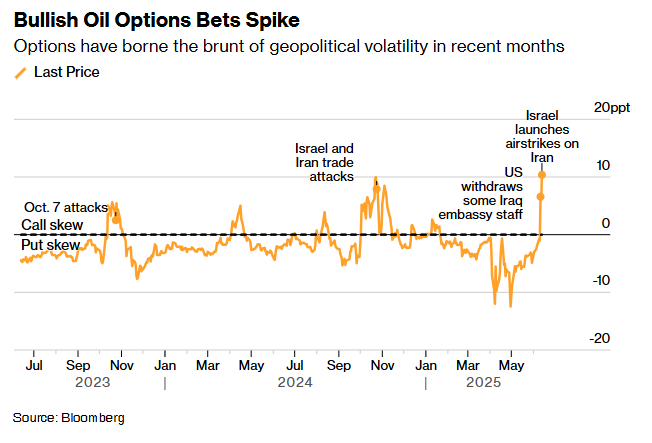
以下是交易员为应对市场的不确定性而采取的一些策略: 石油 智通财经APP获悉,以色列对伊朗发动空袭以及伊朗随后进行报复于上周五在全球市场上引发了波澜,促使交易员纷纷涌入期权市场寻求保护,因为外界仍 在持续关注这场冲突是否会持续很长时间。 能源经纪公司PVM的分析师Tamas Varga表示:"以色列和伊朗之间冲突的升级,包括对核设施和军事目标的打击,标志着中东地缘政治格局的一个转折点, 其连锁反应已经开始在全球市场显现。霍尔木兹海峡——每天有2000万桶石油经过——如今正处于地缘政治的刀刃之上。" 在以色列袭击伊朗之前的几天里,随着紧张局势加剧,一些分析人士曾猜测,一旦爆发冲突,油价可能会飙升至每桶100美元以上。因此,交易员们抢购看 涨期权。这一趋势在以色列上周五对伊朗发动空袭后达到了峰值。 布伦特原油和WTI原油期货价格一度飙升14%,隐含波动率猛增。对看涨期权的恐慌性买盘将看涨期权的溢价推高至自2022年俄乌冲突爆发以来从未见过的 水平。伊朗的报复性打击更进一步推高了买盘。 瑞穗证券美国能源期货部门主管Robert Yawger表示:"投机者的应对方式是毫不犹豫地抢购屏幕上可见的所有看涨期权,根本不在乎 ...
金十数据全球财经早餐 | 2025年6月16日
Jin Shi Shu Ju· 2025-06-15 22:57
Group 1: Geopolitical Tensions and Market Reactions - The geopolitical tensions in the Middle East, particularly between Israel and Iran, have led to significant market reactions, with investors buying safe-haven assets [3][4] - Oil prices surged, with WTI crude oil rising over 13% at one point, marking the largest intraday increase since 2022, and closing up 5.94% at $72.91 per barrel [4] - The U.S. stock market saw declines, with the Dow Jones falling 1.79%, S&P 500 down 1.13%, and Nasdaq decreasing by 1.30%, while energy and defense sectors maintained upward momentum [4] Group 2: Domestic Market Performance - The Hong Kong stock market opened lower, with the Hang Seng Index closing down 0.59%, while the tech index fell 1.72% [5] - In the A-share market, all three major indices closed lower, with the Shanghai Composite Index down 0.75% and the Shenzhen Component down 1.1%, amidst a trading volume of 1.47 trillion yuan [6] - The oil and gas, precious metals, and military equipment sectors showed strength, while sectors like IP economy, beauty care, and liquor experienced significant declines [6] Group 3: Economic Indicators - The People's Bank of China reported that M2 money supply grew by 7.9% year-on-year as of the end of May, while M1 increased by 2.3% [11] - The total social financing stock was approximately 426.16 trillion yuan, reflecting a year-on-year growth of 8.7% [11]

金都财神:6.15黄金下周一行情走势分析及操作建议
Sou Hu Cai Jing· 2025-06-15 17:00
【消息面】 金价周五急升,站上3400美元关口,最高至3446.71美元/盎司,创近两个月新高,中东地缘紧张,投资者纷纷涌向避险资产,此前以色列空袭伊 朗,再次引发人们对中东地区爆发更广泛冲突的担忧。 随着周末中东地缘紧张越演越烈,下周金价或继续受益于避险情绪的推动,金价下周初有望剑指3500美元;周内还将受美联储决议和鲍威尔讲话 影响,此外美国总统特朗普于6月15日至17日访问加拿大参加七国集团领导人峰会,届时的讲话或也影响金价波动,值得关注。 【黄金行情走势简析】 来源:金都财神A 2,从2小时走势看,尾盘黄金上涨3440美元后小幅回落,KDJ指标超买后在高位2次死叉,附图拐头向下,MACD指标快慢线在0轴上方粘合,红 色多头动能缩量,短线走势相对偏空。由于日线和周线走势偏多,黄金日内操作倾向回落做多单为主,下方关注3400美元支撑,上方关注3450美 元压力。 【6.16黄金下周一交易建议】 1,黄金稳健回落3405-3408美元附近多,止损3400美元,止盈看3430美元 2,周一若平开的话,上涨3453-3456美元附近空,止损3461美元,止盈看3420美元。 3,行情瞬息万变,更多行情以实时策略 ...