
金ETF

Search documents
基于BLACK-LITTERMAN模型融合资产择时与风格轮动的资产配置研究
Southwest Securities· 2026-02-26 10:30
Asset Allocation Model - The report introduces a dual-driven asset allocation model based on the Black-Litterman (BL) framework, integrating strategic and tactical approaches to enhance decision-making and investment performance[1] - The strategic component utilizes asset timing and regression analysis to generate posterior distributions of asset returns, improving the foresight of allocation decisions[1] - The tactical component focuses on style rotation strategies in the A-share market, dynamically tracking market style shifts to optimize investment portfolios[1] Timing Strategies - The bond timing strategy is based on economic fundamentals (economic growth, real estate cycle) and market interest rates (repo rates, government bond yields) to time government bonds[2] - The commodity timing strategy for gold incorporates financial, monetary, and commodity attributes, analyzing real interest rates, inflation expectations, risk aversion, and supply-demand relationships[2] - The stock timing strategy for A-shares evaluates liquidity (money market rates, credit expansion), international influences (China-US interest rate differentials, exchange rates), and valuation metrics[2] Style Rotation Strategies - The size and value rotation strategy examines macroeconomic changes and the performance of large versus small-cap stocks, utilizing indicators like credit spreads and foreign capital inflows to construct timing metrics[3] - The growth versus value rotation strategy is driven by macro liquidity and micro technical factors, with liquidity being the core driver of growth-value style rotation[3] Performance Metrics - From December 31, 2013, to December 31, 2025, the BL model strategy achieved an annualized return of 12.10%, a Sharpe ratio of 2.38, and a maximum drawdown of 4.72%[7] - The latest asset allocation weights as of December 31, 2025, include 4.54% in money market funds, 58.64% in government bonds, 18.00% in gold, and 18.82% in A-shares, with A-shares equally allocated between small-cap and growth styles[8]
纽约期金突破5100美元,上海金ETF、黄金ETF易方达、金ETF南方、黄金ETF、黄金ETF华夏、金ETF等涨超4%
Ge Long Hui· 2026-02-04 07:26
Group 1 - The core viewpoint of the articles indicates a significant rise in gold prices, with spot gold surpassing $5080 per ounce and New York futures exceeding $5100 per ounce, driven by a decline in the dollar index and market sentiment [1][2] - Gold ETFs, including those from various fund companies, have seen increases of over 4%, reflecting the strong performance of gold as an asset class [1] - The traditional research framework for gold pricing, which relies on the dollar and real interest rates, has lost its explanatory power, with non-framework factors gaining prominence [2] Group 2 - Central banks, particularly in non-Western countries, are accelerating gold purchases to replace foreign exchange reserves, indicating a growing consensus of distrust in the dollar [2] - The supply rigidity of gold mining, combined with large-scale central bank purchases, is expected to create a physical shortage and support long-term price increases, with projections suggesting prices could reach $8000 [2] - Short-term trading risks are highlighted, with a current "naked long" market state and high volatility, suggesting potential for a market correction [2][3] Group 3 - Recent volatility in precious metals is attributed to the nomination of Kevin Warsh as the next Federal Reserve Chair, which has led to a rebound in the dollar index and profit-taking in the market [3] - Despite short-term fluctuations, the long-term support factors for gold remain intact, and it is expected to return to a steady upward trend after market adjustments [3] - Silver, due to its dual industrial and financial attributes, has experienced significant price increases but is now under pressure, suggesting a cautious approach for investors [3]
国际金价反弹,黄金ETF、上海金ETF、金ETF涨超3%
Ge Long Hui· 2026-02-03 02:32
Group 1 - The core viewpoint of the news is that gold prices have rebounded, with spot gold surpassing $4800 per ounce and domestic gold jewelry prices showing a slight increase [1][2] - Gold ETFs, including Shanghai Gold ETF, have risen over 3%, with a year-to-date increase exceeding 10% [2] - Morgan Stanley analysts predict a sustained upward momentum for gold prices, forecasting that gold could reach $6300 per ounce by the end of 2026 due to strong demand from central banks and investors [4] Group 2 - Citigroup has significantly lowered its long-term gold price expectations, warning that in a bear market scenario, gold prices could drop to $3000 per ounce [4][5] - Factors supporting current high gold prices, such as geopolitical tensions and economic conditions, are expected to diminish later this year, leading to a potential decline in gold prices starting in 2026 [5] - The new Federal Reserve chair's policies and the decline in tech stocks are putting pressure on precious metal prices, while central bank gold purchases and ETF holdings are expected to support gold prices in the long term [6]

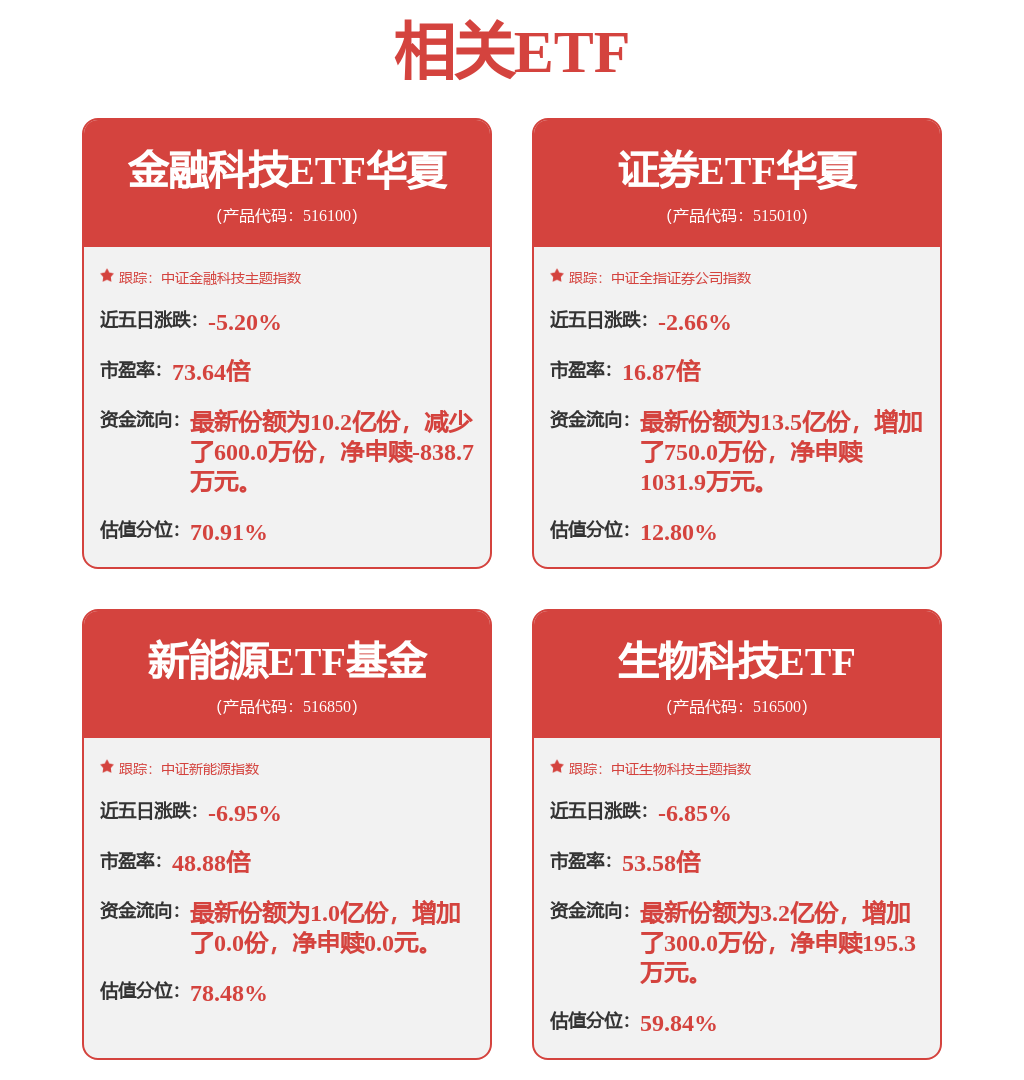
ETF午评 | 金价再创历史新高,金ETF、黄金ETF博时涨5%
Ge Long Hui· 2026-01-29 15:32
Market Performance - The Shanghai Composite Index fell by 0.1% at midday, while the ChiNext Index decreased by 0.05% [1] - AI application themes rebounded, with short drama games and e-commerce leading the gains [1] - The non-ferrous metals sector continued its strong performance, with gold and copper showing significant increases [1] - Real estate, liquor, and agriculture sectors performed well [1] - Semiconductor, AI computing, robotics, and consumer electronics concept stocks experienced adjustments [1] ETF Movements - Two Brazilian ETFs continued to rise, with the Huaxia Fund Brazilian ETF increasing by 7.74% [1] - Gold prices reached a new historical high, with the Fidelity Fund Gold ETF, Bosera Gold ETF, and GF Fund Shanghai Gold ETF all rising by 5.15% [1] - AI applications rebounded, with the online consumption ETF from ICBC and GF Fund Media ETF increasing by 4.88% and 4.5%, respectively [1] - The semiconductor sector declined, with the semiconductor equipment ETFs from E Fund dropping by 2.8% [1] - The consumer electronics sector adjusted, with consumer electronics ETFs from E Fund falling by 2.15% [1]
金ETF(159834.SZ)上涨2.48%
Sou Hu Cai Jing· 2026-01-26 03:30
Group 1 - The core viewpoint of the article highlights the increasing appeal of gold as a safe-haven asset due to rising geopolitical uncertainties and central banks' continued accumulation of gold, which supports long-term gold prices [1] - As of 11:00 AM on January 26, the gold ETF (159834.SZ) rose by 2.48%, indicating a strong market response to current conditions [1] - The analysis from Guotai Junan Securities suggests that despite increased price volatility from speculative inflows, gold prices are expected to remain resilient, especially if U.S. international credit expectations weaken [1] Group 2 - The initiation of the Federal Reserve's interest rate cut cycle and the low risk-return ratio of U.S. Treasury bonds further enhance the investment value of gold [1] - The recommendation is to increase allocation to gold assets, with a specific focus on the gold ETF (159834.SZ) to capitalize on related investment opportunities [1]
金ETF(159834.SZ)涨1.20%
Jin Rong Jie· 2025-12-22 06:09
Group 1 - The core viewpoint of the article emphasizes the increasing value of gold ETFs as a strategic investment opportunity due to the established cycle of interest rate cuts by the Federal Reserve and the expectation of low rates until the end of 2025, which reduces the holding costs of gold [1] - The macroeconomic uncertainty enhances gold's appeal as a safe-haven asset, particularly in the context of increasing policy divergence in the U.S., the Bank of Japan's interest rate hikes triggering carry trade reversals, and pressure on global equity markets [1] - The differentiation between industrial and financial attributes is highlighted, with gold expected to benefit from liquidity easing, while industrial commodities like oil and copper face deflationary pressures [1] - Despite silver being more sensitive to economic conditions, gold is noted for its stability in diversifying systemic risks, with a long-term trend of central banks purchasing gold and ongoing geopolitical disturbances likely to keep gold prices elevated [1] - The article suggests focusing on strategic allocation opportunities in gold ETFs, particularly in light of the confluence of liquidity easing and increased demand for safe-haven assets [1]
白银暴涨,银/铜比创历史,资金盘狂欢倒计时...
雪球· 2025-12-12 04:41
Core Viewpoint - The article discusses the current state of silver investments, highlighting the risks associated with the recent surge in silver prices and the implications of high volatility in the market [3][4]. Group 1: Silver Market Analysis - The silver-gold ratio has decreased from a high of 88 to 68, indicating that the potential for profit has diminished as the market has already absorbed much of the gains [5][6]. - The article argues that investing in silver at this stage is characterized by low returns and high volatility, making it a risky endeavor [7]. - The narrative that industrial demand is driving the silver market is challenged, as other industrial metals like copper and aluminum have not shown similar price increases, suggesting that the current silver price surge is driven by speculative capital rather than fundamental demand [8][11]. Group 2: Historical Context and Risks - Historical examples of silver market manipulation, such as the Hunt brothers' actions in 1980, illustrate the potential for rapid price increases followed by steep declines, emphasizing the risks of current market dynamics [12][13]. - The article warns that the current silver price does not align with either safe-haven investment logic or industrial demand, indicating a potential bubble driven by speculative trading [11][13]. Group 3: Investment Recommendations - The article advises against being the "last one holding the bag" in the silver market, suggesting that investors should consider more stable assets like gold or cheaper industrial metals like copper and aluminum [14][15]. - It highlights an arbitrage opportunity in silver LOF (Listed Open-Ended Fund), where the premium has surged above 15%, suggesting that selling now could yield better returns than holding onto silver [16]. - The article emphasizes the importance of patience in investment, noting that the current market conditions are not conducive to finding good opportunities compared to earlier periods when the silver-gold ratio was higher [18].

冲击三连涨!金ETF(159834)再度高开涨超1%,多重因素支撑黄金结构性牛市周期
Sou Hu Cai Jing· 2025-12-12 02:20
Group 1 - The core viewpoint of the articles highlights the recent performance of gold ETFs and the impact of the Federal Reserve's interest rate decisions on gold prices [1][2] - As of December 12, 2025, the gold ETF (159834) has risen by 1.13%, marking a three-day consecutive increase with a transaction volume of 22.36 million yuan [1] - The Federal Reserve announced a 25 basis point rate cut on December 10, 2025, lowering the target range for the federal funds rate to 3.50%-3.75%, which is the third rate cut of the year [1] Group 2 - According to Guotai Junan Securities, gold has performed well among domestic asset classes since November 2025, with SHFE gold rising by 3.15% [2] - Despite a weak economic recovery, factors such as narrowing PPI declines and stable liquidity from the central bank support gold prices [2] - State Street Global Advisors predicts that gold prices will experience their best annual performance since 1979 in 2025, with expectations of a price range between $4,000 and $4,500 per ounce in 2026 [2]
美联储降息兑现,金价强势反弹,金ETF(159834)红盘向上涨近1%,机构研判金价牛市基础仍存
Sou Hu Cai Jing· 2025-12-11 02:10
Core Viewpoint - The Federal Reserve has lowered the federal funds rate by 25 basis points to a target range of 3.50% to 3.75%, marking the third rate cut of the year and the sixth since September 2024, which has positively impacted gold and silver prices [1] Group 1: Federal Reserve Actions - The Federal Reserve concluded a two-day monetary policy meeting on December 10, announcing a 25 basis point reduction in the federal funds rate [1] - This rate cut is the third of the year and the sixth since September 2024, indicating a trend of easing monetary policy [1] Group 2: Economic Indicators - The Fed's statement highlighted that economic activity is expanding at a moderate pace, with employment growth slowing and a slight increase in the unemployment rate prior to September [1] - Inflation has risen since the beginning of the year and remains at relatively high levels [1] Group 3: Market Reactions - Following the rate cut, gold and silver prices increased, with spot gold reaching $4,230 per ounce and spot silver rising by 2% to $61.85 per ounce, setting a new historical high [1] - Analysts from Funi Futures expect gold prices to remain strong due to ongoing geopolitical uncertainties and the impact of the dollar's credit system [1] Group 4: Future Outlook - Bank of America projects significant upside potential for gold prices in 2026, suggesting that gold bull markets typically peak only after the initial factors that triggered them have dissipated [1]
Mhmarkets迈汇:贵金属与美股的双高位隐忧
Xin Lang Cai Jing· 2025-12-10 11:39
Core Viewpoint - Gold and silver prices have been experiencing high volatility, with analysts expecting continued momentum in precious metals and the S&P 500, despite warnings from the Bank for International Settlements about potential dual bubbles [1][4]. Group 1: Market Performance - The S&P 500 has seen a year-to-date increase of over 16%, fluctuating around 6,850 points, while gold prices have recorded their best performance since 1979, with a year-to-date increase of over 50%, hovering around $4,200 per ounce [1][4]. - The S&P 500 has set over 20 record highs this year, and gold has nearly 50 new highs since breaking the $4,000 mark [1][4]. Group 2: Investor Behavior - The primary driving force behind the rise in both the stock and gold markets this year has been retail investors, who have been increasing their positions due to media hype and rising prices [2][5]. - There is a notable divergence between retail investors, who are seeing net inflows, and institutional investors, who have mostly chosen to reduce holdings or remain cautious [6]. Group 3: Market Risks - The influx of retail funds is not inherently problematic, but the divergence in direction from institutional investors may pose a risk for future volatility [2][6]. - The potential for emotional trading is heightened, as concentrated selling by retail investors could amplify price fluctuations and impact market stability [6]. Group 4: Fundamental Support - Despite gold prices entering overbought territory after surpassing $4,360 in October, the fundamental backdrop remains strong, with central banks expected to purchase approximately 900 tons of gold this year, which is still above the long-term average [3][6]. - The expectation of continued monetary easing by the Federal Reserve until 2026 is likely to support demand for precious metals through its effects on interest rates, long-term yields, and the dollar [3][6].