出海

Search documents
十大外资对2026年A股的建议
Sou Hu Cai Jing· 2025-12-18 15:36
Group 1: Core Insights - The core viewpoint is that the ability of listed companies to achieve real profits will be the key driver for the rise of Chinese assets in 2026, shifting focus from valuation recovery to earnings realization [2][23]. - The predicted target for the CSI 300 index in 2026 is 5200 points, indicating a potential increase of approximately 13% from the closing price in December 2025, with an average market valuation of about 15.9 times earnings [2][24]. Group 2: Investment Themes - Morgan Stanley identifies four clear investment themes: curbing excessive competition, artificial intelligence (AI), global expansion, and a structural recovery in domestic demand [3][4]. - Goldman Sachs emphasizes five major investment themes: leading industry players, beneficiaries of the "14th Five-Year Plan," AI, global expansion, and curbing excessive competition [6][7]. - UBS highlights three main investment lines: self-sufficiency, curbing excessive competition, and global expansion, suggesting a focus on consumer sectors in the second half of the year [9][11]. Group 3: Earnings Growth Projections - Morgan Stanley forecasts a 6% earnings growth for listed companies in 2026, with an acceleration to 10% in 2027, driven by supportive policies and a narrowing decline in producer prices [13][41]. - Goldman Sachs expects the MSCI China index's earnings per share (EPS) growth to rise to 12% in 2026, significantly higher than previous cycles [5][29]. - UBS anticipates an increase in overall A-share earnings growth from 6% in 2025 to 8% in 2026, supported by nominal GDP growth and ongoing policy support [9][36]. Group 4: Sector-Specific Insights - The renewable energy sector is expected to benefit from policies aimed at restoring pricing power and healthy profit margins, particularly in the context of curbing excessive competition [3][8]. - The AI sector is projected to see a 30% increase in global capital expenditure for data centers in 2026, positively impacting related industries such as optical modules and power equipment [3][28]. - Consumer sectors, particularly essential goods and high-end luxury items, are expected to perform well, with the restaurant industry growing faster than overall retail [4][6]. Group 5: Policy and Economic Environment - The Chinese government is expected to implement a series of supportive fiscal and monetary policies, including increased fiscal deficits and continued monetary easing, to stimulate domestic demand and promote industrial upgrades [23][33]. - The anticipated fiscal policy for 2026 includes a budget deficit of around 4% and a significant increase in special government bonds, aimed at supporting consumption and infrastructure [33][34]. - The overall economic growth forecast for 2026 is set at 4.4%, with a gradual recovery in the real estate market expected to reduce its drag on the economy [23][41].





摩根大通刘鸣镝:2026年中国股市有望迎“春季行情”
Zheng Quan Ri Bao Wang· 2025-12-18 07:57
Core Viewpoint - The market is expected to experience a "spring market" driven by earnings growth in 2026, supported by policies aimed at reducing competition, advancements in AI infrastructure, and a recovering consumer market [1][2]. Market Short-term Style Shift - Morgan Stanley's China stock strategy team has shifted its outlook to positive for MSCI China and CSI 300 indices since January 9, 2023, predicting that the upward trend may continue until 2026 [2]. - A style shift from growth and momentum sectors to value, defensive, and high-dividend sectors is recommended, likely lasting until the end of this year and early next year [2]. - The MSCI China, CSI 300, and MSCI Hong Kong indices are projected to reach 100 points, 5200 points, and 16000 points respectively by 2026, representing potential increases of approximately 22%, 13.5%, and 17.8% [2]. Earnings Growth as Market Driver - Stable growth in earnings per share (EPS) is identified as the core driver for sustained market growth [3]. - The proportion of companies in the MSCI China index with upward earnings revisions has significantly increased since May [3]. - The current net profit margin of Chinese listed companies (excluding the financial sector) is relatively low in the Asia-Pacific region, but the return on equity (ROE) remains strong [3]. Foreign Investment Trends - Foreign long-term funds have increased their holdings in the Chinese stock market, with a 100 basis point rise in the holdings of global active funds by the end of October [4]. - Four key investment themes for 2026 are identified: "anti-involution," AI, overseas expansion, and consumption, with real estate as a potential theme [4][5]. Sector-Specific Insights - The "anti-involution" theme focuses on sectors with strong growth prospects, such as batteries and photovoltaics, as well as macro-sensitive sectors like steel and cement [5]. - Companies with overseas operations are expected to gain more attention from global investors due to their balanced business models [5]. - The essential consumer sector in MSCI China is currently undervalued, with a price-to-earnings ratio below 20, indicating significant potential for valuation recovery [5]. AI Sector Analysis - The assessment of whether the AI sector is in a bubble depends on valuation levels, with recent corrections observed in semiconductor hardware valuations [6]. - The focus is on energy storage companies within AI infrastructure, which are currently in a recovery phase [6]. - The technology sector's performance in the fourth quarter is crucial for sustaining high expectations, with long-term growth dependent on companies improving quality and profitability [6].

腾讯“千域计划”2025成绩单公布:“被集成”模式增长153%
Sou Hu Cai Jing· 2025-12-18 07:46
Core Insights - Tencent Smart Retail and Life Industry announced the upgrade of the "Qianyu Plan" to provide more support for partners, focusing on cooperation mechanisms, incentives, and resource support to help partners discover new growth opportunities [1][3] - The "2025 Qianyu Achievement Report" highlighted significant growth, with the total number of cooperative projects reaching over 150% of the previous year, and overall cooperation amount exceeding 150 million yuan [1][3] Group 1: Ecosystem Development - The partnership ecosystem has expanded, with cross-industry collaborations emerging in retail, tourism, hospitality, property, and real estate, enhancing the overall cohesion and combat effectiveness of the "warrior system" [3][5] - Notable collaborations include the CHATBI solution for management challenges, cloud hosting models for cost reduction in hospitality, and AI co-creation with Youzan for improved user operations [3][5] Group 2: 2026 Qianyu Plan Upgrades - The 2026 Qianyu Plan will focus on addressing partner pain points by enhancing cooperation mechanisms, incentives, and resource support to help partners navigate challenges and uncover new growth opportunities [5][6] - The plan will welcome partners from various industries to co-create solutions, emphasizing digital infrastructure, applications, and strategies to support clients' digital upgrades [5][6] Group 3: Market Resources and Opportunities - The Qianyu Plan will integrate marketing resources and provide diverse training, certification, and AI resources to address market challenges such as insufficient business opportunities and low market visibility [6][8] - The focus will be on AI, overseas expansion, and holistic operations to explore new growth directions, with an emphasis on making AI accessible across industries [6][8] Group 4: Future Directions - The Qianyu Plan aims to recruit and nurture excellent partners through selection, management, and Tencent ecosystem empowerment, fostering collaborative growth and exploring new digital growth paths [9]

申万宏源晨会报告-20251218
Shenwan Hongyuan Securities· 2025-12-18 01:58
Core Insights - The report highlights that the construction industry is expected to stabilize in 2026, supported by local government debt management and the implementation of central projects, despite current pressures in infrastructure, manufacturing, and real estate investments [1][2] - The company has shown marginal improvement in new contract signings, with a robust backlog ensuring steady long-term growth. The cumulative new contracts from 2021 to 2025 Q1-3 show a mixed trend, with a notable improvement in the first three quarters of 2025 [1][2] - The company's balance sheet is undergoing continuous repair, with improved cash flow and optimized accounts receivable aging structure, despite revenue and profit pressures due to external economic factors [2][3] Summary by Sections Industry Overview - The fixed asset investment growth has slowed down in 2025, but the outlook for 2026 is optimistic due to government initiatives aimed at stabilizing investments [1] - The construction sector is expected to receive support from the implementation of key projects, which may lead to higher investment elasticity in certain sub-sectors [1] Company Performance - The company reported a total revenue of 728.4 billion RMB in 2025 Q1-3, a decrease of 3.9% year-on-year, with a net profit of 14.8 billion RMB, down 5.6% year-on-year [2] - New contract signings for 2025 Q1-3 showed a marginal improvement, with a total of 8.1 trillion RMB in backlog, ensuring long-term growth [1][2] Financial Health - The company has implemented a three-year plan to control financial metrics, resulting in a reduction of cash outflow by 9.26 billion RMB in 2025 Q1-3 [2] - The aging structure of accounts receivable has improved, with the proportion of long-term receivables decreasing, indicating better cash management [2] Valuation and Investment Recommendation - The report assigns an "Outperform" rating, projecting net profits of 21.4 billion RMB, 21.7 billion RMB, and 22.3 billion RMB for 2025-2027, with corresponding PE ratios of 3X [3] - The valuation comparison with peers indicates a significant discount for H-shares compared to A-shares, with a potential upside of 14.7% based on 2026 earnings estimates [3]

记者手记:那些在迪拜做生意的中国人
2 1 Shi Ji Jing Ji Bao Dao· 2025-12-17 09:29
Group 1 - The article discusses the increasing trend of Chinese companies and business elites venturing into the Middle East, particularly Dubai and Abu Dhabi, highlighting the region's appeal for business opportunities and tourism [2][5][6] - In 2024, Dubai is expected to receive 824,000 Chinese tourists, marking a 31% year-on-year increase, indicating a growing interest in the region [3] - The "China Ready Strategy" by Dubai's Economic and Tourism Department aims to facilitate Chinese visitors and businesses, showcasing the city's commitment to attracting Chinese investments and tourism [2][3] Group 2 - Many Chinese companies are seeking to expand their international presence due to declining profit margins in the domestic market, with a focus on the Middle East as a new growth area [5][6] - The article notes a diverse demographic of Chinese professionals in Dubai, including young executives from tech companies with international experience, reflecting a globalized business approach [5][6] - The rise of AI and international expansion are identified as key trends for Chinese enterprises, with various sectors, including engineering, manufacturing, and technology, actively pursuing opportunities abroad [6]
汽车行业2026年度投资策略:洞察周期脉络,把握智能主线
Changjiang Securities· 2025-12-17 07:23
Core Insights - The automotive sector is transitioning from a purely domestic demand-driven model to a multifaceted approach that includes overseas expansion, premiumization, and smart technology integration, with a focus on AI as a key growth driver for 2026 [3][10]. Summary by Sections Overall Market Outlook - Domestic demand for passenger vehicles may face pressure, with a projected registration volume of 22.6 million units in 2026, down 3.4% year-on-year. Exports are expected to reach 6.8 million units, up 17.2% year-on-year, while wholesale volume is forecasted at 29.41 million units, a slight increase of 0.7% [6][32]. - Heavy-duty trucks are anticipated to see a domestic retail sales volume of 695,000 units in 2026, down 13.2% year-on-year, with exports of 365,000 units, up 10% [6][40]. - The motorcycle industry is expected to continue its recovery, with total sales projected at 23.44 million units in 2026, reflecting a 7% year-on-year increase [6]. Main Line 1: Overseas Expansion - The overseas market presents significant growth potential, with a focus on electric vehicle (EV) exports. Excluding China, the U.S., and Japan, the potential for EV exports is expected to triple, with a forecast of 3.38 million units exported in 2026 [7]. - Domestic parts manufacturers are leveraging their technological and cost advantages to penetrate global supply chains, particularly benefiting from the growth of the European EV market [7]. - Heavy-duty truck exports are projected to reach 365,000 units in 2026, while bus exports are expected to grow by 15% [7]. Main Line 2: High-End Vehicles and Domestic Substitution - The high-end and luxury passenger vehicle markets are less affected by economic downturns, presenting opportunities for domestic substitution [8]. - The automotive parts sector is expected to benefit from technological advancements, with significant growth anticipated in areas such as magnesium alloys and smart driving components [8]. - The penetration rate of domestic parts in certain categories, such as seats and airbags, is expected to increase from approximately 10% to over 30% [8]. Main Line 3: Embracing AI - The production of humanoid robots is entering a new phase, with significant growth expected in 2026 as Tesla prepares for mass production [9]. - The liquid cooling sector is poised for explosive growth, with strong applicability in both automotive and server cooling systems [9]. - The smart driving market is entering a phase of affordability, with penetration rates expected to accelerate between 10% and 50% [9]. Investment Recommendations - The automotive sector is advised to focus on identifying turning points in domestic demand while leveraging opportunities in overseas markets, high-end vehicle segments, and AI-driven transformations [10].
西城商界畅谈服贸会影响力,多维赋能区域经济高质量发展
Bei Jing Shang Bao· 2025-12-17 07:10
Core Insights - The China International Fair for Trade in Services (CIFTIS) serves as a multi-functional platform for regional economic development, showcasing opportunities for investment and international cooperation [3][4]. Group 1: Economic Development and Investment - The CIFTIS has been pivotal for the Xicheng District, acting as a "showcase window," "cooperation bridge," and "growth engine," with pre-scheduled investment amounts exceeding $16.5 billion, marking a 71.5% increase from the previous year [3]. - The district launched the "Central-Local Cooperation: Going Global Navigation Plan" during the fair, facilitating partnerships between Chinese enterprises and foreign companies, particularly in the Middle East [3]. Group 2: Support for Traditional Brands - Xicheng District is enhancing its commercial districts and supporting traditional brands through targeted upgrades and innovative actions, including the "Old Brand Renewal" initiative [4]. - The fair has allowed traditional brands like Quanjude to connect with younger consumers through innovative products, showcasing the blend of heritage and modern consumer preferences [7]. Group 3: Digital and Financial Technology - Cheche Technology aims to expand its digital insurance services internationally, leveraging the overseas sales networks of Chinese electric vehicle brands [5]. - LianDong YouShi, a fintech company, is focusing on providing localized solutions for developing countries, aligning with the Belt and Road Initiative [6]. Group 4: Innovation in Food and Beverage - Zhang Yiyuan is launching a new tea brand, "Yuan Lai Shi Cha," at the fair, emphasizing innovation while maintaining traditional values, particularly in jasmine tea [8]. - Huatiandish's participation in the fair has allowed it to test innovative business models and integrate technology into its offerings, enhancing customer engagement [9]. Group 5: Brand Image and Cultural Value - Caibai has utilized its five-year participation in the fair to enhance its brand image and cultural value, positioning itself as a platform for cross-border cooperation [10]. - The fair serves as a significant venue for Chinese brands to narrate their stories and promote Eastern aesthetics on a global stage [10].

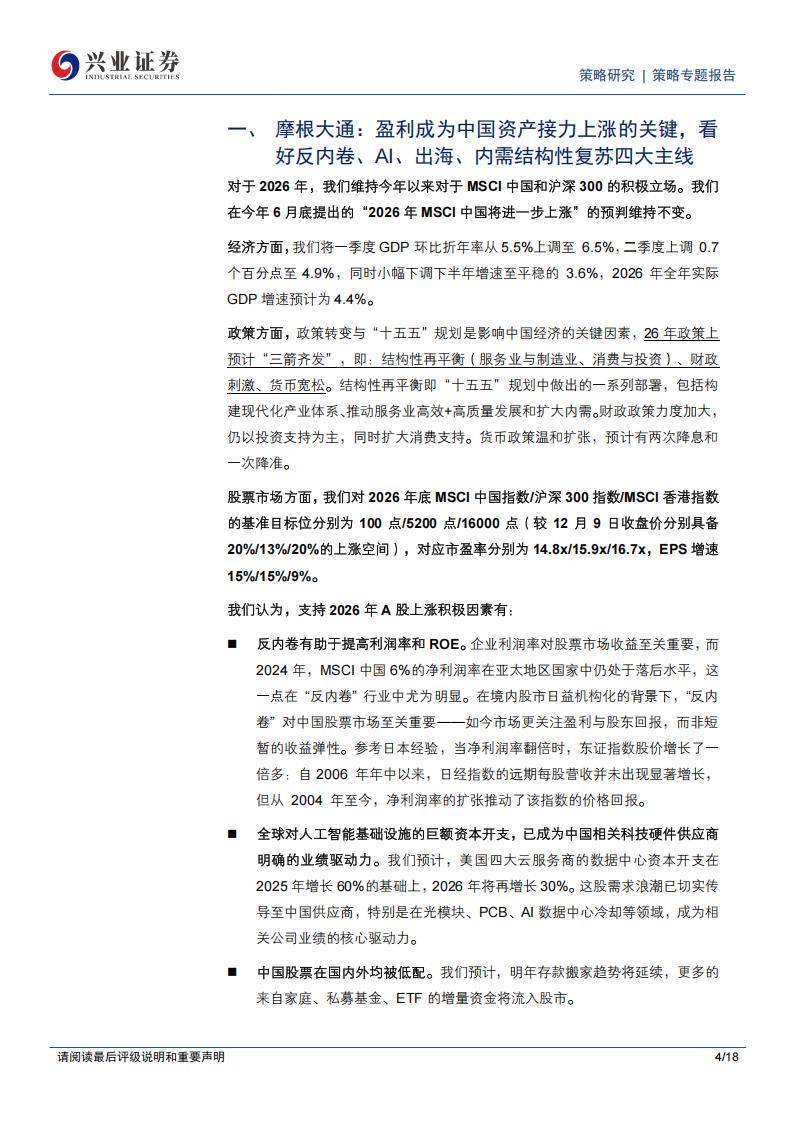
兴证策略张启尧:十大外资如何看2026年A股?
Xin Lang Cai Jing· 2025-12-16 07:57
Economic Outlook - The GDP growth forecast for 2026 has been adjusted to 4.4%, with a quarterly increase expected in Q1 to 6.5% and a slight decrease in H2 to 3.6% [1] - The fiscal deficit is projected to expand by 1 percentage point in 2026, with a total budget deficit of 4% and special government bonds amounting to approximately 4.8 trillion yuan [9] - Inflation is expected to remain low, with CPI projected to rise slightly to 0.4% and PPI potentially turning positive by the end of 2026 [11] Stock Market Projections - The target levels for major indices by the end of 2026 are set at 100 points for MSCI China, 5200 points for CSI 300, and 16000 points for MSCI Hong Kong, indicating potential increases of 20%, 13%, and 20% respectively [2] - The expected EPS growth for MSCI China is around 15% for 2026, with a significant contribution from the consumer discretionary sector [4][6] Key Investment Themes - The four main investment themes identified are anti-involution, AI, overseas expansion, and structural recovery in domestic demand [1][6] - The easing of price wars among major companies is anticipated to improve profit margins, particularly in the consumer discretionary sector [4] - The demand for AI infrastructure is expected to drive performance for Chinese tech hardware suppliers, with significant capital expenditure growth projected for major cloud service providers [5] Industry Insights - The "anti-involution" policy is expected to enhance profit margins and return on equity (ROE) across various sectors, particularly in industries facing excessive competition [5] - The structural recovery in sectors such as healthcare, information technology, and communication services is showing signs of broadening, with over one-third of sub-sectors currently in a revenue expansion phase [3] - The automotive, consumer electronics, and AI-related hardware sectors are projected to see significant improvements in overseas revenue contributions [7] Policy Environment - The policy landscape is expected to support consumption and investment, with a focus on structural rebalancing between services and manufacturing [1][9] - Monetary policy is anticipated to remain moderately accommodative, with expectations of interest rate cuts and reserve requirement ratio reductions [9][15] - The government is likely to implement targeted measures to stimulate consumption, particularly in service and green sectors [9][10]
摩根士丹利基金:看好具备出海能力的AI科技公司以及品牌消费公司
Zheng Quan Shi Bao Wang· 2025-12-16 06:45
Group 1 - The core viewpoint is that the stock market may continue to be influenced by overseas factors, but there is a high probability of earnings improvement for listed companies next year [1] - The policy environment is expected to remain accommodative, which will support market valuation increases [1] - There is an optimistic outlook for Chinese assets, particularly for AI technology companies with overseas capabilities and brand consumer companies [1]
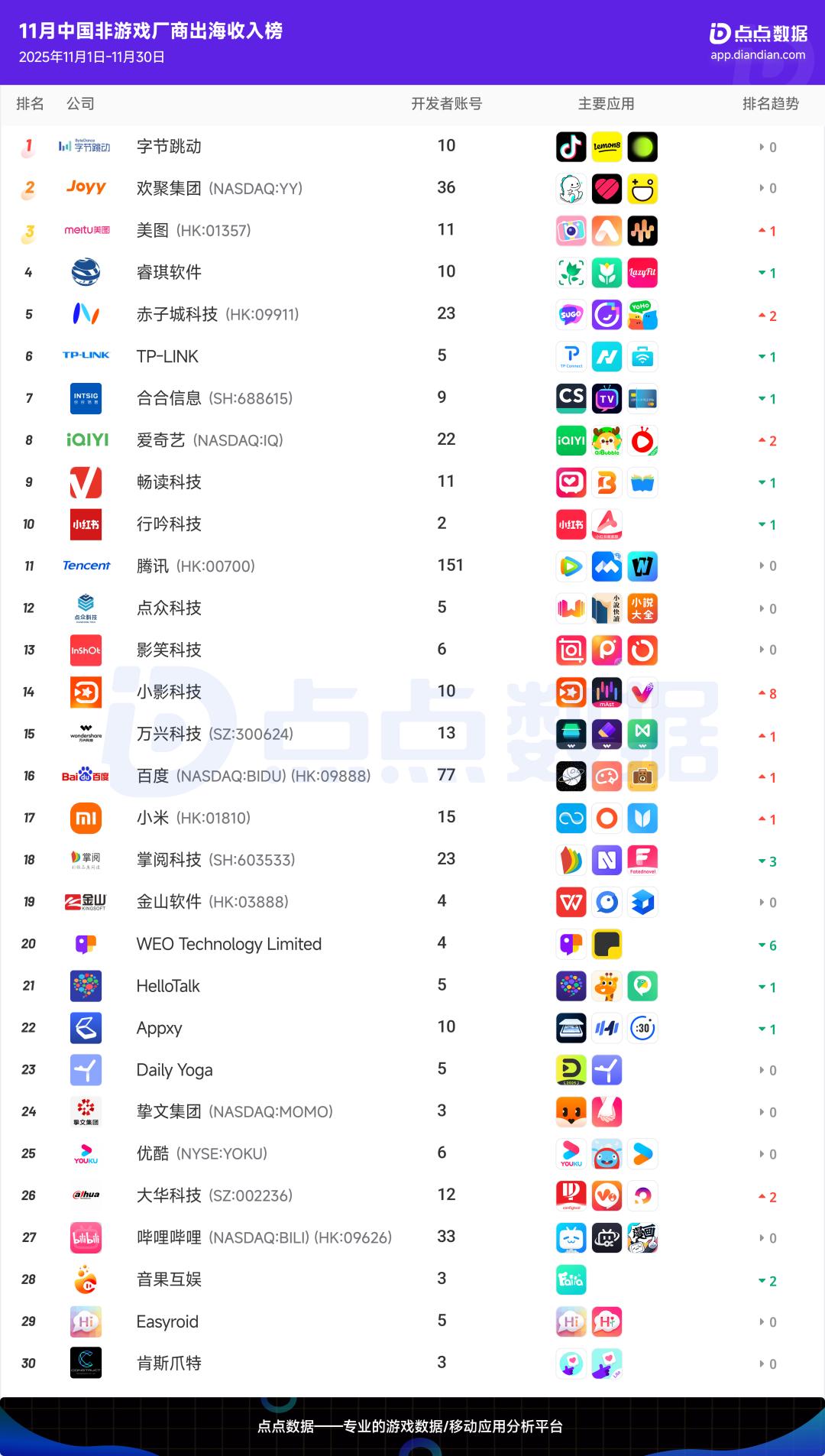
出海厂商:2025年11月中国应用/游戏厂商出海收入Top30榜
3 6 Ke· 2025-12-16 04:10
Core Insights - In November, Chinese non-gaming companies continued to show strong overseas revenue growth, with ByteDance and YY leading the rankings. Meitu's revenue surged by over 21.4% due to seasonal features, returning to the top three [2][3]. Non-Gaming Companies Revenue - ByteDance and YY maintained their positions at the top of the revenue chart for non-gaming companies in November [2]. - Meitu's application "Meitu" launched a winter-themed feature, achieving record revenue growth, particularly in Asian markets like Thailand and Japan [2][3]. - Qicheng Technology's applications "TopTop" and "DramaBite" helped the company rise into the top five, maintaining previous month's revenue momentum [3]. - iQIYI's revenue increased by over 13.3% due to promotional activities during the Double Eleven shopping festival, moving up two ranks to eighth place [3]. - Youku's application "YOUKU" saw a revenue increase of over 20.2% driven by the success of the series "暗河传" in Thailand [3]. - Xiaoying Technology reversed its revenue decline with a growth of over 21.8%, aided by its video editing app "VivaVideo" and new AI applications [4]. - Other companies like Wanjing Technology, Baidu, and Xiaomi also saw improvements in their rankings and revenue [4]. Gaming Companies Revenue - The global gaming market remained strong, with Chinese gaming companies maintaining their revenue levels from the previous month [7]. - Tencent's overseas revenue grew significantly, driven by its FPS game "GODDESS OF VICTORY: NIKKE," which achieved record revenue due to new content [7][8]. - 4399's new game "英雄來搞鬼:房間保衛戰" performed well in the Hong Kong and Taiwan markets, contributing to its improved ranking [7]. - KuLo Games' "Wuthering Waves" saw a revenue increase of over 16.1%, helping the company rise in the rankings [8]. - Iceberg Network's new game "X-Clash: Survival Challenge" achieved an estimated revenue of over $3 million, with a month-on-month growth of over 162.9% [8]. - Other companies like Lilith, Mu Tong, and BeheFun also experienced notable revenue growth and ranking improvements [8].