
未来产业

Search documents
开局之年中央政治局首次集体学习聚焦未来产业发展
Xin Hua She· 2026-02-02 11:47
Core Insights - The central theme of the article emphasizes the importance of cultivating and developing future industries in China, driven by cutting-edge technologies, to seize development opportunities and enhance the modern industrial system [1][2]. Group 1: Importance of Future Industries - Developing future industries is crucial for gaining technological and industrial advantages, improving quality of life, and promoting comprehensive social progress [2]. - By 2025, the industrial and information sectors are expected to contribute over 40% to China's economic growth, with significant advancements in artificial intelligence, quantum technology, and biomanufacturing [2]. Group 2: Strategic Planning and Focus Areas - The focus for the "14th Five-Year Plan" period should be on key areas such as quantum technology, biomanufacturing, hydrogen energy, and brain-computer interfaces, ensuring a strategic approach that considers national needs and technological maturity [3]. - There is a need to prevent disconnection between future industries and traditional sectors, emphasizing the importance of industry integration [3]. Group 3: Role of Technology and Innovation - The pace and depth of future industry development are largely determined by technological breakthroughs, necessitating seamless integration between innovation and industry [4]. - The government is encouraged to leverage a new type of national system to enhance key technology breakthroughs and accelerate the application of scientific achievements [4]. Group 4: Empowering Enterprises - Enterprises are identified as the main drivers of innovation in future industries, requiring a collaborative ecosystem that supports the growth of leading technology firms and specialized small and medium enterprises [5]. - The focus should be on gathering various innovation resources around enterprises to foster continuous advancement in high-end sectors [5]. Group 5: Support and Governance - The government is tasked with providing comprehensive support and establishing a governance framework to facilitate the development of future industries [7]. - This includes improving fiscal policies, promoting technology finance, and ensuring effective talent management while exploring regulatory methods to mitigate risks [7].
政策半月观:力争“开门红”,还有哪些政策可期?
GOLDEN SUN SECURITIES· 2026-02-02 11:46
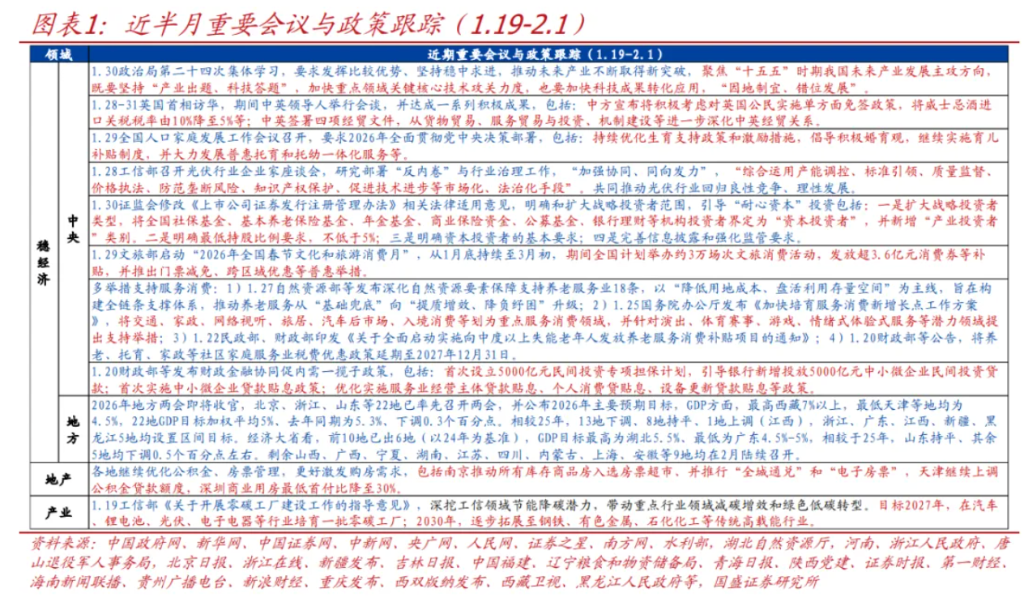
证券研究报告 | 宏观研究 gszqdatemark 2026 02 02 年 月 日 宏观点评 政策半月观—力争"开门红",还有哪些政策可期? 我们定期对每半月重大政策进行跟踪:1)中央、部委重要会议与政策; 2)地方政策;3)行业与产业政策。本期为近半月(1.19-2.1)综述。 核心结论:总体看,近半月政策推动 2026 年"开门红"多聚焦扩内需, 具体有 6 大焦点:一是 1.28-31 英国首相访华,期间中英领导人举行会 谈,并达成一系列积极成果(对英单方面免签、降低威士忌酒进口关税 率等);二是多举措支持服务消费,包括深化自然资源要素保障支持养 老服务业 18 条,《加快培育服务消费新增长点工作方案》出炉(将交通、 家政、网络视听、旅居、汽车后市场、入境消费等划为重点领域),向中 度以上失能老年人发放养老服务消费补贴项目,养老、托育、家政等社 区家庭服务业税费优惠政策延期等;三是 1.29 文旅部启动"2026 年全 国春节文化和旅游消费月",从 1 月底持续至 3 月初,期间计划举办约 3 万场次文旅消费活动、发放超 3.6 亿元消费券等补贴,并推出门票减 免、跨区域优惠等普惠举措;四是 1.2 ...
第一观察 | 开局之年中央政治局首次集体学习聚焦未来产业发展
Xin Hua She· 2026-02-02 11:29
Core Insights - The central message emphasizes the importance of cultivating and developing future industries to seize technological and industrial advantages, enhance productivity, and improve the quality of life for citizens [2][3]. Group 1: Future Industry Development - Future industries are characterized by being driven by cutting-edge technologies and are seen as strategic, forward-looking, and disruptive [1]. - Key areas identified for development include quantum technology, biomanufacturing, hydrogen and nuclear fusion energy, brain-computer interfaces, embodied intelligence, and sixth-generation mobile communications [1]. - The contribution of the industrial and information sectors to China's economic growth is projected to exceed 40% by 2025, with over 6,000 AI companies and biomanufacturing evolving into a trillion-dollar industry [2]. Group 2: Strategic Planning and Coordination - A scientific and comprehensive approach is required for planning future industries, focusing on national strategic needs, technological maturity, and resource support [3]. - Emphasis is placed on avoiding a rush into future industries without proper integration with traditional and emerging sectors, promoting continuous industrial convergence [3]. Group 3: Innovation and Technology Integration - The speed and depth of future industry development are significantly influenced by technological breakthroughs, necessitating seamless integration between innovation and industry [4]. - The government is urged to enhance support for key technological advancements and accelerate the application of scientific achievements [4]. Group 4: Role of Enterprises - Enterprises are recognized as the main drivers of innovation, and there is a call to create an ecosystem centered around businesses to foster collaboration and resource aggregation [5]. - The development of leading technology enterprises and support for specialized small and medium-sized enterprises are crucial for advancing industries towards high-end sectors [5]. Group 5: Support and Governance - The cultivation of future industries involves long cycles and significant market risks, requiring government support and a robust governance framework [6]. - Policies related to finance, talent development, and effective regulatory measures are essential to ensure a balance between flexibility and control in the industry [6].
国盛证券:力争“开门红”,还有哪些政策可期?
Xuan Gu Bao· 2026-02-02 09:08
Core Viewpoint - Recent policies are focused on expanding domestic demand to achieve a "good start" for 2026, with six major focal points identified [1][2] Group 1: Major Policies - The UK Prime Minister's visit to China resulted in several positive outcomes, including visa exemptions and reduced import tariffs on whiskey [2][11][12] - Multiple measures to support service consumption were introduced, including a plan to issue subsidies for elderly care services and tax incentives for community service industries [2][21][26] - The Ministry of Finance announced a package of policies to promote domestic demand, including a 500 billion yuan special guarantee plan for private investment and interest subsidies for small and micro enterprises [2][27] - The China Securities Regulatory Commission (CSRC) revised regulations to attract "patient capital" by expanding the types of strategic investors and setting minimum shareholding requirements [2][19] - The local governments are entering the two sessions period, with an average GDP target of 5% across 22 regions, reflecting a slight decrease from the previous year [2][28] Group 2: Local Policies - Local two sessions are concluding, with 22 regions announcing their GDP targets, showing an average target of 5%, down 0.3 percentage points from last year [2][28] - Economic provinces have set varied GDP targets, with the highest being 5.5% for Hubei and the lowest being 4.5% for Guangdong [2][29] Group 3: Industry Policies - Various regions are optimizing housing fund and housing ticket management to stimulate housing demand, with initiatives like electronic housing tickets and increased loan limits [2][30][31] - The Ministry of Industry and Information Technology issued guidelines for the construction of zero-carbon factories, aiming to promote energy-saving and carbon reduction in key industries by 2027 [2][30]


东海证券晨会纪要-20260202
Donghai Securities· 2026-02-02 07:24
Group 1 - The report emphasizes the importance of seizing opportunities in cyclical industries from price expectations to performance realization, particularly focusing on the relationship between commodities and US Treasury yields [5][7] - In the week ending January 30, 2026, global stock markets showed mixed results, with Hong Kong and the UK markets leading gains, while major commodity futures like crude oil saw significant increases [5][6] - The report highlights that the manufacturing PMI for January 2026 fell to 49.3%, down from 50.1% in December, indicating a contraction influenced by the upcoming Spring Festival and a high base effect from the previous month [10][11] Group 2 - The report discusses the correlation between commodity prices and US Treasury yields, noting that during different economic phases, their relationship varies, particularly at economic turning points [8][9] - The January PMI data indicates a decline in both manufacturing and non-manufacturing sectors, with the manufacturing PMI reflecting a drop due to seasonal factors and high base effects [10][12] - The report outlines new regulations from the China Securities Regulatory Commission aimed at standardizing public fund performance benchmarks, which will take effect on March 1, 2026, to protect long-term investor interests [14][15] Group 3 - The report notes that the high-tech and midstream equipment manufacturing sectors remain above the prosperity line, while downstream consumer goods manufacturing has not sustained its previous strength, reflecting weak domestic demand [11][13] - The report indicates that the service sector's PMI also showed weakness, particularly in the real estate sector, which has seen a significant decline, impacting overall confidence [12][13] - The report suggests that the new regulations will enhance transparency and accountability in fund management, thereby improving investor trust and decision-making [17][18]

基建ETF(159619)收跌超3%,产业变革催生转型机遇,回调或可布局
Mei Ri Jing Ji Xin Wen· 2026-02-02 07:20
Core Viewpoint - The infrastructure ETF (159619) has seen a decline of over 3%, but the ongoing industrial transformation presents opportunities for strategic repositioning, suggesting that this pullback may be a good time for investment [1] Group 1: Industry Trends - The upcoming era of industrial transformation is emphasized, highlighting the importance of construction companies' cross-industry transformation opportunities [1] - There is a notable increase in net financing from special bonds, with a total of 308.6 billion yuan as of January 30, which is higher than the same period in the past three years [1] - Key construction companies are showing signs of stabilizing and recovering in new order contracts as of Q4 2025, indicating potential acceleration in capital expenditures from major engineering and industrial firms [1] Group 2: Market Performance - The infrastructure ETF (159619) tracks the CSI Infrastructure Index (930608), which includes listed companies involved in infrastructure construction, professional engineering, and building decoration [1] - The market share of leading construction companies is gradually increasing, supported by favorable policies that are expected to continue [1] - There is a positive outlook for the bottom rebound opportunities of leading cyclical companies in the current market environment [1]
政策仍在“等待期”——政策周观察第66期
一瑜中的· 2026-02-02 07:13
Group 1: Central Government Policies - The central government has focused on several key areas, including diplomacy, anti-corruption, industry regulation, and capital markets [2][3] - The Ministry of Industry and Information Technology emphasized the need to combat "involution" in the photovoltaic industry, advocating for capacity control and other measures to ensure healthy competition [2][3] - The National Development and Reform Commission announced improvements to the capacity pricing mechanism for coal, gas, and pumped storage power generation, including the establishment of a new pricing mechanism for independent energy storage [2][3] Group 2: Key Meetings and Events - The Politburo of the Communist Party held a meeting to discuss the strategic direction for future industrial development, emphasizing the importance of innovation and collaboration among industries [8] - The State Council held a meeting on anti-corruption, highlighting the ongoing challenges and the need for a strong stance against corruption to achieve the goals set for the 14th Five-Year Plan [8] - The China Securities Regulatory Commission convened a meeting to discuss the "14th Five-Year Plan" for the capital market, focusing on risk prevention and promoting high-quality development [13][14] Group 3: State-Owned Enterprises Reform - The State-owned Assets Supervision and Administration Commission outlined plans for the restructuring and strategic integration of central enterprises, aiming to enhance their role in national security and public service [11] - The focus will be on promoting high-quality mergers and acquisitions to secure core resources and technological advantages [11] - The government aims to reduce industry involution by supporting strong innovative enterprises in horizontal and vertical integration [11] Group 4: Industry-Specific Developments - The photovoltaic industry is facing challenges related to excessive competition, prompting the government to call for regulatory measures to restore rational development [12] - The Ministry of Commerce indicated a willingness to engage in new rounds of economic negotiations with the U.S. ahead of a potential leaders' meeting [13] - The National Development and Reform Commission's new pricing mechanism aims to enhance the participation of energy storage in the electricity market, promoting fair competition [15]

股指关注美元指数,债市或震荡运行
Chang Jiang Qi Huo· 2026-02-02 06:07
股指关注美元指数,债市 或震荡运行 2026-02-02 长江期货股份有限公司交易咨询业务资格:鄂证监期货字[2014]1号 长江期货股份有限公司研究咨询部 研究员:张志恒 执业编号:F03102085 投资咨询号:Z0021210 01 金融期货策略建议 目 录 重点数据跟踪 02 01 金融期货策略建议 资料来源:iFinD、长江期货 p 国债走势回顾:30年期主力合约跌0.23%,10年期主力合约涨0.06%,5年期主力合约涨0.01%,2年期 主力合约持平。 p 核心观点:《求是》杂志发表习近平总书记重要文章《走好中国特色金融发展之路,建设金融强国》。习近 平:发挥比较优势,坚持稳中求进,推动我国未来产业发展不断取得新突破。目前债市无显性重大利空,债 市总体上震荡偏多。但暂无更进一步推动利率下行的动力,经过年初以来的修复之后,配置盘可能已经建立 不少仓位。在当前位置上,如果不能吸引更多配置资金入场,债券收益率下方空间恐怕相当有限,债市可能 在一个相对比较窄的区间横盘,等待下一阶段主线的产生。国债或震荡运行。 p 技术分析:MACD指标显示T主力合约或震荡运行。 p 策略展望:震荡运行。 p 风险提示: ...
政策周观察第66期:政策仍在等待期
Huachuang Securities· 2026-02-02 04:51
证 券 研 究 报 告 【宏观快评】 ❖ 近一周,中央层面政策出台不多,主要关注以下内容: 1、外交:1 月 29 日,商务部召开例行发布会,有记者提问"美国贸易代表日 前在达沃斯向记者表示,在可能于 4 月举行的中美领导人会晤之前,中美双 方有机会开启新一轮经贸谈判"。 2、反腐:1 月 27 日,总理在国务院第四次廉政工作会议上指出,深刻理解和 把握管党治党越往后越严、一严到底的鲜明立场,树立和践行正确政绩观。 3、产业:一是光伏反内卷。1 月 28 日,工信部部长召开光伏行业企业家座谈 会,提出当前形势下,"反内卷"是光伏行业规范治理的主要矛盾,要求综合运 用产能控制等手段坚决破除行业内卷式竞争。二是发电侧容量电价改革。1 月 30 日,国家发改委等引发通知,对现行煤电、气电、抽水蓄能容量电价机制 进行了完善,并首次在国家层面明确建立电网侧独立新型储能容量电价机制。 4、资本市场:1 月 30 日,证监会召开资本市场"十五五"规划上市公司座谈会, 吴清主席在会上提出,高质量编制和实施好资本市场"十五五"规划,全力巩 固资本市场稳中向好势头,聚焦持续深化资本市场投融资综合改革、提高制度 包容性适应性,抓紧 ...
面向“十五五”完善上海未来产业发展政策的对策建议
Guo Ji Jin Rong Bao· 2026-02-02 04:45
Core Insights - Shanghai's strategic focus on future industries during the "14th Five-Year Plan" period aims to enhance its global competitiveness in technology and industry, while improving its core functions as an international economic, financial, trade, shipping, and innovation center [1] Group 1: Current Development and Characteristics of Future Industries - Shanghai ranks second nationally with 14,281 high-potential future industry enterprises, following Beijing's 27,788, indicating a robust foundation for cultivating high-quality, specialized market entities [2] - The enterprise ecosystem in Shanghai is characterized by a "specialized and steady" development pattern, with 136 listed companies, 594 high-tech enterprises, and 25 unicorns, highlighting the need for stronger top-tier enterprises [2] - A multi-node networked spatial layout has emerged, with various districts specializing in different sectors, such as biomedicine in Fengxian and artificial intelligence in Pudong, creating a collaborative development environment [3] Group 2: Core Industry Matrix and Competitive Strength - Shanghai has established a competitive matrix in five key future industries: artificial intelligence, synthetic biology, energy storage technology, new materials, and deep-sea exploration, with significant advancements in patents and market activity [4] Group 3: Challenges and Bottlenecks in Development - Key challenges include a lack of collaborative platforms for industry chains (50% of enterprises) and difficulties in market promotion (48.67%), indicating inefficiencies in cross-enterprise collaboration and market access for new technologies [5] - Talent acquisition faces significant pressure, with 71.33% of enterprises citing high salary costs as a major issue, alongside a 56.67% shortage in the quantity and quality of talent [6][7] - Innovation is hindered by difficulties in accessing critical resources (53.33%) and a lack of supportive trial scenarios (52%), reflecting weaknesses in the support system for transitioning from research to commercialization [8] Group 4: Recommendations for Policy Improvement - Strengthening top-level design and global vision is essential, with a focus on regional collaboration and a differentiated layout to enhance Shanghai's role in the Yangtze River Delta [9] - Establishing an open digital collaboration platform to improve industry chain resilience and cooperation is crucial, leveraging new technologies for data sharing and collaboration [11][12] - Implementing a "nuclear explosion" special attack plan targeting major breakthroughs in key areas, supported by a resource-sharing platform among enterprises and research institutions, is recommended [14]