货币贬值

Search documents
黄金已经涨疯了,接下来你能做些什么?
Sou Hu Cai Jing· 2025-10-14 20:57
- 299 - 2 a All Reportation on The Children 刚过去的"黄金周",这次成了真正的"黄金"周。 黄金的警告:为何金价一路狂飙? 黄金从来不只是商品,它是全球经济和政治的晴雨表。 10月8日,国际金价一举突破4000美元/盎司大关,最高触及4081美元,创下历史新高。 看着这闪亮的数字,我想起美国经济学家彼得·伯恩斯坦的那句名言:"黄金被选为货币,并非因为其光泽,而是因为它诚实。" 当然,国内足金饰品价格也随之飙升,周大福、周大生等品牌的足金首饰价格已达1168元/克,较9月30日上涨45元/克。 无数抱着"等等看"心态的消费者傻眼了——去年还在犹豫每克500多的价格,转眼间就已高不可攀。 一位在深圳水贝采购金饰的顾客分享道,她曾因金价高反对儿子买20克金手串,没想到儿子购入短短20天竟升值900多元。 黄金的保值能力,再次让人惊叹。 而更多的人看到金价飙升,才发现手里的资产如此脆弱。 在当今这个充满不确定性的世界里,黄金似乎正在用它耀眼的光芒,向我们揭示某些不容忽视的真相。 这次金价暴涨,表面上是市场供需变化,背后却是多重因素共同作用的结果。理解这些,才能明白我们正处在 ...


黄金破4160、白银破53 贵金属双双缔造历史
Jin Tou Wang· 2025-10-14 08:11
Group 1 - Precious metals continue to rise, with spot gold reaching $4,060 and silver surpassing $50.80, driven by historical short squeezes and trade tensions [1] - Gold has increased over 50% this year, recently breaking through the historical high of $4,100 per ounce, while silver also set new records [1] - As of Wednesday morning, spot gold climbed to $4,160 per ounce, with a year-to-date increase exceeding $1,500, and silver breaking the $53 per ounce mark [1] Group 2 - Significant capital migration from currency and government bonds to alternative assets is observed, indicating a potential shift in investment strategies [2] - The status of U.S. Treasury bonds as a safe haven asset is declining, with prominent investors suggesting gold may be a more reliable option [2] - Concerns about rising U.S. deficits are highlighted, with warnings of a looming debt crisis, reflecting a broader loss of government credibility [2] Group 3 - The domestic gold market shows a strong upward trend, with prices reaching approximately 948 for Shanghai gold and 943 for Rongtong gold, with expectations of hitting 950 [4] - Shanghai silver has reached a high of 12,000, maintaining a bullish outlook, with support levels identified between 11,600 and 11,500 [4] - Current trading strategies suggest either entering long positions or maintaining a wait-and-see approach, depending on market adjustments [4]
DeepTalk:“操控者”被击溃!国际现货金银已登上“失控列车”
Jin Shi Shu Ju· 2025-10-13 12:54
Core Insights - Precious metals, particularly gold and silver, are experiencing significant price increases, with gold surpassing $4000 and silver exceeding $50 per ounce, marking historical highs since the Hunt brothers attempted to corner the silver market [3][4][5] - The demand from institutions and nations is influencing prices, while the short-selling pressure on gold and silver is diminishing, indicating a shift in market dynamics [4][5] - There are alarming signs of a global silver shortage, with reports of supply disruptions from mints in Canada and South Africa, suggesting a potential crisis in precious metal availability [5][6] Market Dynamics - The reduction of short positions by major banks in silver contracts by 50% from July to August indicates a weakening of the forces that have historically suppressed silver prices [5][6] - The potential for extreme price volatility in silver is predicted, with daily fluctuations of $5 to $20 becoming possible as the market transitions into a new phase of price discovery [7][8] - The recent speech by Federal Reserve Chair Jerome Powell is seen as a catalyst for the surge in precious metal prices, suggesting that monetary policy changes are driving market behavior [6][7] Economic Implications - The current trends in precious metals reflect deeper issues within the global monetary system, with the dollar losing significant purchasing power, estimated at 99.34% [6][8] - Predictions suggest that gold could reach prices between $13,000 and $30,000 per ounce as the monetary system undergoes reevaluation, indicating a potential systemic collapse [7][8] - The potential for hyperinflation similar to that experienced in Venezuela and Argentina is highlighted, with significant implications for the value of currencies and precious metals [7][8] Investment Considerations - Investors are advised to consider precious metals as a hedge against inflation and economic uncertainty, as historical trends show that physical assets tend to retain value in depreciating currency environments [8] - The volatility in the market is expected to be severe, necessitating preparedness for short-term corrections and significant price swings [8] - The current environment may represent a historical turning point, requiring a reevaluation of traditional investment strategies and perceptions of value [8]

机构看金市:10月13日
Xin Hua Cai Jing· 2025-10-13 07:34
Core Viewpoint - The precious metals market is experiencing increased support due to rising risk aversion driven by geopolitical tensions, economic uncertainties, and challenges to the traditional financial system [1][2][3]. Group 1: Market Dynamics - The U.S. government shutdown and economic uncertainties are contributing to a heightened demand for safe-haven assets like gold and silver [2]. - Geopolitical risks, including tensions in Gaza and border conflicts in Pakistan and Afghanistan, are further supporting the demand for precious metals [2]. - Central banks are continuously increasing their gold reserves, reflecting a growing recognition of gold as a safe-haven and store of value [1]. Group 2: Price Predictions - Analysts from Canadian Imperial Bank of Commerce predict gold prices will rise to $4,500 per ounce in 2026 and 2027, before declining to $4,250 in 2028 and $4,000 in 2029 [3]. - The recent surge in gold prices is attributed to concerns over long-term inflation and currency devaluation, with the Federal Reserve's policies being scrutinized [3]. - The overall outlook for precious metals remains strong, with expectations of continued price support amid ongoing geopolitical and economic challenges [2][3].
黄金飙升背后的逻辑,美债并不认可?
Hua Er Jie Jian Wen· 2025-10-11 02:33
Core Viewpoint - The current market is experiencing a divergence in asset pricing, particularly between gold and U.S. Treasury bonds, driven by differing expectations regarding inflation and economic policy responses [1][2][9]. Group 1: Market Dynamics - Gold prices have surged by 51% over the past 12 months, surpassing $4000, while the U.S. dollar has depreciated by over 10% against a basket of major currencies [4][5]. - The concept of "devaluation trade" has gained traction, where investors bet on government-induced inflation to alleviate rising debt burdens, leading to increased demand for hard assets like gold and stocks [5][6]. - The U.S. debt-to-GDP ratio has risen from 96% in 2020 to 98% in 2023, raising concerns about future inflation as a means to manage debt [5]. Group 2: Inflation Expectations - The long-term inflation expectations in the U.S. bond market remain stable, with key indicators like the five-year, five-year forward breakeven inflation rate close to the Federal Reserve's 2% target [7][8]. - This stability suggests that bond investors do not foresee runaway inflation, contrasting sharply with the bullish sentiment in the gold market [6][8]. Group 3: Divergence in Economic Signals - The market is currently divided on which economic signals will dominate Federal Reserve decisions—whether to cut rates in response to potential recession or tighten policies to combat inflation [2][10]. - The stock market's rise is attributed more to optimism surrounding AI technology and its potential to drive strong growth with moderate inflation, rather than solely as a hedge against inflation [9]. - The conflicting macroeconomic data, with signs of a slowing job market and strong growth, creates uncertainty about the Fed's future actions [9][10].
黄金大涨与普通人没有太大的关系 :不要过分解读
Sou Hu Cai Jing· 2025-10-09 03:28
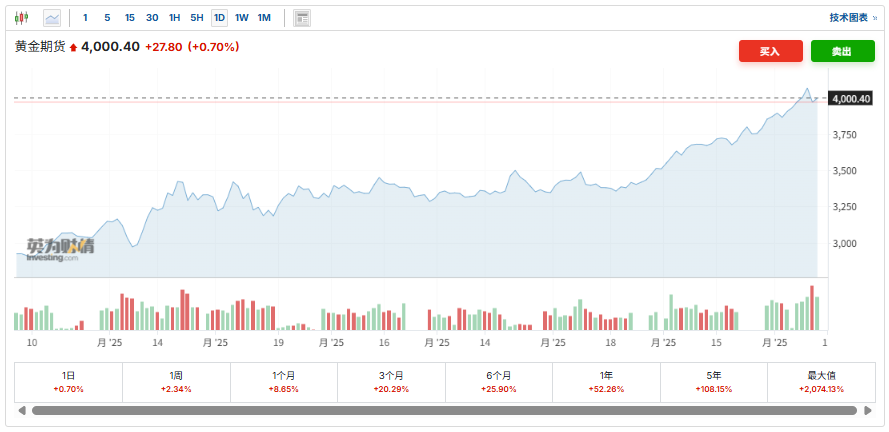
Group 1 - The core viewpoint is that the price of gold has increased significantly, with a nearly 45% rise since 2025, driven by various factors including central bank purchases and inflation expectations [2][6] - The trend of global currency depreciation is seen as inevitable, with experts advocating for the issuance of long-term special government bonds to manage debt [4][6] - Geopolitical instability, particularly the tensions between the US and China, is contributing to increased demand for gold as a safe-haven asset [6] Group 2 - Ordinary individuals are generally not purchasing gold for investment due to the volatility and the speculative nature of short-term trading, which is more suited for wealthier investors [9] - The long-term outlook for gold remains positive, as depreciation of currency is expected to drive its value higher over time [6][9]
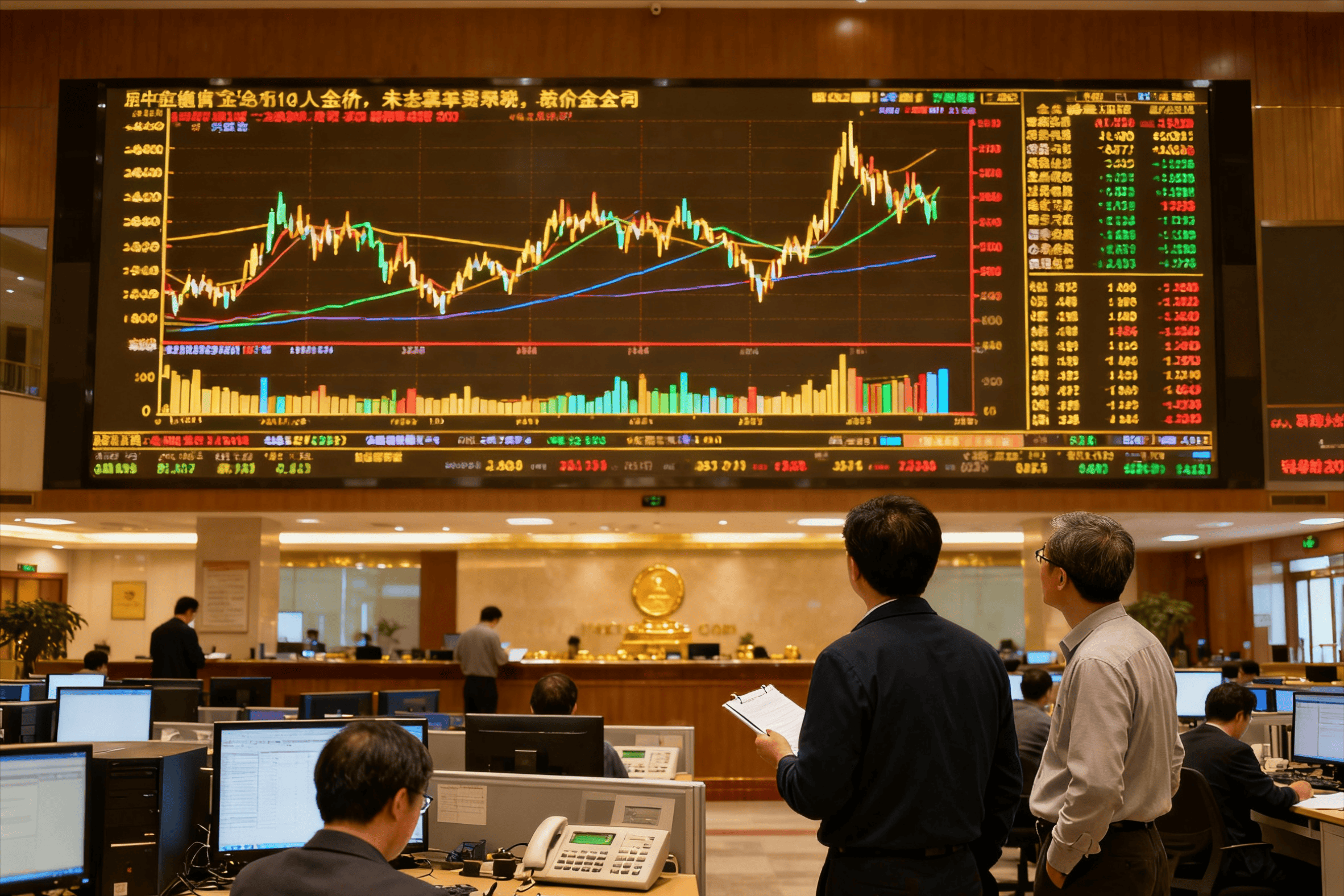
Chart Master: Charting gold's record run
Youtube· 2025-10-08 21:53
Carter Worth of Worth Charting joining us now. It was a great call, Carter. Congrats to you.The anybody who listened to you now, what do you see. Well, first very kind. I got duds around the world, but uh so far so good.Good call. But now what. Right.Only as good as your last trade. Um gold, this is the the setup, right. Gold converging trend lines worked into that symmetrical triangle.And then of course, if you look at the next chart, we have this massive breakout uh since July. So the pattern is resolved. ...
今年以来巴西雷亚尔上涨16%,升值幅度居全球第五
Shang Wu Bu Wang Zhan· 2025-10-08 17:28
Core Insights - The Brazilian real has appreciated by 16.18% against the US dollar year-to-date as of September 17, making it the fifth strongest currency globally [1] - The depreciation of the US dollar is attributed to investor skepticism regarding President Trump's economic policies [1] - Among 33 global currencies, only four have depreciated, with the Russian ruble, Hungarian forint, and Swedish krona leading in appreciation [1] Currency Performance - The Brazilian real's nominal appreciation of 16.18% ranks fifth globally [1] - The top three appreciating currencies are: - Russian ruble (+36.6%) - Hungarian forint (+19.96%) - Swedish krona (+18.29%) [1] - The currencies with the largest depreciation include: - Argentine peso (-30.05%) - Turkish lira (-14.45%) - Indian rupee (-2.98%) [1]
黄金股市齐创新高,本轮“泡沫”该如何交易?
Hua Er Jie Jian Wen· 2025-09-22 13:36
Core Viewpoint - The Federal Reserve is initiating interest rate cuts, leading to a surge in global asset prices and entering a bubble period driven by loose monetary policy [1] Group 1: Market Performance - As of September 22, gold has risen 35.4% year-to-date, Bitcoin is up 17.2%, and global stock markets have increased by 14.3%. High-yield bonds and investment-grade bonds have recorded returns of 8.5% and 8.3%, respectively [1] - In contrast, the US dollar index and oil prices have decreased by 9.3% and 11.4%, respectively [1] Group 2: Economic Environment - Michael Hartnett from Bank of America highlights that tariff cuts, tax reductions, and interest rate cuts create a "run-it-hot" policy environment, providing implicit "too big to fail" guarantees for the economy and stock market [1] - Despite evident bubble signs, Hartnett suggests that the market may not have peaked yet [1] Group 3: Trading Strategies - Hartnett proposes five trading strategies to navigate the current market conditions: 1. Go long on core bubble assets 2. Build a "barbell" portfolio with bubble assets on one end and cheap value stocks on the other 3. Short corporate bonds of bubble companies 4. Short US bonds 5. Go long on bond volatility and short stock volatility [1][6][11] Group 4: Historical Context - Historical analysis shows that from 1900, the average rise from market lows to peaks in 10 major bubbles was 244%, with an average peak dynamic P/E ratio of 58 times [4] - The "Magnificent Seven" tech stocks have risen 223% since their March 2023 lows, with a dynamic P/E ratio of 39 times, indicating potential for further upside [4] Group 5: Market Sentiment - Goldman Sachs trader Paolo Schiavone notes a prevailing market sentiment that favors consumption or investment over holding cash due to perceived currency devaluation, driving funds into risk assets [3] - Fund managers are compelled to chase high-risk, high-beta investments to keep up with market benchmarks as year-end bonuses approach [3] Group 6: Global Opportunities - The ongoing weakness of the US dollar presents opportunities in international markets, with a theme of "global rebalancing" emerging in the latter half of the 2020s [9] - A notable correlation between the Japanese yen and the Japanese stock market suggests a potential bull market in Japan, as both are moving in tandem [9]