贸易战

Search documents
有中企向美国转移生产线,特朗普的阴招见效了?事实出乎你的预料
Sou Hu Cai Jing· 2025-05-05 10:02
Core Viewpoint - The article discusses the impact of Trump's tariffs on Chinese companies, suggesting that some are relocating production lines to the U.S., but the significance and implications of this trend are questioned [3][5]. Group 1: Production Line Relocation - Some Chinese companies, including low-tech manufacturers, are reportedly moving production lines to the U.S. in response to tariffs [3]. - The types of companies involved in this relocation are primarily those with low technological content, such as gift manufacturers and small electronic assembly plants [3]. - The article argues that this relocation is more about the elimination of outdated capacity rather than a significant shift in the industry [3]. Group 2: U.S. Industry Dynamics - The U.S. is shifting its export structure towards Russia and its acceptance of industrial transfers towards Southeast Asia, which does not pose a significant threat to China [5]. - Historical attempts by various U.S. administrations to bring global supply chains back to America have faced challenges, with companies like TSMC struggling to achieve profitability in U.S. operations [5][6]. - TSMC's Arizona plant has reported losses exceeding $3 billion, highlighting the difficulties of establishing manufacturing in the U.S. [6]. Group 3: Future Implications - The article suggests that while some Chinese companies may consider relocating due to pressure, the long-term viability of such moves is questionable given the current state of U.S. manufacturing capabilities [8]. - The narrative of companies relocating may serve as a "negative example" to illustrate the complexities of the trade war between China and the U.S. [8].


五一长假结束后的新一周,也是美国人将感受到特朗普再次伟大的新一周
Sou Hu Cai Jing· 2025-05-05 09:35
Group 1 - The trade war is impacting the U.S. consumer market as new tariffs on hundreds of billions of dollars' worth of goods will increase retail prices [1] - The resumption of federal student loan repayments will affect 5 million borrowers, leading to immediate wage garnishments and tax refund intercepts [1] - A wave of layoffs is anticipated in the U.S. port and freight industries due to reduced orders from importers seeking to avoid tariffs, resulting in a significant drop in container throughput [1] Group 2 - The federal government is experiencing a growing wave of layoffs, with thousands of positions already cut across various agencies, including postal and agricultural departments [1] - The underground labor market is expanding as the Department of Homeland Security and ICE are enforcing stricter immigration policies, impacting industries reliant on low-wage workers [1] - Inflation and rising unemployment are creating a stagflation scenario in the U.S., complicating monetary policy for the Federal Reserve [2]

中美差距又扩大!一季度中国GDP跌至美国60%左右,究竟是什么原因
Sou Hu Cai Jing· 2025-05-05 09:06
Economic Overview - China's GDP for the first quarter reached 31 trillion yuan, approximately 60% of the United States' GDP of 53.22 trillion yuan [1][6] - Despite global economic challenges, China's GDP grew by 5.4% year-on-year, surpassing last year's growth by 0.1 percentage points [6][13] Consumption and Investment - Consumer spending contributed 2.8 percentage points to economic growth, indicating strong market activity [8] - Industrial production also played a role, adding 0.5 percentage points to GDP growth [8] Export Performance - In March, China's export growth surged to 13.5%, driven by businesses rushing to ship goods before tariffs took effect [10] - The trade surplus with the U.S. reached 76.6 billion USD, showcasing the resilience and adaptability of Chinese businesses [10] Manufacturing and Industrial Growth - China's manufacturing sector is shifting from low-value products to high-value items like drones and solar panels, achieving a growth rate of 9.7% [13] - Investment data, excluding real estate, showed an 8.3% increase, indicating a robust industrial base [13] U.S. Economic Challenges - The U.S. GDP figure appears inflated, with underlying issues such as a 0.3% quarter-on-quarter contraction and rising inflation affecting consumer purchasing power [15][19] - The U.S. faces a crisis of hollowed-out industries and high debt levels, raising questions about the sustainability of its economic growth [21] Trade War Dynamics - The trade war initiated by the U.S. has led to a strategic economic confrontation, with China leveraging its large domestic market and comprehensive industrial chain [22][24] - China's consumer market saw a 5.6% growth in retail sales, supported by government incentives to stimulate consumption [22][24] Technological and Energy Transition - China is advancing in sectors like photovoltaics, lithium batteries, and new energy vehicles, positioning itself as a leader in the global market [26] - The U.S. struggles with manufacturing challenges, as seen in Intel's budget overruns and slow construction progress in Ohio [26][28] Regional Trade Shifts - In response to U.S. trade barriers, China has increased exports to ASEAN countries at a rate three times faster than to the U.S. [28] - China's policy toolbox remains robust, with initiatives like rural revitalization and new infrastructure projects yet to be fully utilized [28]
金晟富:5.5黄金独家看涨符合预期!晚间黄金分析及操作
Sou Hu Cai Jing· 2025-05-05 09:06
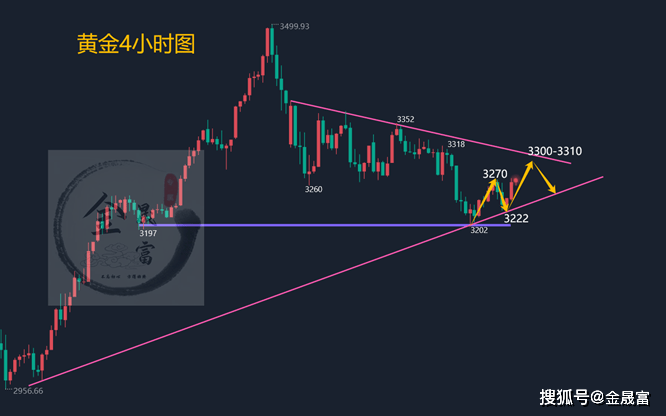
近期有哪些消息面影响黄金原油走势?后市黄金多空该如何研判? 周一(5月5日)欧市早盘,现货黄金维持日内反弹走势,目前金价位于3265美元/盎司附近,日内上涨逾25 美元。归因于贸易不确定性和美联储决议前的仓位调整,美元重回跌势。黄金买家大举回归,金价目标 瞄准3300美元/盎司。作为传统避险资产的黄金价格也受到中东地缘政治紧张局势加剧以及俄罗斯和乌 克兰之间紧张局势的支撑。本交易日,投资者将聚焦美国4月ISM非制造业PMI,预计这一重量级将引 发市场大行情。美国4月ISM非制造业PMI将提供有关特朗普宣布关税后企业行为的更多见解。该数据 预计将进一步下滑,反映出在贸易政策不确定性的情况下,企业越来越谨慎。 基本面上,美国彭博社周一报道称,美国总统特朗普计划对所有海外制作的电影征收100%的关税,从 而升级了贸易战。特朗普在其社交平台Truth Social上写道:"我授权商务部和美国贸易代表立即启动程 序,对所有在国外制作的进入美国的电影征收100%的关税。我们要让电影重新在美国拍摄!虽然,上 周五公布的非农等数据,整体好于预期,美国3月工厂订单月率也明显高于前值,显示经济仍显健康, 这减弱了此前公布的美国一 ...
美元失血引发汇市震荡 亚洲货币集体暴走
智通财经网· 2025-05-05 08:34
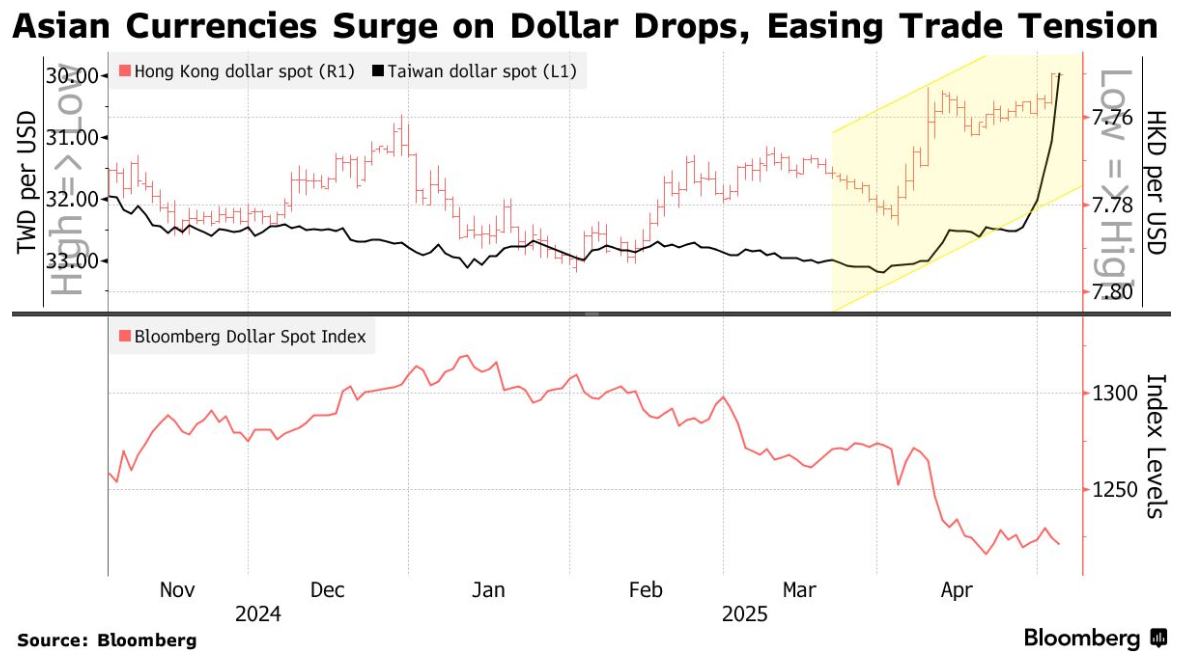
Group 1 - Asian currencies experienced significant appreciation, negatively impacting exporters and putting pressure on stock markets, prompting central banks to intervene [1][3] - The New Taiwan Dollar saw its largest increase since 1988, leading to the biggest drop in Taiwan's benchmark stock index in nearly a month [1][3] - The offshore Renminbi reached its highest level in nearly six months as exporters repatriated dollar earnings [1][3] Group 2 - The Bloomberg index measuring Asian currencies recorded its largest increase since 2022, while an index for emerging market currency returns hit an all-time high [3] - The New Taiwan Dollar surged approximately 5%, driven by speculation that exporters and retailers were selling dollars amid expectations of further dollar depreciation [3] - Taiwan's monetary authorities intervened in the market, urging foreign investors and large exporters to delay dollar sales [3][4] Group 3 - Traders are closely monitoring potential further currency interventions, especially after the Hong Kong dollar tested the strong end of its trading range against the US dollar [4] - The appreciation of Asian currencies is also driven by investors withdrawing funds from the US dollar, amid concerns over Trump's tariffs potentially raising inflation and harming the economy [4] - Analysts suggest that due to the pressure on the US dollar and rising recession risks, the risk-reward profile for maintaining dollar deposits appears unfavorable for Asian exporters [4]
闫瑞祥:黄金与欧美日线阻力之下,空头能否掌控全局?
Sou Hu Cai Jing· 2025-05-05 06:59
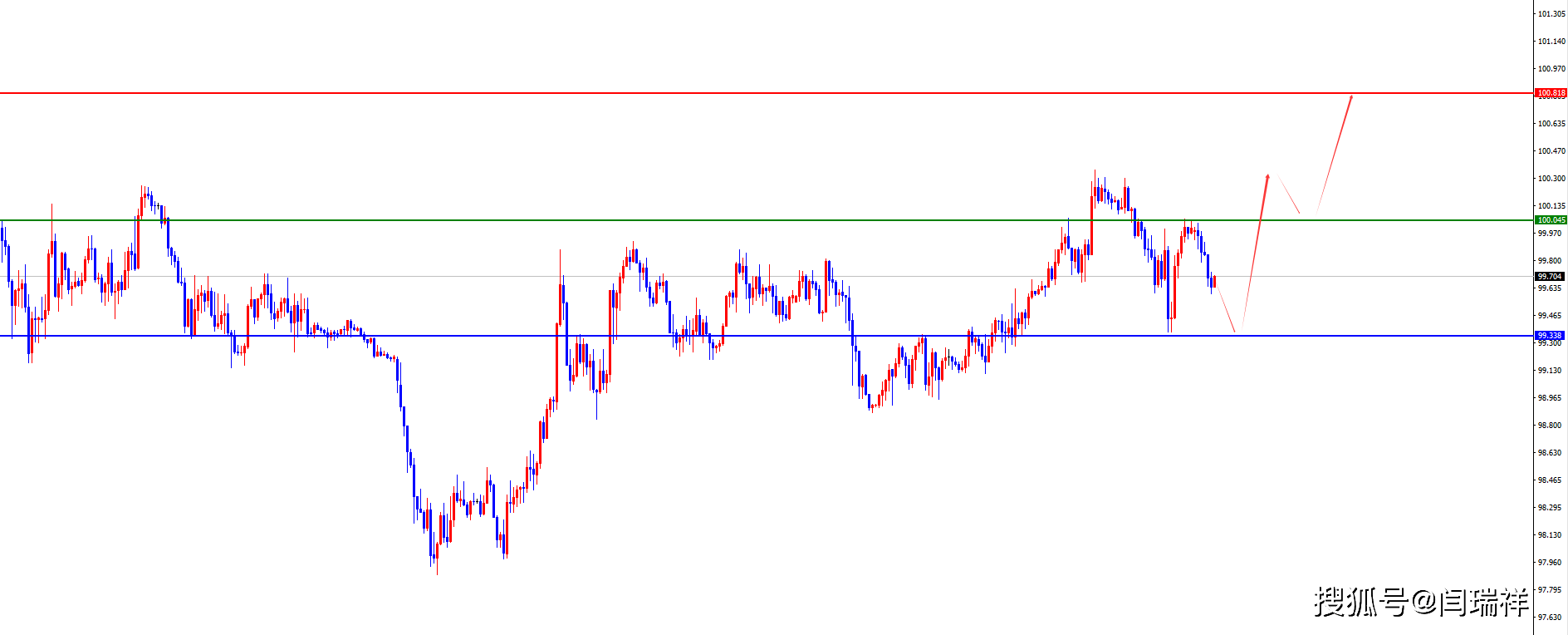
Macroeconomic Overview - Trump's administration has significantly impacted both the US and global situations, with economic turbulence reflected in the decline of the S&P 500 index and the US dollar index, alongside volatility in the US bond market [1] - The US economy shows weakness across multiple sectors, with Trump attributing these issues to Biden's term, asserting that economic recovery is forthcoming [1] - Domestic challenges include calls for new tax reform and a looming trade war, with the Republican Party facing difficulties ahead of the midterm elections [1] - Internationally, trade negotiations with Europe and Japan are progressing slowly, while discussions with China regarding tariffs are ongoing, with China demanding sincerity from the US [1] - Geopolitical tensions include a potential ceasefire in the Russia-Ukraine conflict, a mineral agreement between the US and Ukraine, strained US-Iran relations, and a shift in Saudi policies [1] - Upcoming decisions from the Federal Reserve and the Bank of England are anticipated, with expectations for the Fed to maintain interest rates and the Bank of England to cut rates, contributing to uncertainty in the US economic outlook [1] US Dollar Index - The US dollar index experienced a downward trend, with a high of 100.304 and a low of 99.364, closing at 99.996 [2] - The weekly analysis indicates resistance at the 103.30 level, suggesting a bearish outlook for the dollar index in the medium term [2] - On the daily chart, the price has broken above the 99.30 resistance, indicating potential for further upward movement if it maintains above this support level [2] Gold Market - Gold prices showed volatility, reaching a high of 3269.13 and a low of 3222.59, closing at 3240.53 [4] - The monthly analysis indicates a correction after three months of gains, with a focus on market risks as May approaches [4] - The weekly support level is identified at 3070, while the key resistance level is at 3310, which will determine future price movements [4] Euro and USD Exchange Rate - The EUR/USD pair exhibited fluctuations, with a low of 1.1273 and a high of 1.1380, closing at 1.1298 [6] - Long-term analysis suggests support at 1.0800, with a continued bullish outlook despite recent price corrections [7] - Short-term trading strategies indicate a focus on the 1.1300-1.1000 support area, with potential for upward movement if this support holds [7]
贸易战无赢家:从美国青年困境看中国的大国定力与全球担当
Sou Hu Cai Jing· 2025-05-05 06:25
Group 1 - The trade war initiated by the Trump administration has resulted in significant economic repercussions for young Americans, who are now facing increased living costs and reduced consumer choices due to tariffs [3][4] - Data indicates that the poorest American households spend three times more of their income on clothing compared to wealthier families, highlighting the disproportionate impact of tariffs on low-income groups [3] - A notable shift in public opinion has occurred, with disapproval of Trump among the 18 to 29 age group rising by 14 percentage points within four months, reflecting the adverse effects of trade policies on this demographic [3][5] Group 2 - China has responded to U.S. tariffs with strategic measures, including rare earth export controls and expanding free trade agreements, demonstrating its commitment to maintaining economic stability and countering protectionism [4][6] - Chinese e-commerce platforms like Temu and Shein are effectively meeting global consumer demands, showcasing the resilience and competitiveness of China's digital economy in the face of geopolitical tensions [4][5] - The global economic contribution of China remains significant, with over 30% of global growth attributed to the country in 2023, emphasizing its role in promoting an open world economy [5][6] Group 3 - The backlash from young Americans against trade policies reflects a broader discontent with the manipulation of globalization benefits for political gain, indicating a potential shift in consumer behavior and political support [6] - The ongoing challenges in the global economy, such as climate change and technological advancements, necessitate international cooperation, particularly between major economies like the U.S. and China [6] - The narrative suggests that closing off markets will not yield future benefits, reinforcing the idea that collaboration and mutual benefit are essential for navigating economic uncertainties [6]

特朗普没想到,日本和美国的贸易谈判,主动权却掌握在中国手里?
Sou Hu Cai Jing· 2025-05-05 06:25
Core Viewpoint - Japan's strong stance against the U.S. in trade negotiations signals a shift in its economic strategy, leveraging its relationship with China as a counterbalance to U.S. pressure [2][3][4]. Group 1: Japan's Trade Position - The second round of trade talks between Japan and the U.S. ended without agreement, with Japan's Prime Minister asserting that Japan will not accept increased tariffs on automobiles [2]. - Japan's Finance Minister threatened to use its $1.13 trillion in U.S. Treasury holdings as leverage in negotiations, indicating a significant shift in Japan's approach to U.S. economic pressure [3][7]. - Japan's trade with China has been robust, with trade volume exceeding $400 billion in 2024, making China Japan's largest trading partner for 16 consecutive years [4][5]. Group 2: Economic Strategies - Japan is considering increasing exports to China, where import tariffs on cars are significantly lower than those proposed by the U.S. [5]. - Japan is accelerating negotiations for a free trade agreement with China and South Korea, capitalizing on the benefits seen from the Regional Comprehensive Economic Partnership (RCEP) [5]. - Japan's internal reports suggest that while losing the U.S. market would be challenging, losing access to the Chinese market would be catastrophic for its economy [5]. Group 3: Financial Leverage - Japan holds a significant amount of U.S. debt, and a large-scale sell-off could lead to a spike in U.S. Treasury yields, creating financial pressure on the U.S. government [7][8]. - The potential for Japan to utilize yen carry trades as a financial weapon could destabilize U.S. financial markets if Japan were to raise interest rates or strengthen the yen [8][9]. - The current geopolitical landscape, where the U.S. relies on Japan to counter China, gives Japan leverage in its negotiations with the U.S. [9]. Group 4: Global Trade Dynamics - The ongoing trade war has seen China emerge as a strategic pivot for other nations, with Japan and the EU considering similar tactics to delay U.S. demands [14][16]. - The U.S. is facing increasing isolation as allies like Japan and the EU begin to push back against its trade policies, leading to a potential weakening of U.S. economic dominance [16][18]. - Recent data indicates that while U.S. tariff revenues have increased, the trade deficit has also widened, suggesting that the current strategy may not be effective [18].

美国股债汇三者难平衡 贸易战若持续美国将迎滞胀
Sou Hu Cai Jing· 2025-05-05 05:49
Group 1 - The U.S. added 177,000 non-farm jobs in April, exceeding the expected increase of 130,000, while the unemployment rate remained stable at 4.2% [1] - Despite strong job growth, there are indications of employment pressure among U.S. residents, with many struggling to find work after being laid off [1] - The impact of Trump's trade policies is still unfolding, with significant layoffs in the federal government and potential supply chain disruptions affecting major retailers like Walmart and Target [1] Group 2 - Concerns have been raised about the reliability of U.S. economic data, which is perceived to serve Wall Street rather than reflect the realities of residents' lives [2] - Warren Buffett criticized current U.S. trade policies and highlighted the unsustainable nature of the fiscal deficit, emphasizing the risks of currency devaluation [2] - Berkshire Hathaway's cash reserves reached a record high of over $347 billion, indicating Buffett's cautious outlook on the U.S. economy [2] Group 3 - The better-than-expected non-farm data temporarily stabilized U.S. stocks, but it led to a downward adjustment in expectations for Federal Reserve rate cuts, with Goldman Sachs now predicting a cut in July instead of June [3] - Former Treasury Secretary Janet Yellen warned that Trump's tariff policies could have significant negative impacts, potentially leading the U.S. into recession [3] - There is a growing disconnect between the seemingly positive economic data and the underlying realities, suggesting that financial risks in the U.S. may need to be carefully monitored [3]
华尔街见闻早餐FM-Radio | 2025年5月5日
Hua Er Jie Jian Wen· 2025-05-04 23:02
华见早安之声 请各位听众升级为见闻最新版APP,以便成功收听以下音频。 市场概述 关税方面有更多利好消息,叠加美国非农就业强劲,缓解市场对经济的担忧,市场的风险偏好上升。 周五,美股指涨超1%,标普连涨九天,创最近21年最长连涨天数,收复"对等关税"以来所有跌幅。Meta收涨超4%,微软、英伟达、特斯拉涨超2%,周四盘 后公布财报的苹果一度跌超5%、亚马逊曾跌2%。中概指数涨超3%。 美债再下挫。非农就业报告后,美债收益率连续第二日盘中拉升超10个基点。离岸人民币一度涨超700点、涨破7.21。比特币逼近9.8万美元。 OPEC+讨论6月增产消息后,原油盘中跌超2%。 要闻 市场收报 欧美股市:道指涨1.39%,标普500指数涨1.47%,纳斯达克涨1.51%。欧洲STOXX 600指数收涨1.67%,全周累计上涨3.07%。 债市:美国10年期基准国债收益率上涨8.88个基点,报4.3064%,全周累计上涨7.30个基点。两年期美债收益率涨12.53个基点,报3.8239%,全周累计涨7.60 个基点。 付鹏说|利率、汇率、资产价格"不可能三角",普通人如何保住钱包?了解详情>> 2025年伯克希尔股东大会 ...