
产能过剩

Search documents
瓶片短纤数据日报-20251112
Guo Mao Qi Huo· 2025-11-12 07:21
Group 1: Report's Core Views - Gasoline profit and low benzene prices support PX. The gasoline crack spread has risen above $15, prompting refineries to prioritize gasoline production and reduce aromatics unit feedstock. PTA processing fees have been compressed to below 200. Industry profits are still constrained by overcapacity due to new plant commissions. Despite the end of the "Golden September and Silver October," export demand may improve under the easing of the China-US trade war. Downstream weaving has performed well recently, and the current peak season is expected to last until November. Attention should be paid to whether the reduction of China-US tariffs can further stimulate domestic exports. Bottle chips and staple fiber costs follow suit [2] Group 2: Data Summary Price and Cost Data - PTA spot price decreased from 4605 to 4600, a change of -5.00; MEG domestic price decreased from 4003 to 3981, a change of -22.00; PTA closing price decreased from 4704 to 4648, a change of -56.00; MEG closing price decreased from 3953 to 3875, a change of -78.00; 1.4D direct-spun polyester staple fiber price decreased from 6415 to 6365, a change of -50.00; short fiber basis increased from 122 to 123, a change of 1.00; 12-1 spread decreased from 44 to 56, a change of -12.00; polyester staple fiber cash flow increased from 240 to 246, a change of 6.00; 1.4D imitation large chemical fiber price remained unchanged at 5400; the price difference between 1.4D direct-spun and imitation large chemical fiber decreased from 1015 to 965, a change of -50.00; East China water bottle chip price decreased from 5760 to 5712, a change of -48.00; hot-filled polyester bottle chip price decreased from 5760 to 5712, a change of -48.00; carbonated polyester bottle chip price decreased from 5860 to 5812, a change of -48.00; foreign water bottle chip price remained unchanged at 760; bottle chip spot processing fee decreased from 482 to 445, a change of -36.35; T32S pure polyester yarn price remained unchanged at 10310; T32S pure polyester yarn processing fee increased from 3895 to 3945, a change of 50.00; polyester-cotton yarn 65/35 45S price remained unchanged at 16300; cotton 328 price increased from 14440 to 14445, a change of 5.00; polyester-cotton yarn profit increased from 1589 to 1620, a change of 31.26; primary three-dimensional hollow (with silicon) price remained unchanged at 7020; hollow staple fiber 6 - 15D cash flow increased from 542 to 553, a change of 11.65; primary low-melting staple fiber price remained unchanged at 7480 [2] Market and Production Data - Direct-spun staple fiber load (weekly) decreased from 94.40% to 93.90%, a change of -0.01; polyester staple fiber sales decreased from 72.00% to 37.00%, a change of -35.00%; polyester yarn startup rate (weekly) remained unchanged at 63.50%; recycled cotton-type load index (weekly) increased from 51.00% to 51.50%, a change of 0.01 [3]
关联采购超60%绑定中国巨石,振石股份IPO陷产能过剩与财务承压双重困局
Zhong Jin Zai Xian· 2025-11-12 03:03
Core Viewpoint - Zhejiang Zhenstone New Materials Co., Ltd. (referred to as "Zhenstone") is facing multiple risks as it pursues an IPO, including declining revenue, significant reliance on a single supplier, high debt levels, and challenges in the glass fiber industry due to overcapacity and international trade protectionism [1][8]. Group 1: Supply Chain Dependency - Zhenstone's supply chain is heavily reliant on China Jushi, with over 82% of its procurement coming from its top five suppliers, and China Jushi alone accounting for over 62% of its operating costs [2]. - The shared control by the Zhang family raises concerns about pricing fairness, as China Jushi has significant price-setting power in the glass fiber industry [2]. - Any changes in the relationship with China Jushi could lead to severe operational risks for Zhenstone, including increased costs and supply shortages [2]. Group 2: Industry Cycle and Expansion Challenges - Zhenstone's expansion plans are challenged by an oversupply in the glass fiber market, with an expected additional capacity of 500,000 tons by May 2025, while current production capacity exceeds 7.8 million tons [3]. - The company's revenue has declined from 5.267 billion yuan in 2022 to an estimated 4.439 billion yuan in 2024, indicating a downward trend in sales prices amid increasing competition [3][4]. - The strategy of expanding during a downturn poses risks, including potential depreciation costs and the inability to absorb new capacity if a price war ensues [4]. Group 3: Financial Vulnerability - Zhenstone's financial statements reveal a high debt ratio, consistently above 67%, with a ratio of 69.27% as of June 2025, indicating significant short-term repayment pressure [5]. - The company has reported negative cash flows from operating activities in the first two years of the reporting period, highlighting a struggle to convert profits into cash [5]. - High accounts receivable, amounting to 2.653 billion yuan (40.51% of revenue), poses additional risks, particularly if customer payment delays occur [5]. Group 4: Trade Protection and International Operations - Zhenstone's international business faces challenges from rising global trade barriers, with a consistent overseas revenue share of over 15% [6]. - Recent anti-dumping duties imposed by the EU and India on Chinese glass fiber products complicate Zhenstone's market expansion efforts [6]. - Plans to establish a production base in Spain may be hindered by geopolitical tensions and fluctuating trade policies, raising concerns about profitability in foreign markets [6]. Group 5: Internal Control and Governance Issues - Zhenstone has a history of financial irregularities, including improper lending and related party transactions, which raises concerns about its internal control systems [7]. - The absolute control by the Zhang family over the company could lead to conflicts of interest and potential harm to minority shareholders [7]. - The company also faces risks related to employee benefits, which could impact operational stability and innovation capabilities [7]. Group 6: Overall Risk Assessment - The interplay of various risks, including supply chain dependency, financial instability, and external market pressures, creates a complex environment for Zhenstone's IPO journey [8]. - The company's ability to mitigate these risks and improve its operational and financial health will be crucial for its long-term sustainability [8].

“AI泡沫”的领先指标--美国云厂商的债券遭遇连续抛售
Hua Er Jie Jian Wen· 2025-11-12 00:56
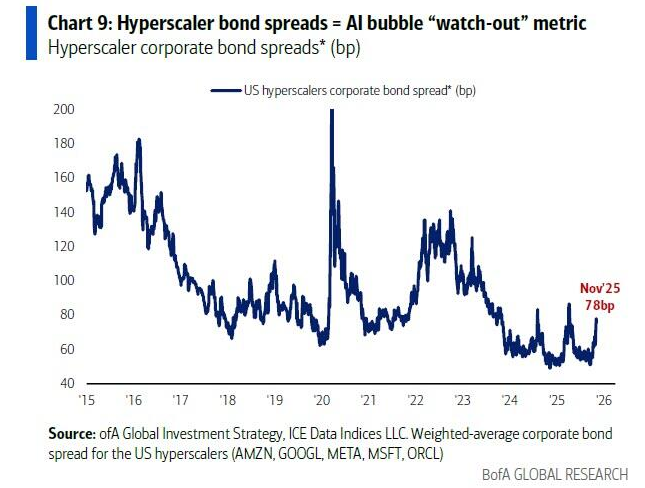
Core Insights - Concerns over AI spending by large tech companies have spread to the bond market, with debt spreads for hyperscale cloud computing firms reaching multi-month highs, indicating a potential risk reassessment of the entire AI narrative [1][3] - Barclays downgraded Oracle's debt rating, citing that the company's capital expenditures for AI contracts have significantly exceeded its free cash flow capacity, leading to a heavy reliance on external financing [1][4] Debt Market Dynamics - The yield spread of bonds issued by hyperscalers, including Alphabet, Meta, Microsoft, and Oracle, has risen to 0.78 percentage points above U.S. Treasuries, marking a significant increase from 0.5 percentage points in September [3] - Over the past seven weeks, tech companies have issued more than $120 billion in bonds, primarily to fund data center construction, raising concerns about overcapacity, long-term profitability, and energy demand [3] Oracle's Financial Strain - Oracle's situation is particularly notable, with Barclays predicting a severe financing gap starting in fiscal year 2027 and potential cash exhaustion by November 2026, driven by a high leverage ratio of 500% compared to Amazon's 50% and Microsoft's 30% [4][5] - Oracle's bond prices have dropped nearly 5% since mid-September, contrasting with a 1% decline in an index tracking high-rated tech bonds, reflecting investor concerns [5] Industry-Wide Implications - The challenges faced by Oracle are indicative of broader industry pressures stemming from the AI investment boom, with JPMorgan strategists warning that building AI infrastructure could cost over $5 trillion, necessitating participation from public capital markets, private credit, alternative capital, and even government [6] - Despite holding approximately $350 billion in cash and investments, tech giants are opting for significant debt issuance, signaling a shift from conservative financial strategies to higher leverage operational models [6] Recent Major Transactions - Meta completed a $30 billion bond issuance at the end of October, the largest corporate bond deal of 2023, and secured a $27 billion private debt agreement for data center funding [7] - Alphabet issued $25 billion in bonds in early November, while Oracle sold $18 billion in bonds in September to finance infrastructure leasing, including the "Stargate" data center for OpenAI [8] Market Reactions and Future Outlook - The credit market's pressure is affecting smaller core participants, with CoreWeave's stock dropping over 20% in the past two weeks, coinciding with the bond sell-off by large tech firms [9] - Some analysts view the bond market sell-off as a healthy market response, suggesting that price corrections following significant bond supply are a positive sign [9]


高盛:对人形机器人技术的长期趋势仍持积极看法
Zhi Tong Cai Jing· 2025-11-11 11:41
Core Insights - Goldman Sachs recently released a field research report on the supply chain of humanoid robots in China, indicating that most companies plan to gradually scale up after receiving actual orders, suggesting that current plans may not imply an imminent risk of oversupply [1] - The report highlights a positive long-term outlook for humanoid robot technology, but emphasizes the need to monitor the performance of key robotic products and specific end applications to assess whether a technological inflection point is approaching [1] Summary by Sections Company Insights - The report surveyed nine companies in the Chinese robotics industry chain, including Sanhua Intelligent Controls, Top Group, and Shuanghuan Transmission, none of which confirmed receiving significant large orders or provided clear mass production timelines [1] - These companies are actively planning production capacity both domestically and overseas, with annual capacity plans ranging from approximately 100,000 to 1 million units of robots [1] Industry Trends - Goldman Sachs forecasts a global shipment of 1.38 million robots by 2035, contrasting with the optimistic capacity planning of supply chain companies, which raises concerns about potential "oversupply" in the market [1] - An industry analyst cautioned against prematurely concluding "oversupply," noting that the specific application scenarios and technological paths for humanoid robots are still in exploratory development [2] - The current "order vacuum" should be understood as a natural phase in the early development of the industry, where trial and error costs and time are expected [2] - The analyst believes that proactive capacity planning by supply chain companies is a necessary preparation for potential demand surges, and that the future demand volume and technological evolution remain highly variable [2]

A股机器人“订单荒”?相关公司回应
财联社· 2025-11-11 10:47
Core Viewpoint - Goldman Sachs conducted a field research report on the supply chain of humanoid robots in China, revealing that companies are planning significant production capacity expansions despite a lack of confirmed large orders [1][2]. Group 1: Research Findings - The report surveyed nine companies in the Chinese robotics industry, including Sanhua Intelligent Control, Top Group, and Shuanghuan Transmission, indicating a planned annual production capacity ranging from 100,000 to 1,000,000 robot equivalents [1]. - Goldman Sachs predicts a global shipment of 1.38 million units by 2035, highlighting an optimistic outlook for the supply chain's growth potential [1]. - None of the surveyed companies confirmed receiving substantial orders or provided a clear mass production timeline, raising concerns about potential "overcapacity" in the robotics supply chain [1]. Group 2: Industry Insights - Despite the current contrast between the vacuum of orders and the expansion of production capacity, industry insiders caution against prematurely concluding "overcapacity," as proactive planning is often characteristic of emerging industries on the rise [2].



高盛调研发现A股机器人“订单荒”?产业链上市公司:静待订单落地
第一财经· 2025-11-11 10:11
Core Viewpoint - The article discusses the contrasting expectations and realities in the humanoid robot sector, highlighting a recent Goldman Sachs report that indicates a lack of confirmed large orders despite optimistic production capacity plans from several companies [4][12]. Group 1: Market Sentiment and Capacity Planning - Goldman Sachs conducted a survey of nine Chinese robot supply chain companies, revealing that while they are planning annual production capacities ranging from 100,000 to 1 million units, none have confirmed large orders or clear timelines for mass production [4][6]. - Companies like Top Group and Sanhua Intelligent Control are actively planning production facilities in Thailand and Mexico, with Top Group's Thai factory projected to have an annual capacity of 1 million units and an investment of 7-8 billion yuan [7][8]. - Despite the current lack of orders, industry insiders suggest that the proactive capacity planning is typical for emerging industries and does not necessarily indicate an impending oversupply [5][12]. Group 2: Company Responses and Market Dynamics - Several companies, including Sanhua Intelligent Control and Top Group, have acknowledged the absence of confirmed orders but emphasize that their capacity planning is based on guidance from major clients [10][11]. - The article notes that the current "order vacuum" should not be hastily interpreted as a sign of oversupply, as the industry is still in its early development stages, and the demand-supply mismatch is common in new sectors [13]. - Companies like Minth Group and Double Ring Transmission are expanding their production capabilities in anticipation of future demand, with Minth expecting humanoid robot-related revenue to reach 5 billion yuan by 2030 [8][12]. Group 3: Long-term Industry Outlook - The report suggests that the current lack of orders does not negate the long-term growth potential of humanoid robots, as the industry is still exploring specific applications and technological paths [13]. - Goldman Sachs maintains a positive outlook on the long-term trends in humanoid robot technology, although it emphasizes the need to monitor key product performance and specific end-use applications to assess potential technological breakthroughs [12][13].

PVC日报:震荡下行-20251111
Guan Tong Qi Huo· 2025-11-11 09:39
Report Industry Investment Rating - No information provided Core View of the Report - The PVC industry is expected to experience weak and volatile trends in the near future due to factors such as increased supply, decreased export expectations, high inventory, and a sluggish real - estate market [1] Summary According to Relevant Catalogs Market Analysis - The calcium carbide price in the upstream northwest region is stable. The PVC operating rate has increased by 2.49 percentage points to 80.75%, remaining at a relatively high level in recent years. The downstream PVC operating rate has started to decline slightly and is still at a low level. India has postponed the BIS policy for six months until December 24, 2025. The price quoted by Formosa Plastics in Taiwan, China in November has been reduced by $30 - 40 per ton. India has raised the anti - dumping tax on imported PVC from the Chinese mainland by about $50 per ton, weakening the export expectations of Chinese PVC in the fourth quarter. Traders are starting to wait and see, and last week's export orders decreased compared to the previous week. The social inventory has increased slightly and is still high. The real - estate market is still in the adjustment stage, and the improvement of the real - estate market still takes time. The comprehensive profit of chlor - alkali is still positive, and the PVC operating rate is higher than in previous years. New production capacities are in operation, and there is no actual policy implementation in the PVC industry yet [1] Futures and Spot Market Conditions - The PVC2601 contract increased in positions while oscillating downward, with a minimum price of 4,570 yuan per ton, a maximum price of 4,613 yuan per ton, and finally closed at 4,572 yuan per ton, below the 20 - day moving average, with a decline of 0.74%. The position volume increased by 63,608 lots to 1,407,131 lots [2] Basis - On November 11, the mainstream price of calcium carbide - based PVC in East China rose to 4,520 yuan per ton, and the futures closing price of the V2601 contract was 4,572 yuan per ton. The current basis was - 52 yuan per ton, weakening by 2 yuan per ton, and the basis was at a relatively low - neutral level [3] Fundamental Tracking Supply Side - The production of devices such as Ningbo Zhenyang and Inner Mongolia Yili has increased. The PVC operating rate has increased by 2.49 percentage points to 80.75%, remaining at a relatively high level in recent years. New production capacities, including Wanhua Chemical with an annual capacity of 500,000 tons, Tianjin Bohua with 400,000 tons, Qingdao Gulf with 200,000 tons, Gansu Yaowang with 300,000 tons, and Jiaxing Jiahua with 300,000 tons, are in different stages of operation [4] Demand Side - The real - estate market is still in the adjustment stage. From January to September 2025, the national real - estate development investment was 677.06 billion yuan, a year - on - year decrease of 13.9%. The commercial housing sales area was 658.35 million square meters, a year - on - year decrease of 5.5%; the residential sales area decreased by 5.6%. The commercial housing sales volume was 630.4 billion yuan, a decrease of 7.9%, and the residential sales volume decreased by 7.6%. The new housing construction area was 453.99 million square meters, a year - on - year decrease of 18.9%; the new residential construction area decreased by 18.3%. The construction area of real - estate development enterprises was 6.4858 billion square meters, a year - on - year decrease of 9.4%. The housing completion area was 311.29 million square meters, a year - on - year decrease of 15.3%; the residential completion area decreased by 18.3%. As of the week of November 9, the commercial housing transaction area in 30 large - and medium - sized cities decreased by 32.15% compared to the previous week, reaching the lowest level in recent years [5] Inventory - As of the week of November 6, the PVC social inventory increased by 1.13% to 1.0416 million tons, a 26.42% increase compared to the same period last year. The social inventory increased slightly and is still high [6]
高盛调研发现A股机器人订单荒?产业链公司回应
Di Yi Cai Jing· 2025-11-11 09:17
Core Viewpoint - The human-shaped robot sector is experiencing a clash between optimistic expectations and the current reality, as highlighted by a Goldman Sachs report indicating that nine surveyed supply chain companies have not confirmed any significant mass production timelines or large orders [2][3]. Group 1: Survey Findings - Goldman Sachs conducted a survey from November 3 to 6, covering nine companies in the Chinese robot supply chain, including prominent firms like Sanhua Intelligent Control and Top Group [2][3]. - The surveyed companies are planning annual production capacities ranging from 100,000 to 1,000,000 robot equivalents, reflecting a positive outlook on industry growth despite the absence of confirmed large orders [3][4]. - Companies like Top Group and Sanhua Intelligent Control are actively establishing production lines in Thailand and Mexico, with Top Group's Thai factory projected to have an annual capacity of 1,000,000 units and an investment of approximately 7 to 8 billion yuan [4]. Group 2: Production Capacity and Market Response - Despite the ambitious production plans, none of the surveyed companies have confirmed receiving substantial orders, leading to concerns about potential overcapacity in the robot supply chain [3][6]. - Companies are preparing for future demand based on guidance from major clients, even though they currently lack confirmed orders [6][7]. - Analysts suggest that the current lack of orders should not be interpreted as a sign of overcapacity, as proactive capacity planning is typical in emerging industries [8]. Group 3: Industry Outlook - The optimism surrounding production capacity expansion is driven by the belief in the long-term potential of the human-shaped robot market, with companies like Minth Group projecting revenues of 5 billion yuan from related businesses by 2030 [5][8]. - The current phase of order scarcity is viewed as a natural part of the industry's early development, with significant uncertainties regarding future demand and technological evolution [8]. - Goldman Sachs maintains a positive long-term outlook on human-shaped robot technology, emphasizing the need to monitor key product performance and applications to assess potential technological breakthroughs [8].
高盛调研发现A股机器人“订单荒”?产业链上市公司:静待订单落地
Di Yi Cai Jing· 2025-11-11 08:40
Core Insights - The human-shaped robot sector is experiencing a clash between optimistic expectations and the current reality of order shortages, as highlighted by a recent Goldman Sachs report on the Chinese supply chain [1][2] Industry Overview - Goldman Sachs conducted a survey from November 3 to 6, involving nine Chinese companies in the robot supply chain, revealing that none confirmed receiving large orders or clear mass production timelines [2][3] - The surveyed companies are planning annual production capacities ranging from 100,000 to 1,000,000 units, indicating a positive outlook on industry growth despite the lack of confirmed orders [2][3] Company Responses - Companies like Top Group and Sanhua Intelligent Control have stated that their production capacity planning is based on guidance from major clients, despite not having received specific orders [5][6] - Sanhua Intelligent Control is focusing on technological improvements and product development, while Top Group is preparing capacity in anticipation of future demand [5][6] Capacity Expansion Plans - Top Group plans to establish production lines in Thailand, Mexico, and the U.S., with a projected annual capacity of 1,000,000 units and an investment of approximately 7 to 8 billion yuan [3] - Sanhua Intelligent Control has acquired land in Thailand for assembling humanoid robot actuators and has initiated capacity for humanoid robots [3] - Minth Group has completed a production line with an annual capacity of 10,000 sets for head and facial assemblies, expecting to achieve mass production by Q1 2026 [4] Market Sentiment - There are concerns about potential overcapacity in the robot supply chain due to the aggressive capacity expansion without confirmed demand [2][6] - Industry analysts suggest that the current order vacuum should not lead to premature conclusions about overcapacity, as it is typical for emerging industries to experience initial trial and error phases [7]
CoreWeave(CRWV.US)2025Q3电话会:预计2.9吉瓦电力未来24个月内落地 延迟不改长期增长前景
智通财经网· 2025-11-11 08:04
Core Viewpoints - CoreWeave reported a mixed Q3 earnings, indicating that delays in individual data center projects will have a diminishing impact on overall performance as the company scales up its operations [1] - The company is actively expanding its business by initiating self-built projects in Pennsylvania, aiming to mitigate losses or delays in infrastructure delivery [1][3] - The management emphasized that the majority of the 2.9 GW of power capacity will be operational within the next 12 to 24 months, reducing the relative impact of any single project's delay [1][6] Infrastructure and Supply Chain - CoreWeave is facing systemic challenges in the supply chain that support global infrastructure construction, particularly in the context of AI [2] - The company has diversified its data center suppliers to enhance its ability to meet future challenges and has established dedicated teams to assist in infrastructure operations [2][4] - The current capacity has reached approximately 590 MW, with an increase of 120 MW since the last earnings call, showcasing significant progress in infrastructure delivery [4] Customer Contracts and Flexibility - The infrastructure built by CoreWeave is designed to be interchangeable among clients, allowing for flexibility in usage for both training and inference [6] - The company has seen a significant increase in backlog orders, indicating strong customer demand, and expects capital expenditures in 2026 to be more than double that of 2025 [8][15] - CoreWeave's contract with NVIDIA allows for the reservation of capacity and resale to other clients, enhancing the company's ability to serve smaller clients while managing capacity utilization risks [10][11] Future Outlook and Strategy - The company is committed to exploring various financing structures to ensure the successful delivery of computing services to clients, while also considering self-built data centers as a means to reduce delivery risks [13][14] - CoreWeave is focused on maintaining a diverse customer base, with no single customer accounting for more than 35% of total revenue, a significant decrease from 85% earlier in the year [15] - The management believes that the ongoing demand for infrastructure will continue to grow, driven by the increasing needs of major tech companies and AI labs [15]
