
实体经济

Search documents
首贷破局 赋能科创——南京银行常州分行精准服务助力医疗科技企业首贷破冰
Jiang Nan Shi Bao· 2025-12-02 03:35
Core Insights - Jiangsu Province has launched a special action to expand the first loan coverage for technology-based enterprises since 2025, addressing the "first loan difficulty" faced by innovative companies [1] - Nanjing Bank's Changzhou branch has successfully provided a first project loan to Qikangyuan Medical Technology (Changzhou) Co., Ltd., utilizing a multi-currency loan scheme to support the company's financial needs [1][2] Company Overview - Qikangyuan Medical Technology was established in 2021 with a registered capital of €40 million, co-owned by Dongcheng Nuclear Medicine and Germany's Eckert & Ziegler AG [1] - Dongcheng Pharmaceutical, a national high-tech enterprise, has multiple provincial innovation platforms and was recognized as a "Little Giant" enterprise by the Ministry of Industry and Information Technology in 2021 [1] - Eckert & Ziegler AG is a well-known supplier of isotopes for medical, scientific, and industrial applications, particularly strong in nuclear medicine imaging and cancer treatment [1] Industry Context - The company focuses on the research and production of medical radioactive isotopes and generators, which have historically relied on imports, leading to high costs and limited clinical application in China [1] - Changzhou has rapidly developed its medical device sector, forming a complete industrial chain that includes high-end medical equipment, in vitro diagnostics, and medical consumables, supported by policy initiatives and technological innovation [2] Financial Support - Nanjing Bank's Changzhou branch identified Qikangyuan's funding needs during a visit to companies on the "first loan expansion action" list and tailored a comprehensive financing solution based on the company's equity structure and growth trends [2] - The bank approved a medium- to long-term project loan of ¥180 million, with ¥46.08 million disbursed so far, easing the company's financial pressure for initial investments [2] - The successful loan issuance exemplifies the collaboration between government, banks, and enterprises to empower the real economy and enhance financial services for technology-based companies in Changzhou [2]


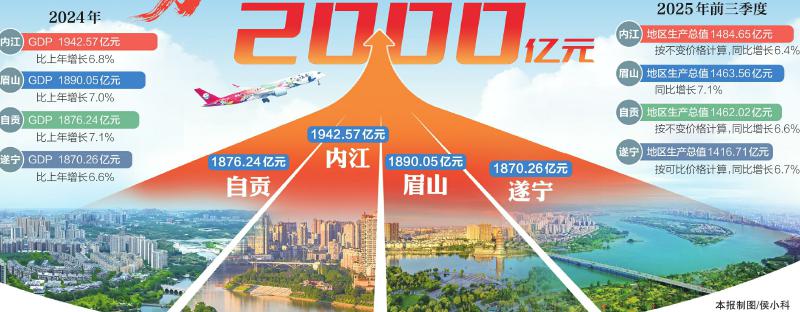
四川经济“黄金腰部”集体发力,内眉自遂四市加速冲刺 竞速之势 谁将跨过两千亿元
Si Chuan Ri Bao· 2025-12-02 00:06
Core Insights - The four cities of Neijiang, Meishan, Zigong, and Suining are targeting an economic development goal of over 200 billion yuan for the year, with each city having already surpassed 140 billion yuan in GDP by the third quarter, aiming to collectively enter the "200 billion club" for the first time in Sichuan's history [2][3][4]. Economic Performance - All four cities are positioned between 140 billion and 150 billion yuan in GDP, showcasing strong growth potential as they pursue their shared goal of reaching 200 billion yuan [3]. - Neijiang's GDP reached 194.26 billion yuan in 2024, with a target of exceeding 200 billion yuan as part of its "14th Five-Year Plan" [5]. Industrial Growth - Industrial output is the primary driver of economic growth in these cities, with significant contributions to GDP from various sectors [6][7]. - Zigong's industrial output value increased by 16% year-on-year from January to October, while Meishan maintained a leading industrial growth rate, contributing 3.7 percentage points to GDP growth [6][7]. - Suining's industrial output value grew by 11.3% in the first three quarters, contributing 48.5% to GDP growth, marking a 12.1 percentage point increase from the previous year [6]. Sector-Specific Highlights - Meishan's industrial growth is significantly driven by the lithium battery sector, with a leading enterprise reporting a 190% increase in sales revenue from January to September [7]. - Suining's investment in fixed assets grew by 8.6% year-on-year, with major infrastructure projects underway, including the Chengda-Wan High-speed Railway [8]. - Zigong is focusing on traditional manufacturing and energy-efficient industries, with the equipment manufacturing sector accounting for 46.4% of the total industrial output value [8]. Future Outlook - The performance in the fourth quarter will be crucial for achieving the 200 billion yuan target, emphasizing the importance of speed, strategy, and endurance in the final stretch [9].

经济日报:金融高质量发展取得新成就
Xin Lang Cai Jing· 2025-11-30 23:36
中国银行业发展稳健,银行业总资产近470万亿元,位居世界第一。股票、债券市场规模位居世界第 二,外汇储备规模连续20年位居世界第一。在"十四五"时期,我国坚持支持性的货币政策立场,金融服 务实体经济质效大幅提升。5年来,银行业保险业通过信贷、债券、股权等多种方式,为实体经济提供 新增资金170万亿元。资本市场服务科技创新跑出加速度,目前A股科技板块市值占比超过四分之一。 全球前50大银行有43家在华设立机构,40家最大的保险公司半数已进入中国。(经济日报) ...
各大银行都降息了,这对老百姓的生活有什么影响?结果来了
Sou Hu Cai Jing· 2025-11-29 02:26
Core Viewpoint - Recent collective interest rate cuts by major banks in China are driven by various economic factors, impacting both savings and borrowing behaviors in the economy [1][3]. Group 1: Reasons for Rate Cuts - The decline in yields of wealth management products and government bonds is a significant factor, with government bond rates dropping by 0.15 percentage points in September [3]. - Increased savings willingness among residents, driven by economic uncertainties, has led to a surge in household deposits, with a notable increase of 10 trillion yuan in the first half of 2022 [3]. - The primary goal of lowering deposit rates is to alleviate pressure on the real economy, providing lower financing costs for businesses and easing mortgage burdens for homebuyers [5]. Group 2: Impacts on Daily Life - Reduced interest income from deposits is expected, exemplified by a decrease in the three-year fixed deposit rate from 2.75% to 2.60%, resulting in a loss of 1,500 yuan in interest for a 1 million yuan deposit [8]. - Lower mortgage rates, now around 4.25% compared to over 5.8% last year, will benefit homebuyers, although existing borrowers may have to wait until early next year for new rates [10]. - Inflationary pressures may persist due to increased consumer spending and lower loan rates, suggesting that demand-side inflation could remain a concern in the coming years [10].

新华指数|10月普惠金融-景气指数显示:经营融资波动调整
Xin Hua She· 2025-11-27 06:45
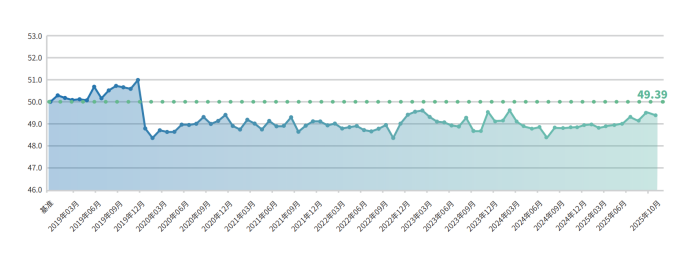
新华财经北京11月26日电(蒲玉)2025年10月,普惠金融-景气指数达49.39点,较9月下降0.11点,仍高 于去年同期。融资端规模持续扩张,成本稳中有降,政策红利持续释放;经营端企业平稳运行的基本面 未变,企业发展潜力有望进一步释放。 图1:普惠金融-景气指数结果 融资景气度小幅下降 分维度来看,10月,融资景气度指数为54.69点,较9月下降0.24点。企业融资规模持续扩张。中国人民 银行数据显示,10月末,社会融资规模存量437.72万亿元,同比增长8.5%。其中,对实体经济发放的人 民币贷款余额为267.01万亿元,同比增长6.3%,金融对实体经济的支持力度高位运行。10月末,普惠小 微贷款余额、制造业中长期贷款余额分别同比增长11.6%、7.9%,均高于同期各项贷款增速。融资成本 方面,贷款利率持续保持低位水平,10月,企业新发放贷款(本外币)加权平均利率为3.1%,比上年 同期低约40个基点,在适度宽松的货币政策带动下,实体经济有效融资需求得到满足。 经营景气度稳中趋缓 10月,经营景气度指数为48.35点,较9月下降0.09点,小微企业发展整体保持平稳。部分企业进入调整 期,盈利水平有所放缓 ...
林武在东营调研时强调 持续促进经济结构优化升级 坚定不移推动绿色低碳高质量发展
Da Zhong Ri Bao· 2025-11-27 01:09
Group 1 - The core message emphasizes the need to implement the spirit of the 20th Central Committee and Xi Jinping's important speech, focusing on strengthening the real economy and promoting green, low-carbon, and high-quality development [1][2] - The company aims to enhance the petrochemical industry by reducing oil consumption, increasing chemical production, and extending the supply chain to improve quality and efficiency [1] - There is a focus on carbon capture, utilization, and storage technology to improve resource utilization efficiency and reduce carbon emissions, contributing to national energy security and green transformation [1] Group 2 - The company is encouraged to leverage its leading role in the wind power equipment industry to support the development of a new energy system in the province [2] - The development of the East Dongying Zero Carbon Industrial Park is highlighted, with an emphasis on accelerating construction and expanding the industrial cluster [2] - The importance of ecological protection and restoration in the Yellow River Delta is stressed, aligning with Xi Jinping's ecological civilization thought [2]
浙江台州壮大实体经济根基
Jing Ji Ri Bao· 2025-11-26 22:44
Core Insights - Jack Technology Co., Ltd. has launched the AI sewing machine "Ai 10" and humanoid robots, showcasing Taizhou's innovation capabilities in high-end equipment [1] - Taizhou has focused on the development of the real economy, promoting digital and intelligent transformation in manufacturing, resulting in an 8.3% year-on-year growth in industrial output value for the first nine months of the year [1] - The establishment of the first provincial-level low-altitude economy industry fund in Taizhou Bay New Area has attracted over 80 upstream and downstream enterprises for development [1] - The second phase of the 10GWh solid-state lithium battery industrialization project by Qingtai Energy is progressing rapidly in the Chengjiang Industrial Zone of Huangyan Economic Development Zone [1] - The CNC and Intelligent Manufacturing Technology Innovation Center, co-established by Yuhuan City and Tianjin University, has achieved a transformation rate of over 75% for its results [1] - The municipal government emphasizes leveraging the advantages of a vibrant private economy, diverse manufacturing sectors, and numerous listed companies to enhance the quality and resilience of development through practical measures [1]

智库·数据丨“数”览前三季度银行业“成绩单”
Sou Hu Cai Jing· 2025-11-26 04:56
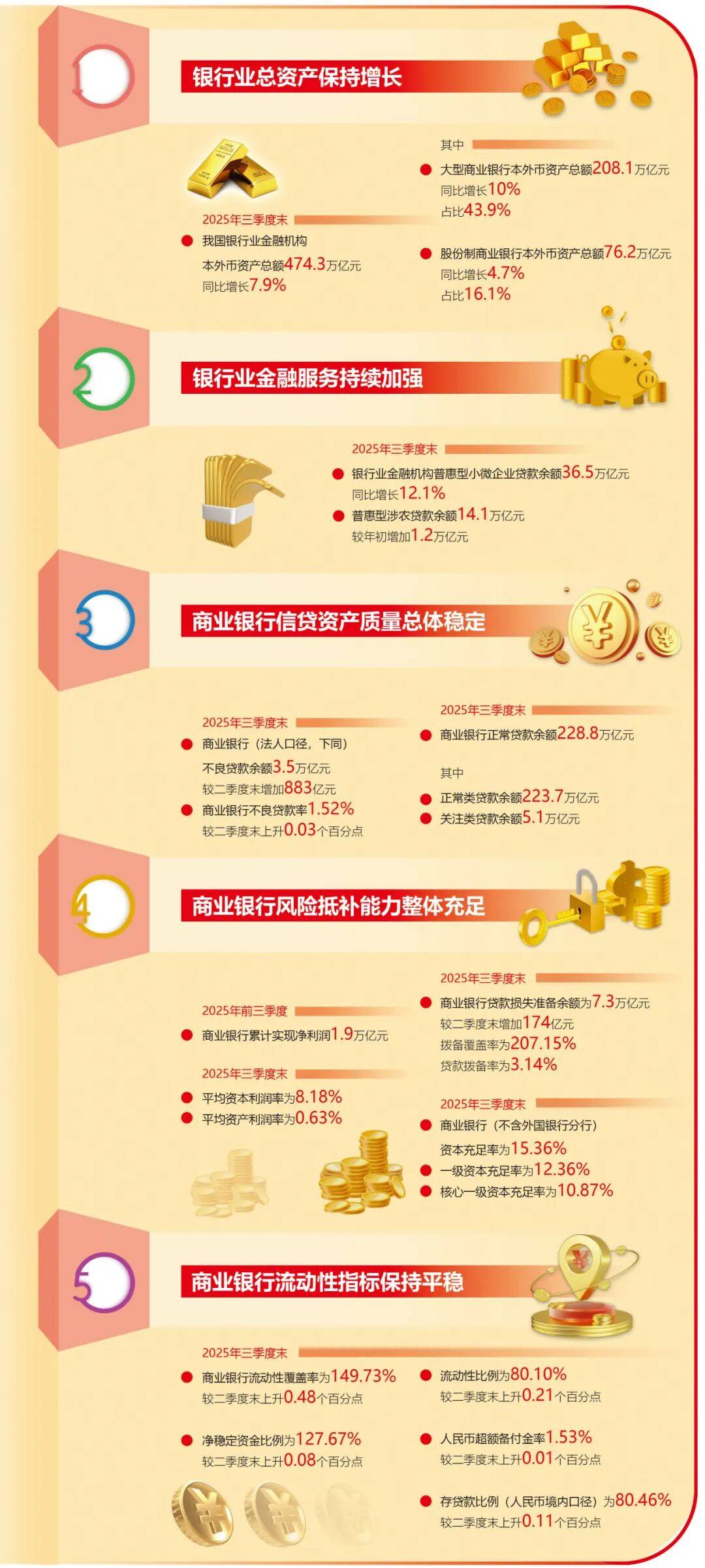
Core Insights - The overall operation of China's banking industry remains stable, with total assets exceeding 474 trillion yuan and a double-digit growth in inclusive finance loans [1][5] - Large commercial banks play a crucial role in stabilizing the macro economy, with their total assets reaching 208.1 trillion yuan, a 10% year-on-year increase [5][6] - The banking sector is effectively supporting the real economy, with inclusive loans for small and micro enterprises growing by 12.1% to 36.5 trillion yuan [6][7] Group 1: Financial Performance - As of the end of Q3 2025, the total assets of China's banking institutions reached 474.3 trillion yuan, marking a 7.9% year-on-year growth [5][6] - Commercial banks achieved a net profit of 1.9 trillion yuan in the first three quarters of 2025, maintaining stable profitability [8] - The average capital return rate and asset return rate were 8.18% and 0.63%, respectively, indicating solid financial performance [8] Group 2: Asset Quality and Risk Management - The non-performing loan balance stood at 3.5 trillion yuan, with a non-performing loan rate of 1.52%, reflecting manageable risk levels [7][8] - The loan loss provision balance reached 7.3 trillion yuan, with a provision coverage ratio of 207.15%, ensuring robust risk mitigation [8] - Capital adequacy ratios remained high, with a capital adequacy ratio of 15.36% and a core tier one capital ratio of 10.87% [8] Group 3: Support for the Real Economy - Inclusive loans for small and micro enterprises reached 36.5 trillion yuan, growing by 12.1%, demonstrating a clear focus on supporting these sectors [6][7] - Agricultural inclusive loans amounted to 14.1 trillion yuan, contributing to rural revitalization and agricultural modernization [6][7] - The banking sector is increasingly aligning its services with the needs of the real economy, benefiting various industries and households [6][7] Group 4: Future Outlook - Recommendations for the banking sector include optimizing asset-liability management, deepening digital transformation, and enhancing risk management efforts [8] - Financial regulatory authorities are encouraged to adjust monetary and regulatory policies to foster a conducive environment for high-quality development [8]
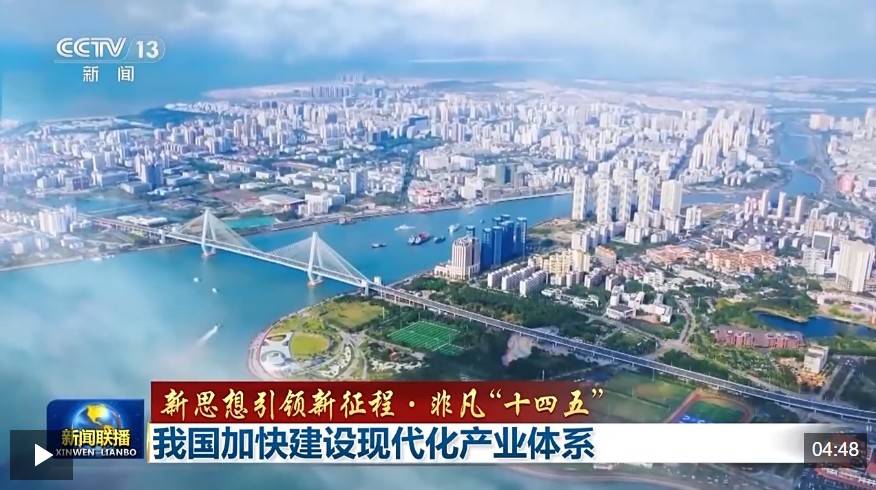
新思想引领新征程·非凡“十四五”丨我国加快建设现代化产业体系
Yang Shi Xin Wen Ke Hu Duan· 2025-11-26 01:21
Core Insights - The construction of a modern industrial system is emphasized as a material and technological foundation for a modernized nation, with a focus on the real economy to support the second centenary goal [2] - The "14th Five-Year Plan" period aims to accelerate the establishment of a modern industrial system driven by technological innovation and rooted in the real economy [2] Group 1: Industrial Development - The Yangtze River Delta's industrial internet platform processes 20,000 data sets every minute, with a refrigerator rolling off the production line every eight seconds [4] - In the eastern coastal bonded zones, cross-border data flows enable verification and customs clearance in just one second, facilitating rapid global distribution of Chinese manufacturing [6] - The Pearl River Delta's lighthouse factories offer 100,000 personalized options for customizing a car, showcasing advanced manufacturing capabilities [7] Group 2: Government Initiatives and Leadership - President Xi Jinping has consistently highlighted the importance of a modern industrial system supported by the real economy, making significant directives on its construction [9] - The modern industrial system reflects changes in industrial structure, development dynamics, and factor relationships, aligning with the context of Chinese-style modernization [11] Group 3: Progress and Achievements - In 2023, the construction of the modern industrial system has accelerated, with over 80% of steel companies establishing intelligent control centers and more than half of coal production capacity achieving digital mining [13] - The manufacturing sector remains the largest in the world, with over 10,000 provincial-level digital workshops and smart factories established, and 6,430 national-level green factories operational [14] - The first batch of leading smart factories has been announced, covering various sectors including steel and consumer goods, aiming to explore new manufacturing models [15] Group 4: Emerging Technologies and Economic Growth - In the first three quarters of the year, the value added of high-tech manufacturing increased by 9.6%, with industrial robot production rising nearly 30% and drone sales revenue growing by almost 70% [19] - The continuous optimization of industrial structure and the increasing proportion of high-tech and strategic emerging industries are driving high-quality economic development [21] Group 5: Future Planning - Regions are actively planning for the "15th Five-Year Plan," with Hunan Province allocating 50 billion yuan to support 1.89 million small and medium-sized enterprises, focusing on key industrial chains [23] - The "15th Five-Year Plan" emphasizes the construction of a modern industrial system and the strengthening of the real economy as primary strategic tasks [23]
黄秋生:把握科学思维建设全国统一大市场
Jing Ji Ri Bao· 2025-11-26 00:08
Core Viewpoint - The construction of a nationwide unified market is essential for strengthening domestic circulation and enhancing the resilience of the national economy, as well as stimulating domestic demand and gaining an advantage in international competition [1]. Group 1: Key Strategies for Market Construction - The approach should combine "establishing" and "breaking," focusing on creating institutional rules that meet practical needs while eliminating outdated regulations that hinder fair competition [2]. - A unified property protection system and a negative list for market access should be established to ensure equal rights and opportunities for all economic entities [2]. - It is crucial to dismantle institutional barriers that restrict economic circulation, such as local protectionism and market segmentation, while simplifying business registration and exit processes [3]. Group 2: Emphasis on Real Economy - The real economy serves as the foundation for a strong nation, and the virtual economy, represented by finance, acts as a catalyst for the real economy [4]. - There is a need to enhance the manufacturing sector, promote innovation, and ensure a balanced development between traditional and emerging industries [4]. - Financial resources should be directed towards technology innovation and green development, with a modern regulatory framework established to ensure financial safety [4]. Group 3: Supply and Demand Dynamics - The interaction between supply and demand should be promoted, with new demand leading to new supply and vice versa, to create a robust domestic market [5]. - A modern circulation system and effective market information transmission mechanisms are necessary to ensure efficient supply and demand balance [5][6]. Group 4: Government and Market Interaction - The government should reduce direct intervention in market activities while enhancing regulatory oversight to maintain order and fairness [7]. - A unified land and labor market should be established to facilitate the free flow of resources and eliminate employment discrimination [7]. Group 5: Central-Local Coordination - Strengthening coordination between central and local governments, as well as among various departments, is vital for the effective construction of a unified national market [8]. - A mechanism for regular coordination and assessment should be established to ensure the implementation of key tasks [8].