
AI泡沫

Search documents
2025/12/30:市场主流观点汇总-20251230
Guo Tou Qi Huo· 2025-12-30 10:11
市场主流观点汇总 2025/12/30 报告说明 黄 恬 期货从业资格证号:F03100883 投资咨询从业资格证号:Z0021089 此报告,意在客观反映行业内期货公司、证券公司对大宗商品各品种的 研究观点,追踪热点品种,分析市场投资情绪,总结投资驱动逻辑等。 本报告不构成个人投资建议,仅供公司内部使用,仅作参考之用。 报告中策略观点和投资逻辑是基于所采纳的机构当周公开发布的研究报 告,对于各期货品种的多空观点、交易逻辑进行整理加工汇总而成,收 盘价数据选择上周五,周度涨跌为上周五较前一周五收盘价变动幅度。 | 【行情数据】 | | | | | | | | --- | --- | --- | --- | --- | --- | --- | | 资产类别 | 细分品种 | 收盘价 | | 周度涨跌情况 | | | | 数据时点 | | 2025/12/26 | | 2025/12/22 | 至 | 2025/12/26 | | | 白银 | 18319.00 | 白银 | | | 19.14% | | | PTA | 5280.00 | PTA | 8.15% | | | | | 铜 | 98720.00 | ...
前商汤总裁闯关港股,能复制摩尔、沐曦的暴富神话吗?
Tai Mei Ti A P P· 2025-12-30 04:14
Core Viewpoint - The article discusses the rise of domestic chip companies in China, particularly focusing on Birun Technology's upcoming IPO in Hong Kong and the challenges it faces in a competitive market dominated by Nvidia [1][2][20]. Group 1: Company Overview - Birun Technology plans to raise over HKD 4.2 billion through its IPO on the Hong Kong Stock Exchange, aiming to become the "first GPU stock" in Hong Kong [2]. - The founder, Zhang Wen, has a diverse background, including a Harvard Law degree and experience in private equity, which he leverages to attract top talent from the industry [3][4]. - The company has raised over CNY 5 billion in funding within a year and a half, setting a record for domestic chip startups [4]. Group 2: Financial Performance - Birun has incurred losses exceeding CNY 6.3 billion over three and a half years, despite a significant revenue increase, with 2024 revenue reaching CNY 337 million, a fourfold increase from the previous year [9]. - R&D expenditures for the years 2022, 2023, and 2024 were CNY 1.018 billion, CNY 886 million, and CNY 827 million, respectively, with an additional CNY 572 million spent in the first half of 2025 [8]. - The gross margin dropped from approximately 70% in 2024 to 32% in the first half of 2025, indicating challenges in cost control and pricing power [10][11]. Group 3: Market Challenges - Birun faces significant competition from Nvidia, especially with the potential re-entry of Nvidia's H200 chip into the Chinese market, which poses a threat to domestic players [17]. - The current market environment in Hong Kong is characterized by a high influx of new listings, making investors more selective and cautious about new investments [15]. - The ongoing debate about the sustainability of the AI boom raises concerns about the long-term viability of capital investments in the chip sector [18][19]. Group 4: Strategic Positioning - Birun's strategy involves a dual focus on immediate product launches, such as the BR20X series, while also planning for long-term developments like the BR30X series [12]. - The company has established strategic partnerships with major telecom players like China Telecom and China Mobile, which provide a foundation for its market presence [20]. - Zhang Wen emphasizes the need for patience and resilience in navigating the challenges of the chip industry, highlighting that success is not solely defined by initial stock performance [21].
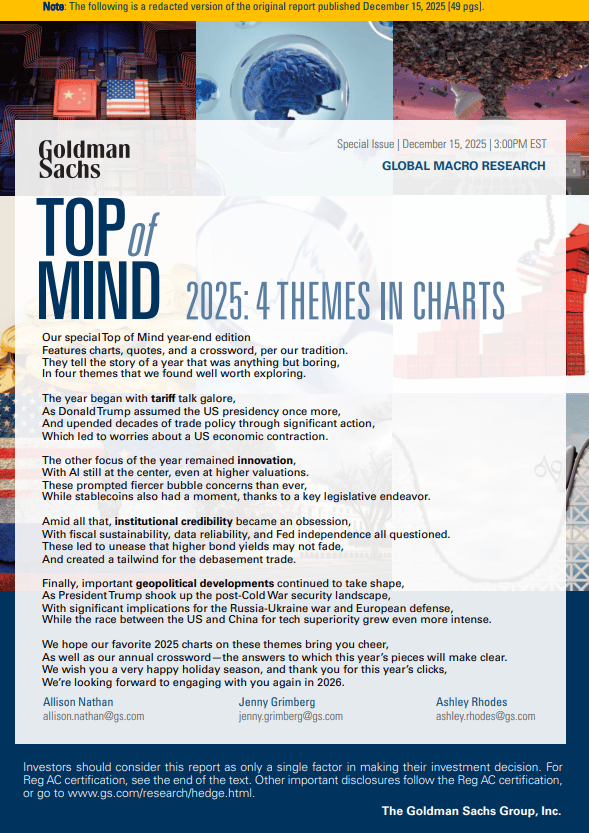
高盛2025影响全球宏观经济的四大核心主题:全球经济真要变天了?
Sou Hu Cai Jing· 2025-12-30 02:53
Core Themes - The report outlines four major themes impacting the global economy in 2025: tariff waves and trade shocks, AI frenzy and the rise of stablecoins, institutional credibility facing a "trust crisis," and geopolitical rifts alongside technological competition [1][7]. Group 1: Tariff Waves and Trade Shocks - The re-election of Donald Trump has led to a significant shift in U.S. trade policy, with tariffs sharply increasing and causing global trade tensions [6]. - The uncertainty index regarding trade policies has reached historical highs, complicating corporate decision-making [6]. - Historical patterns suggest that large-scale trade conflicts often precede economic recessions, raising market concerns [6]. Group 2: AI Frenzy and Rise of Stablecoins - Investment in AI continues to surge, particularly in semiconductor and cloud computing sectors, with major companies significantly increasing capital expenditures [6]. - There are ongoing discussions about potential AI bubbles, especially as stock performance of major tech companies becomes closely tied to AI narratives [6]. - The passage of the GENIUS Act has provided a regulatory framework for stablecoins, facilitating their market expansion and clearer business models [6]. Group 3: Institutional Credibility and Trust Crisis - Concerns about U.S. fiscal sustainability and the reliability of economic data have led to rising bond yields and increased interest in "currency debasement" trades [6]. - The U.S. deficit and debt as a percentage of GDP are at historical highs outside of crisis periods, raising alarms about fiscal health [6]. - The independence of the Federal Reserve is under scrutiny, with political pressures affecting its monetary policy [6]. Group 4: Geopolitical Rifts and Technological Competition - The ongoing stalemate in the Russia-Ukraine war has prompted Europe to bolster its defense spending, although internal structural issues remain [6]. - The U.S.-China tech rivalry is intensifying, particularly in critical areas like semiconductors and rare earths, with both nations striving for strategic dominance [6]. - Ensuring self-sufficiency in key technologies and supply chain resilience has become a core strategic goal for both countries [6].

以史为鉴,黄金“超涨”了吗?
Hua Er Jie Jian Wen· 2025-12-30 01:45
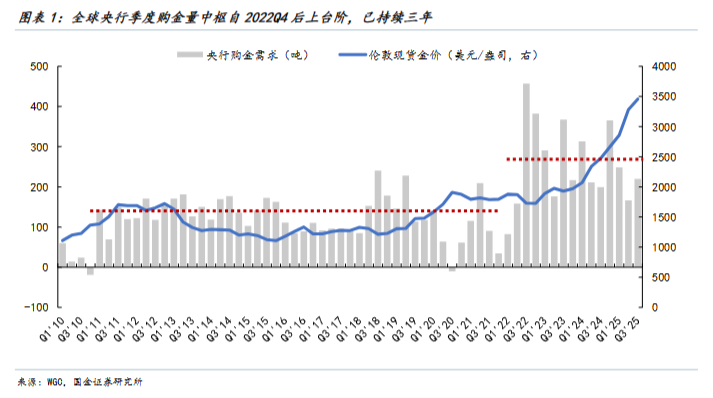
Core Viewpoint - The gold market is experiencing a significant bull run, with London spot gold achieving its highest annual increase in nearly 46 years in 2025, driven by speculative inflows despite a slowdown in central bank purchases. The underlying support from global stagflation and the monetization of U.S. deficits remains intact, suggesting a continued upward trend for gold into 2026 [1][2][3]. Central Bank Gold Purchases - Central banks have increased their gold reserves over the past three years, with the global gold reserve proportion rising by 7 percentage points to 22%, although still below historical peaks of 29% and 58% during significant geopolitical shifts [4][5]. - 76% of surveyed central banks plan to moderately increase their gold reserves over the next five years, citing reasons such as crisis performance and inflation hedging [5]. - There remains a potential demand for 3,300 tons of gold if central bank holdings return to historical levels, indicating that central bank purchases will continue to support gold prices and limit downside risks [4][5]. Market Dynamics and Investment Strategies - Gold is viewed as a low-correlation, low-drawdown hedge, making it an attractive asset in a market where traditional hedges are failing. The demand for gold in risk parity and mean-variance strategies is evident, with many non-institutional investors yet to enter the gold market, indicating significant room for allocation [11][13]. - The ongoing Fed rate cut cycle and the need for hedging against the AI bubble are expected to further drive market funds into gold [2][15]. - The correlation between U.S. stocks and bonds is at a near 27-year high, highlighting the necessity for alternative assets like gold in diversified portfolios [14]. Historical Context and Future Outlook - Historical analysis shows that the current gold bull market has not reached excessive levels compared to past cycles, with gold prices increasing 5.7 times since the 2008 monetization of deficits and 2.4 times since the 2022 shift in U.S. dollar credibility, both significantly lower than the 24-fold increase seen in the 1970s [22][23]. - The U.S. debt-to-GDP ratio is projected to reach 118.5% by 2035, suggesting a continued bullish outlook for gold unless AI technology significantly improves productivity and fiscal conditions [23]. - The potential spillover effects of the gold bull market could benefit silver and copper, which are essential in the AI supply chain, as well as other strategic metals that may exhibit "gold-like" properties [24][31].
美债波动率即将创2009年来最大年降幅 “全球资产定价之锚”踏向下行轨迹?
智通财经网· 2025-12-30 00:06
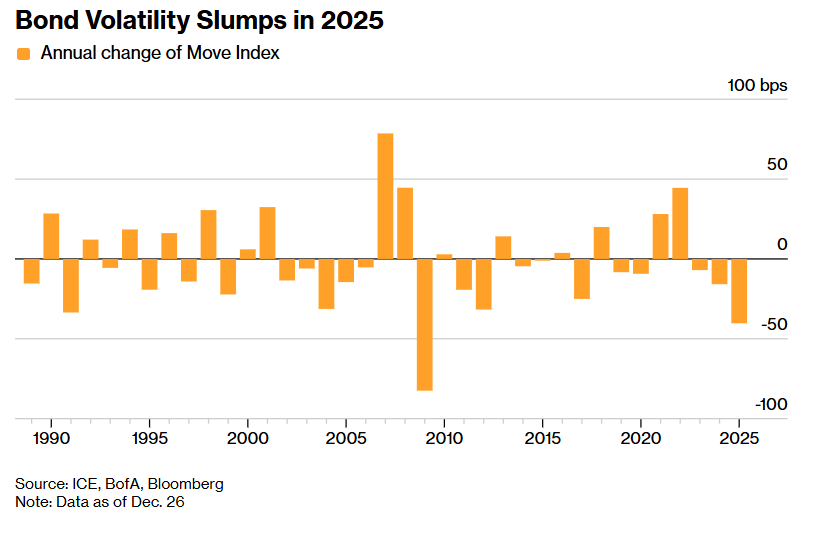
Core Viewpoint - The U.S. Treasury market is experiencing a significant decline in volatility, potentially leading to a favorable environment for long-term Treasury bonds in 2026, especially if the government shifts towards issuing more short-term debt [1][4][5]. Group 1: Market Volatility and Economic Indicators - A key indicator of U.S. Treasury market volatility, the ICE BofA MOVE index, has dropped to approximately 59, the lowest level since October 2021, indicating a substantial decline from a high of about 99 at the end of 2024 [1][4]. - The decline in volatility is attributed to a combination of reduced global tariffs, a shift in the Trump administration's stance, and the Federal Reserve's interest rate cuts, which have contributed to a more stable economic outlook [4][5]. - Economic data suggests that the U.S. is moving closer to a "soft landing," with cooling inflation and a resilient labor market, further reducing uncertainty in financial markets [4][5]. Group 2: Federal Reserve and Interest Rate Expectations - The Federal Reserve has lowered interest rates three times since September to prevent a downturn in the labor market, with expectations of two more 25 basis point cuts in 2026 [5][6]. - Market consensus is focused on lower policy rates and a slightly steeper yield curve in 2026, reflecting ongoing discussions about inflation persistence and economic growth resilience [5][6]. Group 3: Long-term Treasury Bonds Outlook - If the U.S. Treasury reduces the net supply of 10-year and longer bonds while increasing short-term debt issuance, it could enhance the attractiveness of long-term bonds, potentially marking 2026 as a "reversal year" for these assets [6][7]. - The expectation of lower interest rates and rising global economic uncertainty may drive risk-averse investors towards U.S. Treasury bonds, particularly long-term ones, which are seen as more appealing compared to short-term bonds [7][9]. - Predictions indicate that the yield on 10-year Treasuries could fall below 3.5% by the end of 2026, driven by strong demand and a favorable pricing environment [9][10]. Group 4: Impact on Broader Financial Markets - A sustained decline in the 10-year Treasury yield could positively influence the valuations of risk assets such as stocks, cryptocurrencies, and high-yield corporate bonds, as these assets are sensitive to changes in the risk-free rate [9][10]. - The potential for a new bull market in equities is supported by strong narratives surrounding major tech companies and the AI sector, which could thrive in a low-interest-rate environment [10].
Alphabet(GOOG.US,GOOGL.US)2025打赢“翻身战” 股价涨幅居“七巨头”之首
Zhi Tong Cai Jing· 2025-12-29 22:21
Core Viewpoint - 2025 is expected to be a "turnaround year" for Alphabet, with a strong stock price rebound despite facing antitrust lawsuits, increased search competition, and high AI investments [1] Group 1: Stock Performance - Alphabet's stock price rebounded approximately 116% from a 52-week low of $144.70, achieving a year-to-date increase of 65%, outperforming other major tech companies [1] - In comparison, Nvidia increased by 39%, Tesla by 16%, Microsoft by 15%, Meta Platforms by 12%, Apple by 9%, and Amazon by 5.5% during the same period [1] Group 2: Legal and Competitive Landscape - A federal judge ruled in August 2024 that Google maintained its monopoly in general search and text advertising, raising concerns about potential structural changes [2] - Subsequent limited remedial measures proposed by the judge alleviated investor fears regarding significant business disruptions [2] - Competition from companies like OpenAI and Microsoft in AI-driven search products is a key concern for investors [2] Group 3: AI Strategy and Investment - Alphabet is proactively advancing its AI search transformation, introducing features like "AI Overviews" to enhance user engagement [2] - Analysts noted that despite threats from AI chat tools, Alphabet's position is significantly better than a year ago, with Google Search remaining robust [2] - The company is increasing capital expenditures to strengthen its competitive edge in AI, despite investor concerns about rapid spending in the tech sector [3] Group 4: Analyst Outlook and Valuation - A majority of analysts remain optimistic about Alphabet, with 64 out of 76 covering analysts rating it as "buy" and an average target price of $334.50, indicating a potential upside of about 6.7% from the latest closing price of $313.51 [3] - The current expected price-to-earnings ratio for Alphabet is approximately 27.8, higher than the five-year average of 21.7 and significantly above the low of 15.5 reached in May [3] - The ability of Alphabet to sustain growth and profitability at elevated valuations is contingent on the successful conversion of AI investments into tangible results [3]

史蒂夫·霍夫曼:生成式AI规模将超万亿美元,不必过于担心泡沫
2 1 Shi Ji Jing Ji Bao Dao· 2025-12-29 16:21
12月27日,北京科学教育发展基金会联合硅谷著名创业家史蒂夫·霍夫曼(Steve Hoffman)设立的"船长未来(专项)公益基 金"在清华科技园启迪大厦启动。该基金立足全球视野与中国实践,致力于在人工智能快速发展的时代背景下推动科技向善,系 统性赋能青年成长,培育具有人文关怀与责任意识的未来领航者。 史蒂夫·霍夫曼(Steve Hoffman),别名"霍夫曼船长"(Captain Hoff),美国硅谷连续创业者、天使投资人及创业教育家。霍夫 曼活跃于全球科技与创投圈,对初创企业的生存策略及人工智能时代的商业变革有深入研究。 活动现场。拍摄:张旭 在题为《AI重塑世界的下一站:趋势、挑战与人的位置》的演讲中,史蒂夫·霍夫曼全面阐述人工智能对商业、社会与未来的深 远影响,并从全球创新实践的角度出发,系统分析人工智能对经济、社会及未来工作的深远影响。 他强调,技术进步不应削弱人的价值,"未来的工作将更加关乎关爱、联结与人类福祉",必须在效率之外重新确立以人为本的 发展方向。 北京海外高层次人才协会副理事长兼秘书长、HICOOL一站式创业生态平台执行负责人武沂认为,青年作为AI"原生一代",需培 养交叉学科背景与" ...

4000人涌入现场 听吴晓波说AI:十年泡沫期已来 可“泡沫是我们的热情,我们的钱”
Mei Ri Jing Ji Xin Wen· 2025-12-29 14:50
12月28日晚,超过4000人涌入厦门国博会议中心,他们都是赶来看优酷人文主办的《AI闪耀中国 2025 吴晓波科技人文秀》的观众。 今年,吴晓波将"AI"(人工智能)定为核心议题,大秀也是由一首女孩与机器人合奏的钢琴曲《花开在 眼前》开幕。吴晓波说:"一个是硅基人类,一个是碳基人类,他们用双手弹奏同一首曲子,这样的场 景指向一个正在发生的未来。" 演讲通过优酷全程直播。出乎意料的是,原本设想的是科技话题受众以男性为主,但预约数据显示,女 性观众占比不低。 正式演讲前,吴晓波接受了每日经济新闻等媒体采访。他反复强调一个判断:AI已不再是遥远的技术 概念,它正在渗透日常生活和产业现场。 他深入分析了AI与国家、产业乃至每个人的关系。吴晓波还感叹:"晚会有很多年轻观众在线。原来说 世界属于'90后''00后',现在看来,似乎是真的了。" 第四次工业革命发生了 "2023年,ChatGPT3.5出来后,人类实际上就进入到了新的人工智能纪元。"吴晓波表示。 两年过去,AI不再只是实验室里的模型或媒体标题里的热词。他看到:"在今天,人工智能距离我们的 生活仅仅只有1米之远了,我们每个人已经在使用AI,或者说我们已经在被 ...

2025年全球IPO回暖背后:盛宴还是隐忧?
Sou Hu Cai Jing· 2025-12-29 11:59
Group 1 - The global IPO market is expected to recover significantly in 2025, primarily supported by a fundamental shift in the global liquidity environment as major central banks, led by the Federal Reserve, begin to lower interest rates after a period of aggressive rate hikes [2] - In the US stock market, private equity and venture capital are leading the financing of AI startups, with significant investments from firms like SoftBank into OpenAI, indicating a trend towards rapid IPOs to exit before potential market shifts [2] - The Hong Kong stock market is experiencing a dual-driven liquidity support from both domestic and international capital, which is crucial for large IPO projects [2] Group 2 - Despite volatility in global stock markets, the IPO market is thriving, particularly in Hong Kong, where the number of pending IPO applications has surged from 84 at the beginning of the year to 331, suggesting an acceleration in IPO transactions by year-end [3] - Hong Kong is leading in IPO fundraising, with a total expected to reach HKD 2787.03 million (approximately USD 35.9 billion), surpassing the Nasdaq's USD 25.8 billion, marking the highest level since 2021 [4] - If SPACs are included, the Nasdaq remains the top market for IPO fundraising, with a total of USD 46 billion [6] Group 3 - Other regions, such as India and Japan, are also seeing active IPO markets, with over 200 companies in India receiving approval or submitting IPO applications, the highest in 27 years, and Japan's IPO fundraising expected to reach JPY 1.2 trillion (approximately USD 770 million), the highest since 2018 [8] - The largest IPO in the US this year was Medline, raising USD 6.265 billion, followed by Venture Global and Coreweave, indicating strong interest in healthcare and energy sectors [9] - In Hong Kong, the largest IPO was by CATL, raising HKD 310.06 million (approximately USD 39.88 billion), reflecting strong demand for battery technology [10] Group 4 - The IPO market is expected to become more crowded in 2026, with a shift in focus from recovery to competition and differentiation, driven by high listing enthusiasm and urgent capital exit needs [13] - Major tech companies, including SpaceX and AI firms like OpenAI and Anthropic, are planning IPOs in 2026, which could lead to the largest IPO wave in history [14][15] - The backlog of IPO applications in Hong Kong is expected to exacerbate the crowded market situation, with a significant number of companies from various sectors, including biotech and AI, preparing to go public [16] Group 5 - Despite a shift towards a more accommodative global liquidity environment, capital is not flowing evenly across markets, with the US stock market, particularly the Nasdaq, maintaining a competitive edge in attracting large IPOs [17] - The competition for top projects between the US and Hong Kong markets may lead to a relative disadvantage for Hong Kong, despite local support from "southbound funds" [17] - Investors are advised to focus on high-quality assets with long-term competitive advantages in a crowded IPO market, emphasizing the importance of valuation discipline [18]

霍华德·马克斯最新访谈:改变世界≠投资者赚到了钱
Xin Lang Cai Jing· 2025-12-29 11:47
Group 1 - The current investment climate is compared to the internet bubble of 1998-2000, highlighting that both are driven by revolutionary technologies that spark market imagination, but "changing the world" does not equate to "making money for investors" [1][71][24] - There is a lack of clarity regarding the commercialization and profitability of AI compared to the internet bubble, where many ideas have since materialized [2][73][82] - Investors are warned to avoid a "lottery mentality" and "binary bets" when investing in AI [3][30][100] Group 2 - Two types of investment choices are identified: betting on pure AI concept companies, which are high-risk but potentially high-reward, and investing in established tech companies where AI serves as a growth driver [4][75] - Investors must be aware of their risk tolerance and investment plans [5][76] - For gold and Bitcoin, these assets do not generate cash flow, making it impossible to assess their intrinsic value; their prices are entirely dependent on market supply and demand [6][77][120] Group 3 - Historical data shows that gold has underperformed compared to the S&P 500, with annualized returns of approximately 7.7% for gold since 2010, compared to 12.7% for the S&P 500 [7][52][123] - The long-term return of gold is lower than that of the stock market, and investors should not be misled by short-term price increases [7][54][124] - High-yield bonds are considered relatively attractive assets in the current environment, offering around 7% returns [67][138]
