地缘政治风险

Search documents
降息突变!美联储重磅来袭!
天天基金网· 2025-11-10 01:26
Group 1 - The core viewpoint of the article is that the Federal Reserve is unlikely to lower interest rates again during Chairman Powell's term, which ends in May 2026, marking a significant shift in market expectations [4][6][8] - The prediction from Bank of America is considered one of the most hawkish on Wall Street, contrasting with the market's general anticipation of a rate cut in December [6][8] - The ongoing U.S. government shutdown has led to delays in key economic data releases, including the October CPI report, creating uncertainty for the Fed and investors [7][10] Group 2 - Recent statements from Fed officials reflect a cautious sentiment, with several expressing concerns about inflation and showing reluctance towards further rate cuts [8][10] - Bank of America has updated its core economic forecasts, projecting that the federal funds rate will remain in the range of 3.75% to 4.0% until late 2025, with potential cuts beginning only in mid-2026 under a new chair [8][10] - The Fed's latest financial stability report highlights policy uncertainty as a primary risk to the U.S. financial system, with 61% of surveyed market participants identifying it as a major concern [10][11] Group 3 - The U.S. market is facing a liquidity crisis, with key indicators showing significant stress, including a spike in the secured overnight financing rate (SOFR) [14][15] - The Treasury's general account balance has surged over the past three months, pulling over $700 billion from the market, which has exacerbated liquidity issues [15]

油价重回供需交易,继续关注委内瑞拉潜在风险
Sou Hu Cai Jing· 2025-11-10 01:23
聚酯:下游工厂前期备货尚未完全消耗同时原料端价格下跌,下游企业对长丝采购意愿偏低。周内长丝 产销数据偏淡,PTA加工费小幅改善至142元/吨。涤纶长丝POY150D平均盈利水平为174.51元/吨,较上 周平均毛利上涨97.29元/吨;涤纶长丝FDY150D平均盈利水平为-65.49元/吨,较上周平均毛利上涨57.29 元/吨;涤纶长丝DTY150D平均盈利水平为110元/吨,较上周平均毛利下降40元/吨。原料端,PX方面, 油价回调,厂家成本压力减轻,PX市场重心相对稳定,本周PXN水平变动幅度不大,目前在230-240美 元/吨附近;短流程方面,MX价格偏低,PX-MX价差稳定在120美元/吨上方,生产利润较为可观。PTA 方面,周内PTA市场价格震荡运行,PX市场也基本稳定,故PTA加工费变动有限,行业仍处于亏损状 态,周内加工费整体维持在200元/吨以下震荡。截至11月6日,PTA行业加工费为142.20元/吨。 国金证券近日发布石油化工行业研究:本周油价震荡回落。美国政府持续停摆导致市场宏观风险偏好下 降。同时沙特下调12月销往亚洲的原油官方售价表明其保证亚洲市场份额决心。截止11月6日,WTI现 ...
油价重回供需交易,继续关注委内瑞拉潜在风险 | 投研报告
Zhong Guo Neng Yuan Wang· 2025-11-10 01:05
以下为研究报告摘要: 国金证券近日发布石油化工行业研究:本周油价震荡回落。美国政府持续停摆导致市场 宏观风险偏好下降。同时沙特下调12月销往亚洲的原油官方售价表明其保证亚洲市场份额决 心。截止11月6日,WTI现货收于59.43美元,环比-1.14美元;BRENT现货收于64.03美元, 环比-1.47美元。EIA10月31日当周商业原油库存环比+520.2万桶,前值-685.8万桶。其中库 欣原油环比+30万桶,前值+133.4万桶。汽油库存环比-472.9万桶,前值-594.1万桶。 原油:本周油价震荡回落。美国政府持续停摆导致市场宏观风险偏好下降。同时沙特下 调12月销往亚洲的原油官方售价表明其保证亚洲市场份额决心。短期地缘风险下降后,市场 关注点重回供需基本面油价回落。尽管特朗普称尚未决定对委内瑞拉境内地面目标发动袭 击;但我们认为南美地缘风险未来1-2周仍可能上升。截止11月6日,WTI现货收于59.43美 元,环比-1.14美元;BRENT现货收于64.03美元,环比-1.47美元。EIA10月31日当周商业原 油库存环比+520.2万桶,前值-685.8万桶。其中库欣原油环比+30万桶,前值+1 ...
中金:明年黄金有望延续涨势
Di Yi Cai Jing· 2025-11-10 00:37
Core Viewpoint - The report from CICC indicates that gold is expected to continue its upward trend next year, with structural and cyclical opportunities likely to resonate together [1] Group 1: Economic and Market Factors - The trend of de-globalization and strategic security demands may continue to support the long-term increase in gold reserves by central banks in emerging markets [1] - Changes expected by 2025 will raise the requirements for physical gold inventory construction in regional markets, which may already be reflected in the tightening liquidity of the gold market observed this year [1] Group 2: U.S. Economic Conditions - Economic growth pressures in the U.S. may persist into the first half of next year, with the Federal Reserve having restarted interest rate cuts in September and potentially ending balance sheet reduction by year-end [1] - The ongoing liquidity easing cycle is expected to provide support for investment demand in gold ETFs and other assets, although a shift towards recovery trading may require some time [1] Group 3: Geopolitical Risks - The geopolitical risks associated with the ongoing restructuring of order may not completely dissipate, further supporting the demand for gold as a safe-haven asset [1]
贵金属周度观察:关注美国政府重新开门进程-20251109
Guo Lian Qi Huo· 2025-11-09 12:58
Report Industry Investment Rating No relevant content provided. Core Viewpoints of the Report - Gold is expected to be in a volatile pattern. In the long - term, it has strategic allocation advantages due to global central bank gold - buying trends. In the short - term, it will fluctuate around the interest - rate cut expectation before the December Fed meeting and oscillate at the key level of $4000. Trading positions should wait, while long - term allocation can be made on dips after stabilization [4]. - Silver is in a short - term volatile consolidation. Its price trend is highly correlated with gold, and the long - term price center will follow gold's upward movement. Its price elasticity is higher than gold [5]. - The report suggests paying attention to the progress of the US government shutdown and subsequent macro data, as well as whether the Fed will start bond - buying operations for reserve management [5]. Summary Based on Related Catalogs 01 Macro Impact Factors - **Fed Interest - Rate Cut**: Powell's hawkish stance made the market re - price the future easing path. Before the December Fed meeting, the market will fluctuate around the interest - rate cut expectation due to data uncertainty caused by the government shutdown and internal Fed differences [7]. - **US Supreme Court's Tariff Legality Ruling**: The case's final decision is pending. In the long - term, the US tariff system will shift to "precision strikes", and the economic drag from tariffs will continue [7]. - **Trade Conflict**: In the short - term, the risk of industrial chain "decoupling" in Sino - US trade has decreased, but structural contradictions remain, and future disputes will focus on technology and security [7]. - **Geopolitical Conflict**: Conflicts in areas like Russia - Ukraine and Venezuela are still ongoing, which is positive for precious metals [7]. - **US Government Shutdown**: It has entered the 40th day, causing impacts on welfare payments, healthcare, and air traffic. The probability of a bipartisan compromise has increased, and attention should be paid to whether an agreement can be reached on November 15 for the government to reopen [8]. - **Physical Gold ETF**: It has seen continuous net inflows for five months, with $82 billion in October. The trading volume has reached a record $170 billion per day, mainly driven by North American funds [8]. - **Central Bank Gold Buying**: Global central banks' net gold purchases in Q3 2025 were 220 tons, with a 28% quarterly increase and a 10% year - on - year increase. China's central bank has increased its gold reserves for 12 consecutive months [8]. 02 ETF持仓跟踪 - **Gold and Silver ETF Holdings**: Specific data on the holdings and changes of SPDR Gold ETF and SLV Silver ETF from November 3 - 7, 2025 are provided [30]. - **October Global Physical Gold ETF Inflows**: It had net inflows for five consecutive months, with $82 billion in October. North America and Asia led the inflows, while Europe had outflows. The trading volume reached a record high [35]. 03 Exchange Inventory - There is information about gold and silver exchange inventory, but no specific content is provided in the summary part. The data source is WIND and the research institute of Guolian Futures [40][42]. 04 Domestic and Foreign Futures - Spot Price Differences - There is information about domestic and foreign futures - spot price differences, but no specific content is provided in the summary part. The data source is WIND and the research institute of Guolian Futures [46][49]. 05 Precious Metals Ratio - There is information about precious metals ratio, but no specific content is provided in the summary part. The data source is WIND and the research institute of Guolian Futures [52][55].
OPEC+暂停增产改善供给过剩,地缘紧张有望支撑油价:石油化工行业周报第427期(20251103—20251109)-20251109
EBSCN· 2025-11-09 09:37
Investment Rating - The report maintains an "Overweight" rating for the oil and petrochemical industry [7] Core Views - OPEC+ has announced a pause in production increases starting January 2026, aiming to balance oil prices amid declining global demand and rising inventories [2][3] - Oil prices have been under pressure due to concerns over demand, with Brent and WTI prices reported at $63.70 and $59.84 per barrel, respectively, reflecting declines of 1.4% and 1.7% from the previous week [1][11] - The IEA forecasts a modest increase in global oil demand of 700,000 barrels per day in 2026, while supply is expected to grow by 2.4 million barrels per day, leading to a potential oversupply situation [3][16] - Geopolitical tensions, particularly sanctions against Russia, are likely to provide a risk premium that supports oil prices [3][18] - The "Big Three" oil companies in China (PetroChina, Sinopec, and CNOOC) are expected to enhance their production and cost management strategies, showcasing resilience during price downturns [4][19] Summary by Sections OPEC+ Production Decisions - OPEC+ has decided to increase production by 137,000 barrels per day in December and pause further increases from January to March 2026, reflecting a strategy to stabilize oil prices amid low demand expectations [2][11] Oil Supply and Demand Outlook - The IEA has revised down its global oil demand growth forecast for 2025 to 700,000 barrels per day, indicating a slowdown in consumption growth due to macroeconomic conditions and electrification trends [16][14] - The report highlights a significant increase in oil inventories, with a notable rise in floating storage, suggesting a potential oversupply in the market [16][14] Geopolitical Factors - Recent escalations in sanctions against Russia, including the U.S. Treasury's blacklisting of major Russian oil companies, are expected to tighten the oil market and support prices [3][18] Investment Recommendations - The report recommends a focus on the "Big Three" oil companies and their associated oil service firms, as well as leading players in the refining and chemical sectors, anticipating long-term growth despite current market volatility [5][19]



降息突变,美联储重磅来袭
Zheng Quan Shi Bao· 2025-11-09 09:13
Group 1 - The core viewpoint of the article is that Bank of America predicts the Federal Open Market Committee (FOMC) will not lower interest rates again during Chairman Powell's term, which ends in May 2026, contrasting with market expectations for a rate cut in December [1][3][5] - The ongoing U.S. government shutdown has delayed the release of key economic data, including the October CPI report, creating uncertainty for the Federal Reserve and investors [1][4] - According to CME's FedWatch tool, the probability of a 25 basis point rate cut in December is 66.9%, while the probability of maintaining the current rate is 33.1% [1] Group 2 - Bank of America believes that the cautious statements made by Powell after the October rate cut indicate that the threshold for a December rate cut has been raised, requiring data to "prove" its necessity [3][4] - The report highlights that the labor market is cooling but not deteriorating sharply, providing a rationale for the Fed to pause rate cuts [4] - Recent comments from various Federal Reserve officials reflect a hawkish sentiment, with concerns about inflation and reluctance to support further rate cuts [4][5] Group 3 - Bank of America has updated its core economic forecast, predicting that the federal funds rate will remain in the range of 3.75% to 4.0% until late 2025, with potential cuts beginning in mid-2026 under a new chair [5] - The Fed's latest financial stability report warns that policy uncertainty is the primary risk facing the U.S. financial system, with 61% of surveyed market participants identifying it as a major concern [7][8] - The report also notes a significant increase in concerns about geopolitical risks and the rising perception of AI as a financial stability risk [8]

国债衍生品周报-20251109
Dong Ya Qi Huo· 2025-11-09 01:23
Report Summary 1. Report Industry Investment Rating - Not provided in the given content 2. Core View of the Report - There are both positive and negative factors affecting the treasury bond market. Positive factors include high geopolitical risks driving up market risk - aversion and the central bank's restart of treasury bond trading operations. Negative factors are the accelerated bond supply, reduced positions, and rising inflation expectations. The short - term technical support is effective, and investors can focus on rebound opportunities while controlling risks and monitoring policy trends [2] 3. Summary by Related Catalogs Factors Affecting the Market - **Positive Factors**: High geopolitical risks increase market risk - aversion, driving up demand for treasury bond futures. The central bank's restart of treasury bond trading operations signals monetary policy support and boosts market confidence [2] - **Negative Factors**: The accelerated bond supply and significant reduction in positions suppress futures prices. Rising inflation expectations and climbing yields of overseas treasury bonds indirectly affect market sentiment [2] Market Indicators - **Yield**: The report presents the historical data of 2Y, 5Y, 7Y, 10Y, and 30Y treasury bond yields from 2024/04 to 2025/08 [3] - **Funding Rate**: It shows the historical data of deposit - type institutional pledged repurchase weighted average rates (1 - day and 7 - day) and 7 - day reverse repurchase rates from 2023/12 to 2025/06 [3] - **Term Spread**: Data on the 7Y - 2Y and 30Y - 7Y treasury bond term spreads from 2024/04 to 2025/08 are provided [4][5] - **Open Interest**: Historical open interest data of 2 - year, 5 - year, 10 - year, and 30 - year treasury bond futures from 2015/12 to 2023/12 are presented [8] - **Trading Volume**: Historical trading volume data of 2 - year, 5 - year, 10 - year, and 30 - year treasury bond futures from 2024/04 to 2025/08 are shown [9] Basis and Spread - **Basis**: Data on the basis of 2 - year, 5 - year, 10 - year, and 30 - year treasury bond futures' current - quarter contracts are provided, with different time ranges for each [10][11][12][16] - **Inter - delivery Spread**: Data on the inter - delivery spreads (current - quarter minus next - quarter) of 2 - year, 5 - year, 10 - year, and 30 - year treasury bond futures are presented, with different time ranges for each [14][15][17][18] - **Inter - variety Spread**: Data on the TS*4 - T and T*3 - TL inter - variety spreads are provided, with different time ranges for each [19][20]
地缘问题带动避险投资,黄金ETF(交易型开放式指数基金)需求强劲(附40页报告)
Sou Hu Cai Jing· 2025-11-08 23:44
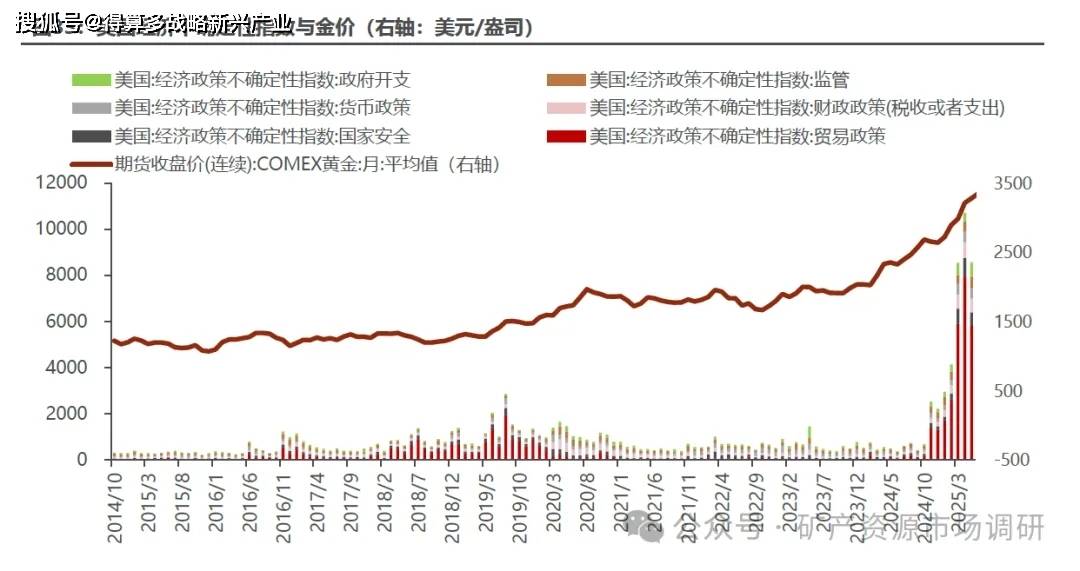
Group 1: Geopolitical Tensions and Economic Policies - The complex geopolitical situation has led to increased demand for gold as a safe-haven asset, driven by various global conflicts since 2025 [1][4] - Notable geopolitical events include Trump's proposal to make Canada the 51st state, ongoing tensions over Greenland, and the prolonged Russia-Ukraine conflict [1][2] - The U.S. has implemented fluctuating tariff policies, including significant increases on imports from China and other countries, contributing to economic uncertainty [3][4] Group 2: Gold Investment Trends - Global gold ETF holdings have risen, with Asian markets showing particularly strong investment sentiment, reflecting a growing influence of Asian capital in the gold market [7][8] - As of June 2025, SPDR Gold Trust's holdings increased by approximately 62 tons since the beginning of the year, although they remain at relatively low historical levels [7] - China's gold ETF market has seen record inflows, with a total asset management increase of 57% to 158 billion RMB (approximately 68 billion USD) and a rise in holdings by 65 tons to 203 tons [8]
印度雄心勃勃欲成造船大国
日经中文网· 2025-11-08 00:33
Core Viewpoint - The Indian maritime industry is rapidly developing, with a focus on expanding shipbuilding capabilities and increasing global market share, particularly as geopolitical risks prompt shipping companies to diversify their orders away from China [4][6]. Group 1: Industry Overview - Over 500 companies participated in the maritime exhibition in Mumbai, highlighting the global interest in strengthening maritime systems [4]. - The global shipbuilding market is dominated by China, South Korea, and Japan, which together account for over 90% of the market share, leaving India yet to establish a significant presence [2][10]. Group 2: Government Initiatives - The Indian government aims to transform the country into a global maritime hub, targeting an increase in the share of Indian ships in global freight from approximately 1% to 20% by 2047 [6]. - A support package worth 697.3 billion rupees (approximately 55.88 billion yuan) has been announced, which includes the establishment of a maritime development fund for shipbuilding and marine infrastructure [6]. Group 3: Company Developments - Cochin Shipyard, the largest shipbuilding company in India, has successfully delivered 70 small commercial vessels and is now focusing on international orders, having recently secured a contract for six container ships from CMA CGM [8][9]. - The company reported a sales increase of over 20% year-on-year for the fiscal year 2024, reaching approximately 50 billion rupees (around 4.01 billion yuan) [8]. Group 4: Market Dynamics - The geopolitical climate has led to increased risks associated with ordering ships from China, prompting shipping companies to seek alternatives, which benefits the Indian shipbuilding sector [9]. - The number of completed ships in India for the fiscal year 2023 is expected to reach around 200, tripling the figures from 2020 [9].