
出口增长

Search documents
马来西亚2025年贸易顺差为1518亿林吉特,同比增长9.2%
Xin Lang Cai Jing· 2026-01-20 04:32
Core Insights - Malaysia's December exports increased by 10.4%, significantly surpassing market expectations of 2.5% [1] - Imports rose by 12.0%, also exceeding the market forecast of 8.5% [1] - The trade surplus for December was recorded at 19.3 billion ringgit, well above the expected 12.8 billion ringgit [1] Trade Projections - For 2025, Malaysia's imports are projected to grow by 6.2% and exports by 6.5% [1] - The trade surplus for 2025 is expected to reach 151.8 billion ringgit, reflecting a year-on-year increase of 9.2% [1]
出口延续高增长,结构性降息政策出台
Hua Lian Qi Huo· 2026-01-18 13:32
1. Report's Investment Rating for the Industry - No investment rating for the industry is provided in the report. 2. Core Viewpoints of the Report - In December 2025, China's exports continued high - growth, imports rebounded significantly, and the trade surplus expanded. The Fed's January rate - cut probability decreased, and the RMB showed an appreciation trend. The central bank adjusted the structural monetary policy tool rate and commercial real - estate credit policies, aiming to improve capital activation and support the real economy [8][10]. 3. Summary According to Relevant Catalogs 3.1 National Economic Accounting - GDP quarterly data from 2023 to 2025 are presented, showing the performance of different industries, including agriculture, forestry, animal husbandry, fishery, industry, and services. The contribution rates and pulling effects of the three industries on GDP are also provided [13][18]. 3.2 Industry Analysis - **Industrial Sector**: The growth rate, added - value of major industries, and production of key products are analyzed. The profit situation of industrial enterprises shows mixed results, with some industries growing and some declining. The inventory of industrial enterprises is at a relatively high level, and enterprises still have the intention to reduce inventory [28][43][53]. - **Price Index**: In December 2025, the national consumer price index (CPI) increased year - on - year, and the industrial producer price index (PPI) decreased year - on - year but the decline narrowed. The prices of different categories in CPI and PPI showed different trends [60][68]. 3.3 Real Estate Market - In January - November 2025, real estate development investment, construction area, new - start area, completion area, sales area, and sales volume all declined year - on - year. The prices of new and second - hand residential properties in major cities also showed different degrees of decline [122][126][130]. 3.4 Foreign Trade and Investment - In December 2025, China's total import and export volume reached a record high. Exports to ASEAN and the EU increased, while exports to the US decreased. The export of key products and the import of key commodities are presented in detailed tables [93][100][101]. 3.5 Fixed - Asset Investment - From January - November 2025, national fixed - asset investment (excluding rural households) decreased year - on - year. Private fixed - asset investment also declined. Investment in different industries showed different trends, with the second - industry investment growing and the third - industry investment declining [114]. 3.6 Domestic Trade - The growth of service retail sales and social consumer goods retail sales is analyzed, and the year - on - year changes in retail sales of different industries above the quota are presented [158][165]. 3.7 Transportation - The transportation volume of goods and passengers by different means, the subway passenger flow in major cities, and the freight rates of shipping routes are analyzed [168][173][179]. 3.8 Banking and Currency - The new social financing scale, social financing scale stock, new RMB loans, and money liquidity are analyzed. The central bank emphasizes reasonable interest - rate control to promote the decline of the real - economy financing cost [183][194][200]. 3.9 Bond Market - The issuance of interest - bearing bonds and the yields of long - and short - term treasury bonds are analyzed [213][216]. 3.10 Foreign Exchange and Gold - The RMB exchange rate against the US dollar and the US dollar index are presented. China's gold reserves increased, and the foreign exchange reserves reached a new high [220][223]. 3.11 Fiscal and Employment - The central and local general public budget revenues and expenditures are analyzed, and the urban surveyed unemployment rate and new urban employment are presented [232][236][242]. 3.12 Business Climate Survey - The global and Chinese manufacturing and non - manufacturing PMI are analyzed. In December 2025, China's manufacturing PMI returned to the expansion range, and the non - manufacturing business activity index also rebounded [245][248][256]. 3.13 US Macroeconomy - The US real GDP growth rate, employment situation, treasury bond yields, retail sales, and the Fed's asset structure and federal funds rate are analyzed [263][266][274].
公布了!中国贸易顺差1.19万亿美元,对美国出口4200亿美元
Sou Hu Cai Jing· 2026-01-18 11:35
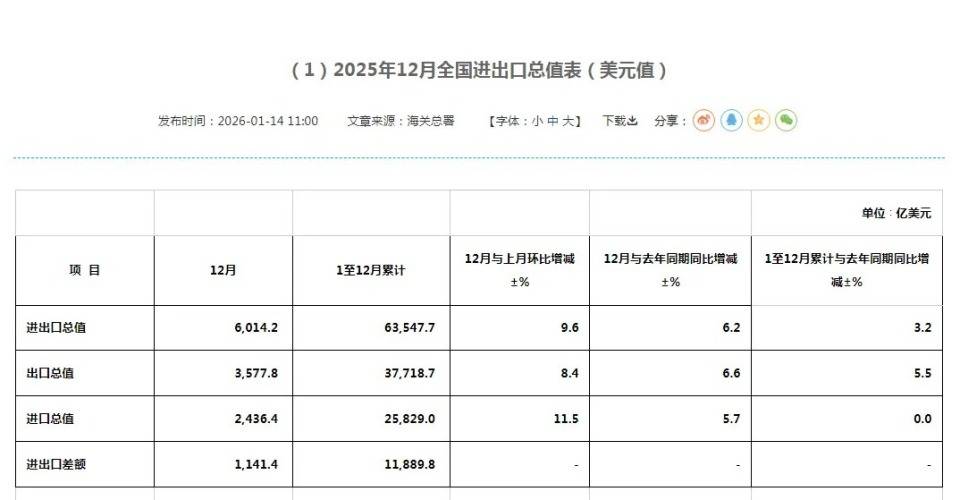
Core Insights - The overall performance of China's foreign trade in 2025 is impressive, with significant growth in both exports and imports, leading to a record trade surplus [1][4][10]. Trade Data Summary - In December 2025, China's exports increased by 5.2% year-on-year in RMB terms and 6.6% in USD terms, while imports grew by 4.4% and 5.7% respectively, resulting in a trade surplus of over 800 billion RMB and 114.1 billion USD [1][3]. - For the entire year of 2025, China's total foreign trade exceeded 45 trillion RMB, a 3.8% increase year-on-year, with exports reaching 27 trillion RMB (up 6%) and imports at 18.5 trillion RMB (up 0.5%), resulting in a trade surplus of 8.5 trillion RMB [4][6]. - In USD terms, the total trade volume reached 6.35 trillion USD, a 3.2% increase, with exports at 3.77 trillion USD (up 5.5%) and imports at 2.58 trillion USD (flat) [6][10]. Trade Relationships - China remains the world's largest exporter and the second-largest importer, with a record trade surplus of 1.19 trillion USD, the highest ever recorded for any country [6][10]. - The trade volume between China and the US in 2025 was 559.7 billion USD, a decline of 18% year-on-year, with exports to the US dropping by 20% and imports decreasing by 14% [8][11]. - In contrast, trade with ASEAN reached 1.05 trillion USD (up 7.4%), with exports to ASEAN at 665.2 billion USD (up 13.4%), making it China's largest export market, followed by the EU [8][10]. Market Dynamics - Despite a significant drop in exports to the US, China's overall exports still grew by over 5%, primarily due to strong performance in non-US markets such as ASEAN and the EU, which together accounted for 1.22 trillion USD, three times the exports to the US [10][11]. - The growth in exports to other regions, including Latin America and Africa, was notable, with exports to Africa increasing by 25.6% [10].

【光大研究每日速递】20260116
光大证券研究· 2026-01-15 23:04
Macro Insights - China's exports showed a year-on-year growth of 6.6% in December 2025, with an annual growth rate of 5.5%, driven primarily by high-tech products, integrated circuits, and automobiles. The outlook for exports remains optimistic despite a high comparative base in 2026, supported by overseas fiscal expansion and alignment of China's advantageous industries with global demand [5] - In the U.S., retail sales data for November 2025 indicated a month-on-month increase of 0.6%, surpassing expectations. The rebound in consumer data is attributed to the resolution of tariff policies and government shutdown impacts, with expectations for significant economic data improvements in Q1 2026 if government operations stabilize [5] Industry Developments - The State Grid of China plans to invest 4 trillion yuan in fixed assets during the 14th Five-Year Plan period, representing a 40% increase from the previous plan. This investment aims to enhance the new power system's industrial chain and supply chain, reinforcing the State Grid's role as an economic stabilizer [6] Company Performance - CITIC Bank reported a slight decline in operating revenue to 212.5 billion yuan for 2025, a decrease of 0.5% year-on-year, while net profit attributable to shareholders increased by 3% to 70.62 billion yuan. The bank's expansion remains steady, with a stable profit growth rate [7] - Li Ning Company announced a low single-digit year-on-year decline in retail revenue for Q4 2025, with offline and online channels experiencing mid-single-digit and flat growth, respectively. The company anticipates new contributions from upcoming Olympic and outdoor series [7]

【宏观】出口逆势破局,继续看好2026年表现——2025年12月进出口数据点评(赵格格/周可)
光大证券研究· 2026-01-15 23:04
Core Viewpoint - The article highlights the optimistic outlook for China's export growth in 2026, driven by strong overseas demand and the competitive advantages of Chinese exports, despite facing high year-on-year comparison bases [3][4]. Group 1: Export Performance - In December 2025, China's exports increased by 6.6% year-on-year, with a cumulative annual growth of 5.5%, primarily due to robust overseas demand and significant competitive advantages in exports [3]. - High-tech products, integrated circuits, and automobiles were the main drivers of export growth, while labor-intensive products contributed less [3]. Group 2: Future Outlook - The outlook for exports remains optimistic, as the fiscal expansion in major economies like the US and EU is expected to boost demand in 2026 [4]. - The alignment of China's advantageous industries with global demand is anticipated to support continued export growth [4]. - The transition of China's export dynamics towards new growth drivers, such as industrial robots and integrated circuits, aligns with global trends in green transformation and intelligent upgrades, potentially increasing their share in global trade [4]. - The easing of US-China trade tensions is expected to reduce uncertainties in exports to the US in 2026 [4].

内地出口增长韧性进一步夯实:环球市场动态2026年1月16日
citic securities· 2026-01-15 03:07
Market Overview - A-shares opened high but closed lower, with the financing margin ratio adjustment cooling the market; Hong Kong stocks rose, driven by AI applications boosting tech stocks[3] - European markets slightly retreated, with energy and resource stocks performing well; US stocks weakened, particularly in tech, while healthcare and resource stocks supported the market[3] Economic Indicators - China's December exports increased by 6.6% year-on-year, significantly above the expected 2.2%, while imports rose by 5.7%, also exceeding expectations of a 0.3% decline[5] - The resilience in non-US exports, particularly in the semiconductor and automotive sectors, contributed to the stronger export performance[5] Commodity and Forex Markets - Safe-haven demand lifted metal prices, with gold, silver, tin, and copper reaching new highs; oil prices fell nearly 3% in early Asian trading due to geopolitical tensions easing[4] - The US Treasury yields declined by 2-5 basis points, with the yield curve flattening amid increased demand for safe assets[4] Stock Market Performance - The Dow Jones closed at 49,149.6, down 0.1%; S&P 500 fell 0.5% to 6,926.6; Nasdaq dropped 1.0% to 23,471.8[7] - In Latin America, the São Paulo Stock Exchange index rose by 2.0%, while the S&P Mexico IPC index increased by 1.6%[8] Sector Highlights - In the Hong Kong market, the Hang Seng Index rose by 0.56%, driven by tech stocks, particularly in AI applications, with Alibaba Health surging by 18.9%[10] - The energy sector in the US saw a notable increase of 2.26%, while the non-core consumer goods sector led declines with a drop of 1.75%[8] Fixed Income Market - The primary market saw $12.6 billion in investment-grade bonds issued, with strong demand reflected in an average oversubscription of 5.6 times[30] - Asian investment-grade bonds showed positive sentiment, with spreads generally narrowing due to strong buying interest[30]
——2025年12月进出口数据点评:出口逆势破局,继续看好2026年表现
EBSCN· 2026-01-14 11:14
Export Performance - In December 2025, China's exports reached $357.78 billion, a year-on-year increase of 6.6%, surpassing the expected 2.2%[2] - The cumulative year-on-year growth for exports in 2025 was 5.5%[3] - High-tech products, integrated circuits, and automobiles were the main drivers of export growth, while labor-intensive products showed weak contributions[3] Import Trends - Imports in December 2025 totaled $243.64 billion, with a year-on-year growth of 5.7%, up from 1.9% in November[2][18] - Key imports included copper and iron ore, with respective year-on-year growth rates of 33.2% and 10.1%[18] Trade Balance - The trade surplus for December 2025 was $114.14 billion, slightly up from $111.68 billion in the previous month[2] Regional Export Dynamics - Exports to the EU and ASEAN grew by 11.6% and 11.1% respectively, while exports to the US fell by 30.0%[5] - The combined share of exports to the US, EU, and ASEAN accounted for 42.6% of total exports[5] Future Outlook - The outlook for 2026 remains optimistic, driven by fiscal expansion in major economies and alignment of China's competitive industries with global demand[22] - Potential impacts from easing US-China trade tensions and possible changes in tax policies in the EU and Japan are expected to have limited effects on exports[22] Risks - Risks include potential inflation in the US, high interest rates affecting global demand, and escalating international trade conflicts[25]
高盛首席中国经济学家闪辉:看多中国经济 预计今年底人民币汇率将升至6.85
2 1 Shi Ji Jing Ji Bao Dao· 2026-01-13 23:16
带着这些问题,21世纪经济报道记者对高盛首席中国经济学家闪辉进行了独家专访。在她看来,驱动这 一乐观预期的核心动能,源于对中国出口前景的全新评估。 在全球经济的再平衡进程中,中国制造业凭借其深厚的产业链优势和不断增强的科技竞争力,正展现出 强大的增长韧性。 然而,经济"外贸强内需弱"的不平衡格局,也对可持续发展提出了深刻挑战。如何善用出口带来的宝 贵"窗口期",系统性地构建内需增长的长效机制,将是中国经济实现高质量、可持续发展的关键所在。 新年伊始,全球经济图景在不确定性的迷雾中展开。当多数市场参与者仍在谨慎观望时,国际知名投行 高盛却逆势而上,率先在去年10月将其对中国2026年和2027年的GDP增速预测分别上调至4.8%和 4.7%。这是自2019年以来,该行对中国经济增长预期做出的最大幅度上调,其乐观程度显著高于市场 平均预期。 这一判断的底气何在?在全球经济的顺风与逆风之间,中国经济这艘巨轮将如何航行? 出口预期强劲 《21世纪》:在当前的国际经济形势下,高盛对中国经济的预测相对其他外资银行显得更为乐观:将 2025年GDP增速从4.9%上调至5.0%,2026年从4.3%上调至4.8%,2027年 ...

国补落地及2026年消费趋势判断
2026-01-04 15:35
Summary of Conference Call Notes Industry Overview - The conference call primarily discusses the **automobile** and **home appliance** industries in China, focusing on government subsidy policies and their implications for market dynamics and consumer behavior [1][2][20]. Key Points on Government Subsidies - **2025 National Subsidy Funding**: The funding mainly comes from special government bonds, with a total government debt of **14 trillion RMB**. The narrow deficit is **5.66 trillion RMB**, and special bonds amount to **1.8 trillion RMB** [2][3]. - **Subsidy Strategy Changes**: The automobile industry will see a shift to a high-price, high-subsidy and low-price, low-subsidy model, which is expected to reduce demand. The subsidy for electric vehicles and traditional vehicles will be adjusted based on vehicle price [2][14]. - **Impact on Tax Revenue**: Consumer subsidies are expected to increase sales and tax revenues, but the tax revenue growth rate is projected to be **2%**, lower than the nominal GDP growth rate of **4%**, indicating fiscal pressure [9]. Automobile Industry Insights - **Market Trends**: The automobile sector is expected to face a decline in domestic demand by **3-4%** in 2026, but the penetration rate of new energy vehicles is anticipated to increase by **4-5%**. Exports are expected to grow by **15%**, with new energy vehicle exports increasing by **35%** [14][19]. - **Investment Opportunities**: Key growth areas include international expansion, high-end market development, and smart technology integration, particularly in L4 autonomous driving [15][17]. - **Consumer Behavior**: There is a significant consumer wait-and-see attitude, with **40-60%** of consumers hesitant to make purchases, leading to inventory buildup [19]. Home Appliance Industry Insights - **Subsidy Policy Changes for 2026**: The number of subsidized categories will be reduced from **12 to 6**, focusing on energy-efficient products. The maximum subsidy per product will decrease from **2000 RMB to 1500 RMB** [20]. - **Market Performance**: The home appliance sector showed mixed results in 2025, with overall sales growth in the first half but a decline in the second half due to tightening policies and high base effects [21]. - **Future Outlook**: If the government continues to provide **80 billion RMB** in subsidies, the home appliance market is expected to see modest growth, with air conditioning sales projected to increase by **4.7%** under reduced subsidy effectiveness [22]. Competitive Landscape - **Market Dynamics**: The competitive landscape in the home appliance industry is shifting towards larger companies like Midea and Haier, which are enhancing shareholder returns through dividends and stock buybacks. Emerging markets and new product exports are becoming crucial for growth [24]. - **Investment Potential**: The two-wheeler market and emerging products like robotic vacuums are highlighted as having strong investment potential due to resilient demand and low valuations [23]. Conclusion - The conference call emphasizes the cautious approach of the government in adjusting subsidy policies to stabilize investment and consumption while addressing fiscal pressures. The automobile and home appliance industries are adapting to these changes, with a focus on innovation and international expansion as key growth strategies.
塞尔维亚2025年GDP增长2%
Shang Wu Bu Wang Zhan· 2026-01-01 16:46
Economic Growth - Serbia's GDP is projected to grow at a real rate of 2% in 2025 [1] - Most service and industrial activities have shown growth, with retail growing by 4.2%, transportation by 4.7%, and the restaurant sector by 1.5% [1] Sector Performance - Industrial production value increased by 1.0%, with mining up by 4.4% and manufacturing by 1.2% [1] - The construction sector experienced a decline of 8.4% [1] - The energy sector faced a decrease of 2% due to drought affecting hydroelectric reserves [1] - Agriculture saw a slight decline of 0.3% due to adverse weather conditions [1] Inflation and Labor Market - The average inflation rate for 2025 is expected to be 3.8%, with December's inflation rate at 2.8%, aligning with the central bank's target of 3%±1.5% [1] - The labor market remains strong, with nominal wages increasing by 11.2% and real wages by 7.1% [1] - The unemployment rate decreased to 8.2% in the third quarter [1] Trade Performance - Despite weak external demand, Serbia's exports are estimated to grow by 8% in 2025, primarily driven by the automotive sector [1] - Imports are projected to rise by 7.3%, attributed to ongoing imports of raw materials and equipment, as well as increased consumer goods imports due to rising disposable incomes [1]