
宽松交易

Search documents
贵金属日报-20251215
Guo Tou Qi Huo· 2025-12-15 13:09
1. Report Industry Investment Rating - Gold: ★☆☆, indicating a bullish bias but poor operability on the market [1] - Silver: ★☆☆, indicating a bullish bias but poor operability on the market [1] 2. Core View of the Report - Today, precious metals continued to strengthen. After the Fed's interest - rate cut and bond - buying, the easing trade is expected to continue. Attention is paid to this week's US November non - farm and CPI data [1] - Short - term silver hit a new high, and gold is approaching the October high. If the resistance is broken, precious metals may remain strong. Platinum and palladium hit new highs, and long - term allocation is clear [1] 3. Summary by Related Information Fed's Policy and Officials' Views - Last week, the Fed cut interest rates by 25 basis points as expected, announced to buy $40 billion short - term bonds in the next 30 days. There were internal differences, and the dot plot maintained the expectation of one interest rate cut each in the next two years [1] - Powell said the risk of employment decline increased, and the interest rate was at the upper end of the neutral range. The meeting was overall neutral, and restarting bond - buying was earlier than expected [1] - After the meeting, several officials still expressed a cautious attitude towards interest rate cuts. Last week's employment data was mixed, with the number of job openings in October increasing to 7.67 million and the weekly initial jobless claims increasing by 44,000 to 236,000 [1] - Goolsbee: Wait for more data before cutting rates, and expect more rate cuts in 2026 than the median; Schmid: Inflation is still too high, and a moderately restrictive monetary policy should be maintained; Paulson: More concerned about employment risks, and the monetary policy is restrictive; Harker: Tend to adopt a slightly more restrictive policy stance [2] Market Performance of Precious Metals - Short - term silver continued to hit a new high, showing strong financial attributes and tight spot supply under the enhanced expectation of Fed's rate cut. Gold rose to near the October high [1] - Platinum and palladium prices hit new highs on Monday, with the outer market breaking through the previous high and accelerating. They follow the bull market of precious metals, are favored by long - term funds, and have macro premium and potential demand from the commercial space and hydrogen sectors [1] Other News - Trump prefers to choose former Fed governor Warsh or White House National Economic Council Director Hassett as the next Fed chairman [2] - Ukrainian President Zelensky proposed to give up joining NATO during a five - hour talk in Berlin. The US envoy said the talks made "significant progress" but did not disclose details [2]
2026年外汇市场展望:宽松交易或阶段性回归
2025-12-04 02:21
Summary of Key Points from the Conference Call Industry Overview - The conference call discusses the foreign exchange market outlook for 2026, highlighting the expected return of loose trading conditions and the potential weakening of the US dollar in the first half of 2026, with the dollar index projected to fall to the 90-94 range [2][13]. Core Insights and Arguments - **2025 Market Dynamics**: The US dollar weakened in the first half of 2025 due to tariff uncertainties and fluctuating employment data, leading to a de-dollarization trend. However, by the second half, the dollar rebounded as tariff issues were resolved and the Federal Reserve's rate cuts were fully priced in, resulting in a low volatility environment [3][4]. - **Carry Trade Strategy**: In the current low volatility environment, the primary trading strategy is the carry trade, where investors sell low-yield currencies and buy high-yield currencies. Latin American currencies, such as the Brazilian real and Mexican peso, performed well due to high interest rates [4][5]. - **Factors Influencing 2026 Volatility**: Key factors that may affect volatility in 2026 include changes in US policy expectations, deteriorating employment data, signs of economic recession indicated by PMI indices, and the stance of the new Federal Reserve chairman on interest rates [6][7]. - **Federal Reserve's Potential Actions**: The Federal Reserve may adjust interest rates in response to economic conditions, with a potential for further rate cuts if employment continues to decline. Current forward implied rates suggest a 50-75 basis point reduction is possible [7][8]. - **Global Interest Rate Disparities**: There is a significant difference in the future rate cut potential between the US and other central banks, with the US having more room to cut rates compared to the European Central Bank and the Bank of England. This could narrow interest rate differentials and encourage foreign investment in US assets without significantly increasing the dollar's value [8]. Other Important Considerations - **Upcoming Risks**: Notable risks include the potential for a US government shutdown, which could tighten liquidity, and ongoing tariff issues that may create market volatility. The possibility of the Supreme Court ruling on current tariffs could lead to renegotiations of trade agreements [10][11]. - **Impact of Technology and AI**: The rise of AI technology may enhance productivity but could also lead to demand shrinkage, creating imbalances in the global economy and potentially causing significant fluctuations in financial markets, including the forex market [9]. - **Chinese Yuan Outlook**: The Chinese yuan is expected to appreciate gradually in 2025, supported by stable US-China trade relations and a weak dollar environment. The yuan may fall below 7 against the dollar in the first half of 2026 [14][15]. This summary encapsulates the key points discussed in the conference call, providing insights into the foreign exchange market's dynamics, strategies, and potential risks moving forward.
【中金外汇 · 年度展望】宽松交易或回归
Sou Hu Cai Jing· 2025-12-02 07:01
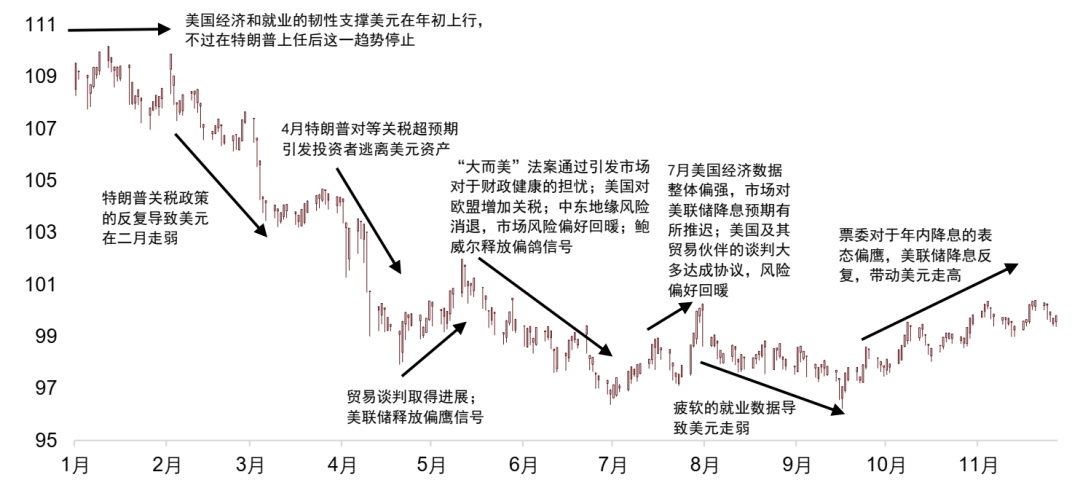
Summary of Key Points Core Viewpoint The global foreign exchange market has been significantly influenced by tariff expectations and fluctuations in the US dollar exchange rate since 2025. The dollar index experienced a notable decline in the first half of 2025, followed by stabilization in the latter half, with expectations of further movements in 2026 driven by interest rate differentials and changes in risk appetite. Group 1: 2025 Overview - The dollar index fell significantly in the first quarter of 2025 due to weaker-than-expected tariff policy advancements by the Trump administration, reversing the "Trump trade" [1] - In the second quarter, the dollar experienced a sharp decline driven by unexpected "reciprocal tariffs" and escalating US-China trade tensions, raising concerns about the US economic outlook and the stability of dollar assets [1][5] - The dollar stabilized in the third quarter as the US reached tariff agreements with major trading partners, alleviating market concerns about economic and financial stability [1][5] Group 2: 2026 Outlook - The narrowing of interest rate differentials and changes in risk appetite are expected to become the main themes in currency trading for 2026 [2][19] - The Federal Reserve's potential for more aggressive rate cuts compared to other non-US central banks may lead to a further decline in the dollar's volatility center [2][19] - The performance of different non-US currencies is likely to diverge, with the euro expected to lead due to improved economic growth dynamics in the Eurozone [3][19] Group 3: Renminbi (RMB) Dynamics - The RMB's exchange rate will be influenced by the dollar's performance and changes in US-China trade relations, with a stable exchange rate policy potentially impacting the RMB's trajectory [3][41] - The RMB is expected to appreciate moderately as the Fed's rate cuts narrow the interest rate differential between China and the US [3][41] - The resilience of the Chinese economy and financial markets under tariff pressures has reduced the impact of tariff risks on the RMB [3][41][64] Group 4: Currency Performance and Strategies - High-yield currencies from Latin America and Europe have performed relatively well, supported by favorable interest rate differentials and lower volatility [12][13] - The carry trade strategy has been the most profitable forex trading strategy in 2025, indicating a return to traditional trading logic based on interest rate differentials [13] - The euro is expected to benefit from reduced need for aggressive rate cuts by the European Central Bank, while the yen and pound may face relative weakness due to domestic policy pressures [3][38][39] Group 5: External Factors and Risks - The US government shutdown and tariff rate fluctuations pose risks to market stability and may increase volatility in the forex market [32][33] - Political uncertainties in France and Japan, as well as geopolitical factors like the Ukraine conflict, could also impact global risk sentiment and currency performance [32][36] - The overall environment is expected to favor a gradual appreciation of the RMB, supported by the internationalization of the currency and a stable economic outlook [62][76]

中金2026年展望 | 外汇:宽松交易或阶段性回归(要点版)
中金点睛· 2025-11-04 23:48
Core Viewpoint - The global foreign exchange market in 2025 has been significantly influenced by tariff expectations and fluctuations in the US dollar exchange rate, with a notable decline in the dollar index during the second quarter due to unexpected tariff announcements and deteriorating employment data [2][3][4]. Group 1: 2025 Overview - In the first quarter of 2025, the dollar index fell from its high as Trump's tariff policies progressed slower than expected, reversing the "Trump trade" that had boosted the dollar [2][4]. - The second quarter saw a significant drop in the dollar index, primarily due to the announcement of "reciprocal tariffs" that exceeded market expectations and rising trade tensions between the US and China, leading to concerns about the stability of the US economy and dollar assets [2][4]. - By the third quarter, the dollar's performance stabilized as the US reached tariff agreements with major trading partners, alleviating market concerns about economic stability, and the dollar entered a consolidation phase [2][4]. Group 2: 2026 Outlook - For 2026, narrowing interest rate differentials and changes in risk appetite are expected to be the main themes in currency trading, with the Fed's potential for rate cuts being greater than that of other non-US central banks [3][10]. - The US labor market is anticipated to slow down, prompting the Fed to consider more accommodative monetary policies, especially with a potential change in leadership at the Fed [3][11]. - The dollar's decline is expected to be limited due to the absence of crowded long positions and the relative economic strength of the US compared to Europe and Japan [3][13]. Group 3: Renminbi (RMB) Dynamics - The core variables influencing the RMB exchange rate in 2026 will be the dollar's performance and changes in US-China trade relations, with a stable exchange rate policy likely impacting the RMB's trajectory [4][16]. - The RMB appreciated approximately 2.5% in the first three quarters of 2025, initially facing depreciation pressure due to tariffs but later benefiting from the dollar's decline and improved trade negotiations [14][15]. - The expectation is that the RMB will continue to appreciate moderately in 2026, supported by the weakening dollar and converging interest rates between China and the US [16][17].

美股2026年度策略 | 高处如何布局?
Sou Hu Cai Jing· 2025-11-04 05:27
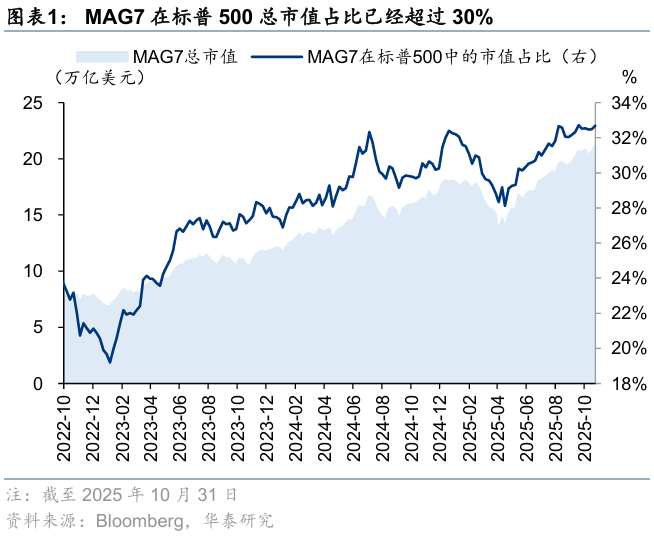
Group 1: Market Overview - The liquidity easing trend is expected to continue until the first half of 2026, with a focus on cyclical economic recovery in the second half of the year [1][5] - The U.S. stock market has experienced a K-shaped divergence, with the MAG7 companies contributing significantly to market capitalization growth [2][6] - As of October 31, 2025, the MAG7 companies accounted for over 30% of the S&P 500's total market capitalization, contributing nearly 50% of the market's expansion since 2023 [6][10] Group 2: Technology Sector Analysis - The current technology market is reminiscent of the late 1990s, with a concentration on high-quality large-cap stocks, raising concerns about potential market bubbles [3][22] - The EPS growth contribution from top tech stocks has been substantial, with MAG7's EPS growth reaching 24.7% [23][34] - Speculative trading has increased, with leverage in the stock market nearing levels seen during the 2020 QE period [34][35] Group 3: Economic Projections - The U.S. economy is expected to maintain a K-shaped divergence, but the driving factors may become more balanced compared to the past [4][57] - Bloomberg forecasts a 13.7% EPS growth for the S&P 500 in 2026, with a slowdown in capital expenditure growth for MAG7 [57][59] - Traditional economic recovery is anticipated to accelerate, supported by reduced trade policy uncertainty and monetary easing [57][63] Group 4: Investment Strategy Recommendations - Investors are advised to focus on profitable leading companies in the tech sector while gradually increasing exposure to cyclical sectors as the year progresses [5][64] - Historical data suggests that cyclical sectors tend to perform well after the end of a rate-cutting cycle, with significant positive returns expected [64][66] - Global diversification is recommended, with particular attention to developed markets like Germany and Switzerland, and emerging markets such as Saudi Arabia, South Korea, and India [65][67]
每日投行/机构观点梳理(2025-10-13)
Jin Shi Shu Ju· 2025-10-13 11:33
Group 1: Copper and Nickel Market Outlook - Goldman Sachs forecasts copper prices to remain in the range of $10,000 to $11,000 per ton in 2026/2027 [1] - Goldman Sachs predicts nickel prices will decline by 6% to $14,500 per ton by December 2026 due to the need for Indonesian nickel producers to lower profit margins to limit supply growth [1] Group 2: Gold Price Predictions - Canadian Imperial Bank of Commerce expects gold prices to rise to $4,500 per ounce in 2026 and 2027, before falling to $4,250 in 2028 and $4,000 in 2029, driven by long-term inflation concerns [1] - The recent surge in gold prices is attributed to fears of long-term inflation and wealth preservation, as the Federal Reserve's monetary policy has not adequately addressed these concerns [1] Group 3: Japanese Yen and Interest Rate Expectations - State Street Bank indicates that the delay in interest rate hikes has exacerbated the weakness of the Japanese yen, with market reactions expected if there is no consensus on the appointment of the new Prime Minister [2] Group 4: European Central Bank's Stance - Pantheon Macroeconomics suggests that the European Central Bank is unlikely to lower interest rates in the coming months despite a weak economic outlook, as they may view current economic weakness as temporary [3] Group 5: Chinese Market and Liquidity - China International Capital Corporation highlights October as a potential liquidity resonance window, suggesting that A-shares and Hong Kong stocks offer better value compared to U.S. stocks due to a shift towards a more accommodative monetary policy [4] - The report indicates that the recent escalation in U.S.-China trade tensions is expected to have a weaker impact on A-shares compared to previous events, with a focus on long-term asset revaluation in China [5] Group 6: Gold Market Dynamics - Guoxin Securities notes that the recent rise in gold prices is driven by expectations of Federal Reserve rate cuts, geopolitical risks, and increased investment demand, marking the beginning of a new strong cycle for gold [6] Group 7: Energy Storage and Lithium Battery Sector - CITIC Securities continues to recommend the energy storage sector, citing a turning point in domestic energy storage economics and a favorable outlook for the lithium battery industry [7] Group 8: Cobalt and Rare Earth Strategic Opportunities - CITIC Securities identifies strategic opportunities in cobalt and rare earths, with new export quotas from the Democratic Republic of Congo expected to lead to a market shift from surplus to shortage [8] Group 9: Market Volatility and Investment Strategy - Everbright Securities predicts that the market may enter a phase of wide fluctuations due to high valuations and cautious capital, while also noting potential support from upcoming policy expectations [9] Group 10: Long-term Outlook for Gold - Guoxin Securities maintains a positive long-term outlook for gold, suggesting that the third wave of opportunities may arise from shifts in capital flows due to the peak of the AI technology wave [10] Group 11: External Shocks and Chinese Market Opportunities - Guotai Junan Securities views external shocks as buying opportunities for the Chinese market, emphasizing the internal certainty of China's transformation and the demand for quality assets [11]
张尧浠:未来一年宽松交易为主流 金价4000关或又只是开始
Sou Hu Cai Jing· 2025-10-13 09:57
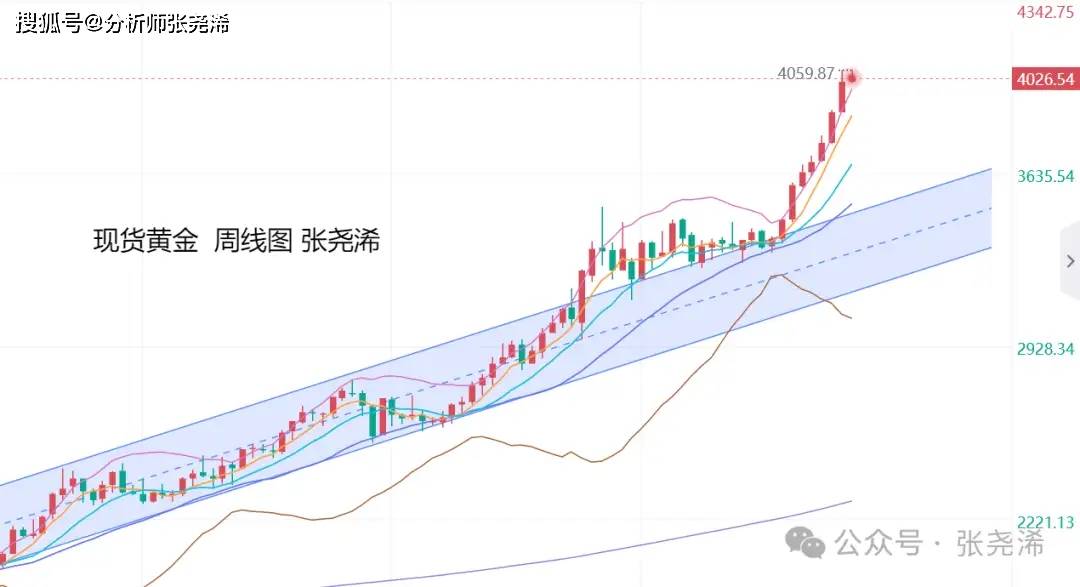
Core Viewpoint - The international gold market has seen a strong rebound, reaching historical highs, driven by geopolitical tensions, expectations of interest rate cuts by the Federal Reserve, and ongoing concerns about the U.S. government shutdown [1][3][6]. Price Movements - Gold prices opened the week at $3887.48 per ounce, hitting a low of $3884.01 before rebounding to a high of $4058.85, ultimately closing at $4012.63, marking a weekly increase of $128.31 or 3.3% [3][4]. - The price volatility included a significant drop to $3945 before recovering, indicating strong buying interest at lower levels [3][4]. Influencing Factors - Geopolitical factors, including the Israel-Hamas ceasefire and U.S. government shutdown concerns, have contributed to fluctuations in gold prices [3][7]. - The market is also reacting to U.S. tariffs on imports and the World Trade Organization's downward revision of global trade growth forecasts for 2026, which have added to the uncertainty [3][5]. Future Outlook - Short-term expectations suggest that even if gold prices do not rise, they will likely remain in a range-bound fluctuation due to ongoing geopolitical and economic uncertainties [5][6]. - Long-term projections indicate a potential for further increases in gold prices, with Goldman Sachs raising its 2026 gold price target to $4900 per ounce, supported by continued central bank purchases and a shift towards "de-dollarization" in emerging markets [5][6]. Market Sentiment - The overall sentiment remains bullish for gold, with a 52% increase in prices year-to-date, driven by factors such as interest rate cut expectations, geopolitical uncertainties, and central bank buying [6][9]. - The market is expected to maintain a positive outlook, with key support levels to watch for potential buying opportunities [6][9].
金晟富:10.13黄金强势破位大涨顺势而为!晚间黄金分析参考
Sou Hu Cai Jing· 2025-10-13 06:24
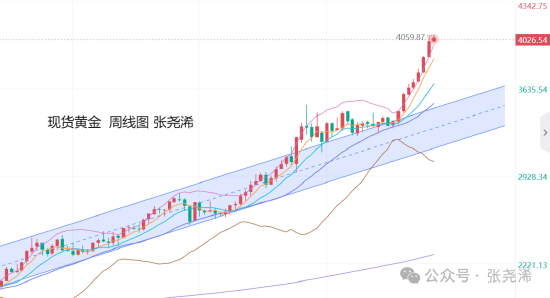
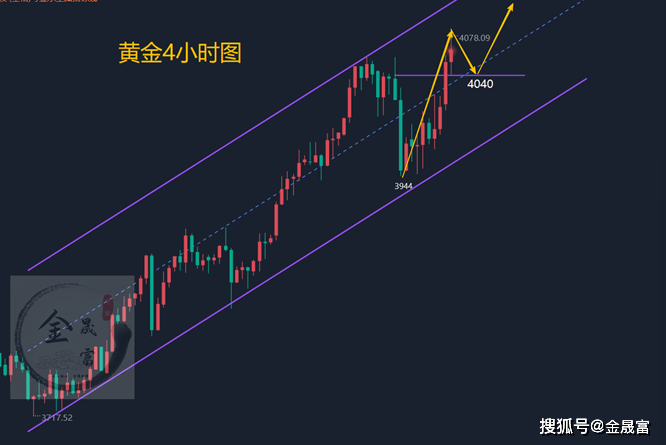
Core Viewpoint - The recent surge in precious metal prices, particularly gold, is driven by various factors including geopolitical tensions, central bank buying, and expectations of further monetary easing by the Federal Reserve [1][2][3] Group 1: Market Trends - Gold prices reached a historical high of $4,078.13 per ounce, marking an increase of over 52% year-to-date [1][2] - Silver prices approached $51 per ounce, with platinum and palladium also seeing significant increases of over 2% [1] - The overall precious metals market has seen price increases ranging from 50% to 80% for major metals this year [1] Group 2: Economic Influences - Geopolitical events, such as the ceasefire agreement between Hamas and Israel, have temporarily cooled market risk appetite but have not eliminated underlying concerns [2] - The likelihood of further interest rate cuts by the Federal Reserve is high, with expectations of a dovish shift in monetary policy [2] - Central banks globally are increasing their gold reserves, with China reporting a rise in gold holdings to 7.406 million ounces, marking the 11th consecutive month of increases [2] Group 3: Technical Analysis - Technical indicators across various timeframes (monthly, weekly, daily, and hourly) show a strong upward trend for gold, suggesting a continued bullish outlook [3][5] - Current trading strategies recommend focusing on buying on dips, with key resistance levels identified at $4,090-$4,100 and support levels at $3,990-$4,000 [5][6] Group 4: Market Sentiment - The market sentiment remains bullish, with a prevailing belief that the upward trend in gold and silver prices is not yet at its peak [7][8] - Historical patterns suggest that significant price increases often precede market tops, indicating that the current rally may continue [8] - The overall market environment is characterized by a strong demand for safe-haven assets amid economic uncertainties [2][7]
张尧浠:未来一年宽松交易为主流、金价4000关或又只是开始
Sou Hu Cai Jing· 2025-10-13 00:54
Core Viewpoint - The international gold market has shown a strong rebound, reaching historical highs, driven by geopolitical tensions, expectations of interest rate cuts by the Federal Reserve, and ongoing concerns about a potential U.S. government shutdown [1][3][7]. Price Movements - Gold prices opened the week at $3887.48 per ounce, hitting a low of $3884.01 before rebounding to a high of $4058.85, ultimately closing at $4012.63, marking a weekly increase of $128.31 or 3.3% from the previous week's close of $3884.53 [3][4]. - The price volatility for the week was $174.84, indicating significant market movements influenced by various factors [3]. Influencing Factors - Geopolitical risks, including the ongoing U.S.-China trade tensions and the Israel-Hamas conflict, have contributed to increased demand for gold as a safe-haven asset [3][4][6]. - The Federal Reserve's anticipated interest rate cuts and the potential economic impact of a government shutdown have further supported gold prices [1][6][7]. - The World Trade Organization's downgrade of global trade growth forecasts for 2026 has also played a role in driving gold prices higher [3]. Market Sentiment - Despite a temporary dip in gold prices following a ceasefire agreement between Israel and Hamas, the overall market sentiment remains bullish due to ongoing geopolitical uncertainties and expectations of further monetary easing by the Federal Reserve [6][7]. - The market is characterized by a strong demand for gold, with central banks, particularly in emerging markets, increasing their gold reserves as part of a "de-dollarization" strategy [7][8]. Long-term Outlook - Analysts predict that the Federal Reserve may adopt a more dovish stance in the coming year, potentially accelerating the pace of interest rate cuts, which would be favorable for gold prices [7][8]. - Goldman Sachs has raised its gold price target for December 2026 to $4900 per ounce, reflecting a bullish long-term outlook for gold [7].
中金:美联储降息节奏可能在“快-慢-快”之间切换
Sou Hu Cai Jing· 2025-10-10 00:21
Core Viewpoint - The report from CICC suggests that the Federal Reserve's interest rate cut cycle may unfold in three phases: a fast phase in Q4 2025, a slow phase in the first half of 2026, and a subsequent acceleration in cuts later in 2026 [1] Summary by Sections - **Phase 1: Fast Cuts (Q4 2025)** - The initial phase is expected to involve rapid rate cuts, potentially 3-4 consecutive reductions [1] - **Phase 2: Slower Cuts (First Half of 2026)** - In the second phase, the pace of cuts is anticipated to slow down as inflation continues to rise, prompting the Fed to balance growth and inflation risks [1] - **Phase 3: Accelerated Cuts (Second Half of 2026)** - The final phase may see a renewed acceleration in rate cuts, especially with the potential appointment of a more dovish Fed chair after Powell's term ends in May 2026 [1] - **Market Implications** - The overall expectation is for a trend towards monetary easing over the next year, which is likely to favor various asset classes including equities, bonds, and commodities, while also contributing to a depreciation of the US dollar [1]