
市场利率

Search documents
MLF加量续作
Qi Huo Ri Bao· 2025-09-26 06:54
Core Viewpoint - Domestic market interest rates are showing a strong trend due to high demand for funds at the end of the quarter, with expectations of a weaker rate next week as short-term funding needs are likely to ease [1] Interest Rate Summary - As of September 25, the Shanghai Interbank Offered Rate (Shibor) overnight rate closed at 1.472%, a decrease of 4.2 basis points from September 18 [1] - The rates for 1-week, 2-week, 1-month, 3-month, 6-month, 9-month, and 1-year periods are reported at 1.584%, 1.625%, 1.564%, 1.574%, 1.635%, 1.669%, and 1.679% respectively, with increases of 5.6, 4.4, 2, 1.8, 0.4, 0.7, and 0.6 basis points compared to September 18 [1] Central Bank Operations - This week, the central bank has 18,268 billion yuan of reverse repos maturing, and has conducted 17,016 billion yuan of reverse repos in the first four working days [1] - The central bank has 300 billion yuan of Medium-term Lending Facility (MLF) maturing and has rolled over 600 billion yuan of MLF, injecting 300 billion yuan of liquidity into the market [1] Future Outlook - The probability of weaker domestic market interest rates next week is high due to the release of short-term funding needs before the holiday and the central bank's liquidity injection through MLF, which helps stabilize medium to long-term rates [1]
债基全解析:从分类到风险,一文读懂“稳健投资”的真相!
Sou Hu Cai Jing· 2025-09-24 02:41
Core Viewpoint - The article addresses the confusion among investors regarding bond funds, which are traditionally seen as stable investments, highlighting the importance of understanding different types of bond funds and the risks associated with them [1] Group 1: Types of Bond Funds - Bond funds can be categorized into three main types based on asset allocation and investment strategy: pure bond funds, mixed bond funds, and bond index funds [2] - Pure bond funds focus entirely on bonds, making them the least risky category, suitable for conservative investors seeking stable returns [3] - Mixed bond funds combine bonds with stocks or convertible bonds to enhance yield while managing risk, with performance closely tied to stock market movements [6] - Bond index funds aim to replicate the performance of specific bond indices, offering low fees and transparency, making them suitable for long-term investors [8] Group 2: Reasons for Decline in Bond Funds - The average decline of 0.3% in bond funds during Q2 2023 can be attributed to four main risks: rising interest rates, credit risk, liquidity crises, and strategic errors [10][11] - Rising interest rates negatively impact bond prices, leading to potential declines in fund net values [11] - Credit risk arises when bond issuers default, directly affecting the net value of bond funds [11] - Liquidity issues can occur during large redemptions, forcing fund managers to sell bonds at lower prices, resulting in net value drops [11] - Strategic errors, such as investing in convertible bonds or using leverage, can amplify risks and lead to greater volatility in fund values [13][15] Group 3: Investment Strategies - Investors are advised to choose bond fund types based on their risk tolerance, focusing on key indicators such as duration, credit rating, and fund size [13][15] - Conservative investors should consider short-term pure bond funds or bond index funds, while more aggressive investors might explore mixed bond funds or convertible bond funds [16] - Timing investments is crucial; for instance, investing in medium to long-term pure bond funds is favorable when long-term interest rates are high [16]


固定收益专题研究:关注CPI内部的结构分化
Guoxin Securities· 2025-09-17 09:22
Report Industry Investment Rating No industry investment rating information is provided in the report. Core View - The internal structure of CPI (food and non - food items) has shown significant divergence in recent years, which has smoothed the CPI's volatility and made it difficult to determine the direction of CPI changes. The influence on CPI depends on the weight composition (2:8) and the volatility of food and non - food items [1][10][11]. - Monetary policy and the market should pay more attention to non - food price changes because non - food prices are more related to demand factors, while food prices are more related to supply factors [19][20][26]. Summary by Directory Why have the trends of food and non - food items differed in recent years? - Food prices are more affected by domestic supply and national security management factors. Since 2015, the correlation between Chinese and international food prices has weakened, indicating that China's food supply cycle is out of sync with the world's, likely due to China's efforts in ensuring food supply security [14][17]. - Non - food prices are still closely related to global demand cycles, and the correlation between China's non - food prices and international industrial raw material prices remains strong [17]. Which factor determines the rise and fall of CPI between food and non - food divergence? - The direction and trend of CPI changes depend on the weight composition (2:8) of food and non - food items in CPI and their volatility. Although non - food items have a higher weight, food items with larger volatility can also significantly affect CPI. For example, in August, the sharp decline in food prices led to a drop in CPI [18]. - Using overall CPI to judge supply - demand strength is challenging, especially when food and non - food trends diverge. It is better to conduct in - depth structural analysis [18]. Which type of factor in the structural divergence will monetary policy and the market pay more attention to? - Monetary policy focuses on non - food price changes because they better reflect economic demand. For example, during the so - called high - inflation period in the second half of 2019, the central bank maintained a moderately loose stance because the CPI increase was mainly driven by food prices [19][20]. - The interest rate market also pays more attention to non - food factors. The correlation between the 10 - year treasury bond rate and non - food price growth has increased since 2015, while the correlation with food price growth has decreased significantly [22][23][26].
宝城期货国债期货早报-20250911
Bao Cheng Qi Huo· 2025-09-11 01:50
Group 1: Report Industry Investment Rating - No relevant content provided Group 2: Core Views of the Report - The short - term, medium - term, and reference views of TL2512 are all "oscillation", with an intraday view of "oscillation on the weak side". The core logic is that there is still a long - term expectation of interest rate cuts, but the possibility of a short - term comprehensive interest rate cut is low [1]. - The main varieties TL, T, TF, TS have an intraday view of "oscillation on the weak side", a medium - term view of "oscillation", and a reference view of "oscillation". In the short term, the upward and downward momentum of treasury bond futures is insufficient, and they are expected to be in low - level oscillation. In the long run, there is still an expectation of interest rate cuts, and there is support below the treasury bond futures [5]. Group 3: Summary by Related Catalogs Variety Views Reference - Financial Futures Stock Index Sector - For the variety TL2512, the short - term, medium - term, and reference views are "oscillation", and the intraday view is "oscillation on the weak side". The core logic is the co - existence of long - term interest rate cut expectations and low short - term comprehensive interest rate cut possibility [1]. Main Variety Price Market Driving Logic - Financial Futures Stock Index Sector - Yesterday, treasury bond futures oscillated and pulled back. In the short term, the necessity for a comprehensive interest rate cut is insufficient, so the downward space of market interest rates is limited, and the upward momentum of treasury bond futures is insufficient. The rebound momentum from late August to early September has weakened, and market interest rates have gradually recovered. - In the long run, monetary policy is supportive, and there is still an expectation of interest rate cuts, so there is support below treasury bond futures. - Recently, the risk appetite in the stock market has declined, and the stock market has entered an oscillatory adjustment. The siphoning effect of the equity market on bond market funds has weakened. - The latest inflation data shows a month - on - month stabilization but is still weak overall. Subsequent policy will continue to introduce demand - stabilizing policies, with fiscal policy as the main means. There may be some pressure on the supply side of treasury bonds in the fourth quarter [5].
宝城期货国债期货早报-20250904
Bao Cheng Qi Huo· 2025-09-04 01:30
Report Summary 1. Report Industry Investment Rating No information provided. 2. Core Viewpoint of the Report The overall view of treasury bond futures is to oscillate. In the short - term, they are likely to be in an oscillatory consolidation phase with limited upside and downside potential. In the medium - term, they are expected to oscillate, and in the long - term, there is a relatively high possibility of an upward trend [1][5]. 3. Summary According to Relevant Catalogs 3.1 Variety Viewpoint Reference - Financial Futures Stock Index Sector - For the TL2512 variety, the short - term view is oscillatory, the medium - term view is oscillatory, the intraday view is weakly oscillatory, and the overall view is oscillatory. The core logic is that there are still long - and medium - term expectations for interest rate cuts, but the possibility of a short - term comprehensive interest rate cut is low [1]. 3.2 Main Variety Price Market Driving Logic - Financial Futures Stock Index Sector - The intraday view for varieties such as TL, T, TF, and TS is weakly oscillatory, the medium - term view is oscillatory, and the reference view is oscillatory. The core logic is that treasury bond futures rebounded oscillatoryly yesterday. Recently, the stock market has entered a short - term adjustment, increasing risk - aversion sentiment. Market interest rates are restricted by policy rates, limiting their upward space and causing treasury bond futures to bottom out. However, due to the lack of necessity for a short - term comprehensive interest rate cut and the focus on structural easing, the short - term rebound space of treasury bond futures is limited. In the future, the monetary policy environment is generally loose, and with the increasing expectation of the Fed's interest rate cut, the depreciation pressure on the RMB exchange rate has weakened, leaving room for interest rate cuts and increasing the long - term upward possibility of treasury bond futures [5].
香港第一金:关注黄金能否守住3500
Sou Hu Cai Jing· 2025-09-03 09:36
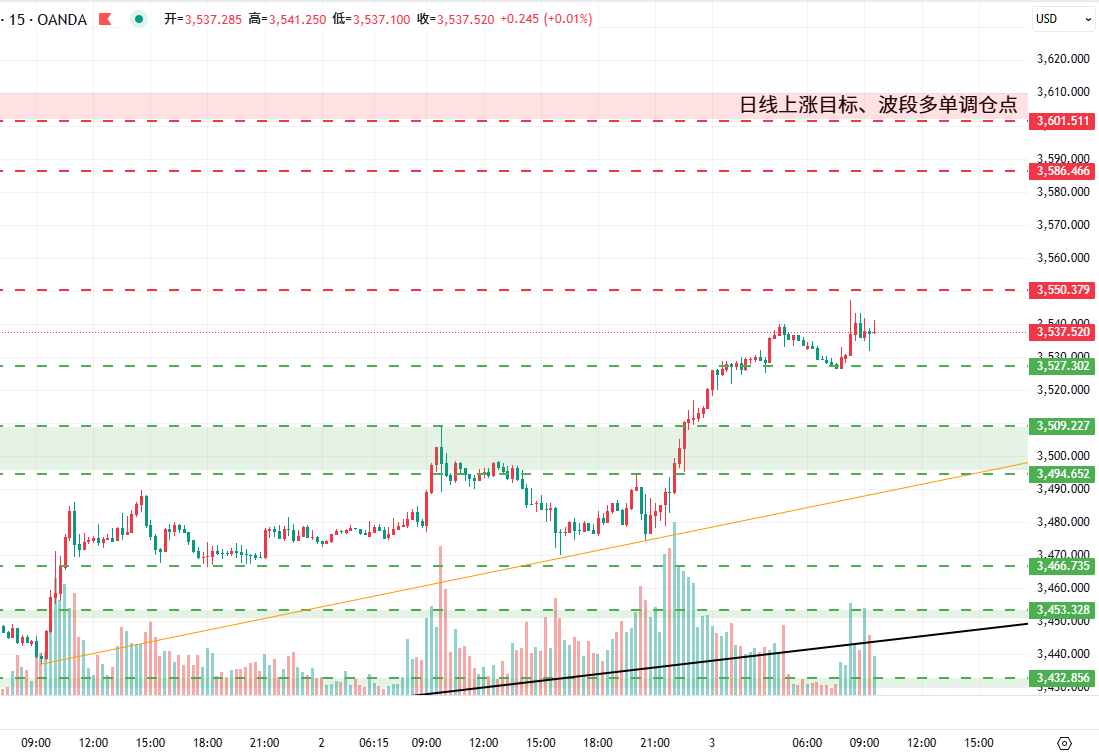
Group 1 - Concerns over the UK's fiscal situation and record bond issuance in Europe have led to a sell-off in the UK bond market, which has spread to US, Japanese, and European bonds, causing a significant rise in yields [1] - The increase in bond yields is a potential pressure on gold prices, as rising interest rates typically negatively impact gold [1] - The US ISM Manufacturing PMI for August has increased compared to the previous value, but the rise is below expectations and marks the sixth consecutive month of contraction [2][3] Group 2 - The upcoming US JOLTs job openings report is a key employment indicator that the market is watching, but it is expected to have only a short-term impact and not change the overall trend [4] - Gold prices experienced a temporary decline due to the bond market sell-off but managed to stabilize above the Asian session high of 3508, reaching a daily target of 3545-50, with no strong resistance above [5] - The short-term outlook for gold remains bullish, with a focus on maintaining positions above key support levels, particularly 3526, which if broken could lead to a deeper correction towards 3500 [7]
宝城期货国债期货早报-20250903
Bao Cheng Qi Huo· 2025-09-03 01:25
Report Summary 1. Report Industry Investment Rating No information provided regarding the report industry investment rating. 2. Core Viewpoints - The short - term view of treasury bond futures is mainly for oscillatory consolidation, with limited upside and downside space. The overall view for TL2512 is oscillatory, with a short - term and mid - term oscillatory trend and an intraday oscillatory - weakening trend, due to the decreased possibility of a comprehensive interest rate cut and the rising risk appetite in the stock market [1][5]. - Although the short - term necessity for a comprehensive interest rate cut is insufficient, with structural easing to support technology and boost consumption, the future monetary policy environment is generally loose. The increasing expectation of the Fed's interest rate cut overseas has weakened the RMB exchange - rate depreciation pressure, leaving room for future interest rate cuts. The market interest rate is anchored by the policy rate, limiting the upside space of the market interest rate and the downside space of treasury bond futures [5]. 3. Summary by Relevant Catalogs 3.1 Variety Viewpoint Reference - Financial Futures Stock Index Sector - For TL2512, the short - term view is oscillatory, the mid - term view is oscillatory, the intraday view is oscillatory - weakening, and the overall view is oscillatory. The core logic is the decreased possibility of a comprehensive interest rate cut and the rising risk appetite in the stock market [1]. 3.2 Main Variety Price Market Driving Logic - Financial Futures Stock Index Sector - The varieties include TL, T, TF, TS. The intraday view is oscillatory - weakening, the mid - term view is oscillatory, and the reference view is oscillatory. Yesterday, all treasury bond futures oscillated and pulled back. The short - term necessity for a comprehensive interest rate cut is insufficient, with structural easing as the main approach. The strong risk appetite in the stock market has a siphoning effect on funds, suppressing bond - buying demand, limiting the rebound space of treasury bond futures. However, the future monetary policy environment is loose, and the increasing expectation of the Fed's interest rate cut overseas has weakened the RMB exchange - rate depreciation pressure, leaving room for future interest rate cuts. The market interest rate is anchored by the policy rate, limiting the upside space of the market interest rate and the downside space of treasury bond futures [5].
宝城期货国债期货早报-20250822
Bao Cheng Qi Huo· 2025-08-22 01:09
Group 1 - Report Industry Investment Rating - No information provided Group 2 - Core Viewpoints of the Report - The overall view of government bond futures is that they will maintain a bottom - oscillating pattern in the short term. The possibility of a comprehensive interest rate cut has decreased, and the risk appetite in the stock market has increased. The TL2509 variety is expected to oscillate in the short and medium - term and show a slightly weaker oscillation trend during the day [1][5] Group 3 - Summary by Relevant Catalogs Variety Viewpoint Reference - Financial Futures Stock Index Sector - For the TL2509 variety, the short - term view is oscillation, the medium - term view is oscillation, and the intraday view is slightly weaker oscillation, with an overall view of oscillation. The core logic is that the possibility of a comprehensive interest rate cut has decreased, and the risk appetite in the stock market has increased [1] Main Variety Price Quotation Driving Logic - Financial Futures Stock Index Sector - The varieties include TL, T, TF, and TS. The intraday view is slightly weaker oscillation, the medium - term view is oscillation, and the reference view is oscillation. The core logic is that government bond futures oscillated and slightly rebounded yesterday. As market interest rates continue to rise, the anchoring effect of policy interest rates is gradually emerging, limiting the upward space of market interest rates, which means government bond futures have strong support. From the perspective of monetary policy, the focus of implementing a moderately loose monetary policy in the future is on structural loosening, and the possibility of comprehensive loosening has decreased. From the perspective of capital preference, the risk appetite in the stock market has continued to rise recently, and the profit - making effect in the stock market has attracted funds into the stock market, suppressing the demand for buying government bonds [5]
国债期货震荡偏弱
Bao Cheng Qi Huo· 2025-08-20 10:32
Report Summary 1. Report Industry Investment Rating No investment rating information is provided in the report. 2. Core View of the Report - Today, all treasury bond futures fluctuated slightly downward. The central bank announced the LPR rates for August, which remained unchanged, meeting market expectations. The future implementation of a moderately loose monetary policy will focus on structural easing, reducing the possibility of comprehensive easing, and weakening the expectation of a general decline in policy rates. However, as market interest rates continue to rise, the anchoring effect of policy rates is gradually emerging, limiting the room for further increases in market interest rates, which may maintain high - level fluctuations. Recently, the risk appetite in the stock market has been continuously rising, and the profit - making effect in the stock market has attracted funds into the stock market, suppressing the demand for treasury bonds. The year - on - year growth rate of M1 in July rebounded significantly, indicating that fixed - deposit and bank - wealth - management products and other fixed - income assets were not renewed after maturity, suggesting a possible change in the direction of large - scale asset allocation, which will have a non - negligible impact on the stock and bond markets. In general, treasury bond futures will operate weakly in the short term [2]. 3. Summary by Relevant Catalog Industry News and Related Charts - On August 20, 2025, the People's Bank of China authorized the National Inter - bank Funding Center to announce that the 1 - year LPR was 3.0% and the 5 - year - plus LPR was 3.5%, which would be valid until the next LPR release [4]. - On August 20, the central bank conducted 616 billion yuan of 7 - day reverse repurchase operations in the open market at an operating rate of 1.40%, consistent with the previous rate. Data showed that 118.5 billion yuan of reverse repurchases matured on the same day [4].
LPR报价连续3个月保持不变
Hua Xia Shi Bao· 2025-08-20 02:57
Core Viewpoint - The People's Bank of China (PBOC) has maintained the Loan Prime Rate (LPR) for both the 1-year and 5-year terms at 3.0% and 3.5% respectively, which aligns with market expectations [2] Group 1: LPR Quotation Stability - The LPR rates for August remained unchanged due to the stability of the policy interest rates, specifically the central bank's 7-day reverse repurchase rate [2] - Market interest rates have seen an upward trend recently, but banks lack the incentive to lower the LPR due to historically low net interest margins [2] Group 2: Economic Context - The continuous stability of the LPR for three months is attributed to a relatively strong macroeconomic performance in the first half of the year, reducing the immediate need for downward adjustments [2] - Experts suggest that the current period is one of policy observation, indicating a cautious approach to monetary policy adjustments [2] Group 3: Future Expectations - Analysts anticipate that the central bank may implement a new round of interest rate cuts and reserve requirement ratio reductions around the beginning of the fourth quarter, which could lead to a subsequent decrease in the LPR [2]
