
康波萧条期

Search documents
对话鹏华基金王云鹏-化工破局-2026-价值投资如何反内卷反脆弱
2026-01-21 02:57
Summary of Conference Call Notes Industry Overview - The chemical sector is currently experiencing a critical turning point in its cycle of recovery and growth upgrade, with a projected profit cycle, inventory cycle, capacity cycle, supply status, demand status, and chip status coupling in the second half of 2025, presenting investment opportunities in the industry [1][6] - The chemical industry is benefiting from emerging industries such as new energy vehicles, energy storage, and AI, with global GDP growth driving exports, although supply is constrained by policy assessments on new capacity related to carbon neutrality [1][10] Key Insights and Arguments - Investment strategies should focus on "anti-fragile" assets such as gold, coal, and oil transportation to enhance risk resistance during the current Kondratiev depression period, characterized by declining stability in the dominant currency system and a burgeoning gold bull market [1][5] - The fine chemicals sector is showing positive signals at the EPS level, indicating potential for a "Davis Double Play," while the agricultural chemicals sector has significant EPS elasticity, highlighting investment opportunities driven by supply-demand gaps [1][6] - The transition from low-price competition to pursuing efficiency and value in the chemical industry is essential, relying on policy-driven supply-side reforms to improve supply-demand relationships [3][21] Investment Strategy - The investment philosophy emphasizes value investing with a focus on safety margins, utilizing a bottom-up approach and cyclical timing to identify opportunities [4][6] - The portfolio management strategy includes a concentrated selection of high-potential stocks, particularly in the fine chemicals and agricultural chemicals sectors, with a focus on companies that can leverage cyclical earnings effectively [7][8] - The anticipated long-cycle elasticity opportunity in the chemical industry may surpass previous cycles, driven by global demand diversification and the emergence of new sectors [9][10] Policy and Market Dynamics - National policies aimed at upgrading traditional manufacturing and promoting low-carbon development will restrict new capacity expansion in the chemical industry, leading to the exit of inefficient old capacities and stabilizing the price system in the long term [12][22] - The implementation of quota systems in specific sectors, such as refrigerants, has successfully increased prices and profitability for companies, demonstrating the effectiveness of controlled production to enhance industry profitability [23] Future Outlook - From 2026 onwards, certain sub-industries or investment targets are expected to stand out, with a shift in focus from traditional safe-haven assets to equities potentially offering better returns [20] - The chemical industry is poised for new development opportunities driven by supply-demand improvements, with a strong emphasis on policy-driven changes and corporate self-discipline [22][24]
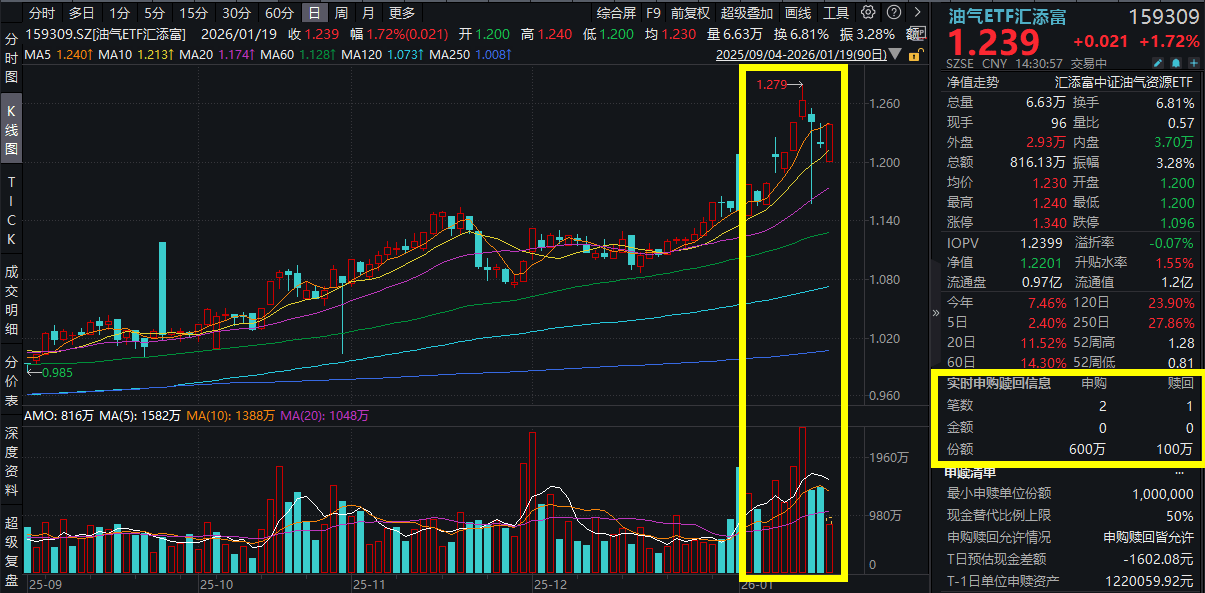
油气板块震荡冲高,杰瑞股份涨超3%,油气ETF汇添富(159309)涨近2%,强势吸金600万元!“金银铜铝油气米”?油气板块四大配置逻辑备受关注
Sou Hu Cai Jing· 2026-01-19 06:56
Core Viewpoint - The A-share market is experiencing a rebound, with the oil and gas ETF Huatai-PineBridge (159309) showing a strong performance, gaining 1.72% and attracting over 6 million yuan in investment [1][3]. Group 1: Market Performance - The oil and gas ETF Huatai-PineBridge (159309) has seen most of its constituent stocks rise, with notable increases from companies such as Jereh Group and COSCO Shipping Energy, both exceeding 3% [3]. - As of 14:37, the top ten constituent stocks of the oil and gas ETF are listed, showcasing significant price changes and industry classifications [4]. Group 2: Geopolitical Factors - Recent geopolitical tensions are highlighted as a potential risk for oil production and exports, particularly concerning Iran's average monthly oil production of 3.26 million barrels per day for 2025 [5]. - The ongoing geopolitical uncertainties are expected to support oil price stability in the long term, as indicated by the analysis from Guangda Securities [5]. Group 3: Investment Logic - Four key investment logic points are identified for the oil sector: 1. Geopolitical conflicts may boost oil prices, with the Russian geopolitical outlook being a core factor influencing supply expectations [5]. 2. The commodity cycle suggests that the oil sector is worth monitoring during the current economic conditions, with a potential super cycle for commodities [5]. 3. The supply-demand dynamics are expected to improve, with historical low inventory levels and reduced capital expenditure in oil supply over the past decade [9]. 4. The oil sector offers high dividend advantages, with the oil and gas ETF Huatai-PineBridge (159309) showing a 12-month dividend yield of 3.83% and a payout ratio exceeding 50% for 2023-2024 [5][9]. Group 4: Long-term Value - The oil and gas sector is positioned as a long-term investment opportunity, with the ETF focusing on the oil and gas industry chain, highlighting its importance as a national pillar industry [5].





新年抱“矿”富,有色“基”遇正澎湃!有色ETF泰康(159163)正在发行中
Xin Lang Cai Jing· 2026-01-19 03:36
Core Viewpoint - The non-ferrous metals sector is experiencing significant activity in early 2026, driven by global liquidity easing, domestic policy support, and emerging demand, creating a favorable investment window for precious metals [1] Group 1: Macro Environment - The Federal Reserve's expected continuation of easing policies in 2026, following three rate cuts in 2025, is anticipated to lower the cost of holding commodities in a weak dollar environment, benefiting the non-ferrous metals sector [1] - Domestic policies, particularly the "Work Plan for Stabilizing Growth in the Non-Ferrous Metals Industry" issued by eight departments, aim to enhance resource exploration for lithium and nickel and promote breakthroughs in recycled metal production [1] Group 2: Industry Opportunities - According to Western Securities, the non-ferrous metals industry is poised for multiple opportunities, supported by global liquidity easing, increased demand from AI and high-end manufacturing, and geopolitical factors leading to a revaluation of commodity prices [1][2] - The core logic of non-ferrous metals is tied to global re-industrialization and de-dollarization narratives, with expectations of a commodity supercycle driven by the Federal Reserve's quantitative easing [2] Group 3: Index Performance - The China Securities Non-Ferrous Metals Mining Theme Index stands out by focusing on upstream mining sources, covering key non-ferrous products like copper (31%) and gold (14%), and includes 39 listed companies with quality mineral resource reserves [3] - The current valuation of the index is at a favorable level, with a PE ratio of 26.9 and a PB ratio of 3.9, both near five-year lows, while projected ROE is expected to rise from 13.7% in 2024 to 16.9% in 2026, indicating sustained profit growth [3] Group 4: Demand Dynamics - The index has outperformed other indices since the end of 2013, supported by clear policy drivers and strong demand from sectors such as renewable energy, AI, and electric vehicles, confirming a tightening supply-demand dynamic and a potential upward price trend [4] Group 5: Investment Tools - The upcoming Taikang Non-Ferrous ETF, which tracks the Non-Ferrous Mining Index, offers investors a convenient way to gain exposure to the non-ferrous metals sector, employing a strategy aimed at minimal tracking deviation [5] - The ETF is managed by an experienced quantitative team, emphasizing a professional and meticulous approach to investment management [5]
有色金属或迎超级周期,矿业ETF(561330)近20日资金净流入超10亿元
Sou Hu Cai Jing· 2026-01-19 03:19
Group 1 - The core viewpoint of the article highlights that the mining ETF (561330) has seen a net inflow of over 1 billion yuan in the past 20 days, indicating a potential super cycle for non-ferrous metals [1] - Western Securities points out that the underlying logic for commodities and non-ferrous metals is tied to the Federal Reserve's quantitative easing (QE), suggesting that the super cycle in commodities is driven by the excess liquidity of the dollar [1] - By 2026, the acceleration of dollar liquidity due to the Federal Reserve's QE is expected to reinforce the super cycle of commodities, with gold, silver, copper, and lithium being systematically revalued due to their monetary and safety attributes [1] Group 2 - The mining ETF (561330) tracks the non-ferrous mining index (931892), which includes securities from companies involved in the development of copper, aluminum, lead, zinc, and rare metals, reflecting the overall performance of the non-ferrous metal mining industry [1] - According to Wind data, the mining ETF (561330) achieved a year-to-date increase of 106.11% in 2025, ranking first among 10 ETFs in the non-ferrous sector, indicating a concentrated leadership with a higher proportion of gold, copper, and rare earths [2][1]
策略周末谈(0118):白酒,在康波中重生
Western Securities· 2026-01-18 05:27
Core Insights - The underlying logic of commodities and liquor is interconnected, primarily revolving around the trading of Federal Reserve QE, which is expected to lead to increased dollar liquidity by 2026, marking the beginning of a new cycle for the liquor industry [1][11]. - The probability of the Federal Reserve initiating QE significantly increases by mid-2026, driven by the current administration's push for interest rate cuts, which are anticipated to alleviate inflationary pressures in the U.S. [2][14]. - Once the Federal Reserve begins QE, the People's Bank of China is expected to follow suit with debt monetization, leading to a recovery in the real economy and a return to prosperity in 2026 [3][20]. Group 1: Commodity and Liquor Logic - The current commodity supercycle is driven by the expectation of rampant dollar liquidity due to the Federal Reserve's QE, which will also enhance the appeal of commodities with monetary and safety attributes [1][11]. - The initiation of QE by the Federal Reserve is anticipated to prompt the People's Bank of China to quickly implement debt monetization, thereby improving the balance sheets of the real economy and enhancing consumer capacity and willingness [1][11]. Group 2: Federal Reserve's QE Probability - The current administration's core demand for interest rate cuts is expected to lead to a significant reduction in inflationary pressures, which will likely force the Federal Reserve to initiate QE [2][14]. - By mid-2026, the Federal Reserve is projected to face a liquidity crunch that may compel it to expand its balance sheet through QE, marking a critical window for such actions [2][16]. Group 3: Liquor Industry Revival - The liquor industry has experienced four cycles since 2003, and the anticipated QE in 2026 is expected to initiate a new cycle, driven by a return to prosperity and increased consumer spending [4][25]. - The combination of Federal Reserve interest rate cuts and a strengthening yuan is expected to accelerate the return of national wealth, thereby enhancing consumer demand and initiating a new cycle for the liquor industry [7][28]. Group 4: Investment Recommendations - The report suggests focusing on sectors that will benefit from the anticipated QE, including oil, chemicals, liquor, and high-end manufacturing, as the market is expected to reach new highs [8][31]. - Specific investment strategies include emphasizing metals, consumer goods, and high-end manufacturing sectors that are poised to benefit from the return of cross-border capital and improved consumer sentiment [8][31].
资产的信号(20260114):油价的“地缘游戏”
Western Securities· 2026-01-14 13:03
Core Insights - The report indicates that the geopolitical situation surrounding oil prices is complex, with short-term and long-term impacts from events like the Venezuela situation being minimal on oil prices due to low current production levels and high investment risks [1][2][5] - Trump's strategy regarding oil prices is not straightforward, as low oil prices could negatively impact Republican-aligned oil companies, suggesting that a balance is sought to maintain profitability while addressing inflation concerns [2][3] - The new Monroe Doctrine proposed by Trump aims to secure American interests in both the Americas and the Middle East, potentially increasing U.S. control over global oil production, which could reshape market dynamics and influence pricing [3][5] Group 1: Geopolitical Factors - The Venezuelan oil situation is unlikely to significantly alter global oil supply in the short term, as the country’s production is currently less than 1% of global output, despite its large reserves [1][10] - Trump's push for increased investment in Venezuelan oil is complicated by the need for substantial capital and the unstable political environment, which may deter companies from committing to such investments [2][5] - The U.S. aims to control approximately 63% of global oil production if it successfully manages resources in both the Americas and the Middle East, which would enhance its influence over global oil prices [3][7] Group 2: Market Dynamics - The report predicts that the oil market may experience a supply-demand balance in 2026, driven by strategic reserves and potential increases in Chinese oil stockpiling, which could create a demand of up to 1.1 million barrels per day [5][32] - The EIA forecasts a daily supply surplus of 2.26 million barrels in 2026, contingent on various assumptions regarding stockpiling and OPEC production decisions [5][32] - The report suggests that oil prices are likely to rise due to geopolitical tensions and strategic reserve demands, with a strong support level at $56 for WTI crude oil [7][32] Group 3: Commodity Revaluation - The report highlights that oil is expected to undergo a revaluation similar to precious and industrial metals, driven by the expansion of the dollar's credit gap, although the pace may be slower due to the U.S.'s significant production and consumption of oil [6][34] - The historical ratios of gold to oil and copper to oil have reached extreme levels, indicating potential for upward movement in oil prices as market conditions evolve [6][34] - A potential easing of the Russia-Ukraine conflict in 2026 could further stimulate strategic stockpiling needs, leading to a notable increase in oil prices [6][34]
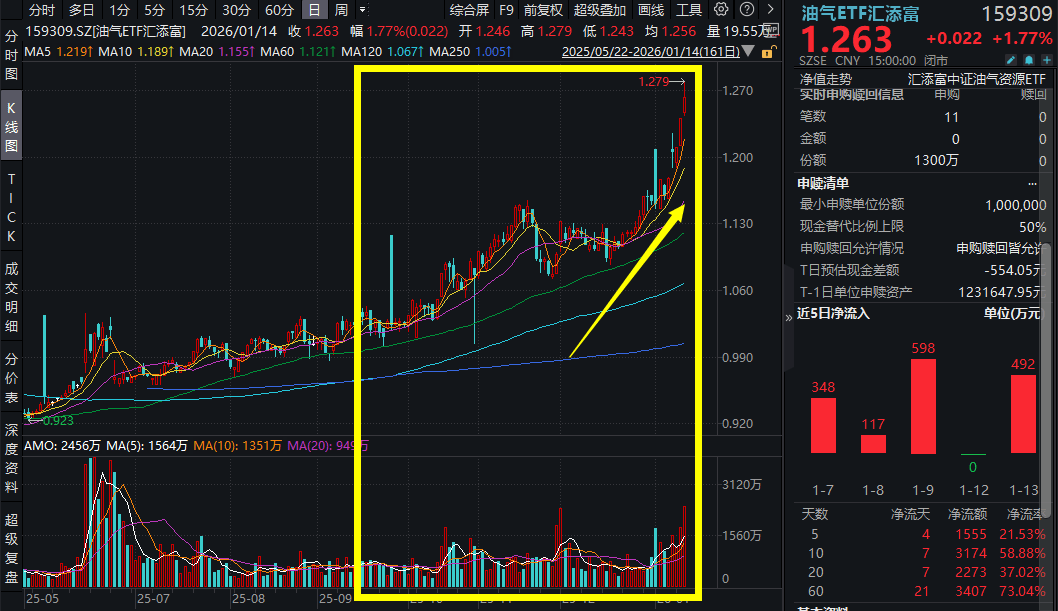
油价连续上攻,洲际油气涨停,油气ETF汇添富(159309)喜提五连涨,强势吸金超1600万元!解密商品超级周期轮动规律,接下来是石油了?
Sou Hu Cai Jing· 2026-01-14 08:44
Core Viewpoint - The A-share market experienced fluctuations with the Shanghai Composite Index rising and then retreating, while the oil and gas sector showed strong performance, particularly the oil and gas ETF Huatai-PineBridge (159309), which achieved a five-day consecutive increase and reached a historical high [1][3]. Group 1: Market Performance - The total trading volume in the two markets approached 4 trillion yuan, setting a new historical record [1]. - The oil and gas ETF Huatai-PineBridge (159309) saw a net inflow of over 16 million yuan for the day, accumulating more than 20 million yuan in the last two days [1]. Group 2: Sector Analysis - The majority of the index component stocks for the oil and gas ETF saw price increases, with notable performances including a limit-up for Jerry Holdings and over 4% increase for Continental Oil [3]. - The main oil contracts, including West Texas Intermediate (WTI) and Brent crude, rose by 2.69% and 2.43%, respectively, due to concerns over oil supply amid regional tensions [5]. Group 3: Commodity Market Insights - The commodity market is experiencing a strong trend, with precious and industrial metals reaching new highs, indicating a potential super cycle for commodities driven by economic conditions [5][6]. - Historical patterns during economic downturns suggest that oil prices may rise following increases in gold and industrial metals, with oil being influenced by geopolitical factors [7][8]. Group 4: Strategic Outlook - The oil and gas sector is highlighted as having long-term investment value, with the oil and gas ETF Huatai-PineBridge focusing on the upstream and downstream of the oil and gas industry [8]. - The current low levels of strategic oil reserves in the U.S. and OECD countries, combined with rising commodity ratios, suggest that oil prices are undervalued relative to other commodities [7].
2026十大研判
2026-01-05 15:42
Summary of Key Points from the Conference Call Industry and Company Overview - The discussion centers around the Chinese economy and stock market, particularly focusing on the year 2026 as a pivotal point for China's return to prosperity, drawing parallels with historical trends in the United States and Japan during their industrialization phases [2][5][6]. Core Insights and Arguments 1. **Economic Recovery and Growth**: 2026 is anticipated to mark the beginning of China's return to prosperity, driven by a per capita GDP exceeding $10,000, which signifies a mature industrial phase. This is expected to enhance manufacturing export capabilities and improve domestic consumption [2][5][6]. 2. **Impact of U.S. Federal Reserve Policies**: The Federal Reserve's potential interest rate cuts and quantitative easing (QE) are expected to increase global liquidity, facilitating the return of cross-border capital to China, which will support the appreciation of the Renminbi and aid in the recovery of the balance sheets of the real economy [2][4][7]. 3. **Commodity Supercycle**: A supercycle for commodities began in April 2025, driven by abundant global liquidity. The focus should initially be on PPI manufacturing sectors, followed by CPI consumer sectors as monetary policies are implemented [2][8][14]. 4. **Technology Sector Outlook**: The technology sector remains a strong investment theme, with a focus on humanoid robots, AI applications, and new consumption trends. A dynamic scoring model is suggested for adjusting investment strategies in this sector [2][9][17][18]. 5. **Industry Configuration Recommendations**: Suggested sectors for investment include: - **Non-ferrous Metals**: Gold, silver, and copper, benefiting from global liquidity [2][10][19]. - **New and Consumer Sectors**: Food and beverage, tourism, and travel, which are expected to see growth due to improved consumer sentiment [2][10][19]. - **High-end Manufacturing**: Including power equipment, chemicals, home appliances, and pharmaceuticals, which are projected to have strong growth potential [2][10][19]. Additional Important Insights 1. **Renminbi Exchange Rate Trends**: The Renminbi is expected to enter a medium to long-term appreciation cycle, supported by an increase in the current account surplus due to rising export levels. This trend is anticipated to be reinforced by the return of previously exited capital [2][12]. 2. **Manufacturing Sector Resilience**: China's manufacturing sector is expected to be re-evaluated positively, benefiting from improved cash flows and competitive advantages in exports, particularly during the Renminbi appreciation phase [2][13]. 3. **Cyclical Industry Dynamics**: The cyclical industries are expected to experience a transition from a bear to a bull market, driven by improved cash flows and consumer sentiment as national wealth returns [2][16]. 4. **Market Performance Context**: Despite a global bull market since 2020, the A-share market faced challenges from 2022 to 2024 due to capital outflows caused by U.S. interest rate hikes. However, the outlook for 2026 is optimistic, with expectations of new highs in market indices [2][10][11]. This comprehensive analysis highlights the anticipated economic recovery in China, the implications of U.S. monetary policy, and the strategic sectors for investment as the market evolves towards 2026.
西部证券晨会纪要-20260105
Western Securities· 2026-01-05 02:57
Group 1: Leasing Industry Overview - The leasing industry in China is categorized into financial leasing and commercial financing leasing, with financial leasing companies being regulated by the National Financial Regulatory Administration [6] - The main business models are direct leasing and sale-leaseback, which cater to different financing needs of enterprises [6] - The industry has entered a phase of high-quality development since 2018, with stable growth in financial leasing and domestic commercial leasing, while foreign leasing companies have seen a decline [7] Group 2: Key Players and Market Dynamics - The leasing business is capital-intensive, with net interest income being the primary revenue source, and asset scale reflecting differentiated strategic layouts among companies [8] - Leading companies like Guoyin Financial Leasing and Far East Horizon maintain their positions through diversified industry layouts and national service networks, while others focus on niche markets such as aviation and microfinance [8] Group 3: Weigao Blood Purification Company Analysis - Weigao Blood Purification is a leading player in the domestic blood purification industry, with a comprehensive product matrix including dialysis machines and accessories [11] - The company has shown steady growth, with projected EPS of 1.08, 1.20, and 1.32 yuan for 2025, 2026, and 2027 respectively [11] - The blood purification market in China is expected to grow significantly, with a CAGR of 21.52% from 2023 to 2027, driven by increasing ESRD patient numbers and improving healthcare coverage [12] Group 4: Market Trends and Growth Potential - The demand for blood purification products is rising due to a rapid increase in ESRD patients and enhanced medical payment capabilities [12] - Weigao's market share in key products like blood dialysis machines and accessories is strong, with 32.5%, 24.6%, and 31.8% market shares respectively [13] - The company is expanding its business through acquisitions, such as Weigao Purui, to enhance its position in the biopharmaceutical upstream sector [13] Group 5: Manufacturing PMI Insights - The manufacturing PMI for December showed a seasonal rebound, indicating synchronized expansion in production and demand, with a PMI of 50.1%, up 0.9 percentage points from the previous month [15] - The non-manufacturing business activity index also rose to 50.2%, reflecting a slight recovery in the service sector [21] - The construction industry saw a significant rebound, returning to expansion territory due to favorable weather and increased construction activity [21] Group 6: Hong Kong Stock Market Outlook - The Hong Kong stock market is expected to benefit from a declining US dollar index and a recovering Chinese economy, positioning it as a favorable offshore market for capital [24] - The market is anticipated to experience valuation expansion driven by global liquidity and improved fundamentals in China, potentially leading to a "Davis Triple Play" scenario [29] - The outlook for the Hang Seng Technology Index remains positive, with expectations of significant growth in consumer-sensitive sectors like internet and new energy vehicles [29]


人民币升值-如何引领本轮牛市
2026-01-04 15:35
Summary of Conference Call Notes Industry Overview - The discussion centers around the impact of the appreciation of the Renminbi (RMB) on the Chinese economy and its potential to lead to a bull market in 2026, marking a significant turning point for China as it transitions from a period of economic stagnation to prosperity [2][4][8]. Key Points and Arguments 1. **RMB Appreciation as a Catalyst** - The appreciation of the RMB is seen as a key opportunity for China to transition towards prosperity, with expectations that it may break previous highs of 6.8 and potentially reach 6.3 in the coming years [2][4]. 2. **Strong Export Capacity** - The long-term appreciation of the RMB is attributed to China's robust export capabilities, which emerged as the country entered its industrialization maturity phase around 2018. This pattern has historical parallels in the U.S. post-1945 and Japan post-1975 [2][4][5]. 3. **Capital Reflow** - Approximately 16 trillion RMB that flowed out during the depreciation phase is expected to return, supporting the appreciation trend even if corporate currency settlement decreases in the future [4][6]. 4. **Economic Recovery in 2026** - 2026 is projected to be a pivotal year for the Chinese economy, benefiting from potential Federal Reserve rate cuts and the possibility of quantitative easing (QE) by the People's Bank of China (PBOC), which would help restore cash flow and balance sheets in the real economy [8][11]. 5. **Asset Recovery** - The cash flow statements and balance sheets of China's real sector are gradually improving, aided by anti-involution policies and expected QE measures, which could lead to a return to the prosperity cycle that began in 2019 [11][12]. 6. **Investment Recommendations** - There is a strong recommendation to invest in RMB-denominated assets, particularly in sectors such as non-ferrous metals, new consumption, and high-end manufacturing. The A-share market is expected to reach new highs, and there is optimism for the Hong Kong stock market as well [9][13][14]. 7. **Concerns Over Export Constraints** - Concerns that RMB appreciation might hinder exports are deemed unfounded, as the strong export capacity is the cause of appreciation rather than a consequence [5]. 8. **Long-term Economic Strategy** - The necessity of timely debt resolution is emphasized, drawing lessons from Japan's economic stagnation in the 1990s. The discussion highlights the importance of addressing debt to maximize profits and ensure economic stability [12]. Additional Important Insights - The anticipated shift in U.S. monetary policy towards QE could create favorable conditions for the RMB, allowing the PBOC to implement its own QE strategies to alleviate domestic corporate burdens [12]. - The overall sentiment is optimistic regarding RMB-related assets, with strategic asset allocation advised to navigate future market changes effectively [14].