有效需求

Search documents
【数说经济】“反内卷”不会推动物价普遍上涨
Jing Ji Ri Bao· 2025-08-15 01:16
Group 1 - The essence of the "anti-involution" policy is "correction" rather than "stimulation," aiming to reshape the logic of industrial competition [2][6] - The impact of the "anti-involution" policy on prices is structural and mild, with future price trends dependent on the strength of demand recovery and the pace of policy coordination [2][6] - The "anti-involution" policy aims to address low-price disorderly competition in certain sectors rather than driving up prices, as the fundamental factor determining prices remains supply and demand [2][3] Group 2 - Since the beginning of the year, signals of the "anti-involution" policy have been continuously reinforced, with various measures taken to address "involution-style" competition [3] - The revised Anti-Unfair Competition Law prohibits selling goods below cost, providing a legal basis for combating "involution-style" competition [3] - Recent data shows that the Producer Price Index (PPI) has maintained a low level of -3.6% year-on-year in July, but the month-on-month decline has narrowed, indicating some stabilization in industrial prices [4] Group 3 - The Consumer Price Index (CPI) remains weak overall, but the core CPI has rebounded for three consecutive months, benefiting from reduced price wars in the automotive and home appliance sectors [4] - The improvement in PPI is primarily seen in upstream raw materials and industrial products, which have a low direct correlation with consumer spending [5] - The transmission mechanism from PPI to CPI remains ineffective, as insufficient terminal consumer demand limits companies' pricing power [5]


中经评论:“反内卷”不会推动物价普遍上涨
Jing Ji Ri Bao· 2025-08-15 00:02
Group 1 - The "anti-involution" policy aims to address low-price disorderly competition rather than driving up prices, as the fundamental factor determining prices remains supply and demand, with current domestic effective demand still insufficient [1] - The "anti-involution" policy has been reinforced throughout the year, with various measures such as legal revisions and policy implementations to combat low-price competition, including the revised Anti-Unfair Competition Law and the draft Price Law [1][2] - The Producer Price Index (PPI) showed a year-on-year decline of -3.6% in July, but the month-on-month decline narrowed from -0.4% in June to -0.2%, indicating some stabilization in industrial prices due to policy effects [2] Group 2 - The Consumer Price Index (CPI) remains weak overall, but the core CPI has rebounded for three consecutive months, benefiting from reduced price wars in the automotive and home appliance sectors, as well as seasonal increases in service consumption [2] - The improvement in PPI is primarily seen in upstream raw materials and industrial products, which have a low direct correlation with consumer spending, indicating that the transmission mechanism from PPI to CPI remains ineffective [3] - The essence of the "anti-involution" policy is to correct rather than stimulate, focusing on market-oriented and legal methods to shift competition from price wars to quality, service, and innovation, promoting a healthier market structure [4]
如何理解物价指数与居民感受之间的“温差”?
Jin Rong Shi Bao· 2025-08-08 07:59
Core Insights - The Consumer Price Index (CPI) in China has shown a decline, with a month-on-month decrease of 0.2% and a year-on-year decrease of 0.1% in May, while the core CPI, excluding food and energy, increased by 0.6% [1][4] - There is a discrepancy between the CPI statistics and individual consumer perceptions of price changes, which can be attributed to differences in consumption patterns, frequency of purchases, and the comparison of price points [2][3] Group 1: CPI and Consumer Perception - CPI is a comprehensive statistical indicator that reflects the price level changes of various consumer goods and services, covering eight major categories and 268 basic classifications [1] - Individual consumer experiences of price changes can vary significantly based on their consumption structure and regional differences, leading to a "temperature difference" in perception [2] - Consumers are generally more sensitive to price changes in frequently purchased essential goods, while changes in prices of infrequently purchased items may go unnoticed [2] Group 2: Impacts of Price Changes - A moderate decline in prices can lower consumer costs and enhance purchasing power, allowing consumers to allocate more funds to other areas such as cultural and tourism consumption [3][4] - However, sustained price declines can lead to negative economic consequences, including reduced investment, delayed consumer spending, and potential increases in unemployment, creating a feedback loop that further suppresses demand and prices [4] - Maintaining a moderate increase in prices is beneficial for economic stability, and recent policies aimed at boosting effective demand have shown positive results, with retail sales growing by 6.4% year-on-year in May, the highest monthly growth rate in 2024 [4][5]

经济地理丨湖北加速逼近河南 中部第一省或将易主
Sou Hu Cai Jing· 2025-08-01 04:34
Core Viewpoint - The economic performance of 31 provinces in China for the first half of the year shows significant competition, particularly between Hubei and Henan, with Hubei rapidly closing the economic gap [1][2]. Economic Performance - Henan's GDP reached 31,683.80 billion yuan, growing by 5.7%, while Hubei's GDP was 29,642.61 billion yuan, with a growth rate of 6.2%, indicating Hubei's faster growth compared to Henan [1][2]. - The economic gap between Hubei and Henan has significantly narrowed over the past two years, from 5,066.78 billion yuan in 2023 to 2,041.19 billion yuan in 2024 [1]. Investment and Consumption - Hubei's fixed asset investment grew by 6.5%, surpassing the national average of 3.7%, with manufacturing investment increasing by 12.5% [4]. - Hubei's retail sales reached 13,073.93 billion yuan, growing by 6.9%, which is higher than the national average [4]. Trade Performance - Hubei's total import and export volume exceeded 400 billion yuan for the first time, reaching 402.31 billion yuan, with exports growing by 38.5% [5]. - The export of mechanical and electrical products increased by 26.8%, accounting for 50.7% of total exports [5]. Henan's Economic Characteristics - Henan's economy showed "three fasts and two stability" in the first half of the year, with industrial output, fixed asset investment, and retail sales all experiencing significant growth [6][7]. - The industrial production in Henan grew by 8.4%, with nearly 80% of industries maintaining growth [6].

经济学家朱宁:买房从来没有刚需,楼市预计2027年见底
Sou Hu Cai Jing· 2025-07-29 09:14
Group 1 - The overall trend in the real estate market is stabilizing, but opinions vary on the timeline for recovery, with some predicting a rebound this year and others suggesting it may take three to five years [1] - Economist Zhu Ning predicts a potential decline in housing prices by 20%-30% by early 2024, despite recent stabilization due to policy support, as the market has entered a downward trend again [3][5] - Long-term factors such as demographic shifts, slowing urbanization, and changing attitudes among young people are driving a deep adjustment in the real estate market, shifting the perception of housing from an investment to a consumer good [3][6] Group 2 - Zhu Ning's previous warnings about the real estate market, particularly regarding the "implicit guarantee" that inflated housing prices, have gained attention as the market dynamics shift [5] - The notion of "housing as a necessity" is challenged, with the argument that effective demand is more relevant than the concept of "just demand," emphasizing the need for housing to meet actual living requirements rather than being viewed as an investment [6][8] - The expectation that buying a home guarantees wealth accumulation has reversed, leading to a new focus on selling homes rather than buying, which is crucial for stabilizing the market [6][8]

一财社论:市场出清是经济的必经之役
Di Yi Cai Jing· 2025-07-28 12:21
Group 1 - The core viewpoint emphasizes the importance of a competitive exit mechanism in the market, which can rejuvenate enterprises and allow market entities to realize their value [1][5] - In June, the profits of industrial enterprises showed signs of stabilization, with a total profit decline of 1.8% year-on-year for the first half of the year, and a 4.3% decline in June, which is an improvement compared to May [2] - The manufacturing sector showed notable improvement, with profits shifting from a 4.1% decline in May to a 1.4% increase in June, indicating a significant marginal improvement [2] Group 2 - The data indicates that while the revenue of industrial enterprises grew by 2.5% year-on-year, operating costs increased by 2.8%, leading to a decrease in operating profit margin by 0.22 percentage points [2] - The increase in accounts receivable by 7.8% and finished goods inventory by 3.1% suggests that enterprises are facing challenges of increased production without corresponding revenue growth, intensifying cash flow pressures [3] - The government is urged to provide medium to long-term financial support to real enterprises to avoid intermittent shocks, alongside enhancing fiscal support [3] Group 3 - To improve the uncertain economic environment for enterprises, it is essential to promote market clearing on the supply side, allowing inefficient capacities to exit the market [4] - The government should prepare for the elimination of backward production capacities by providing a supportive legal and institutional environment for bankruptcy and restructuring [4] - A competitive market environment is necessary to enhance risk-bearing capacity and stimulate potential market demand, which requires recognizing and encouraging normal market competition [4]
2.72万亿元,下降1.1%!最新解读来了→
Jin Rong Shi Bao· 2025-06-27 08:48
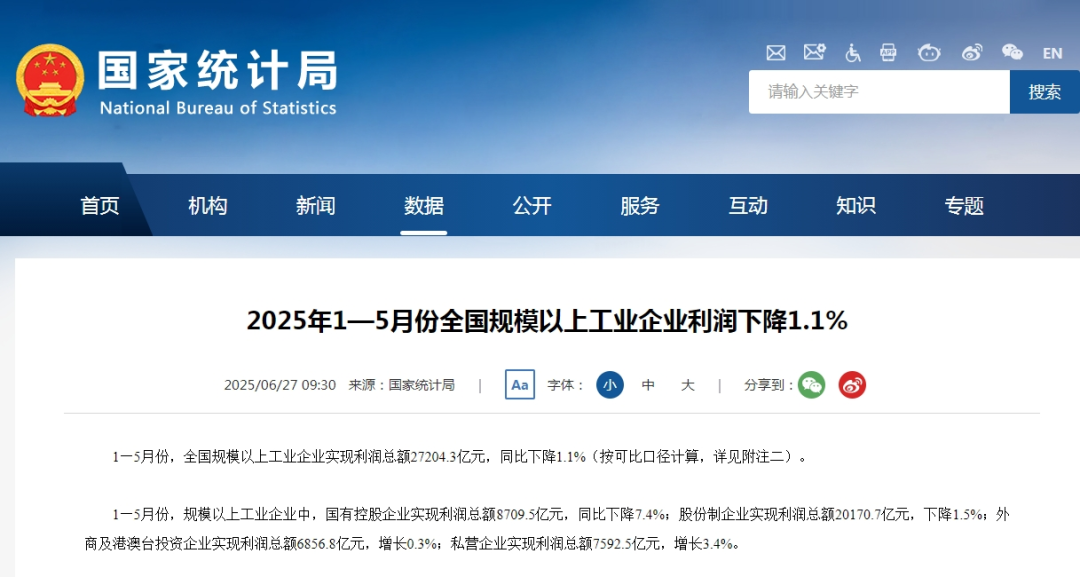
Group 1 - The total profit of industrial enterprises above designated size in China from January to May reached 2.72 trillion yuan, a year-on-year decrease of 1.1%, with a decline in growth rate of 2.5 percentage points compared to January to April [1][3] - The operating revenue for the same period was 54.76 trillion yuan, showing a year-on-year growth of 2.7%, but the growth rate decreased by 0.5 percentage points from the previous value [1][3] - In May alone, the profit of industrial enterprises fell by 9.1% year-on-year, marking the largest decline since October of the previous year, indicating increased operational pressure on industrial enterprises [3][4] Group 2 - Factors contributing to the decline in profits include insufficient effective demand, falling industrial product prices, and short-term fluctuations, with investment income from the previous year’s high base dragging down profit growth by 1.7 percentage points [3][4] - The Producer Price Index (PPI) is identified as the main constraint on the recovery of profit growth for industrial enterprises, with expectations of declining external demand necessitating a rebound in investment and consumption to support profit growth [3][5] Group 3 - Despite the overall profit decline, the gross profit of industrial enterprises increased by 1.1% year-on-year, contributing to a 3.0 percentage point increase in total profits [4] - The equipment manufacturing sector and industries related to the "Three New" policies maintained high profit levels, with equipment manufacturing profits growing by 7.2% year-on-year, contributing 2.4 percentage points to total industrial profits [4][5] - The "Three New" industries, including aerospace and maritime sectors, saw significant profit increases, with aerospace manufacturing profits rising by 120.7% and shipbuilding profits increasing by 85.0% [4][5] Group 4 - The internal demand has accelerated due to large-scale equipment updates and the "Two New" policies, with profits in general and specialized equipment sectors growing by 10.6% and 7.1% respectively, contributing 0.6 percentage points to overall industrial profits [5] - The average collection period for accounts receivable increased to 70.5 days, indicating pressure on asset turnover and affecting production investment expansion [5] - Looking ahead, the production situation in the industrial sector is expected to remain below expectations due to the need for improved internal demand and low price levels, with potential widening of supply-demand gaps in traditional industries [5]
解读!5月金融数据“超预期”背后,中国经济正发生这些大变化!
Sou Hu Cai Jing· 2025-06-14 16:12
Group 1 - The core viewpoint of the financial data for May indicates a mixed outlook for the Chinese economy, with M2 growth suggesting ample market liquidity while structural changes in social financing raise concerns about effective demand [1][12]. Group 2 - M2 growth remains at a relatively high level, indicating a stable monetary policy that supports economic stability and reflects strong deposit willingness among residents and enterprises, suggesting confidence in future economic prospects [5][11]. - The structural changes in social financing show an increase in direct financing methods like corporate and government bonds, indicating effective government policies to support the real economy, but also highlight challenges in effective demand [7][11]. - The growth in RMB loans, particularly in corporate long-term loans, signals increased investment willingness among enterprises, while fluctuations in household loans, especially long-term loans, may indicate changes in the real estate market and consumer confidence [9][11]. Group 3 - The financial data suggests that a prudent monetary policy will continue to play a crucial role in providing necessary funding support for economic recovery, with expectations of flexible use of various monetary policy tools by the central bank [11]. - The focus on structural optimization in financial data indicates that policies are directing funds towards weak areas and key sectors of the real economy, such as technology innovation and green development, which may benefit industries aligned with national strategic directions [11]. - There is a need for further stimulation of effective demand, as some indicators suggest that the internal growth momentum of the economy requires more coordinated fiscal and industrial policies to truly boost investment and consumption [11].
经济学,对个人意味着什么?
Hu Xiu· 2025-05-14 02:44
Group 1 - The core idea of the article emphasizes the importance of understanding economic behavior from an individual perspective, particularly in the context of survival and living standards in society [2] - The article discusses the roots of poverty and famine, highlighting that hunger is not solely a matter of food supply but also of distribution and power dynamics [3][4] - It mentions that poverty is a relative concept and understanding its true causes is essential for effective solutions, as proposed by Amartya Sen [3] Group 2 - The article outlines individual demand, consumption, and division of labor, referencing Keynes' theory of effective demand as a key driver for employment and output [5] - It explains that consumption is the ultimate goal of economic activity, leading to cooperation and division of labor among individuals and families [6][7] - The text also discusses the role of social cohesion and moral standards in economic life, as highlighted by Durkheim [7] Group 3 - The article describes the necessity for individuals to engage in market operations to accumulate wealth, emphasizing the role of free markets and the importance of government regulation [8][9] - It discusses mercantilism and the importance of trade balance in national wealth, suggesting that individuals can benefit from exporting their products [10] - The article highlights the significance of savings and investment, explaining that savings are a result of consumption behavior and investment decisions [10] Group 4 - Decision analysis is presented as crucial for individuals to navigate market opportunities and challenges, with a focus on understanding decision-making rules and their implications [11] - The article concludes that economics reflects the dynamic interplay between individual survival and development, emphasizing the continuous evolution of economic interactions [12]
提升物价,仅仅扩大货币发行是远远不够的
Hua Xia Shi Bao· 2025-05-10 07:12
Core Viewpoint - The central bank emphasizes that merely relying on monetary policy is insufficient to drive price recovery, advocating for structural reforms and coordinated policies across various sectors to promote reasonable price increases [2][5]. Group 1: Price Trends and Indicators - In the first quarter, the Consumer Price Index (CPI) decreased by 0.1% year-on-year, with monthly fluctuations of 0.5%, -0.7%, and -0.1% [2]. - Food prices fell by 1.4% year-on-year, influenced by seasonal factors and international oil price volatility [2]. - Core CPI, excluding food and energy, rose by 0.3% year-on-year, indicating a mild upward trend in non-food prices [2]. Group 2: Demand and Supply Analysis - Demand remains weak due to global growth slowdown, economic structural transformation, and the need for enhanced consumer spending [3]. - Supply-side issues include excessive competition in certain industries and inefficiencies in traditional sectors, exacerbating supply-demand imbalances [3]. Group 3: Policy Recommendations - The central bank refutes the notion that increasing money supply will automatically lead to price increases, citing historical examples of low inflation despite monetary expansion [4]. - Effective demand expansion is crucial for price recovery, necessitating structural reforms and coordinated policy efforts across fiscal, monetary, and social sectors [5]. - The focus should shift from managing high prices to managing low prices, emphasizing quality development and preventing disorderly competition [5].