
查超产

Search documents
煤焦周度报告20251020:现货成交有所改善,双焦震荡偏强运行-20251020
Zheng Xin Qi Huo· 2025-10-20 07:01
1. Report Industry Investment Rating - Not provided in the content 2. Core Viewpoints of the Report - Last week, the spot transaction of coking coal improved. With the news of the upcoming central safety production assessment and inspection in 2025 and better - than - expected steel production reduction and inventory depletion data, both coking coal and coke fluctuated strongly. As of Friday's close, the coke 01 contract rose 0.87% to 1676, and the coking coal 01 contract rose 1.2% to 1179 [8]. - In the context of anti - involution expectations and over - production inspection policies, there are continuous disturbances on the supply side of coal mines. Pig iron production remains at a high level, and the spot transaction of coking coal is acceptable. The upward space of coking coal depends on the macro situation and the sustainability of steel inventory depletion. It is recommended to wait and see on a single - side basis and continue to pay attention to the reverse spread of coking coal 1 - 5. In the long term, coking coal maintains a bullish outlook under the expectations of a strict macro environment and coal mine safety supervision [8]. 3. Summary According to the Directory 3.1 Coke 3.1.1 Price - Last week, the futures market fluctuated strongly. The second - round price increase of spot coke started but has not been implemented yet. The spot price remained stable, and attention should be paid to this week's macro and steel data. The freight for coke transportation remained stable [6][9][16]. - The coke 01 contract rose 0.87% to 1676 as of Friday's close [8]. 3.1.2 Supply - Profit compression and production reduction in some coking plants led to a slight tightening of coke supply. As of October 17, the capacity utilization rate of all - sample independent coking enterprises was 74.24%, a decrease of 0.94 percentage points from the previous week, and the daily average coke output was 65.29 tons, a decrease of 0.83 tons from the previous week. The capacity utilization rate of 247 steel mills' coking plants was 84.72%, a decrease of 0.81 percentage points from the previous week, and the daily average coke output was 45.94 tons, a decrease of 0.44 tons from the previous week [27][32]. 3.1.3 Demand - Pig iron production remained at a high level, providing strong support for raw material demand. However, after the holiday, due to logistics, weather and other reasons, the inventory - building pace of steel mills was slow. As of October 17, the blast furnace start - up rate of 247 sample steel mills was 84.27%, unchanged from the previous week; the capacity utilization rate was 90.33%, a decrease of 0.02 percentage points from the previous week; the daily average pig iron output was 240.95 tons, a decrease of 0.07 tons from the previous week; and the profitability rate of steel mills was 55.41%, a decrease of 3.46 percentage points from the previous week [35]. - Speculative sentiment was average, export profit changed little, and the daily trading volume of building materials was lower than the same period in previous years [37]. 3.1.4 Inventory - Both upstream and downstream reduced their inventories, and the total inventory decreased. As of October 17, the total coke inventory decreased by 17.87 tons to 891.88 tons compared with the previous week. Among them, the port inventory increased by 0.06 tons to 195.15 tons, the inventory of all - sample independent coking enterprises decreased by 6.55 tons to 57.29 tons, and the inventory of 247 sample steel mills decreased by 11.38 tons to 639.44 tons [42][45]. 3.1.5 Profit - The profitability of coking enterprises was compressed, and the futures market profit of coke weakened slightly. The average profit per ton of 30 independent coking enterprises was - 13 yuan/ton, a decrease of 22 yuan from the previous week. The futures market profit of coke 01 decreased by 9.4 yuan/ton to 143.3 yuan/ton compared with the previous week [53]. 3.1.6 Valuation - The premium of coke 01 increased, and the 1 - 5 spread fluctuated. The basis of coke 01 decreased by 44.3 to - 81.86 compared with the previous week, and the 1 - 5 spread increased by 4 to - 148 compared with the previous week [57]. 3.2 Coking Coal 3.2.1 Price - Last week, the futures market fluctuated strongly, and it is expected to maintain a strong trend in the short term. Most of the spot prices increased [60][63]. - The coking coal 01 contract rose 1.2% to 1179 as of Friday's close [8]. 3.2.2 Supply - The supply from production areas continued to recover, the output of coal washing plants was basically flat, the daily customs clearance vehicle number at the Mongolian Ganqimaodu Port has recovered to over 1200 vehicles, and the year - on - year decline in imported coking coal from January to August 2025 narrowed [66][74]. - As of October 17, the capacity utilization rate of 314 sample coal washing plants was 35.79%, an increase of 0.47 percentage points from the previous week, and the daily average clean coal output was 26.11 tons, an increase of 0.45 tons from the previous week [71]. 3.2.3 Inventory - Downstream enterprises replenished their inventories appropriately, coal mines did not accumulate obvious inventories, and the total inventory increased. As of October 17, the total coking coal inventory increased by 42.95 tons to 2554.22 tons compared with the previous week. Among them, the inventory of mining enterprises increased by 9.55 tons to 205.41 tons, the port inventory decreased by 22.28 tons to 272.71 tons, the clean coal inventory of coal washing plants increased by 10.18 tons to 290.41 tons, the inventory of all - sample independent coking enterprises increased by 38.31 tons to 997.37 tons, and the inventory of 247 sample steel mills increased by 7.19 tons to 788.32 tons [77][80]. 3.2.4 Valuation - The basis of coking coal 01 weakened, and the 1 - 5 spread strengthened slightly. The basis of coking coal 01 decreased by 33 to 8 compared with the previous week, and the 1 - 5 spread increased by 14 to - 82.5 compared with the previous week [101].
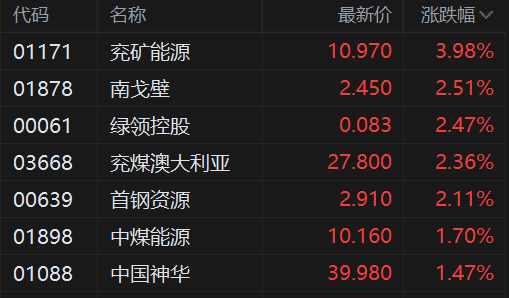
煤炭股普涨 兖矿能源涨4% 中煤能源涨近2%
Ge Long Hui· 2025-10-14 03:58
Core Viewpoint - The coal sector in Hong Kong has seen a general increase in stock prices, driven by a recovery in Mongolian coal imports and a supportive supply-demand balance for coking coal [1][2]. Group 1: Market Performance - Coal stocks in Hong Kong experienced widespread gains, with Yanzhou Coal Mining rising by 4%, South Gobi and Green Leader Holdings increasing by 2.5%, and other companies like Yancoal Australia and Shougang Resources also seeing gains of over 2% [1][2]. - Specific stock price movements include Yanzhou Coal at 10.970 with a 3.98% increase, South Gobi at 2.450 with a 2.51% increase, and Green Leader Holdings at 0.083 with a 2.47% increase [2]. Group 2: Industry Insights - According to Zheshang Securities, the third quarter saw a rebound in Mongolian coal imports, which, along with a recovery in supply chain trade profits, indicates a potential for profit restoration in Mongolian coal trading enterprises [1]. - The report suggests that if the coal industry continues to enforce production checks, the tight supply-demand balance for coking coal may support prices [1]. - Zhongtai Securities noted that despite short-term pressures from poor mid-year performance and the tech sector's influence, there are new investment opportunities emerging in the coal sector, recommending active positioning to capitalize on these opportunities [1].


黑色产业链日报-20251013
Dong Ya Qi Huo· 2025-10-13 09:40
Report Date - The report is dated October 13, 2025 [1] Industry Investment Ratings - No industry investment ratings are provided in the report. Core Views Steel - The current overseas macro - environment is under pressure. Whether the Sino - US trade negotiation can ease will be the core factor affecting asset prices. The overall situation is bearish, and asset prices may face pressure. With the weakening of steel fundamentals and the weakening support of iron ore, steel prices are more likely to decline. Short - term macro - level changes will have a higher impact than fundamental changes, and market volatility may increase [3] Iron Ore - In the short term, the fundamentals of iron ore are under marginal pressure. Shipments are high, inventory is accumulating seasonally, downstream hot metal has support, but steel demand is weak, inventory is accumulating, and profits are declining. The price is expected to rise first and then fall, still oscillating within a range [22] Coal and Coke - In the short term, the supply - demand contradiction of downstream finished products has deteriorated, the profitability of steel mills is under pressure, and the second round of coke price increase is difficult. In the medium - to - long term, under the policy constraints of "anti - involution" and "over - production inspection", the supply elasticity of coking coal in the fourth quarter is limited. The winter storage scale this year is expected to be better than last year, which will support coal and coke prices. However, the rebound height and sustainability of coal and coke prices depend on whether the supply - demand balance sheet of the downstream steel can achieve a "soft landing" [34] Ferroalloys - There is a contradiction between high supply and weak demand in ferroalloys. The production of ferrosilicon remains high, while the production of silicomanganese has declined for many weeks. The cost support is challenged due to the continuous decline of coking coal prices [53] Soda Ash - Market sentiment and focus will fluctuate, increasing the volatility of soda ash. The second - phase of Yuanxing has been ignited and is in the commissioning stage, and the long - term supply pressure of soda ash persists. The inventory of upstream alkali plants is starting to accumulate. The overall high inventory of the upper - and middle - reaches restricts the price of soda ash, but there is limited downward space due to cost support [64] Glass - The implementation of the coal - to - gas project in Shahe may be postponed to November. Glass production and sales are average, and the upstream inventory accumulation exceeds expectations. Some glass production lines still have the intention to ignite. The high inventory of the upper - and middle - reaches and weak real - world demand limit the price increase [89] Summary by Directory Steel Futures Prices - On October 13, 2025, the closing prices of rebar 01, 05, and 10 contracts were 3083, 3139, and 2986 yuan/ton respectively; the closing prices of hot - rolled coil 01, 05, and 10 contracts were 3261, 3274, and 3437 yuan/ton respectively [4] Spot Prices - On October 13, 2025, the aggregated rebar price in China was 3237 yuan/ton, and the aggregated hot - rolled coil price in Shanghai was 3320 yuan/ton [8] Basis and Spreads - On October 13, 2025, the 01 rebar basis in Shanghai was 137 yuan/ton, and the 01 hot - rolled coil basis in Shanghai was 59 yuan/ton. The 01 roll - rebar spread was 182 yuan/ton [8][14] Iron Ore Futures Prices - On October 13, 2025, the closing prices of 01, 05, and 09 iron ore contracts were 804.5, 781, and 759 yuan/ton respectively [23] Fundamental Data - As of October 10, 2025, the daily average hot metal output was 241.54 tons, the 45 - port inventory was 14024.5 tons, and the global iron ore shipment volume was 3207.5 tons [28] Coal and Coke Futures Prices and Basis - On October 13, 2025, the coking coal warehouse receipt cost (Tangshan Mongolian 5) was 1200 yuan/ton, and the main coking coal basis (Tangshan Mongolian 5) was 38.5 yuan/ton. The coke warehouse receipt cost (Rizhao Port wet - quenched) was 1583 yuan/ton, and the main coke basis (Rizhao Port wet - quenched) was - 83.1 yuan/ton [39] Spot Prices - On October 13, 2025, the ex - factory price of Anze low - sulfur main coking coal was 1530 yuan/ton, and the ex - factory price of Jinzhong quasi - first - grade wet coke was 1330 yuan/ton [40] Ferroalloys Ferrosilicon - On October 13, 2025, the ferrosilicon basis in Ningxia was 94 yuan/ton, and the ferrosilicon spot price in Ningxia was 5230 yuan/ton [54] Silicomanganese - On October 13, 2025, the silicomanganese basis in Inner Mongolia was 270 yuan/ton, and the silicomanganese spot price in Ningxia was 5600 yuan/ton [56] Soda Ash Futures Prices and Spreads - On October 13, 2025, the closing prices of soda ash 05, 09, and 01 contracts were 1336, 1406, and 1247 yuan/ton respectively. The 5 - 9 month spread was - 70 yuan/ton [65] Spot Prices - On October 13, 2025, the market price of heavy soda ash in North China was 1300 yuan/ton [68] Glass Futures Prices and Spreads - On October 13, 2025, the closing prices of glass 05, 09, and 01 contracts were 1313, 1392, and 1179 yuan/ton respectively. The 5 - 9 month spread was - 79 yuan/ton [89] Production and Sales - On October 10, 2025, the production - sales ratio of glass in Shahe was 61%, in Hubei was 82%, in East China was 82%, and in South China was 100% [90]
焦煤、焦炭日报-20251010
Yin He Qi Huo· 2025-10-10 11:13
Group 1: Report Overview - Industry: Black Metal Industry - Report Type: Daily Report - Date: October 10, 2025 - Researcher: Guo Chao [2] Group 2: Market Information Futures Prices - **Coking Coal Futures**: JM01 at 1161 (down 3 from yesterday), JM05 at 1259 (down 4), JM09 at 1346 (down 5) - **Coke Futures**: J01 at 1666.5 (up 12.5 from yesterday), J05 at 1819 (up 10), J09 at 1896.5 (up 1.5) [3] Spot Prices - **Coking Coal Spot**: Low - sulfur prime coking coal at 1530 (unchanged), Medium - sulfur prime coking coal at 1280 (unchanged) - **Coke Spot**: Port quasi - first - grade (wet - quenched) at 1420 (unchanged), Port quasi - first - grade (dry - quenched) at 1650 (unchanged) [3] Warehouse Receipts - **Coking Coal Warehouse Receipts**: Shanxi coal at 1200 (unchanged), Meng 5 at 1164 (unchanged) - **Coke Warehouse Receipts**: Port spot (wet - quenched) at 1527 (unchanged), Port spot (dry - quenched) at 1650 (unchanged) [3] Basis - **Coking Coal Basis**: For Shanxi coal, 01 contract at 39, 05 contract at - 59, 09 contract at - 146 - **Coke Basis**: For port spot (wet - quenched), 01 contract at - 140, 05 contract at - 182, 09 contract at - 260 [3] Transportation Prices - **Coking Coal Transportation**: Jiexiu to Fengnan District at 140 (unchanged), Xiaoyi to Guye District at 150 (unchanged) - **Coke Transportation**: Jiexiu to Rizhao Port at 160 (down 15 from yesterday), Xiaoyi to Rizhao Port at 165 (down 15) [3] Group 3: Market Judgment Trading Strategies - **Unilateral**: Adopt a bottom - fishing buying strategy for coking coal, but be cautious about the upside potential [6] - **Arbitrage**: Hold a wait - and - see attitude - **Options**: Hold a wait - and - see attitude - **Futures - Spot**: Hold a wait - and - see attitude [7] Market Analysis - **Supply**: Domestic coking coal supply in October is expected to be stable, lower than last year. Imported coal has room for growth. Future coal production may be restricted by policies such as over - production checks [6] - **Demand**: Iron production in October is expected to remain high, supporting raw material prices. Steel demand has resilience but lacks obvious highlights, restricting the upside of raw material prices [6] Group 4: Important Information - **Steel Mills**: The blast furnace operating rate of 247 steel mills is 84.27%, down 0.02 percentage points from last week, up 3.48 percentage points year - on - year. Daily iron production is 241.54 tons, down 0.27 tons from last week, up 8.46 tons year - on - year [8] - **Coking Coal Market**: In the Lvliang coking coal online auction on the 10th, most prices rose. The total listed volume was 192,000 tons, with 172,000 tons sold and 20,000 tons unsold [10] Group 5: Related Drawings - **Coking Coal**: Include price charts of medium - sulfur prime coking coal, Meng 5 clean coal, high - quality low - volatile Australian coal, etc., as well as basis charts of coking coal [13][15][16] - **Coke**: Include price index charts, export price charts, and basis charts of coke [23][24][27]
港股概念追踪|煤炭旺季或出现阶段性供给缺 机构关注行业反内卷(附概念股)
智通财经网· 2025-10-10 00:43
Core Insights - The coking coal sector experienced inventory reduction during the National Day holiday, with supply constraints due to maintenance at some mines and a seven-day closure of three major ports for Mongolian coal, leading to a rapid decrease in port inventories [1] - According to Zheshang Securities, the import volume of Mongolian coal rebounded in Q3, and supply chain trade profits also saw a recovery alongside price rebounds [1] - The high iron and steel production levels in the domestic "anti-involution" environment may support a tight supply-demand balance in the coking coal industry, potentially stabilizing prices and restoring profit margins for Mongolian coal trading companies [1] - CITIC Securities reported that the average net profit of tracked coal listed companies is expected to grow by approximately 18% quarter-on-quarter in Q3 2025, with a year-on-year decline of about 27% for the first three quarters; coking coal and anthracite companies show greater earnings elasticity, while the thermal coal sector remains the largest profit contributor [1] - Looking ahead to Q4, the overall supply-demand balance in the industry is expected to remain stable, with potential short-term supply gaps during peak seasons; if the anti-involution policies are enforced more rigorously, coal prices may exceed expectations [1] - The current policies, coal prices, and earnings expectations in the sector are improving, and the sector may see sustained excess returns with market style rotation or policy catalysts in the future [1] Related Hong Kong Stocks - The coal sector includes companies such as China Shenhua (01088), China Coal Energy (01898), Yanzhou Coal Mining (01171), Yida Zong (01733), Yancoal Australia (03668), and China Qinfa (00866) [2]
假期间市场平稳,节后关注政策预期
Zhong Xin Qi Huo· 2025-10-09 03:06
1. Report Industry Investment Rating - The mid - term outlook for the black building materials industry is "oscillating", and the short - term prices of various varieties are expected to be mainly in an oscillating state [6]. 2. Core View of the Report - During the long holiday, the spot market of the black building materials industry remained stable. Industry demand was restricted by poor domestic demand and frequent overseas tariffs, but the furnace material side continued to support the prices of sector varieties. In this pattern, it is expected that the prices of sector varieties will mainly oscillate. Attention should be paid to domestic meetings and overseas interest rate cuts to boost market sentiment again [6]. 3. Summary According to Related Catalogs 3.1 Overall Industry Situation - During the long holiday, steel and billet prices remained stable. Iron ore swaps and spot prices rose slightly by 0.3 - 1.3%. The first round of coke price increase was implemented, while coking coal, alloy, glass, and soda ash prices remained stable. The demand performance in early October was still lackluster, and frequent overseas tariff disturbances limited the upside potential of post - holiday prices. High hot metal production supported the demand and prices of furnace materials, thus stabilizing steel costs [1]. 3.2 Specific Variety Analysis 3.2.1 Steel - During the holiday, the inventory of steel accumulated too quickly, and the current pressure still existed. The spot market transactions were generally weak, and the prices were basically stable. The output of the five major steel products remained at a relatively high level during the holiday, but the demand shrank significantly, and the inventory accumulation was obvious. Overseas tariff policies were constantly disturbing, but the short - term impact was expected to be limited. Although the current steel inventory was at a moderately high level and the short - term disk was under pressure, there were still expectations for anti - involution policies in the 14th Five - Year Plan, the macro - environment was still warm, and the cost side had certain support, so the downside space of the disk was limited [7]. 3.2.2 Iron Ore - During the holiday, the iron ore market was stable, and the overseas market rose slightly. Overseas mine shipments decreased slightly month - on - month, while the port arrivals increased. The demand for iron ore was supported by high hot metal production, and some steel mills had restocking plans after the holiday. The inventory pressure was not prominent. However, the general performance of the building materials peak - season demand limited the upside space of iron ore. It is expected that the short - term price will oscillate [8][9]. 3.2.3 Scrap Steel - During the holiday, the supply and demand of scrap steel were stable, and the spot price fell slightly. After the steel enterprises completed pre - holiday restocking, the spot price decreased. The current pressure on finished product prices led to a contraction in electric furnace profits. It is expected that the short - term price will follow the finished products [10]. 3.2.4 Coke - During the holiday, the coke price increase was implemented, and the supply and demand decreased slightly. The profitability of coking enterprises improved slightly, but the high raw coal price still restricted the overall start - up. The demand was supported by high hot metal production. The upstream inventory was still at a low level. It is expected that the post - holiday price will remain oscillating [11]. 3.2.5 Coking Coal - During the holiday, some coking coal mines were on holiday, and the market operated stably. After the holiday, coal mine production will recover quickly, and Mongolian coal imports will also reach a high level. The overall supply is expected to increase, but the increase will be restricted. The demand for coking coal will remain high in the short term. Overall, the fundamental contradiction of coking coal is not prominent, and the price is expected to remain oscillating [11][12]. 3.2.6 Glass - During the holiday, the glass production and sales were weak, and manufacturers tried to raise prices to boost sentiment. A large amount of inventory was accumulated during the National Day. If the post - holiday price increase fails to stimulate restocking sentiment, the fundamental logic may suppress the futures and spot prices again. In the long - term, market - oriented capacity reduction is still needed, and if the price returns to fundamental trading, it is expected to oscillate downward [12][13]. 3.2.7 Soda Ash - During the holiday, soda ash was expected to accumulate inventory, and the fundamental supply - demand situation changed little. The supply - surplus pattern remained unchanged. It is expected that the price will oscillate widely following macro - changes. In the long - term, the price center will decline to promote capacity reduction [15]. 3.2.8 Manganese Silicon - During the holiday, the manganese silicon market remained stable, and the pessimistic supply - demand situation suppressed the price. In the short - term, high production costs and peak - season demand expectations supported the price, but the market supply - demand expectation was pessimistic, and there was still downward pressure on the price center after the peak season [2][16]. 3.2.9 Silicon Iron - During the holiday, the silicon iron market operated stably, and the loose supply - demand situation pressured the price. In the short - term, peak - season expectations and firm costs supported the price, but the market supply - demand relationship was becoming looser, and there was still downward pressure on the price after the peak season [2][17]. 3.3 Other Information - The report also provides basis seasonal charts for steel, iron ore, coking coal, coke, silicon iron, silicon manganese, glass, and soda ash, as well as profit seasonal charts and steel daily trading volume data. In addition, it shows the performance of the CITIC Futures Commodity Index and the steel industry chain index [19][20][61][81].
南华期货2025年度焦煤焦炭四季度展望:远端预期改善,持货意愿增强
Nan Hua Qi Huo· 2025-09-30 11:31
Group 1: Report Industry Investment Rating - Not provided in the document Group 2: Core Views of the Report - In Q4, under the constraints of the "Anti-Involution" and "Overproduction Inspection" policies, the domestic mine operating rate faces a theoretical upper limit, and the supply elasticity of coking coal is limited. As the starting year of the 15th Five-Year Plan in 2026, the long-term market expectation has significantly improved, and this year's winter storage scale is expected to be better than last year, providing phased support for coal and coke prices. However, the rebound height and sustainability of coal and coke prices ultimately depend on whether the supply-demand balance sheet of the downstream steel sector can achieve a "soft landing." The ideal scenario is for steel mills to proactively ease the steel inventory pressure through early maintenance and production cuts based on the anticipation of profit contraction, creating a favorable upward space for the industrial chain. Conversely, if the production adjustment of steel mills lags, the shrinking terminal demand will exacerbate the finished product inventory contradiction, triggering the negative feedback risk of the black industrial chain and restricting the rebound height of coal prices [1][54]. - The trading range of the coking coal main contract is (1100, 1300), and that of the coke main contract is (1550, 1800). Adopt a range-bound trading strategy for single-sided positions, and focus on the reverse spread between the January and May contracts of coking coal, with an recommended entry range of (-70, -60) [1][54]. Group 3: Summary by Directory Chapter 2: Market Review - In the first half of the year, due to factors such as the tariff war, the market had a generally pessimistic outlook on the far-month contracts. As a result, all links in the industrial chain continuously reduced speculative inventories, and the terminal replenishment willingness was low, leading to a deteriorating coking coal inventory structure. A large amount of inventory was积压 at the upstream mines, weakening their bargaining power and resulting in frequent price cuts for promotion. Although the supply-demand contradiction of coke itself was not prominent supported by high hot metal production, the coke price remained difficult to stabilize and showed overall weakness due to the collapse of cost support [2]. - Since June, the expected weak export did not occur. Instead, the year-on-year growth rate of steel exports remained high, and the inventory-to-sales ratio of the five major steel products continued to decline, indicating a healthy steel fundamentals. Meanwhile, the low domestic mine operation and insufficient imported arrivals led to a tightened coking coal supply. Domestically, affected by environmental protection restrictions and regional safety accidents, the operating rates of major coal-producing areas were generally lower than the seasonal average. In terms of imports, the shrinking import profit due to the continuous decline of domestic coal prices in the first half of the year suppressed the import enthusiasm, and the net import volume of coking coal decreased month by month. This structural gap laid the fundamental basis for the subsequent rebound of coking coal. From a valuation perspective, the basis of the coking coal main contract fluctuated between -150 and 150 yuan/ton in the past two years, and this value reached the upper limit at the end of May, indicating significant overselling in the futures market. Subsequently, coking coal started a valuation repair rebound. As the basis turned negative, the cash-and-carry funds entered the market, driving the long-dormant speculative demand to recover and promoting downstream coking enterprises to conduct concentrated replenishment, forming a spiral strengthening mechanism of "futures market rebound - stimulating downstream replenishment - mine de-stocking and price support" [6]. Chapter 3: Core Focus Points 3.1 Coking Coal Supply: Domestic Coal is Constrained by Policies, and the Operating Rate has a Theoretical Upper Limit - Since July, the national level has elevated the political significance of "anti-involution" in the coal industry to curb disorderly competition and stabilize coal prices. Shanxi Province, as the core production area of coking coal in China, accounts for nearly half of the output and is mainly composed of large state-owned mines, playing a strong exemplary and binding role in policy implementation. Shanxi proposed a production strategy of "increasing output to offset price decline" multiple times in the first half of the year, and there were also overproduction phenomena in some other provinces. From January to June, the output of above-scale industrial raw coal was 2.40 billion tons, a year-on-year increase of 5.4%, and the cumulative output was the highest in the same period of the past five years, overusing the production quota for the second half of the year to some extent. To achieve the policy goals of controlling production and stabilizing prices for the whole year, it is expected that major production areas (especially Shanxi, Inner Mongolia, and Shaanxi) will face strong overproduction inspection pressure before the end of the year, and the mine operating rate has a theoretical upper limit, which is expected to provide phased support for coking coal prices [11]. - The recently issued "Work Plan for Stable Growth of the Iron and Steel Industry (2025 - 2026)" by five departments clearly states that it is necessary to "stabilize the supply of raw fuels, increase the supply and price stability of raw fuels such as iron ore and coking coal, support the normal production of compliant mining enterprises, and avoid 'one-size-fits-all' industry rectification measures." This statement sends a clear policy signal that while ensuring safety production and compliant operation, more attention will be paid to the stability and continuity of the supply side to prevent sharp price fluctuations of raw materials caused by excessive supply tightening. Based on this orientation, the possibility of coking coal prices skyrocketing as in 2021 is relatively low. The current policy environment emphasizes "supply stability and price control" and "precise regulation," which is fundamentally different from the background of strong supply constraints and concentrated demand release in 2021. In addition, the strong overseas demand in 2021 provided additional support for prices, while although exports still show resilience this year, there is limited room for further growth on the basis of last year's high base, making it difficult to reproduce the combined effect of domestic and foreign demand [14]. 3.2 Coking Coal Imports: Pay Attention to the Impact of Imported Coal on the Balance Sheet - Currently, China's dependence on imported coking coal is approaching 20%, and the influence of imported coal on the domestic supply structure is continuously increasing. Since July, the price of Mongolian coal has rebounded by more than 300 yuan/ton from the low level, and the import profit has been rapidly repaired, significantly boosting the customs clearance enthusiasm of major ports such as Ganqimaodu. In terms of seaborne coal, as the domestic coking coal price rebounded, the import window was reopened. Recently, the coal shipments of major global coal-exporting countries have significantly increased, and it is expected that the arrivals of seaborne coking coal will remain at a high level in the fourth quarter. Against the background of the constraints on domestic coal mine operation by factors such as overproduction inspection, safety supervision, and environmental protection, the effective supplement of imported coal helps to relieve the supply pressure. On the other hand, the increasing import dependence also brings hidden concerns about the stability of coking coal supply. If domestic production continues to be restricted and there are disturbances in port transportation, policies, or geopolitics for imported coal (especially Mongolian coal with an increasing proportion), the coking coal supply-demand balance may be broken, significantly impacting prices. Therefore, coking coal imports will be one of the key variables affecting the coking coal market balance in the second half of the year [16]. 3.3 Demand: Positive Outlook at the End of the Year, Pay Attention to the Start Time of Winter Storage - During the Spring Festival, affected by factors such as coal mine holidays and logistics disruptions, the coking coal supply is temporarily tightened, and downstream enterprises usually conduct raw material reserves in advance to ensure production continuity, which is the "winter storage" process. The scale of winter storage is not only restricted by the actual supply but also affected by the downstream's expectation of the market in the coming year. When the expectation is optimistic, the replenishment is active; when it is pessimistic, the reserve is cautious. Looking back at the recent years' patterns, downstream coking plants usually start winter storage about 70 days before the Spring Festival, and the start time is strongly correlated with the rebound of the futures market. In most years, the winter storage behavior starts about one week after the rebound of the main contract and lasts until one week before the Spring Festival (except in 2024, when the market was overly pessimistic about the future, and the futures market did not show a seasonal rebound). The Spring Festival in 2025 is relatively late. Based on the historical winter storage rhythm, it is expected that this round of winter storage will start in mid-to-late November. Considering that 2026 is the starting year of the 15th Five-Year Plan and the policy expectation is positive, the market sentiment is expected to improve compared with last year. Therefore, although it is the traditional off-season, it is expected that the coking coal price will have strong bottom support and certain rebound potential at the end of this year [28]. Chapter 4: Valuation Feedback and Supply-Demand Outlook 4.1 Valuation Analysis - When the demand shrinks and causes steel mills to suffer losses, the profit pressure will be transmitted upstream along the industrial chain, usually manifested as steel mills reducing the purchase price of coke, thereby squeezing the coking profit. This feature was显著 in January - February and August - September 2024. In the first half of 2025, benefiting from the continuous decline of coking coal prices, the profits of steel mills and coking plants were generally stable, and there was no large-scale loss, especially the profit performance of steel mills was good. However, since July, as the expectation of the "Anti-Involution" policy has increased, the coking coal price has rebounded strongly, and the downstream profits have begun to be damaged. Coking plants have been the first to fall into losses, and the steel mill profits have also shrunk. Currently, most coking coal mines have turned losses into profits, and most steel products except for rebar can still maintain a profit of 50 - 100 yuan/ton, while coking plants have become the weakest link in the industrial chain, and some regions are approaching the break-even point or even suffering losses. Looking forward to the fourth quarter, if the coking coal price strengthens again due to supply contraction or the negative feedback of the black industrial chain occurs driven by weak demand, the downstream profits will be further pressured, ultimately leading to the reduction of blast furnace and coke oven production, which will in turn restrict the rebound space of coking coal prices [34]. 4.2 Supply-Demand Outlook - In the fourth quarter, under the constraints of the "Anti-Involution" and "Overproduction Inspection" policies, the operating rate of domestic coking coal mines has a theoretical upper limit, and the monthly average output may be lower than the same period in previous years. Meanwhile, the import profit of coking coal has been significantly repaired compared with the first half of the year, promoting the increase of coking coal imports, and the import proportion is expected to increase in the fourth quarter. Overall, although the imports effectively supplement the domestic supply, the coking coal market is unlikely to experience obvious oversupply under the limited domestic output. In addition, as the starting year of the 15th Five-Year Plan in 2026, the positive policy expectation boosts the market sentiment, and the downstream winter storage enthusiasm has increased. It is expected that this year's winter storage scale will be better than the same period last year, providing certain support for the coal price at the end of the year [37]. - There is a strong positive correlation between the short-term supply of coke and the immediate coking profit. As the post-festival coking coal replenishment demand temporarily declines and a round of coke price increase is implemented, the coking profit is expected to be slightly repaired, driving the short-term coke output to remain stable. Due to the high cost of starting and stopping coke ovens, coking plants usually maintain continuous production during the Spring Festival, so there is no significant seasonal characteristic in coke supply. It is expected that the output at the end of the year will be flexibly adjusted according to the coking profit. From the perspective of the capacity structure, the coke industry has been in a long-term overcapacity situation, resulting in its weak bargaining power in the industrial chain. The price mainly follows the fluctuation of the cost-side coking coal, showing obvious cost-driven characteristics. Although the winter storage demand for coking coal in the fourth quarter will support the coke price to a certain extent, limited by the bargaining power, the strength and sustainability of the coke price rebound are expected to be less than those of coking coal. It is recommended that industrial customers pay attention to the selling hedging opportunities of the near-month main contracts to avoid the risk of adverse price fluctuations [39]. - Recently, the rebound of coal prices has caused the steel mill profits to decline from the high level, and some products such as rebar have suffered losses, indicating that the pressure of profit contraction is being transmitted. However, most steel mills can still maintain a profitable state and have not reached the critical point of the negative feedback of the black industrial chain. It is expected that the hot metal production will remain resilient in the short term. However, as the traditional off-season for the black industry in the fourth quarter, the weakening demand will impact the steel supply-demand balance sheet, and the current relatively high hot metal production of over 2.4 million tons per day is difficult to maintain for a long time. In addition, there is also the pressure to meet the annual crude steel production reduction target in the fourth quarter, which may prompt steel mills to adjust their production plans in advance, helping to ease the steel inventory pressure. However, once the production adjustment of steel mills lags or the actual implementation of the crude steel production reduction policy is less than expected, the steel inventory pressure may further increase. Compared with the first half of the year, the absolute value of steel mill profits has significantly decreased, and the sensitivity of steel mills to losses has increased. If the profits are squeezed again, it is easy to trigger a negative feedback decline in the black industrial chain [50].

煤炭ETF(515220)涨近1%,昨日吸金超4亿元
Mei Ri Jing Ji Xin Wen· 2025-09-23 02:48
Group 1 - The coal ETF (515220) has stabilized and rebounded, with an intraday increase of nearly 1% [1] - The coal ETF has attracted over 400 million yuan in inflows recently, with a year-to-date share growth of nearly 300%, bringing its current scale to over 10.9 billion yuan [1] - According to Kaiyuan Securities, the current prices of thermal coal and coking coal are still at historical lows, providing room for a rebound [1] Group 2 - The supply-side "overproduction checks" policy is expected to lead to production cuts, while the demand-side anticipates a recovery in non-electric coal demand during the "golden September and silver October" peak season [1] - The fundamental supply-demand situation for coal is expected to continue improving, with both types of coal showing upward price elasticity [1] - Thermal coal benefits from long-term contract mechanisms and the logic of profit-sharing between coal and power companies, while coking coal, being more market-sensitive, may exhibit greater price elasticity [1]
国泰海通|煤炭:反内卷供给收缩超预期,板块供需扭转吸引力抬升
国泰海通证券研究· 2025-09-22 09:40
Core Viewpoint - The coal prices are expected to rebound during the off-season, with pressure anticipated in the first half of 2026, but the situation will improve compared to the same period in 2025, with coal prices potentially rising above 800 RMB/ton in the second half of 2026 [1]. Group 1: Market Dynamics - The coal price has shown an upward trend during the off-season, with the price at the Huanghua Port for Q5500 coal reaching 714 RMB/ton as of September 19, 2025, an increase of 3.5% from the previous week [3]. - The overall coal production in July and August was 3.8 billion tons and 3.9 billion tons respectively, which is significantly lower than the average monthly production over the past year and a half, indicating a contraction in coal supply [2]. - The demand side has improved, with total electricity consumption in July increasing by 8.6% year-on-year, and thermal power generation rising by 4.3%, showing a significant improvement in the supply-demand balance [2]. Group 2: Supply and Production Insights - In August, the industrial raw coal production was 3.9 billion tons, a year-on-year decrease of 3.2%, while there was a month-on-month increase of 10 million tons [2]. - The production capacity checks in various provinces, including Shanxi and Inner Mongolia, have led to a reduction in coal output, with expectations of a slight decrease in total production in the second half of the year due to these checks [2]. - The total coal production for the year is projected to be between 4.75 billion and 4.8 billion tons, remaining stable year-on-year, alongside a decrease in imports [2]. Group 3: Price Trends and Comparisons - As of September 17, 2025, the price of main coking coal at the Jingtang Port was 1610 RMB/ton, reflecting a 3.9% increase, while the port's primary coke price was 1704 RMB/ton, showing a slight decrease of 0.4% [4]. - The cost of domestic coal remains lower than that of imported coal, with the North Port (Q5500) being 8 RMB/ton cheaper than Australian Newcastle coal [4].

国投期货黑色金属日报-20250918
Guo Tou Qi Huo· 2025-09-18 11:25
Report Industry Investment Ratings - Rebar: ★☆☆ (One star represents a bullish/bearish bias, with a driving force for price increase/decrease, but limited operability on the trading floor) [1] - Hot-rolled coil: ☆☆☆ (White stars indicate a relatively balanced short-term bullish/bearish trend, poor operability on the trading floor, and it's advisable to wait and see) [1] - Iron ore: ☆☆☆ (Same as above) [1] - Coke: ★☆★ (One star represents a bullish/bearish bias, with a driving force for price increase/decrease, but limited operability on the trading floor) [1] - Coking coal: ★☆☆ (Same as above) [1] - Silicon manganese: ★★☆ (Two stars represent a clear bullish/bearish stance, with an obvious upward/downward trend and the market trend is emerging on the trading floor) [1] - Silicon iron: ★☆★ (Same as above) [1] Core Viewpoints - The overall domestic demand for steel is weak, but exports remain high. After the Fed's interest rate cut, market optimism has cooled. The steel trading floor has support below, and attention should be paid to the improvement of building material demand in the peak season. Iron ore is expected to fluctuate at a high level in the short term. Coke and coking coal prices are affected by cost expectations and "anti-involution," and it's advisable to consider buying on dips. Silicon manganese and silicon iron prices follow the rebound of the black series, but their highs are restricted by fundamentals [1][2][3][5][6][7] Summary by Relevant Catalogs Steel - Today's trading floor declined. Rebar demand improved, production continued to fall, and inventory decreased slightly. Hot-rolled coil demand declined, production increased, and inventory accumulated again. High iron water restricts further production resumption space, and attention should be paid to environmental protection restrictions. Domestic demand is weak, and exports remain high. After the Fed's interest rate cut, the market is less optimistic, but the trading floor has support [1] Iron Ore - Today's trading floor fluctuated. Supply is at a high level, with a slight decline in domestic arrivals. Port inventory is stable, and there is no significant pressure to accumulate inventory. Terminal demand is weak, but high iron water production and pre-holiday restocking needs support demand. The market expects macro policies, and "anti-involution" affects the trading floor. It is expected to fluctuate at a high level in the short term [2] Coke - The price declined during the day. There is still an expectation of a third round of price cuts, but due to low profits, some coking plants proposed a first-round price increase. Inventory is increasing, and traders' purchasing intention is average. Cost expectations and "anti-involution" affect prices, and it's advisable to consider buying on dips [3] Coking Coal - The price declined during the day. High expectations of overproduction checks and "anti-involution" make the price relatively strong. Mine production increased slightly, spot auction transactions weakened, and terminal inventory decreased slightly. Total inventory increased, and short-term production disruptions had little impact on inventory. It's advisable to consider buying on dips [5] Silicon Manganese - The price oscillated strongly during the day. Iron water production recovered rapidly, and production increased to a high level. Inventory did not accumulate, and both futures and spot demand were good. Manganese ore prices increased slightly, and inventory accumulated slowly. The price follows the rebound of the black series, but the high is restricted by fundamentals [6] Silicon Iron - The price oscillated strongly during the day. Iron water production recovered rapidly, and export demand remained stable. Metal magnesium production declined slightly, and overall demand was okay. Supply recovered to a high level, and inventory decreased slightly. The price follows the rebound of the black series, but the high is restricted by fundamentals [7]