
氢能产业链

Search documents
东方电气:公司已形成氢能“制储加用”全产业链解决方案及相关服务
Zheng Quan Ri Bao Wang· 2025-12-29 13:17
Core Viewpoint - The company, Dongfang Electric (600875), has developed a comprehensive hydrogen energy solution encompassing the entire industry chain from production, storage, and utilization [1] Group 1 - Dongfang Electric has established a full industry chain solution for hydrogen energy, which includes production, storage, and utilization services [1]
铂金价格突破2000美元,年内涨幅超120%
Jin Rong Jie· 2025-12-22 07:40
Core Insights - Platinum prices have surpassed $2000 per ounce for the first time since 2008, with a year-to-date increase of over 120% [1] Supply and Demand Dynamics - The significant rise in platinum prices is closely linked to changes in market supply and demand structures [1] - The World Platinum Investment Council forecasts a supply shortage in the global platinum market for the third consecutive year in 2025, with a shortfall of approximately 22 tons [1] - South Africa, a major producer of platinum, faces structural challenges such as aging mines and power shortages, which limit production capacity [1] Industrial Demand - Platinum's industrial properties support its demand, particularly in automotive catalytic converters and the hydrogen energy sector [1] - The ongoing global green transition enhances the market's interest in platinum's applications in fuel cells and electrolysis for hydrogen production [1] - High gold prices this year have also increased platinum's attractiveness as an alternative precious metal [1] Market Developments - The Guangzhou Futures Exchange launched platinum and palladium futures contracts on November 27, which is seen as a move to improve the domestic derivatives system and provide risk management tools for industry chain enterprises [1]
行业聚焦:全球储氢碳纤维复合储罐行业生产商排名及市场占有率(附TOP 3 企业介绍)
QYResearch· 2025-12-22 04:15
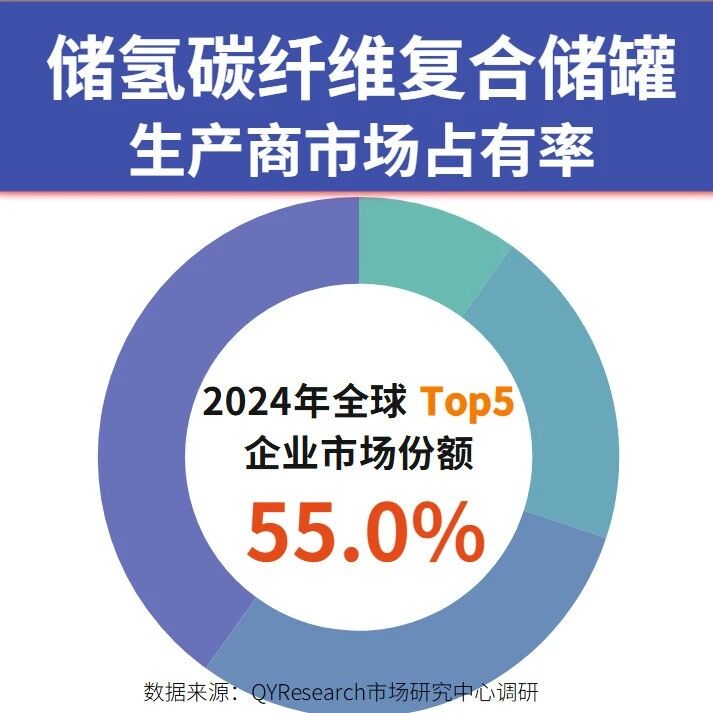
Core Viewpoint - Hydrogen storage carbon fiber composite tanks are critical equipment in the hydrogen energy industry, experiencing rapid growth amid global energy transition, with significant opportunities and challenges ahead [4][5]. Industry Development Overview - The hydrogen storage tank industry is currently dominated by Type III and Type IV tanks, primarily used in fuel cell vehicles. The industry is growing rapidly, with leading positions held by the US, Europe, Japan, and South Korea, while Chinese companies are catching up [4]. - The industry faces high technical barriers and cost pressures, with a diverse competitive landscape where international giants dominate the high-end market, and Chinese firms are gradually increasing their market share supported by government initiatives [4]. - The supply chain shows structural imbalances, particularly in high-performance carbon fiber production, which is heavily influenced by international trade policies. The manufacturing technology for hydrogen tanks is complex and requires high precision across multiple disciplines [4][9]. - Downstream applications are primarily in transportation but are expanding into fixed storage and gas distribution, with global tariff policy changes reshaping competitive dynamics and increasing uncertainty [4]. Market Demand Analysis - The demand for hydrogen storage tanks is closely linked to the sales performance of hydrogen fuel cell vehicles (FCEVs). However, the FCEV market is currently experiencing significant volatility, with global sales declining by 30.2% in 2023 and projected to drop another 21.6% in 2024 [6]. - In contrast, demand for hydrogen tanks in industrial, energy, and fixed transportation scenarios is showing a stable upward trend, indicating a shift away from reliance solely on FCEV sales [7]. Supply Chain Analysis - Key raw materials for hydrogen tanks include carbon fiber, valve components, and liner materials, with carbon fiber costs accounting for approximately 60%-70% of total production costs [9][10]. - Domestic companies in China are actively working to overcome technological barriers and accelerate the industrialization of carbon fiber to ensure supply chain security and reduce costs [10]. - The manufacturing segment is technology-intensive, with Type III and Type IV tanks being the primary products. Type IV tanks are expected to become the mainstream technology due to their advantages in lightweight and fatigue resistance [10]. Global Market Size and Company Rankings - The global hydrogen storage carbon fiber composite tank market is projected to reach $900 million by 2031, with a compound annual growth rate (CAGR) of 15.5% in the coming years [12]. - Major manufacturers in the global market include Hexagon Purus, ILJIN Hysolus, and Zhongcai Technology, with the top five companies holding approximately 55.0% of the market share [13]. - Type IV tanks currently represent about 50.2% of the market share, while commercial vehicles account for approximately 51.2% of demand [17][19].


铂金价格大涨40%,中美铂金战正式打响,美国囤积中国有准备
Sou Hu Cai Jing· 2025-12-20 07:55
Core Insights - The surge in platinum prices, which increased by 45% to over $1,300 per ounce, is driven by a global rush for 290,000 ounces of platinum, highlighting its strategic importance in the hydrogen energy industry [1][3] - The competition for platinum is intensifying between the US and China, with both countries implementing policies to secure their supplies amid a looming supply shortage projected at 26.4 tons by 2025 [5][11] Supply and Demand Dynamics - South Africa produces 70% of the world's platinum, while Russia accounts for 20%, and China has minimal production at only 3 tons annually, despite consuming 30% of global platinum [5][9] - The imbalance in supply and demand is exacerbated by geopolitical factors, including supply chain disruptions in South Africa and sanctions affecting Russian exports [11][14] Market Reactions and Trends - The introduction of platinum futures by the Guangzhou Futures Exchange aims to stabilize prices and provide risk management tools for domestic enterprises, reflecting a shift towards establishing a "Chinese price" for platinum [5][11] - The demand for platinum in the automotive sector remains strong, with 94.74 tons required for catalytic converters in 2023, despite the rise of electric vehicles [9][12] Geopolitical Influences - The geopolitical landscape is complicating the platinum market, with the US considering tariffs and China implementing tax incentives to secure resources [3][11] - The relationship between China and South Africa, along with cooperation within BRICS nations, is becoming increasingly important for ensuring platinum supply [11][14] Investment and Financial Aspects - The financial attributes of platinum are evolving, with its industrial value becoming more pronounced as demand from jewelry declines [12][14] - The current price volatility reflects a broader trend of global investors seeking tangible assets amid concerns over fiat currency stability [14]

海马汽车(000572.SZ):与中国航天科技集团有限公司101研究所曾有过成功合作
Ge Long Hui· 2025-12-16 00:52
Core Viewpoint - Haima Automobile has successfully collaborated with China Aerospace Science and Technology Corporation's 101 Research Institute to establish a "photovoltaic hydrogen production and hydrogen refueling integrated station" in Haikou, which is a significant part of the company's hydrogen energy full industry chain layout [1] Group 1 - The integrated station has been completed and is operational, providing green energy support for the demonstration operation of the company's hydrogen energy vehicles [1]

全国首个民用液氢加氢站投运
Zhong Guo Jing Ji Wang· 2025-12-09 05:40
Core Insights - The first commercial hydrogen production project based on "photoelectrochemical water splitting" technology and the first civilian liquid hydrogen refueling station have been launched in Panzhihua, Sichuan Province, marking significant advancements in China's hydrogen energy industry chain [1][2] Group 1: Hydrogen Production Project - The hydrogen production base in Panzhihua utilizes advanced "multi-faceted strontium titanate photonic quantum hydrogen-oxygen thermal integration technology" [1] - The project features 144 heliostat mirrors and 24 photonic hydrogen reactors, capable of producing 200 tons of hydrogen annually at a cost of 21 yuan/kg [1] - This project has achieved multiple "world firsts," including the use of a 26-faceted strontium titanate and its three-dimensional composite catalytic materials [1] Group 2: Liquid Hydrogen Refueling Station - The liquid hydrogen refueling station, with a total investment of 83 million yuan, aims to enhance the hydrogen supply chain in Panzhihua [2] - It is the first civilian liquid hydrogen refueling station in China and features a "pipeline hydrogen + mother-son refueling" system [2] - The station is expected to contribute to the development of a hydrogen energy industry cluster with an annual output value exceeding 10 billion yuan [2] Group 3: Regional Resources and Policy Support - Panzhihua is known as the "City of Vanadium and Titanium," holding 63% and 93% of China's vanadium and titanium resources, respectively, which are essential for high-performance hydrogen production catalysts [3] - The region benefits from over 2,700 hours of sunlight annually and has significant untapped renewable energy resources, including 9.3 million kilowatts of wind and solar power [3] - The local government has established a development plan for the hydrogen energy industry from 2021 to 2030, outlining goals and support measures for hydrogen-related enterprises [3]
加氢站:燃料电池车先锋军
2025-12-08 00:41
Summary of Hydrogen Station Industry Conference Call Industry Overview - The hydrogen station industry in China primarily adopts an external hydrogen supply model, with construction methods including standalone hydrogen stations and co-built stations. The main pressure level is 35 MPa, while 70 MPa technology is gradually maturing [1][3] - The core infrastructure of hydrogen stations includes compressors, hydrogen storage facilities, and refueling systems, with technology choices impacting operational efficiency and costs [1][4] Key Insights - The global number of hydrogen stations is continuously increasing, with significant growth in China. By the end of 2024, approximately 500 hydrogen stations are expected to be built in China. However, achieving the national target of 1,000 stations by 2025 may be challenging [1][5][7] - The cost of refueling varies significantly based on type and specifications, with large-scale effects being notable. The internal hydrogen production model can save transportation costs, but production costs remain high, necessitating a comprehensive consideration of scale and technological advancements to optimize economics [1][8] Economic Factors - Key factors affecting hydrogen project profitability include: - Hydrogen procurement costs, terminal prices, and the composite rate of hydrogen stations [1][9] - Current hydrogen retail prices are high, with government efforts aiming to reduce prices to below 35 yuan per kilogram by 2025, supported by subsidies [10] Government Support and Policy - Local governments provide financial subsidies and policy support for hydrogen station construction, typically covering 30% to 50% of investment costs. However, the lack of unified industry standards and regulatory frameworks poses challenges [10] - The operational composite rate of hydrogen stations is currently low due to the limited number of fuel cell vehicles, impacting efficiency and profitability [10] Future Development Focus - Future development priorities for hydrogen stations include: - Continuous policy support for infrastructure development - Monitoring the annual construction numbers of hydrogen stations to assess market expansion speed - Observing trends in procurement costs and terminal sales prices, which are closely related to the sales volume and ownership of fuel cell vehicles [11][12]
国投期货品种手册(上市版):铂钯
Guo Tou Qi Huo· 2025-11-25 11:10
1. Report Industry Investment Rating No relevant content provided. 2. Core Viewpoints of the Report - Platinum and palladium are important precious metals with high demand in various industries, and their supply is highly concentrated, with significant supply - side impacts on prices. The supply - side factors such as production cuts, accidents, and disruptions in recycling channels can cause obvious price fluctuations [15]. - The demand for platinum and palladium is mainly in automotive catalysts, industry, jewelry, and medical fields. In the context of carbon neutrality and carbon peaking, the hydrogen energy industry is expected to become a new growth point for platinum and palladium consumption [37][47]. - China's platinum - group metal resources are extremely scarce, with a high degree of import dependence. The importance of the recycling end is increasing, but the supply of waste materials is tight, and domestic recycling enterprises face fierce competition [32][82]. 3. Summary According to the Directory 3.1 Platinum and Palladium Species Overview - **Natural Attributes**: Platinum and palladium are silver - white metals, belonging to the platinum - group metals (PGMs). Platinum has a crustal content of 0.005 ppm, and palladium has 0.0006 ppm. Platinum has high melting point, good ductility, and stable chemical properties. Palladium can adsorb gases, is corrosion - resistant, and is mainly used in the catalyst field [6][7][8]. - **Resource Distribution and Classification**: Platinum - group metal resources are mainly distributed in South Africa, Russia, the United States, and other regions. The deposits can be divided into primary deposits and exogenous sand deposits, with magma - related processes being the main formation mechanism [10][13]. 3.2 Platinum - Group Metal Industry Chain - **Upstream**: The upstream of the platinum - group metal industry chain is dominated by a few mining and smelting integrated producers. The "oligopoly" structure makes the supply side dominant in price. The mining and extraction of platinum - group metals involve exploration, mining development, ore extraction, processing, and refining [15][16]. - **Supply and Recycling of Platinum - Group Materials**: The separation and purification processes of platinum - group metals vary according to the raw material components. The recycling of platinum - group metals is becoming increasingly important, but the supply of waste materials is tight [19][32]. - **Terminal Applications**: Platinum and palladium are mainly used in automotive catalysts, jewelry, industry, medical, and other fields. Automotive catalysts are the largest consumer area, with platinum's consumption structure being more diversified and over 80% of palladium used in automotive catalysts [37]. - **Investment Channels**: Platinum investment channels include physical investment (platinum bars and coins), platinum ETFs, futures, forwards, and stocks. Palladium investment demand is relatively small [49][50]. 3.3 Global Platinum Supply - Demand Pattern - **Supply**: South Africa, Zimbabwe, and Russia are the main suppliers of global platinum. In 2024, South Africa's platinum output accounted for 71% of the global total. The global platinum output decreased in 2024 due to various factors such as power outages and company restructurings [55]. - **Demand**: The main consumers of global platinum are China, Europe, North America, and Japan. In 2024, the global platinum demand decreased by 1.6% to 198 tons, with a supply gap of 1.98 tons [65]. 3.4 Global Palladium Supply - Demand Pattern - **Supply**: Russia, South Africa, Canada, and the United States are the main suppliers of global palladium. In 2024, Russia and South Africa's palladium output accounted for 43% and 41% of the global total respectively. The global palladium output increased slightly in 2024 [69][71]. - **Demand**: The main consumers of global palladium are China, the United States, Europe, and Japan. In 2024, the global palladium demand decreased by 4% to 254.2 tons, with a supply surplus of 2.4 tons [73][77]. 3.5 China's Platinum - Group Resource Pattern - **Resource Endowment**: China's platinum - group metal resources are extremely scarce, mainly distributed in Gansu, Yunnan, and other regions. In 2022, China's platinum - group metal reserves were 80.9 tons, and the resource reserves are decreasing [82]. - **Import Dependence**: China's platinum and palladium resources have a high degree of import dependence. In 2024, China imported 104.1 tons of platinum and 28.1 tons of palladium [86][88][92]. - **Domestic Demand**: In 2024, China consumed 64.4 tons of platinum and 68.9 tons of palladium. The demand for platinum in the automotive catalyst and chemical industries decreased, while the demand for palladium in the automotive catalyst field decreased significantly [97][101]. - **Import and Export and Taxes**: The import tariffs and value - added taxes of platinum and palladium vary according to the processing state. China's platinum is mainly imported from South Africa, and palladium is mainly imported from Russia and South Africa [110][111][114]. 3.6 Platinum and Palladium Price Review No detailed price review content is provided in the text, only a mention of historical price trends. 3.7 Guangzhou Futures Exchange Platinum and Palladium Futures - **Contract Text**: On November 7, 2025, the GZFE issued announcements on the palladium futures and palladium options contracts and related rules [126]. - **Risk Control System**: No detailed content is provided in the text. 3.8 Platinum and Palladium Options - **Option Contracts**: No detailed content is provided in the text. - **Risk Control System**: No detailed content is provided in the text. 3.9 Delivery Business - **Delivery Time**: No detailed content is provided in the text. - **Delivery Product Form and Premium/Discount**: No detailed content is provided in the text. - **Delivery Unit**: No detailed content is provided in the text. - **Delivery Handling Fee**: No detailed content is provided in the text. - **Warehousing and Out - of - Warehouse Fees**: No detailed content is provided in the text. - **Physical Delivery Method**: No detailed content is provided in the text. - **Delivery Quality Standard**: No detailed content is provided in the text. - **Warehouse Standard Warehouse Receipt Delivery**: No detailed content is provided in the text. - **Factory Warehouse Standard Warehouse Receipt Delivery**: No detailed content is provided in the text. 3.10 Platinum and Palladium Delivery Areas, Factories, and Warehouses - **Platinum Futures Delivery Area Factories**: No detailed content is provided in the text. - **Palladium Futures Delivery Area Factories**: No detailed content is provided in the text. - **Platinum and Palladium Futures Delivery Warehouses**: No detailed content is provided in the text. 3.11 Platinum and Palladium Designated Quality Inspection Institutions and Inspection Fees - **Platinum and Palladium Futures Quality Inspection Institution List**: No detailed content is provided in the text. - **Maximum Limit of Platinum Futures Inspection Fees**: No detailed content is provided in the text. - **Maximum Limit of Palladium Futures Inspection Fees**: No detailed content is provided in the text. 3.12 Platinum and Palladium Delivery Brands - **List of Registered Brands for Platinum Futures (Domestic)**: No detailed content is provided in the text. - **List of Registered Brands for Platinum Futures (Overseas)**: No detailed content is provided in the text. - **List of Registered Brands for Palladium Futures (Domestic)**: No detailed content is provided in the text. - **List of Registered Brands for Palladium Futures (Overseas)**: No detailed content is provided in the text.
桐庐举行第三批重大项目推进活动
Mei Ri Shang Bao· 2025-11-05 03:52
Group 1 - The core viewpoint of the news is the significant investment and development of major projects in Tonglu County, which aims to enhance the "5541X" advanced manufacturing cluster and promote high-quality economic growth [1][2] - A total of 12 projects were signed with a total investment of 195.81 billion, primarily in the manufacturing sector, indicating a strong focus on industrial development [1] - The Zhongke Huayue Hydrogen Energy headquarters project, with an investment of 106.2 billion, will establish a production base for hydrogen fuel cells and core components, aligning with the application of hydrogen energy in commercial vehicles [1] Group 2 - 28 projects have commenced construction with a total investment of 103.36 billion, covering various sectors including manufacturing, agriculture, culture, tourism, real estate, and public welfare [2] - The establishment of the Tonglu High-tech Zone Industrial Incubation Park is a key project aimed at fostering technological and industrial innovation, with a focus on smart logistics and artificial intelligence [2] - A total of 185.2 billion in projects have been completed and put into production, showcasing the successful closure of major project initiatives [3] Group 3 - Notable completed projects include the production of synthetic mica, smart manufacturing bases, and energy storage battery production, which highlight the role of leading enterprises in driving industry growth [3]
东华能源(002221):全球丙烷供给趋于宽松,PDH景气度有望改善
Changjiang Securities· 2025-11-02 11:15
Investment Rating - The investment rating for the company is "Buy" and is maintained [10]. Core Views - The report indicates that the global propane supply is becoming more relaxed, which is expected to improve the profitability of the Propane Dehydrogenation (PDH) sector [7][10]. - The company reported a revenue of 23.307 billion yuan for the first three quarters of 2025, a year-on-year decrease of 1.79%. The net profit attributable to the parent company was 75 million yuan, down 42.64% year-on-year [2][7]. - In Q3 2025, the company achieved a revenue of 7.024 billion yuan, a decline of 24.95% year-on-year and 15.41% quarter-on-quarter. The net profit attributable to the parent company was 9 million yuan, down 57.57% year-on-year and 35.38% quarter-on-quarter [2][7]. Financial Performance Summary - For the first three quarters of 2025, the company reported: - Revenue: 23.307 billion yuan, down 1.79% year-on-year - Net profit: 75 million yuan, down 42.64% year-on-year - Non-recurring net profit: 51 million yuan, down 39.12% year-on-year - In Q3 2025: - Revenue: 7.024 billion yuan, down 24.95% year-on-year and 15.41% quarter-on-quarter - Net profit: 9 million yuan, down 57.57% year-on-year and 35.38% quarter-on-quarter - Non-recurring net profit: 17 million yuan, down 51.06% year-on-year but up 392.12% quarter-on-quarter [2][7][10]. Industry Insights - The report highlights that the PDH sector is showing signs of improvement, with domestic prices for propane, propylene, and polypropylene in Q3 2025 being 573 USD/ton, 6463 yuan/ton, and 7370 yuan/ton respectively, with varying changes [10]. - The company has significant PDH and polypropylene production capacity, ranking among the top in China, with ongoing projects in various locations [10]. - The company is focusing on developing a carbon fiber and hydrogen energy industry chain, leveraging its existing resources and partnerships for innovation and cost reduction [10].
