
波动率

Search documents
【今晚播出】市场低估了风险?诺奖得主恩格尔发出2026预警 | 两说
Di Yi Cai Jing Zi Xun· 2026-01-28 07:00
Core Insights - The article emphasizes the increasing complexity of global markets influenced by trade conflicts, AI transformations, geopolitical tensions, and climate crises, raising the question of whether hidden risks have been adequately identified [1] - It highlights the need for financial systems to either fully price in the new normal or risk falling into a collective optimism that leads to cognitive blind spots [1] - The piece introduces Robert Engle, a Nobel laureate in economics, who will provide insights on the risk landscape for 2026 and offer strategies for ordinary investors to safeguard their wealth and future [1] Summary by Sections - **Market Dynamics**: The article discusses the ongoing turbulence in global markets due to multiple overlapping crises, suggesting a critical need for risk recognition [1] - **Expert Insight**: Robert Engle, known for his work on volatility and risk trajectories, is set to analyze the risk scenarios for 2026 and propose rational survival strategies in a volatile world [1][4] - **Broadcast Information**: The insights from Engle will be featured in a program airing on January 28 and January 31, providing a platform for discussing these pressing issues [4]


【今晚播出】市场低估了风险?诺奖得主恩格尔发出2026预警 | 两说
第一财经· 2026-01-28 06:53
Core Insights - The article emphasizes the increasing complexity of global markets influenced by trade conflicts, AI transformations, geopolitical tensions, and climate crises, raising the question of whether hidden risks have been adequately identified [1] - It highlights the need for investors to be aware of potential "black swan" and "gray rhino" events and to consider strategies for protecting their wealth and future [1] Summary by Sections - **Expert Opinion**: Robert Engle, a Nobel laureate in economics and founder of the ARCH model, provides insights and warnings regarding the risk landscape for 2026, focusing on volatility and risk trajectories [3] - **Media Coverage**: The article mentions upcoming broadcasts featuring Engle's analysis, scheduled for January 28 on Oriental TV and January 31 on First Financial [5]

市场降温整固,成长优势延续——市场环境因子跟踪周报(2026.01.16)
华宝财富魔方· 2026-01-22 09:48
Market Overview - A-shares experienced a pullback after reaching highs, with market guidance leading to a rational return and short-term adjustments in themes [1][4] - In the medium to long term, market consolidation is expected to benefit a slow bull market, with high-growth sectors presenting investment value [1][4] - Short-term volatility may occur, but it is recommended to focus on sectors with upward momentum after the weight pressure diminishes [1][4] Equity Market Factors - The market style remains biased towards small-cap stocks, while the growth style continues to favor growth stocks [6][8] - Both small-cap and growth style volatilities have risen to near one-year highs, with increased volatility in the return differences between styles [6][8] - The excess return dispersion among industries has rebounded, while the speed of industry rotation continues to decline [6][8] Trading Activity - The proportion of rising stocks in the 300 and 500 indices has significantly decreased [6] - The trading concentration remains stable, with the top 100 stocks' trading volume holding steady and the top five industries' trading volume share slightly increasing [6][7] Market Liquidity - Market volatility, except for the 1000 index, has generally decreased, while the turnover rate is on an upward trend [7][8] Commodity Market Factors - In the commodity market, the energy and precious metals sectors have seen an increase in trend strength, while other sectors have experienced a decline [21][22] - The basis momentum for precious metals and agricultural products has risen, while other sectors have shown a downward trend [21][22] - Volatility in precious metals and non-ferrous metals remains high, while the volatility in black and energy sectors has slightly decreased [21][22] Options Market Factors - The implied volatility of the Shanghai Composite and CSI 1000 has started to decline from its peak, indicating a cooling market sentiment [28] - The skewness of call options has decreased while that of put options has increased, suggesting a reduction in market exuberance [28] Convertible Bond Market Factors - The convertible bond market has experienced wide fluctuations, with the premium rate for bonds at 100 yuan halting its upward trend and showing a slight adjustment [29] - The proportion of low premium convertible bonds has increased, while market transaction volumes remain high [29]
华尔街2026美股热门交易策略:把握AI分化、博弈波动率、对冲科技股尾部风险
智通财经网· 2026-01-18 23:45
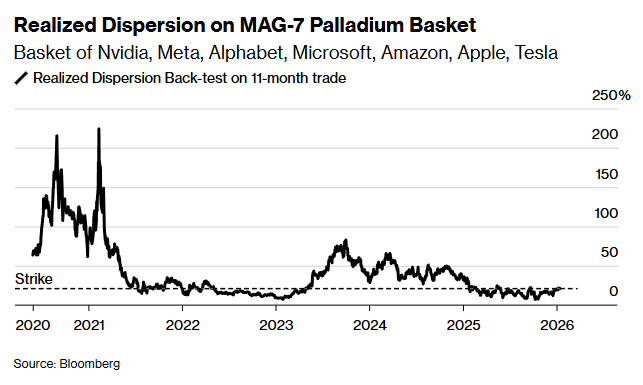
Group 1 - The article discusses the current market sentiment where investors are torn between the fear of missing out on stock market gains and concerns over escalating geopolitical risks, particularly influenced by U.S. President Trump's unpredictable policies [1] - Bloomberg Intelligence's chief global derivatives strategist, Tanvir Sandhu, highlights that the combination of AI momentum and government-induced volatility creates a favorable backdrop for the market, suggesting that both the S&P 500 index and volatility may rise simultaneously [1] - Strategies are being promoted to manage volatility changes and headline risks, transitioning from conventional tail hedging to customized differentiated baskets [1] Group 2 - The "Magnificent Seven" tech stocks are expected to continue leading market gains, but Barclays strategists note that direct purchases of call options are not cost-effective, recommending a Palladium structure that bets on the dispersion of a basket of stocks rather than the overall performance [2] - The Palladium structure is actively utilized among a wide range of clients, including hedge funds and pension funds, and is typically built around investment themes such as cyclical versus defensive stocks and AI versus robotics [6] - The UpVar swap strategy is gaining popularity as it bets on rising volatility when assets exceed a certain level, with several banks recommending 1 to 2-year UpVar swaps on the S&P 500 or Nasdaq 100 [7][10] Group 3 - European banks are considered a hot investment, with expectations of strong rebounds in 2025, and various trading strategies are being developed around cheaper upside options [11] - Barclays reports that European mining stocks are also gaining attention, with potential improvements in fundamentals driven by supportive Chinese policies and AI infrastructure demand [11] - Investors are increasingly inclined to buy volatility exposure in large tech stocks as a hedge against concentrated risks and uncertainties in AI capital expenditures, with recommendations to purchase out-of-the-money put options on companies like Apple and Nvidia [15]

股指期权数据日报-20260115
Guo Mao Qi Huo· 2026-01-15 05:19
tied Volstility Surfas | 5700 6000 | | 6300 | 6600 | 6900 | 202 | 202 | 202 | 2022 | SS | | | --- | --- | --- | --- | --- | --- | --- | --- | --- | --- | --- | | | 行情概况 | | | | | | | | | | | | 1月14日,A股冲高回落,沪指盘中一度涨逾1%,逼近4200点,收盘录得下跌。市场成交额逼近4万亿元,续创历史新高。上证指数收跌 0.31%报4126.09点,深证成指涨0.56%,创业板指涨0.82%,北证50涨0.98%,科创50涨2.13%,万得全A涨0.31%,万得4500跌0.13%, | | | | | | | | | | | 中证A500持平。 | | | | | | | | | | | | 免责 | 本报告中的信息均源于公开可获得的资料,国贸期货力求准确可靠,但不对上述信息的准确性及完整性做任何保证。本报告不构成个人 投资建议,也未针对个别投资者特殊的投资目标、财务状况或需要,投资者需自行判断本报告中的任何意见或建 ...
波动率数据日报-20260113
Yong An Qi Huo· 2026-01-13 07:45
Group 1: Implicit Volatility Index and Historical Volatility - The financial option implicit volatility index reflects the 30 - day implicit volatility trend as of the previous trading day. The commodity option implicit volatility index is obtained by weighting the implicit volatilities of the two - level options above and below the at - the - money option of the main contract month, reflecting the implicit volatility change trend of the main contract [3] - The difference between the implicit volatility index and historical volatility: a larger difference indicates that the implicit volatility is relatively higher than the historical volatility, while a smaller difference means the opposite [3] Group 2: Implicit Volatility Quantile and Volatility Spread Quantile - The implicit volatility quantile represents the current level of the variety's implicit volatility in history. A high quantile means the current implicit volatility is high, and a low quantile means it is low [5] - The volatility spread is related to the implicit volatility index and historical volatility [5]
国投期货贵金属日报-20260108
Guo Tou Qi Huo· 2026-01-08 12:07
Report Industry Investment Rating - Gold: ★☆☆, indicating a bullish bias but with limited operability on the trading floor [1] - Silver: ★☆★, suggesting a short - term balance in the trend and poor operability, with a recommendation to wait and see [1] Core View of the Report - Precious metals declined today. The US ADP employment increase in December was slightly lower than expected but better than the previous value, and the ISM non - manufacturing PMI was better than expected and the previous value. The Shanghai Futures Exchange adjusted trading limits, contract margin ratios, and price limit ranges for silver futures. With global geopolitical turmoil continuing at the beginning of the year and market sentiment driving sharp fluctuations, precious metals are testing resistance at previous highs. Consider participating in a breakout or waiting for volatility to decline before re - entering the market. Tonight, focus on the US weekly initial jobless claims data [1] Other Key Points - The US Secretary of State will meet with Denmark next week to discuss Greenland issues [2] - Trump believes that the military budget in 2027 should be $1.5 trillion instead of $1 trillion [2] - China's gold reserves at the end of December were reported at 74.15 million ounces, a month - on - month increase of 30,000 ounces, marking the 14th consecutive month of gold purchases [2]
贵金属日报-20260108
Guo Tou Qi Huo· 2026-01-08 11:31
1. Report Industry Investment Ratings - Gold: ★☆☆, indicating a bullish bias but limited operability in the market [1] - Silver: ★☆★, with the market in a relatively balanced state and poor operability, suggesting a wait - and - see approach [1] 2. Core Views of the Report - Precious metals declined today. The US ADP employment increase in December was slightly lower than expected but better than the previous value, and the ISM non - manufacturing PMI was better than expected and the previous value. The Shanghai Futures Exchange adjusted trading limits, contract trading margin ratios, and price limit ranges for silver futures [1]. - Global geopolitical turmoil continues at the beginning of the year, and market sentiment leads to sharp volatility. Precious metals are testing resistance at previous highs. Consider participating in a breakout or waiting for volatility to decline before re - entering the market. Tonight, focus on the US weekly initial jobless claims data [1] 3. Other Key Information from the Report - The US Secretary of State will meet with Denmark next week to discuss Greenland issues [2] - Trump believes that the military budget in 2027 should be $1.5 trillion instead of $1 trillion [2] - China's gold reserves at the end of December were reported at 74.15 million ounces, an increase of 30,000 ounces compared to the previous month, marking the 14th consecutive month of gold purchases [2]
资金跟踪系列之二十七:北上明显回流,机构ETF与两融均净流出
SINOLINK SECURITIES· 2026-01-05 07:27
Macroeconomic Liquidity - The US dollar index has rebounded, and the degree of inversion in the China-US interest rate differential has deepened. The nominal and real interest rates of 10Y US Treasury bonds have both increased, indicating a rise in inflation expectations [2][13] - Offshore dollar liquidity has marginally loosened, while the domestic interbank funding situation remains balanced, with a narrowing of the yield spread between 10Y and 1Y bonds [2][18] Market Trading Activity, Volatility, and Liquidity - Overall market trading activity has continued to rise, with trading heat in sectors such as military, textiles, light industry, retail, and consumer services all above the 80th percentile [3][24] - The volatility of major indices has also increased, with sectors like communication, electric power, electronics, and chemicals remaining above the 80th percentile historically [3][31] - Market liquidity indicators have declined, although the liquidity indicators for the oil and petrochemical sector remain above the 80th historical percentile [3][36] Institutional Research - The sectors with the highest research activity include electronics, pharmaceuticals, machinery, electric power, and computers, while research interest in retail, oil and petrochemicals, automobiles, and home appliances has also increased [4][42] Analyst Forecasts - Analysts have adjusted the net profit forecasts for the entire A-share market for 2025/2026, with increases in sectors such as real estate, transportation, chemicals, electric power, and machinery [4][21] - The proportion of stocks in the entire A-share market with upward revisions to their 2025/2026 net profit forecasts has increased, while the proportion of stocks with downward revisions has decreased [4][18] - The net profit forecasts for the ChiNext Index for 2025/2026 have been downgraded, while those for the Shanghai 50 and CSI 300 have been adjusted up and down, respectively [4][23] Northbound Trading Activity - Northbound trading activity has rebounded significantly, with a notable net purchase of A-shares, particularly in sectors such as non-ferrous metals, military, and automobiles [5][31] - The ratio of total buy and sell amounts in the top 10 active stocks has increased in sectors like non-ferrous metals, military, and automobiles, while it has decreased in electronics, communication, and electric power [5][32] Margin Financing Activity - Margin financing activity has slightly decreased but remains at a relatively high level since November 2025, with net purchases primarily in military, electric power, and media sectors [6][35] - The proportion of financing purchases in electric power, public utilities, home appliances, and food and beverage sectors has increased [6][38] Active Equity Fund Positions - The positions of actively managed equity funds have continued to rise, with significant increases in sectors such as communication, electric power, and electronics, while reductions were seen in military and consumer services [7][45] - The correlation of actively managed equity funds with large/mid-cap growth and mid/small-cap value has increased, while the correlation with small-cap growth and large-cap value has decreased [7][48] - New equity fund establishment sizes have decreased, with actively managed funds seeing a decline while passive funds have seen an increase [7][50]
贵金属期现日报-20260105
Guang Fa Qi Huo· 2026-01-05 01:24
Group 1: Investment Ratings - No investment ratings provided in the report Group 2: Core Views - Gold's price has corrected on the chart. In January, precious metals are expected to maintain high volatility due to uncertainties such as the impact of US economic data on Fed policies and geopolitical situations in South America. It is recommended to pay attention to volatility changes and for long - position investors to buy at low prices [1] - For silver, there may be a correction risk due to potential passive selling from the global commodity index rebalancing in the short term. In a high - volatility market, it is advisable to keep a light long - position and use options to lock in profits [1] - The trends of platinum and palladium may gradually stabilize. With the strong performance of the outer - market, the price center of platinum is gradually rising, and a low - buying strategy is recommended. Palladium's fundamentals are relatively weaker and it tends to follow the market. The platinum - palladium ratio is expected to rise further, and investors can choose the right time for hedging arbitrage [1] Group 3: Market Data Summaries Domestic Futures Closing Prices - AU2602 contract closed at 977.56 yuan/gram on December 31, down 0.74% from the previous day [1] - AG2602 contract closed at 17,074 yuan/kilogram on December 31, down 5.88% from the previous day [1] - PT2606 contract closed at 527.25 yuan/gram on December 31, down 10.61% from the previous day [1] - PD2606 contract closed at 425.20 yuan/gram on December 31, down 4.97% from the previous day [1] Foreign Futures Closing Prices - COMEX gold主力 contract closed at 4341.90 on January 2, up 0.23% from December 31 [1] - COMEX silver主力 contract closed at 72.27 on January 2, up 1.81% from December 31 [1] - NYMEX platinum主力 contract closed at 2161.80 dollars/ounce on January 2, up 4.43% from December 31 [1] - NYMEX palladium主力 contract closed at 1695.50 on January 2, up 2.08% from December 31 [1] Spot Prices - London gold was at 4332.51 on the current day, up 0.33% from the previous day [1] - London silver was at 72.82 on the current day, up 1.74% from the previous day [1] - Spot platinum was at 2132.00 dollars/ounce on the current day, down 4.22% from the previous day [1] - Spot palladium was at 1641.00 on the current day, down 1.14% from the previous day [1] - Shanghai Gold Exchange's gold T + D was at 974.39 yuan/gram on the current day, down 0.80% from the previous day [1] - Shanghai Gold Exchange's silver T + D was at 17,059 yuan/kilogram on the current day, down 5.85% from the previous day [1] - Shanghai Gold Exchange's platinum 9995 was at 512 yuan/gram on the current day, down 9.49% from the previous day [1] Basis - The basis of gold TD - Shanghai gold主力 was - 3.17, with a historical 1 - year quantile of 46.10% [1] - The basis of silver TD - Shanghai silver主力 was - 15, with a historical 1 - year quantile of 60.60% [1] - The basis of London gold - COMEX gold was - 0.39, with a historical 1 - year quantile of 77.40% [1] - The basis of London silver - COMEX silver was 0.56, with a historical 1 - year quantile of 97.00% [1] Ratios - COMEX gold/silver ratio was 60.08, down 1.56% from the previous day [1] - Shanghai Futures Exchange's gold/silver ratio was 57.25, up 5.46% from the previous day [1] - NYMEX platinum/silver ratio was 1.28, up 2.31% from the previous day [1] - Guangzhou Futures Exchange's platinum/palladium ratio was 1.24, down 5.94% from the previous day [1] Interest Rates and Exchange Rates - 10 - year US Treasury yield was 4.19%, up 0.2% from the previous day [1] - 2 - year US Treasury yield was 3.47%, unchanged from the previous day [1] - 10 - year TIPS Treasury yield was 1.94%, up 0.5% from the previous day [1] - US dollar index was 98.46, up 0.21% from the previous day [1] - Offshore RMB exchange rate was 6.9699, down 0.15% from the previous day [1] Inventory and Positions - Shanghai Futures Exchange's gold inventory was 97,704, unchanged from the previous day [1] - Shanghai Futures Exchange's silver inventory was 691,638 kilograms, down 8.48% from the previous day [1] - COMEX gold inventory was 36,402,970, up 0.41% from the previous day [1] - COMEX silver inventory was 449,773,368, up 0.08% from the previous day [1] - COMEX gold registered warehouse receipts were 19,361,515, unchanged from the previous day [1] - COMEX silver registered warehouse receipts were 127,264,198, down 0.70% from the previous day [1] - SPRD gold ETF position was 1065, down 0.51% from the previous day [1] - SLV silver ETF position was 16,444, unchanged from the previous day [1]