
海外市场

Search documents
苏博特20151223
2025-12-24 12:57
Summary of Conference Call Notes Company Overview - **Company**: 苏博特 (Subote) - **Industry**: Construction materials, specifically functional materials for infrastructure projects Key Points Industry and Market Trends - **Infrastructure Demand**: The demand for functional materials in the infrastructure sector remains robust, with products like accelerators, crack-resistant agents, and cement-based materials achieving approximately 20% growth in the first three quarters. The growth rate in Q4 is expected to remain consistent with Q3 due to positive infrastructure growth [2][5] - **Real Estate Market Outlook**: The outlook for real estate demand is pessimistic, with new construction and land acquisition indicators showing a double-digit decline. Without new policies to stimulate the market, uncertainty in the real estate sector is expected to persist into next year [2][10] - **Infrastructure Investment**: Overall infrastructure investment is not expected to see significant improvement next year, but major projects like the Yunnan-Tibet Railway are anticipated to provide substantial growth opportunities for the company [2][11] Financial Performance - **Gross Margin**: The gross margin decreased in Q3 due to a decline in sales influenced by the real estate market, fixed cost dilution, and tight profit margins for civilian customers. Future gross margins are expected to recover if pricing and costs remain stable and collections improve [2][6][7] - **Operating Cash Flow**: The company expects to maintain positive operating cash flow for the year, potentially slightly better than last year, benefiting from improved cash flow from state-owned enterprises. However, the final outcome will depend on year-end collection performance [2][8] - **Credit Impairment**: Credit impairment is expected to be better than last year due to the peak accumulation of accounts receivable having passed, with an increase in large infrastructure projects leading to better collection situations [2][9] Product and Project Insights - **Functional Materials Growth**: The growth in functional materials is primarily driven by accelerators, crack-resistant agents, and cement-based materials, which are essential for infrastructure projects [2][5] - **Major Projects**: The company is involved in significant projects like the Yunnan-Tibet Railway, which is expected to contribute to revenue growth. Other projects such as the Lalin and Qinghai-Tibet Railways are also anticipated to provide incremental revenue [2][11][12] - **New Projects**: Potential projects for 2026 include large-scale transportation infrastructure in Tibet and Xinjiang, with significant investments expected in energy and transportation sectors [2][13] International Expansion - **Overseas Business Growth**: The company anticipates a 25%-30% growth in overseas business, focusing on markets in the Middle East and Southeast Asia, with Southeast Asia being the largest market. The company is actively expanding into Singapore, the Philippines, and Saudi Arabia [2][3][15] - **Challenges in Overseas Investment**: While there are plans for overseas expansion, strict approval processes for foreign investments pose challenges. However, the company remains optimistic about its international market prospects [2][15][16] Research and Development - **PEKK Patent**: The company has applied for a PEKK patent, currently in the public notice stage, with plans to explore market applications in sectors like healthcare, robotics, and drones [2][17] - **PEEK Material Development**: The decision to develop PEEK materials is based on the chemical similarity to existing products, with cautious investment planned to avoid excess capacity [2][18] - **Aerated Cement Project**: The company is collaborating on an aerated cement project, which shows promise in modern green building applications, although market launch will depend on demand recovery [2][19][20] Financial Instruments and Borrowing - **Convertible Bonds**: The company has announced that it will not revise the terms of its convertible bonds in the near term, with sufficient funds available for repayment if necessary [2][21] - **Increased Borrowing**: The increase in borrowing is attributed to proactive lending from banks and the utilization of low-interest loans for investment purposes [2][22]

义利天下丨在义乌“听见”时代的变化
Zhong Guo Xin Wen Wang· 2025-12-22 12:19
Core Insights - The article highlights the journey of Xia Zhiwen, who started in Yiwu in 2006 with electronic clocks and small gifts, and successfully adapted to the rise of smart devices and industry transformation, eventually entering the audio sector [2] Company Development - Xia Zhiwen has witnessed the evolution of the Yiwu market from version 1.0 to 6.0, indicating significant changes in market dynamics and consumer preferences over nearly two decades [2] - The company has shifted from traditional offline sales to smart audio products, reflecting a strategic pivot towards modern technology and consumer electronics [2] Brand Strategy - There is a strong confidence in building proprietary brands and expanding into overseas markets, suggesting a focus on brand development and international growth opportunities [2]
“技术+新能源+出海”,铸就优秀车企成长“利刃”|说商道市
Chang Sha Wan Bao· 2025-12-15 07:08
Group 1 - The core viewpoint of the article highlights that three Chinese automakers, Geely, BYD, and SAIC, have achieved over 90% of their annual sales targets by the end of November 2025, with Geely leading at 93% completion rate [1][2] - Geely's success is attributed to the popularity of its models, including the Geely Xingyuan and the Galaxy series, which have contributed to its strong sales performance [1] - BYD's completion rate of 91% is supported by the widespread adoption of its intelligent technology and the growth of its mid-to-high-end brands, particularly the success of the Tang brand [2] Group 2 - SAIC's sales performance benefits from its strong foundation in traditional fuel vehicles and the emergence of its own brands like "Zhiji" and the collaboration with Huawei on the "Shangjie" brand [2] - The overseas market has become a crucial factor for Chinese automakers in achieving their annual targets, with BYD's overseas sales in November reaching 131,661 units, a 297% increase year-on-year [3] - Continuous technological innovation, adherence to the new energy vehicle strategy, and expansion into overseas markets are identified as key factors for the success of these leading Chinese automakers [3]





光大证券晨会速递-20251209
EBSCN· 2025-12-09 02:07
Macro Analysis - In November 2025, China's exports increased by 5.9% year-on-year, primarily due to the fading high base effect and sustained overseas demand [1] - Looking ahead, December's export growth may face high base effects, but optimism remains for next year's overseas demand due to global fiscal expansion and improved China-US trade relations [1] Real Estate Industry - As of December 7, 2025, new home transactions in 20 cities totaled 720,000 units, a decrease of 13.9% year-on-year; Beijing saw 37,000 units (-19%), Shanghai 95,000 units (-5%), and Shenzhen 25,000 units (-33%) [2] - In the secondary housing market, transactions in 10 cities reached 711,000 units, an increase of 1.5% year-on-year; Beijing recorded 160,000 units (+1%), Shanghai 236,000 units (+8%), and Shenzhen 64,000 units (+9%) [2] Company Research - For Anjins Food (603345.SH), the forecasted net profit for 2025-2027 is 1.391 billion, 1.513 billion, and 1.672 billion yuan, translating to EPS of 4.17, 4.54, and 5.02 yuan, with current P/E ratios of 19, 18, and 16 times respectively [3] - The company's short-term operations are improving, with a gradual recovery in profitability expected as industry price competition eases; if the consumption environment improves next year, performance elasticity is anticipated [3] - New products and channel strategies are actively evolving, with expected positive outcomes in the future, maintaining a "buy" rating [3]

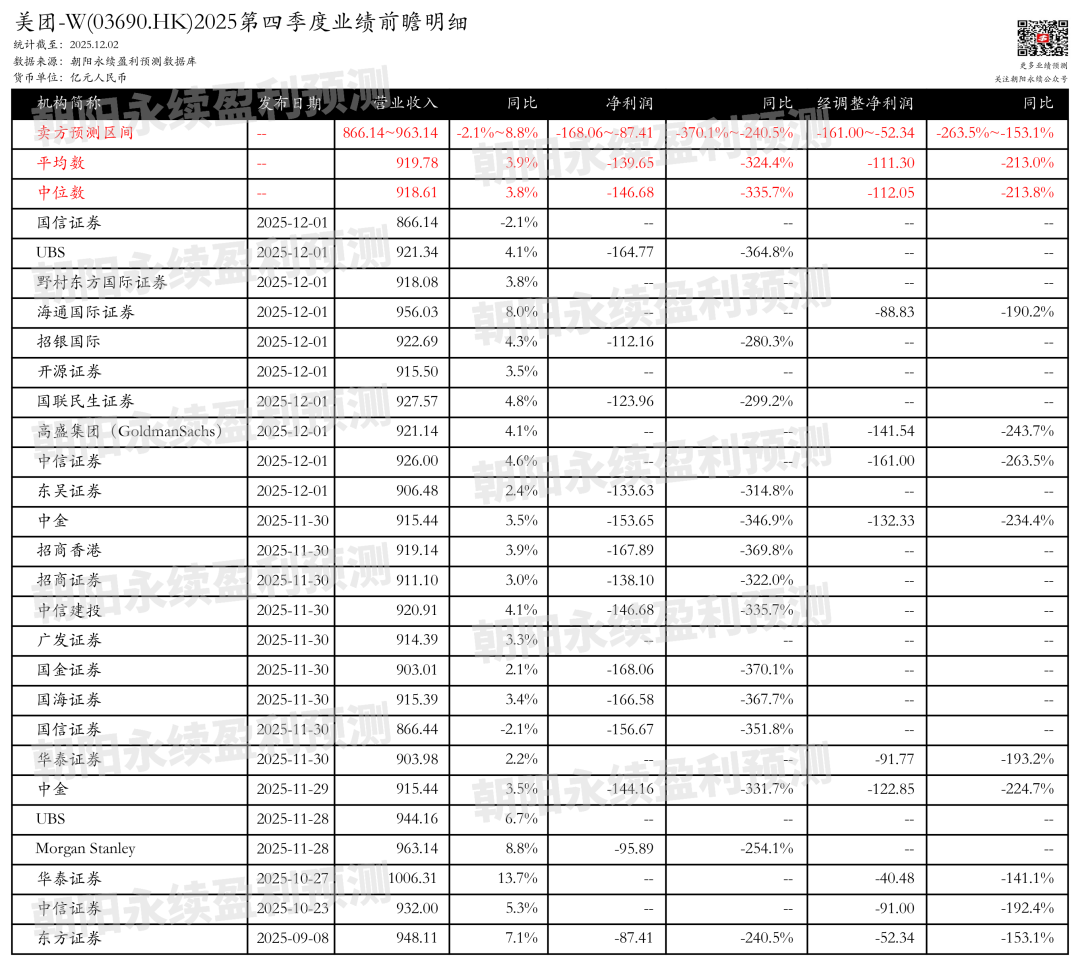
美团-W:竞争加剧,利润修复缓慢,预测Q4一致预期营收866.14~963.14亿元,同比-2.1%~8.8%
Xin Lang Cai Jing· 2025-12-02 12:05
Group 1: Q4 Performance Expectations - The company is expected to report Q4 revenue between 866.14 billion to 963.14 billion RMB, reflecting a year-on-year change of -2.1% to 8.8% [1][11] - The anticipated net profit for Q4 is projected to be between -168.06 billion to -87.41 billion RMB, indicating a year-on-year change of -370.1% to -240.5% [1][11] - Adjusted net profit for Q4 is forecasted to be between -161.00 billion to -52.34 billion RMB, with a year-on-year change of -263.5% to -153.1% [1][11] Group 2: Analyst Insights - Analysts from Kaiyuan Securities believe that the company is increasing investments to consolidate market share, with expectations of slow profit margin recovery due to intense industry competition in 2025 [4][14] - The company’s third-quarter performance was below expectations, with core business performance being unsatisfactory, although losses in new businesses were better than anticipated [4][14] - Long-term prospects for the company are seen positively, particularly in flash purchase and fresh retail businesses, with potential contributions from overseas markets [4][14] Group 3: Business Segment Performance - In the instant delivery segment, the company is increasing subsidies for users, riders, and merchants to maintain market share amid heightened competition [5][14] - The dine-in segment is experiencing slow profit margin recovery due to macroeconomic factors and order structure, with the company responding by expanding categories and adjusting order structures [6][15] - New business revenue grew by 15.9% year-on-year, with a reduction in operating loss rate by 2.5 percentage points, primarily due to improved efficiency in Hong Kong and the Middle East markets [7][16] Group 4: Recent Financial Results - The company reported third-quarter revenue of 95.5 billion RMB, a 2% year-on-year increase, slightly below expectations due to intensified competition in the delivery market [8][14] - Adjusted net loss for the third quarter reached 160 billion RMB, a significant decline from a profit of 12.8 billion RMB in the same period last year [8][14] - The core local commerce (CLC) revenue was 67.4 billion RMB, down 3% year-on-year, resulting in an operating loss of 14.1 billion RMB [8][14]

销量、营收、核心市场份额占比不断提升 海外市场成新增长极
Huan Qiu Wang· 2025-12-02 07:04
Core Insights - The Chinese automotive industry is experiencing a significant shift towards overseas markets, with exports growing faster than domestic sales, indicating a transition from incremental competition to stock competition [1][4][12] - By 2030, it is projected that Chinese automotive brands will achieve nearly 10 million units in overseas sales, highlighting the increasing importance of international markets for growth [1][13] Export Growth - In October, China exported 666,000 vehicles, a month-on-month increase of 2.1% and a year-on-year increase of 22.9%. From January to October, total exports reached 5.616 million units, up 15.7% year-on-year [1] - Chery's overseas sales reached 1.06 million units from January to October, accounting for 46% of its total sales, maintaining a steady growth trend [1] - BYD's exports for the same period were 780,000 units, a significant increase of 130%, with overseas sales making up 21% of total sales [2] - Geely's overseas sales approached 300,000 units, with a remarkable 214% increase in exports of new energy vehicles [3] Financial Performance - Chery's revenue for the first three quarters of 2025 was 214.83 billion yuan, a 17.9% increase year-on-year, with overseas sales contributing significantly to this growth [6] - BYD's overseas revenue share rose from 28% in 2024 to 36.5% in the third quarter of 2025, with a net profit margin of 4.2% surpassing domestic margins [7] - Great Wall Motors reported overseas revenue of 80.3 billion yuan in 2024, accounting for 39.69% of total revenue, indicating the growing importance of international markets [8] Market Share and Competitive Position - By 2025, China's automotive global market share is expected to exceed 38%, with significant growth in Europe, where Chinese brands achieved a record 7.4% market share in September 2025 [10] - In Southeast Asia, particularly Thailand, Chinese brands captured 34.3% of the market share in the first three quarters of 2025, leading the segment [11] - Chinese brands are also making significant inroads in Brazil, with market share increasing from 6.8% in 2024 to 9.1% in 2025, particularly in the new energy vehicle segment [11] Strategic Initiatives - Chinese automotive companies are increasingly establishing local production facilities overseas, allowing them to better meet local market demands and navigate trade barriers [5][9] - The shift from product export to a comprehensive ecosystem approach is evident, with companies focusing on local production, service, and supply chain integration [9][14] - The emphasis on localization and understanding local consumer preferences is crucial for success in international markets, as highlighted by the need for tailored products and services [12][15]


上汽集团前11个月销量约410.8万辆 已超去年全年
Mei Ri Jing Ji Xin Wen· 2025-12-01 09:17
Core Insights - SAIC Motor Corporation reported a total vehicle sales of approximately 4.108 million units in the first 11 months of this year, representing a year-on-year increase of 16.4% [1] - The sales volume has already surpassed the total sales for the previous year [1] Group 1: Sales Performance - Sales of the company's own brands reached 2.666 million units, marking a year-on-year growth of 25.7% [1] - Sales of new energy vehicles amounted to 1.499 million units, reflecting a year-on-year increase of 38.8% [1] - Sales in overseas markets totaled 969,000 units, which is a year-on-year growth of 3.4% [1]
上汽集团1-11月销售410.8万辆,销量已超去年全年
Xin Lang Cai Jing· 2025-12-01 09:05
Core Viewpoint - SAIC Motor Corporation reported a total vehicle sales of 4.108 million units from January to November, representing a year-on-year increase of 16.4%, surpassing the total sales of the previous year [1] Group 1: Sales Performance - The sales of SAIC's self-owned brands reached 2.666 million units, showing a year-on-year growth of 25.7% [1] - Sales of new energy vehicles amounted to 1.499 million units, reflecting a year-on-year increase of 38.8% [1] - Sales in overseas markets reached 969,000 units, with a year-on-year growth of 3.4% [1] Group 2: Future Outlook - The company anticipates that the positive momentum from self-owned brands, new energy vehicles, and overseas markets, referred to as the "new three driving forces," will contribute to a rapid growth in overall sales for the year [1]
盈利趋势向好,“两海”指引方向 | 投研报告
Zhong Guo Neng Yuan Wang· 2025-11-26 02:04
Group 1 - The core viewpoint is that the wind power industry is experiencing a positive trend in profitability, with improvements in the wind turbine manufacturing and bearing segments, and a slight recovery in wind turbine prices [1][2] - In Q3 2025, the domestic wind power installation saw a decline both year-on-year and quarter-on-quarter, primarily due to a wait-and-see approach following a rush in Q2 2025. However, long-term global onshore wind power is expected to grow steadily, supporting new installations, while offshore wind power is anticipated to contribute even more significantly [2] - The bidding prices for wind turbines are rebounding, aided by the effects of reducing internal competition and a slowdown in the trend towards larger turbines, leading to a continuous price recovery [2] Group 2 - The industry maintains high levels of contract liabilities and inventory, which supports future demand [1][2] - Companies with a focus on offshore wind power and increasing overseas revenue proportions are expected to benefit, including those involved in wind turbines, towers, and components [2] - The overseas market offers higher unit prices and better profitability, indicating that exporting companies and those with overseas production capacity are likely to see sustained profit growth [1][2]
25Q3风电业绩总结:盈利趋势向好“两海”指引方向
Minmetals Securities· 2025-11-25 06:57
Investment Rating - The industry investment rating is "Positive" [3] Core Viewpoints - The report indicates a positive trend in profitability for the wind power industry, with significant growth in revenue and net profit year-on-year [6][39] - The demand for offshore wind power is expected to grow significantly, while onshore wind development is relatively stable [21][41] - The report highlights that the industry is experiencing a recovery in profitability, particularly in the wind turbine and bearing segments, with a gradual increase in wind turbine prices [39][41] Revenue and Profitability - In Q3 2025, the wind power industry's revenue and profit remained stable quarter-on-quarter, with year-on-year growth of 17% and 40%, respectively [6][39] - The gross margin and net margin showed a slight decline quarter-on-quarter but remained stable overall [6][39] Segment Performance - The bearing and tower segments saw an improvement in gross margins, while the turbine segment experienced a decline in both gross and net margins due to ongoing profitability challenges [10][39] - The report notes that the profitability of major wind turbine manufacturers has shown signs of recovery, particularly in the bearing segment [10][39] Contract Liabilities and Inventory - The industry maintained a high level of contract liabilities in Q3 2025, with a year-on-year increase of 26%, indicating strong order backlogs [15][39] - Inventory levels have been rising over the past three quarters, suggesting that order deliveries are expected to remain robust [15][39] Demand and Installation - Domestic wind turbine installations in Q3 2025 saw a significant decline, primarily due to a cautious market following a surge in installations in Q2 2025 [21][41] - The report anticipates that the overall wind power tendering capacity will support installation growth in 2026, despite a slight year-on-year decrease in tendering volume [21][41] Supply and Pricing Trends - The report indicates that wind turbine bidding prices have been gradually recovering since Q3 2024, contributing to improved profitability in the wind turbine segment [27][41] - The trend of larger wind turbines is slowing down, which may lead to a reduction in the number of turbines produced [27][41] International Market Opportunities - The report highlights that domestic wind turbine exports can achieve significant price premiums, with overseas revenue margins for tower companies being notably higher than domestic margins [34][39] - Companies with a growing share of overseas revenue are expected to benefit from enhanced profitability [34][39]