滞涨交易

Search documents
每周宏观经济和资产配置研判-20260315
Soochow Securities· 2026-03-15 11:13
Domestic Macro Perspective - China's economy is shifting from low inflation to input-driven price increases, with PPI rising over 0.4% for two consecutive months[1] - The upstream sectors and government benefit from rising prices, while downstream industries and consumer incomes face pressure, particularly in sectors like consumer electronics and automobiles[1] - Economic indicators such as retail sales and employment in March will be crucial for assessing the sustainability of economic recovery amid rising prices[1] Overseas Macro Perspective - Geopolitical disturbances have temporarily impacted risk appetite, with the market currently in a rebound phase[3] - The risk of stagflation is increasing globally due to rising oil prices, suggesting a focus on defensive investments in upstream resource sectors like oil, gas, and chemicals[3] Bond Market Perspective - The yield curve has shown divergence since February, with short-term rates declining and long-term rates rising; 1-3 year rates fell by 1-4 bps while the 10-year rate rose by 3.9 bps[4] - The market is at a crossroads between "inflation trading" and "stagflation trading," with current economic conditions not supporting stagflation[4] Investment Strategy - A balanced ETF allocation is recommended, focusing on sectors that can withstand inflationary pressures[7] - The report suggests monitoring the oil price, which is currently around $100/barrel, with potential to rise above $120/barrel if geopolitical tensions escalate[5] Risk Factors - Key risks include slower-than-expected economic policy implementation, unexpected changes in U.S. Federal Reserve monetary policy, and significant price volatility in major asset classes[9]
有色金属行业跟踪周报:能源价格上行催生输入性通胀担忧,贵金属价格回调
Soochow Securities· 2026-03-09 07:10
Investment Rating - The report maintains an "Overweight" rating for the non-ferrous metals sector [1] Core Views - The non-ferrous metals sector experienced a decline of 5.47% in the week from March 2 to March 6, ranking low among all primary industries. Precious metals fell by 1.12%, industrial metals by 4.83%, new materials by 6.25%, minor metals by 6.88%, and energy metals by 9.22% [1][13] - The geopolitical situation in the Middle East is expected to persist, leading to concerns about input inflation due to rising energy prices, which has resulted in a significant pullback in industrial metal prices. In the precious metals sector, the ongoing geopolitical risks and high energy prices have pressured prices down, although there is potential for gold prices to rise in the medium term due to a declining U.S. labor market [1][4] Summary by Sections Market Review - The Shanghai Composite Index fell by 0.93%, with the non-ferrous metals sector declining by 5.47%, underperforming the index by 4.54 percentage points. Among the sub-sectors, energy metals saw the largest drop at 9.22% [13][1] Industrial Metals - **Copper**: As of March 6, LME copper was priced at $12,869 per ton, down 3.21% week-on-week, while SHFE copper was at ¥101,050 per ton, down 2.76%. Supply issues due to geopolitical tensions and high energy prices are expected to suppress future demand [2][29] - **Aluminum**: LME aluminum closed at $3,431 per ton, up 9.22% week-on-week, and SHFE aluminum at ¥24,715 per ton, up 3.69%. The risk of production disruptions in the Middle East and Europe is increasing, which may support higher prices in the short term [3][34] - **Zinc**: LME zinc was priced at $3,323 per ton, up 0.45%, while SHFE zinc was at ¥24,260 per ton, down 1.82%. Inventory levels showed mixed trends [37] - **Tin**: LME tin fell to $50,050 per ton, down 13.78%, and SHFE tin to ¥393,660 per ton, down 13.15%. Supply recovery in Myanmar is expected to pressure prices further [38] Precious Metals - As of March 6, COMEX gold was priced at $5,181.30 per ounce, down 2.17%, and SHFE gold at ¥1,140.80 per gram, down 0.62%. The ongoing geopolitical tensions and rising energy prices have led to concerns about inflation impacting future U.S. monetary policy, which has pressured precious metal prices [4][42]
黄金板块大涨,黄金股ETF、黄金股票ETF涨超5%,黄金ETF、上海金ETF、金ETF南方涨超4%
Ge Long Hui· 2026-02-24 05:18
Core Viewpoint - The A-share market experienced a strong start to the Year of the Horse, with all three major indices rising, driven by geopolitical tensions and uncertainties surrounding U.S. tariff policies, leading to a surge in gold-related stocks [1][3]. Group 1: Market Performance - The Shanghai Composite Index rose by 1.17% to 4129.78 points, while the Shenzhen Component increased by 1.82%, and the ChiNext Index gained 1.76% [1]. - The trading volume in the Shanghai and Shenzhen markets reached 15,210 billion yuan, an increase of 3,074 billion yuan compared to the previous day, with over 4,200 stocks rising [1]. Group 2: Gold Stocks and ETFs - Gold concept stocks saw significant gains, with companies like Xiaocheng Technology rising over 14%, and others such as Hunan Silver and Sichuan Gold reaching their daily limit [1]. - Various gold ETFs and related funds experienced increases of over 5%, reflecting strong investor interest in gold assets [1]. Group 3: Geopolitical and Economic Factors - Geopolitical risks, particularly tensions between the U.S. and Iran, are expected to keep gold prices elevated, with analysts predicting a target price of $6,200 per ounce for international spot gold in the coming months [2]. - The U.S. economic data has shown mixed signals, with inflationary pressures impacting consumer purchasing power, contributing to a volatile market environment [3]. Group 4: Long-term Outlook on Gold - Analysts maintain a bullish outlook on gold, emphasizing its role as a safe-haven asset amid ongoing geopolitical uncertainties and inflationary pressures [4]. - The long-term investment value of gold remains intact, with expectations of continued demand from central banks and limited supply growth due to depleting mining resources [2][4].
20260207周报:宏观情绪冲击,金属价格波动剧烈-20260207
Huafu Securities· 2026-02-07 09:29
Investment Rating - The report maintains a rating of "Outperform" for the industry [7] Core Views - Precious metals are experiencing significant price volatility, with silver prices retreating from highs due to profit-taking and macroeconomic factors [3][14] - Industrial metals, particularly copper and aluminum, are undergoing price corrections influenced by macroeconomic conditions, with copper prices showing signs of recovery despite inventory accumulation [4][20] - In the new energy metals sector, lithium carbonate prices have sharply declined, but strong demand signals from downstream industries may support a rebound in prices post-holiday [22][27] - Other minor metals, such as rare earths, are showing mixed price movements, with some products experiencing upward pressure due to supply constraints [24][27] Summary by Sections Precious Metals - Silver prices have seen a significant drop, with fluctuations driven by market sentiment and macroeconomic news, including the nomination of Kevin Warsh as the next Federal Reserve Chair [3][14] - Key stocks to watch include Zijin Mining, Zhongjin Lingnan, and others in the gold sector [15] Industrial Metals - Copper prices have corrected, but market activity has increased, with strong buying sentiment noted despite the holiday season affecting production schedules [4][20] - Aluminum prices have experienced volatility, with a notable drop followed by a brief recovery, although the overall supply-demand structure remains weak [20][21] New Energy Metals - Lithium carbonate prices have decreased significantly, but robust demand from downstream sectors indicates potential for price recovery in the near future [22][27] - Key stocks in the lithium sector include Ganfeng Lithium and others [23] Other Minor Metals - The rare earth market has shown mixed price trends, with some products like praseodymium-neodymium oxide experiencing upward price movements due to supply constraints [24][27] - Stocks to monitor include Hunan Gold and others in the minor metals sector [27]
20260201周报:市场现货紧张,镨钕价格大幅上涨:有色金属-20260201
Huafu Securities· 2026-02-01 06:31
Investment Rating - The report maintains a "stronger than the market" rating for the industry [6] Core Views - Precious Metals: The demand for safe-haven assets combined with a declining US dollar continues to drive strong increases in gold prices. Geopolitical risks are a core driver for the recent highs in gold prices, with long-term investment value remaining intact [2][12] - Industrial Metals: A surge in copper prices was observed due to concentrated macro risks leading to impulsive capital movements. The report highlights that copper prices have significant upward potential driven by demand from electric vehicles and renewable energy sectors [3][18] - New Energy Metals: Lithium carbonate futures experienced a pullback, but the trend of inventory reduction continues. The report notes a slight decrease in lithium production and ongoing supply chain disruptions affecting future supply expectations [4][22] - Other Minor Metals: The market for rare earths is tight, with significant price increases for praseodymium and neodymium. The report indicates a strong demand from downstream sectors, leading to increased prices despite some weakness in dysprosium and terbium [4][26] Summary by Sections Precious Metals - Gold prices are rising due to increased safe-haven demand and geopolitical tensions, with significant individual stocks to watch including Zijin Mining and Zhongjin Lingbao [2][13] - Silver and platinum group metals are also benefiting from the gold price movements, with specific stocks highlighted for investment [2][13] Industrial Metals - Copper prices surged by 6.35% in a single day, driven by macroeconomic factors and geopolitical tensions. The report emphasizes the potential for further price increases due to strong demand from the electric vehicle sector [3][15][18] - Aluminum prices are also on the rise, supported by domestic monetary policy and consumption initiatives [3][19][20] New Energy Metals - Lithium carbonate production decreased slightly, but the overall inventory remains low, indicating a continued trend of inventory reduction. The report notes that while demand remains stable, there is cautious optimism regarding future supply [4][21][22] - Key stocks in the lithium sector include Ganfeng Lithium and Tianhua [4][25] Other Minor Metals - The report highlights a significant increase in praseodymium prices due to tight market conditions, while dysprosium and terbium prices have weakened. Specific stocks in this sector include China Rare Earth and Northern Rare Earth [4][26]
20260118周报:海外宏观和地缘风险升温,银价延续加速上涨:有色金属-20260118
Huafu Securities· 2026-01-18 10:46
Investment Rating - The report maintains an "Outperform" rating for the industry [4] Core Insights - The precious metals sector is experiencing an increase in prices due to rising macroeconomic and geopolitical risks, with silver prices accelerating [1][9] - Industrial metals are expected to see price fluctuations due to interest rate expectations and geopolitical tensions, particularly affecting copper and aluminum [2][11] - The lithium carbonate market is witnessing a significant price increase, although spot trading remains sluggish [3][17] - The rare earth market is seeing rapid price increases driven by supply tightening, but demand has not kept pace, leading to a divided sentiment in the industry [3][21] Summary by Sections Precious Metals - The report highlights that geopolitical tensions and macroeconomic factors are enhancing the safe-haven appeal of precious metals, particularly gold and silver [1][9] - Key stocks to watch include Zijin Mining, Zhongjin Lingbao, and others in the A-share and H-share markets [10] Industrial Metals - Copper prices are experiencing volatility due to macroeconomic disturbances and geopolitical risks, with domestic inventories reaching a ten-year high [11][15] - Aluminum prices are expected to remain stable in the short term, but demand is under pressure due to high prices and seasonal factors [15][16] New Energy Metals - Lithium carbonate production is slightly increasing, but overall market sentiment remains strong due to optimistic demand forecasts, particularly in the energy storage sector [17] - Key stocks in the lithium sector include Ganfeng Lithium and others [17] Other Minor Metals - The rare earth market is seeing price increases driven by supply constraints, particularly in recycled materials, but demand has not matched this growth [21] - Key stocks to monitor include Northern Rare Earth and others in the rare earth sector [21] Market Review - The overall non-ferrous metal index increased by 3.0%, outperforming the broader market [22] - Notable stock performances include Hunan Silver, which saw a 41.14% increase, while West Materials experienced a 16.96% decline [32] Valuation - The current PE ratio for the non-ferrous metal industry is 35.36, indicating potential for valuation increases in copper and aluminum sectors due to supply constraints and rising demand for green metals [37]
指数开始高位调整!追高资金被套牢,还有哪些投资机会?
Sou Hu Cai Jing· 2025-08-20 07:16
Group 1: Industry Trends and Recommendations - The article emphasizes three key investment themes for the second half of the year: improvement in cash flow, expansion of domestic demand, and technological innovation [1] - Sectors recommended for cash flow improvement include engineering machinery, beverage and dairy, food processing, chemical pharmaceuticals, passenger vehicles, and industrial metals [1] - New consumption areas with high valuation attractiveness include gaming, cosmetics, personal care products, internet e-commerce, digital media, entertainment products, snacks, and feed [1] - Industries benefiting from the technological innovation cycle and domestic self-sufficiency policies include computer equipment, automation equipment, semiconductors, and national defense [1] - Specific sectors highlighted for attention are computers, machinery (engineering and automation), national defense, non-ferrous metals, and pharmaceuticals (chemical pharmaceuticals) [1] Group 2: Precious Metals Market Insights - The fundamentals of precious metals remain stable, with market risk appetite declining due to trade agreements between the US, Japan, and Europe, impacting gold prices [3] - The primary influence on gold prices is the US dollar index, with historical trends indicating that high gold prices struggle to rise significantly in a strong dollar environment [3] - The article suggests monitoring the dollar index closely, as easing tariffs suppress sentiment, and expectations for interest rate cuts are changing marginally [3] - Long-term, geopolitical uncertainties and US-China tariff policies will continue to drive demand for gold as a safe haven, with central bank purchases and stagflation trades being core to gold trading strategies [3] Group 3: Financial Sector Developments - Securities firms are actively seizing business opportunities by serving as lead underwriters or financial advisors for listed companies' private placements, expanding investment banking growth [5] - These firms are also participating in private placements to capture investment opportunities, benefiting from increased trading commissions and investment banking revenues during bull markets [5] - The banking sector has seen significant inflows from institutional funds, particularly public funds, which have increased their holdings in bank stocks due to policy effects and asset price stabilization [5] - Despite recent adjustments in the banking sector, medium-term investment attractiveness remains, with expectations of continued interest in bank stocks [5] Group 4: Market Dynamics and Monetary Policy - The Shanghai Composite Index is experiencing a stagnation trend, with financial stocks serving as market barometers, indicating potential shifts in capital flows [9] - There is an anticipated 50 basis points interest rate cut in the US, with expectations for the next cut possibly occurring in September, leading to a loosening of overseas liquidity [9] - The ChiNext Index is facing a pullback, with critical support levels being monitored to determine future market direction [9] - Domestic monetary policy will prioritize stabilizing growth and combating deflation in the second half of the year, with expectations for further interest rate cuts and reserve requirement ratio reductions [9]

黄金白银股集体走强,黄金股票ETF、黄金股ETF上涨
Ge Long Hui· 2025-06-06 02:50
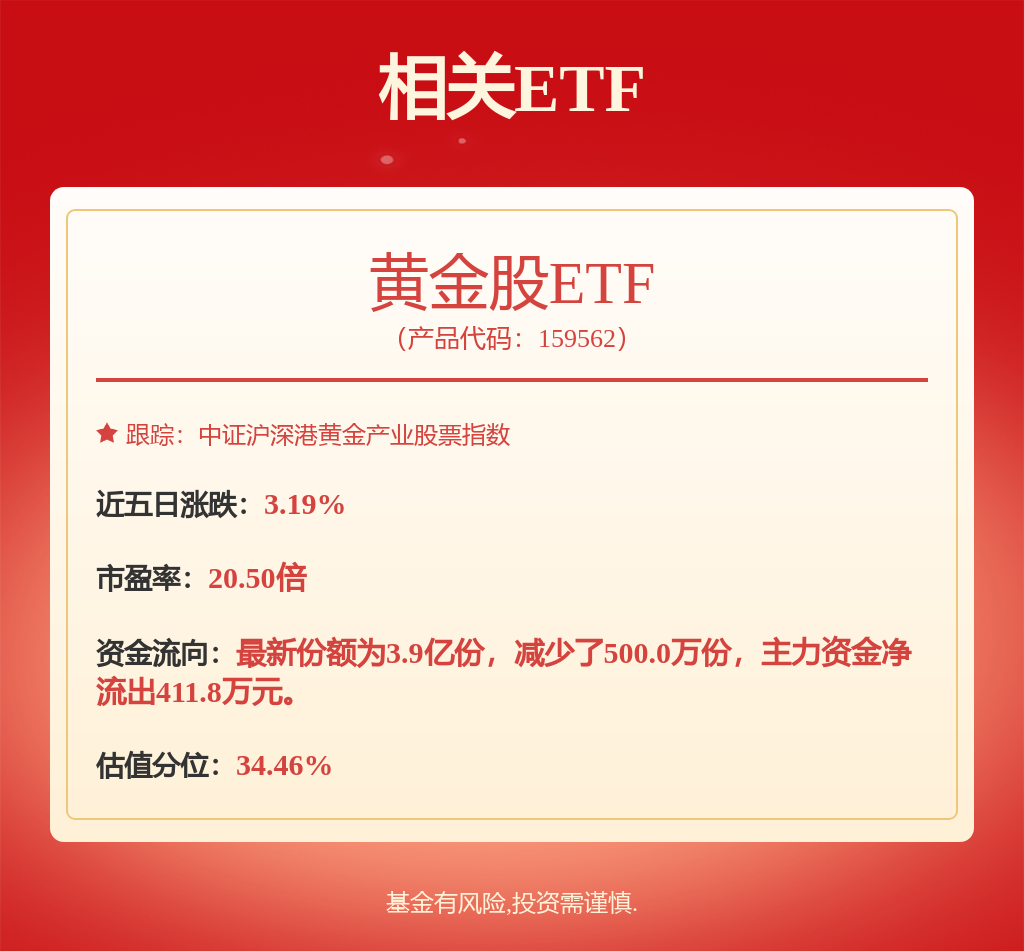
Group 1: Market Performance - The A-share market saw a collective rise in gold and silver stocks, with companies like Fuda Alloy, Silver Industry, and Hunan Silver hitting the daily limit [1] - Hong Kong gold stocks also experienced significant gains, with China Silver Group leading with a 20% increase, followed by Zijin Mining and others [1] - Various gold ETFs, including Huaan Gold Stock ETF and Ping An Gold Stock ETF, reported increases of over 1% [1] Group 2: Silver Price Outlook - London silver prices reached $36.066, the highest since February 2012, with a year-to-date increase of over 24% [2] - Bank of America predicts silver prices could reach $40 by the end of this year or early 2026, driven by both precious metal and industrial demand [2] - Industrial demand for silver is expected to hit a record in 2024, contributing to a structural deficit in the silver market for the fourth consecutive year [2] Group 3: Gold and Silver Market Dynamics - Ole Hansen from Saxo Bank noted that gold and silver are entering a breakthrough phase, supported by the macroeconomic environment [3] - Gold stocks tend to have higher elasticity compared to gold prices, often referred to as "gold price amplifiers," which can yield excess returns [3] - The geopolitical climate is increasing demand for gold as a safe-haven asset, with short-term risks from tariffs and uncertainties supporting gold prices [3] Group 4: Economic and Policy Influences - Huatai Securities highlighted the volatility in tariff policies under Trump, affecting market sentiment and making it difficult to establish a continuous trend [4] - The World Gold Council suggests re-evaluating the Basel Accord's treatment of gold as a high-quality liquid asset, indicating long-term investment opportunities in gold [4] Group 5: ETF Specifics - The Gold Stock ETF (Product Code: 159562) tracks the CSI Hong Kong-Shenzhen Gold Industry Stock Index, with a recent five-day increase of 3.19% and a P/E ratio of 20.50 [6] - The latest share count for the ETF is 390 million, with a decrease of 5 million shares and a net outflow of 4.118 million yuan [6]
黄金股早盘强势!华富永鑫灵活配置混合(A/C:001466/001467) 聚焦黄金股投资
Xin Lang Cai Jing· 2025-06-03 03:51
Group 1 - The gold stock sector is experiencing significant gains, with notable increases in stocks such as Western Gold, Mankalon, and others, indicating strong market interest in gold-related investments [1] - The Huafu Yongxin Flexible Allocation Mixed Fund has heavily invested in gold-related companies, achieving a year-to-date increase of 25.23% as of May 30, 2025, reflecting the positive impact of rising gold prices on these stocks [1] - International gold prices have surged, with spot gold breaking through $3,380 per ounce and COMEX gold futures rising by 2.74% to $3,406.4 per ounce, indicating a bullish trend in the gold market [1] Group 2 - Short-term market sentiment is supported by potential risks from U.S. "reciprocal tariffs," leading to a rise in gold prices, while long-term uncertainties in global tariff policies and regional politics continue to bolster gold's appeal as a safe-haven asset [2] - The Huafu Yongxin Flexible Allocation Mixed Fund focuses on diversifying investments in A-share gold-related companies, allowing for exposure to the benefits of rising gold prices while mitigating risks associated with holding individual gold stocks [2]



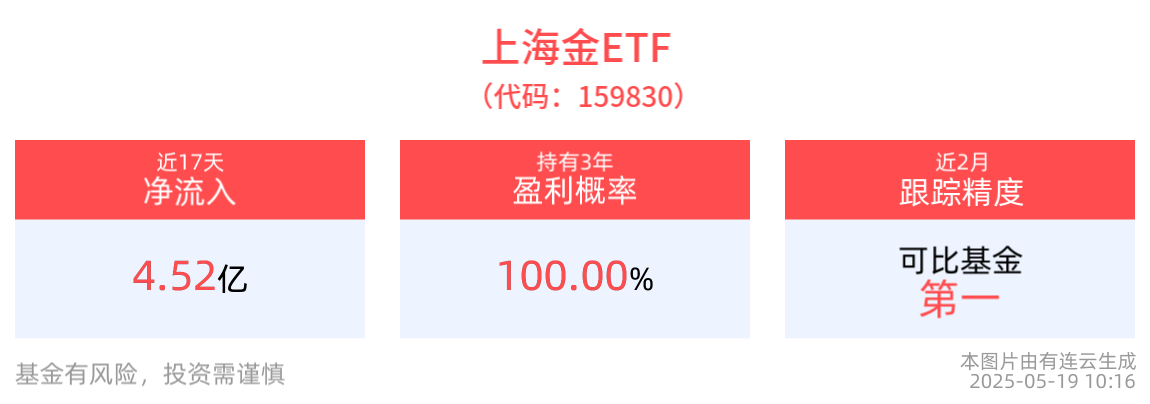
海外不确定性加剧,金价持续反弹,上海金ETF(159830)开盘涨0.47%,配置价值备受关注
Xin Lang Cai Jing· 2025-05-19 02:46
Core Viewpoint - The Shanghai Gold ETF (159830) is experiencing a positive performance with a recent price increase and strong liquidity, driven by ongoing geopolitical tensions and market uncertainties [2][3]. Group 1: Performance Metrics - As of May 16, the Shanghai Gold ETF has seen a 32.68% increase in net value over the past year, ranking in the top 2 among comparable funds [3]. - The ETF has achieved a maximum monthly return of 10.00% since its inception, with the longest streak of consecutive monthly gains being 6 months [3]. - The average monthly return during up months is 3.04%, and the annual profit percentage stands at 100.00% [3]. Group 2: Risk and Market Sentiment - Ongoing geopolitical conflicts and concerns over potential tariffs from the U.S. are contributing to heightened market risk aversion, which supports the continued rise in gold prices [2]. - The market sentiment remains cautious, with the potential for "reciprocal tariffs" adding to uncertainties, reinforcing the attractiveness of gold as a safe-haven asset [2]. Group 3: Fund Characteristics - The management fee for the Shanghai Gold ETF is 0.25%, and the custody fee is 0.05%, which are relatively low compared to similar funds [2]. - The ETF has demonstrated a high tracking accuracy, with a tracking error of just 0.001% over the past two months, the best among comparable funds [3]. - The Sharpe ratio for the ETF over the past year is 2.22, indicating higher returns for the same level of risk compared to peers [3].