
滞胀预期

Search documents
瑞达期货宏观市场周报-20250808
Rui Da Qi Huo· 2025-08-08 10:38
Report Summary 1. Report Industry Investment Rating No specific industry investment rating is provided in the report. 2. Core Viewpoints - The A - share market's major indices rose this week, with small - and medium - cap stocks outperforming large - cap blue - chip stocks. Market attention shifted to corporate semi - annual reports after the Politburo meeting, and the net profit growth of reported companies increased. Trading activity declined compared to last week [8]. - The bond market entered a repair phase. Although the central bank continued net withdrawals in the open - market operations, the bond market stabilized. The potential VAT levy on treasury bonds may widen the spread between new and old bonds [8]. - The commodity market faced a retracement risk. Although the Sino - US tariff truce was extended and trade relations improved marginally, domestic fundamentals remained weak [8]. - In the foreign exchange market, the US dollar was under pressure due to the dovish signals from the Fed and weak economic data, while the euro was boosted by the weakening dollar in the short term [8]. 3. Summary by Directory 3.1 This Week's Summary and Next Week's Allocation Suggestions - **Stocks**: The CSI 300 rose 1.23%, and CSI 300 stock index futures rose 1.27%. Small - and medium - cap stocks were stronger than large - cap blue - chip stocks, with IM>IC>IF>IH in terms of gains. The recommendation is to buy on dips [8]. - **Bonds**: The 10 - year treasury bond yield decreased by 0.15% with a weekly change of - 0.09BP, and the 10 - year treasury bond futures rose 0.18%. The suggestion is to buy on dips [8]. - **Commodities**: The Wind Commodity Index rose 1.86%, and the CSI Commodity Futures Price Index rose 0.10%. Due to weak fundamentals, there is a risk of retracement. The recommendation is to buy on dips [8]. - **Foreign Exchange**: The euro against the US dollar rose 0.65%, and the euro - US dollar 2509 contract rose 0.70%. The suggestion is to observe cautiously [8]. 3.2 Important News and Events - **Domestic**: The central bank will continue a moderately loose monetary policy, and the State Council plans to gradually implement free pre - school education. Several departments issued policies on finance and foreign exchange remittance [16]. - **International**: The US - EU trade tension eased as the EU postponed tariff counter - measures. Trump signed executive orders to impose tariffs on multiple countries, and there were speculations about a new Fed chair [18]. 3.3 This Week's Domestic and International Economic Data - **China**: In July, exports increased by 7.2% and imports by 4.1% in US dollars, both better than expected [13]. - **US**: The factory orders in June decreased by 4.8%, and the initial jobless claims in the week ending August 2 increased to 226,000 [19]. - **EU**: The eurozone's June PPI increased by 0.8%, and retail sales increased by 0.3% [19]. - **UK**: The central bank interest rate remained at 4% [19]. - **Germany**: The industrial output in June decreased by 1.9%, and the trade surplus was 14.9 billion euros [19]. - **France**: The industrial output in June increased by 3.8%, and the trade deficit was 7.623 billion euros [19]. 3.4 Next Week's Important Economic Indicators and Economic Events - Key economic data to be released next week include the UK's July unemployment rate, the US's July CPI, Germany's July CPI, and China's July social consumer goods retail sales [81].

宏观月报 | 关税效应进入“数据验证期”(申万宏观·赵伟团队)
赵伟宏观探索· 2025-07-14 07:05
Group 1 - The article discusses the resurgence of the "Goldilocks" trade in overseas markets, driven by the successful implementation of the "Beautiful Act" and lower-than-expected inflation data, which has alleviated market concerns about economic slowdown and interest rate hikes [2][6] - The article highlights that the Israeli-Palestinian conflict has caused temporary market disturbances, but the overall market reaction to tariff adjustments has been relatively muted, with the S&P 500 experiencing only a slight decline [21][2] - The article notes that the domestic market is witnessing a mild economic recovery, with consumer policies effectively stimulating demand, as evidenced by a significant increase in retail sales growth in May [3][29] Group 2 - The article emphasizes that the focus for July will be on potential inflation risks in overseas markets and the "anti-involution" policies in the domestic market, with evidence suggesting that inflation in the U.S. may begin to rise due to various factors [55][62] - It mentions that the domestic economy is seeing a shift towards service sector recovery, with increased investment and consumption in services, while export pressures may be building [62][39] - The article outlines the government's focus on addressing "involution" through supply-demand adjustments and structural upgrades, indicating a broader scope for policy implementation [69][49]


宏观月报 | 关税效应进入“数据验证期”(申万宏观·赵伟团队)
申万宏源宏观· 2025-07-13 06:19
Group 1 - The article discusses the resurgence of the "Goldilocks" trade in overseas markets, driven by the successful implementation of the "Beautiful Act" and favorable economic indicators such as lower-than-expected inflation and resilient employment data [2][6][21] - The article highlights that the domestic market is experiencing a mild economic recovery, with consumer policies effectively stimulating demand, as evidenced by a significant increase in retail sales growth in May [3][29] - The article notes that the manufacturing PMI exceeded expectations, indicating a faster recovery in domestic orders compared to new export orders [3][29] Group 2 - The article emphasizes the importance of monitoring inflation risks in the U.S. as the focus shifts to potential price increases following the recent rise in retail prices and manufacturing price indices [4][55] - It discusses the ongoing "anti-involution" policies in China, which aim to alleviate supply-demand imbalances and promote structural upgrades in industries [4][69] - The article mentions that the financial market sentiment has been positively influenced by policies promoting financial openness and the lack of further tariff increases on China during recent U.S.-China trade negotiations [3][49]

浙商证券浙商早知道-20250708
ZHESHANG SECURITIES· 2025-07-07 23:40
Market Overview - On July 7, the Shanghai Composite Index rose by 0.02%, while the CSI 300 fell by 0.43%, the STAR Market 50 dropped by 0.66%, the CSI 1000 increased by 0.24%, and the ChiNext Index decreased by 1.21%. The Hang Seng Index also fell by 0.12% [4]. - The best-performing industries on July 7 were comprehensive (+2.57%), utilities (+1.87%), real estate (+1.68%), light industry manufacturing (+1.52%), and environmental protection (+1.1%). The worst-performing industries included coal (-2.04%), pharmaceuticals and biology (-0.97%), telecommunications (-0.77%), home appliances (-0.7%), and electronics (-0.67%) [4]. - The total trading volume for the entire A-share market on July 7 was 1,227.1 billion yuan, with net inflow from southbound funds amounting to 12.067 billion Hong Kong dollars [4]. Key Insights Light Industry Manufacturing - The report emphasizes a trend in consumer growth industries, advocating for a balanced investment in value stocks [5]. - The market outlook indicates that the first half of 2025 saw insufficient national subsidies and weak overall consumption, leading to a structural growth in "new" consumption [5]. - The underlying logic of "new" consumption is attributed to generational shifts and changes in consumer attitudes during the economic transition period. Despite full pricing, mid-term performance growth is expected to digest valuations, making the second half of the year a clear investment focus for the sector [5]. - Key drivers include the sustained prosperity of new consumption and the performance turning point for traditional consumption [5]. - Recommendations include focusing on growth in consumer experience and prioritizing quality manufacturing stocks that have solidified their bottom lines [5]. Strategy Insights - The report projects that in Q3 2025, the domestic equity market may be dominated by local factors, suggesting banks as a stable investment while recommending balanced allocations in brokerage, military industry, and TMT sectors [6]. - The report notes a potential slowdown in the global trend of "de-dollarization" and emphasizes the need for rebalancing in dollar asset allocations. It suggests that U.S. stocks may show resilience beyond expectations, although caution is advised regarding potential inflationary pressures [6]. - Key factors to monitor include the expiration of the 90-day tariff exemption on China by the U.S. in mid-August and the earnings reports of U.S. stocks for Q2 2025 [7]. - The report highlights that the current dollar is likely entering a prolonged downtrend, with U.S. Treasury rates expected to remain high and volatile in Q3 2025 [7].
基本金属短期交易因素影响超过基本面
2025-06-30 01:02
Summary of Key Points from Conference Call Records Industry Overview: Non-Ferrous Metals Core Insights and Arguments - **Copper Price Expectations**: The anticipated copper price for 2025 is around $10,000 per ton, aligning with current fundamentals. The decline in the spot-futures price spread indicates a rationalization of speculative sentiment, with large enterprises slowing down purchases [1][4]. - **Weakening Fundamentals**: The non-ferrous metals sector has shown a marginal weakening over the past three to four weeks, with inventory levels for copper and aluminum halting their decline and slightly increasing. Downstream operating rates, processing fees, and profitability for copper and aluminum are all on a downward trend [1][6]. - **Seasonal Weakness**: The non-ferrous metals market is expected to enter a traditional off-season from July to early August 2025, with high temperatures and holidays negatively impacting consumption. Previous tariff policies have preemptively exhausted some demand, posing short-term risks of returning to fundamental market conditions [1][7]. - **Valuation and Price Caution**: The current valuation of the non-ferrous metals sector is neutral, with commodity prices and sector valuations reflecting caution [1][8]. Additional Important Insights - **Aluminum Industry Conditions**: The aluminum sector is experiencing weak conditions, with aluminum rod margins at their lowest in nearly a year. While aluminum rod factory inventories have decreased by approximately 16,000 to 17,000 tons, social inventories have increased by over 10,000 tons, indicating weak demand [1][9]. - **Copper Demand and Inventory**: Copper demand is relatively weak, with electrolytic copper production declining for four consecutive weeks while factory inventories are rising, indicating insufficient demand. Downstream copper rod production has also decreased for three weeks, further confirming the downward trend in demand [1][10]. - **Future Price Adjustments**: It is expected that commodity prices may undergo two adjustments in the coming year, influenced by short-term factors such as tariff-related behaviors and seasonal effects, as well as the long-term negative impacts of U.S. tariff policies [1][11]. Industry Overview: Gold Core Insights and Arguments - **Gold Price Stability**: Short-term inflation expectations support gold prices, with significant adjustments unlikely. Long-term support for gold prices is provided by central bank purchases in emerging markets, with expectations for gold prices to fluctuate between $3,100 and $3,400 [2][12]. Additional Important Insights - **Investment Opportunities**: The current investment climate suggests that as other sectors present more opportunities, the opportunity cost of holding gold is high. However, as gold prices adjust to reasonable levels, capital may flow back into gold [2][13]. Industry Overview: Steel Core Insights and Arguments - **Steel Industry Performance**: The steel industry performed well in Q1, with Q2 profitability levels expected to remain similar. Investment opportunities may arise if "anti-involution" policies are extended to the steel sector, potentially improving profit margins [14]. Industry Overview: Minor Metals Core Insights and Arguments - **Investment Opportunities in Tungsten and Cobalt**: There are notable investment opportunities in tungsten and cobalt, with tungsten prices currently stabilizing at high levels. The demand for tungsten is supported by growth in electronics and new energy vehicles, while cobalt may see significant changes in July and August due to inventory dynamics [15].
海外经济政策跟踪:地缘风险上升,美联储继续观望
Haitong Securities International· 2025-06-23 05:12
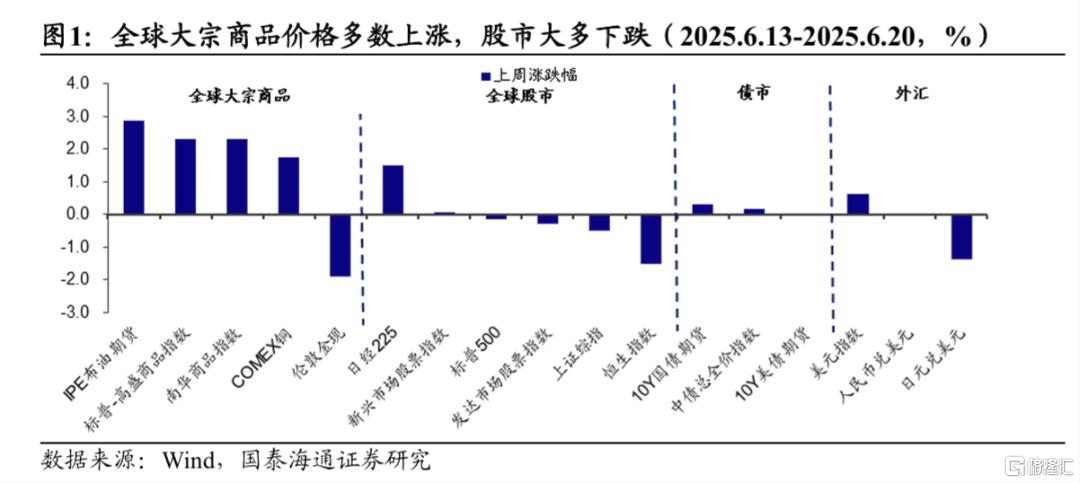
Group 1: Market Performance - Global stock markets mostly declined, with the S&P 500 down 0.15% and the Hang Seng Index down 1.52%[3] - Commodity prices generally increased, with IPE Brent crude futures rising by 2.85% and the S&P-Goldman Commodity Index up 2.30%[3] - The U.S. dollar index rose by 0.63%, closing at 98.76, while the yuan depreciated slightly against the dollar at 7.18[3] Group 2: Economic Indicators - U.S. industrial output fell by 0.13% year-on-year in May, and the industrial capacity utilization rate decreased to 77.43%[9] - The Eurozone ZEW economic sentiment index rose significantly to 35.3% from 11.6% in the previous month[27] - U.S. retail and food service sales decreased by 3.29% year-on-year in May, indicating a slowdown in consumer spending[17] Group 3: Inflation and Monetary Policy - U.S. inflation expectations declined, with the 1-year and 5-year inflation expectations at 5.1% and 4.1%, respectively[22] - The Federal Reserve maintained the federal funds rate target range at 4.25%-4.5%, indicating a cautious approach amid rising stagflation expectations[31] - The European Central Bank (ECB) is expected to lower interest rates again this year, with current inflation at 1.9% in May, close to the 2% target[32] Group 4: Risks and Uncertainties - Geopolitical risks, particularly related to tariffs and Middle Eastern tensions, are contributing to market volatility and inflation uncertainty[35] - The potential for stagflation is increasing, with the Fed's economic growth forecasts being downgraded and unemployment rate predictions rising[31]
国泰海通证券:地缘风险上升,美联储继续观望
Ge Long Hui· 2025-06-23 02:08
Global Asset Performance - Global stock markets mostly declined last week, while commodity prices generally increased. The Nikkei 225 rose by 1.50%, emerging market stock index increased by 0.05%, S&P 500 fell by 0.15%, developed market stock index decreased by 0.30%, Shanghai Composite Index dropped by 0.51%, and Hang Seng Index fell by 1.52% [1][3] - Commodity prices saw significant increases, with IPE Brent crude futures up by 2.85%, S&P-Goldman Commodity Index rising by 2.30%, South China Commodity Index increasing by 2.29%, and COMEX copper up by 1.74%. However, London gold spot price decreased by 1.91% [1][3] - In the bond market, domestic 10Y government bond futures prices rose by 0.30%, and the total price index of China bonds increased by 0.16%. The 10-year U.S. Treasury yield fell by 3 basis points to 4.38% [1][3] Economic Indicators in the U.S. - U.S. industrial output fell both year-on-year and month-on-month in May 2025, with a year-on-year growth rate of -0.13% compared to 0.55% in the previous month, and a month-on-month growth rate of -0.21% compared to -0.10% [6][10] - The industrial capacity utilization rate in the U.S. decreased to 77.43%, while the manufacturing capacity utilization rate slightly increased to 76.73% [6] - The Philadelphia Fed Manufacturing Index for June remained unchanged at -4.0, showing improvement from April's -26.4 [8] - New private housing starts in the U.S. fell by 4.56% year-on-year in May, and retail and food service sales also declined by 3.29% year-on-year [10] Inflation and Monetary Policy - The Federal Reserve maintained its interest rate target range at 4.25%-4.5% during the June meeting, marking the fourth consecutive meeting without a change. However, inflation expectations have increased, with the Fed lowering its economic growth forecasts for 2025 and 2026 [24] - The European Central Bank (ECB) indicated that its anti-inflation measures are nearly complete, with a cautious stance on future rate cuts, although market expectations suggest a potential rate cut later in the year [25] - The Bank of Japan decided to keep its policy rate unchanged at around 0.5% and will slow the pace of bond purchase reductions starting in the fiscal year 2026 [26]

巨富金业:美联储陷入“鹰派言论”与“政策迷茫”,黄金走势未明
Sou Hu Cai Jing· 2025-06-20 09:12
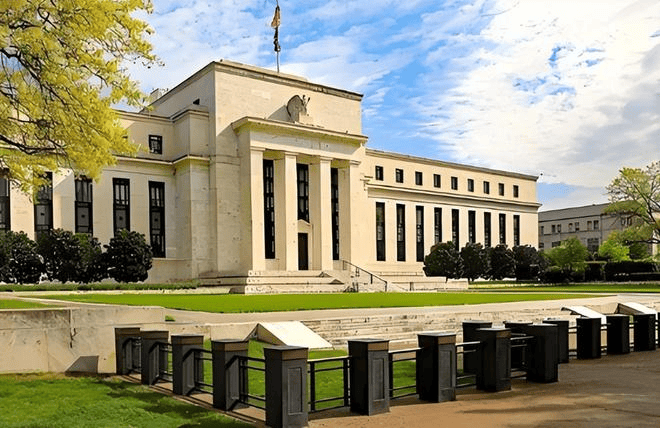
Group 1 - The Federal Reserve maintains the benchmark interest rate at 4.25%-4.50%, with a shift in the dot plot indicating a reduction in rate cut expectations for 2025 from two to one, with seven officials supporting no cuts for the year [2] - Fed Chair Powell emphasizes that inflation pressures may be exacerbated by geopolitical conflicts and tariff policies, leading to increased market uncertainty regarding the Fed's policy path [2][3] - Economic data shows a mixed picture: initial jobless claims reach 245,500, an eight-month high, indicating labor market weakness, while manufacturing and services PMIs suggest economic resilience [3] Group 2 - The gold market is experiencing a "pendulum effect," with short-term support from geopolitical conflicts, but diminishing safe-haven demand as market reactions remain muted despite rising tensions in the Middle East [4] - Current dollar index stands at 98.67, with real interest rates around 1.15%, suggesting a reasonable gold price range of $3,200-$3,300 per ounce, yet spot gold remains above this range, reflecting market pricing for stagflation risks [5] Group 3 - The Fed's policy is highly data-dependent, with potential implications for gold prices based on upcoming economic data releases, particularly the July CPI and the assessment of tariff impacts in the July FOMC meeting [7] - Geopolitical risks, particularly in the Middle East, could lead to increased safe-haven buying of gold, but there is a caution against the "buy the rumor, sell the news" phenomenon, as historical data shows that geopolitical tensions typically boost gold prices for only 1-2 weeks [9]
跨境ETF卷土重来,标普消费ETF尾盘涨停,标普500ETF涨超5%
Ge Long Hui· 2025-06-19 08:26
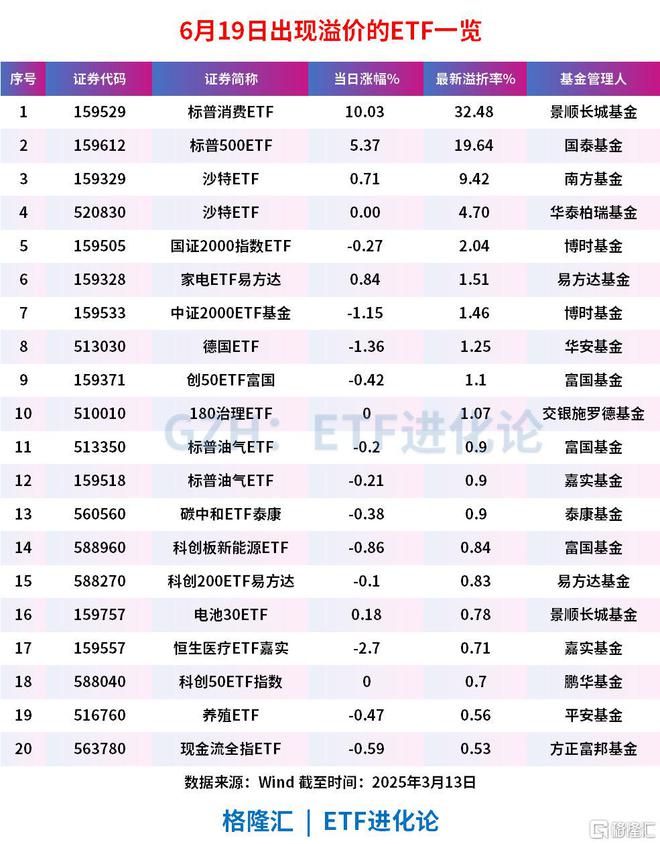
Market Overview - The Hong Kong and A-share markets experienced a significant decline, with the ChiNext Index and Shenzhen Component Index leading the drop, indicating pressure on growth sectors [1] - Despite the overall market downturn, sector ETFs related to oil and gas resources and energy chemicals showed strong performance, reflecting continued investor preference for high dividend yields [1] ETF Performance - The Invesco S&P Consumer ETF surged by 10.03% with a premium of 32.48%, while the Guotai S&P 500 ETF rose by 5.37% with a premium of 19.64% [3] - Other ETFs such as the Saudi ETF and various sector-specific ETFs showed mixed performance, with some experiencing slight declines [3] Geopolitical Impact - The ongoing Middle East conflict is considered a contributing factor to the market's decline, with reports of U.S. officials preparing for potential strikes on Iran [5] - The evacuation of over 1,600 Chinese citizens from Iran and hundreds from Israel highlights the geopolitical tensions affecting market sentiment [5] U.S. Monetary Policy Outlook - The Federal Reserve is expected to maintain its current monetary policy stance, with inflation concerns potentially delaying interest rate cuts [6] - The market anticipates that recovery trades may not materialize until later in the year, contingent on tax reform and debt ceiling developments [6] QDII Investment Opportunities - The People's Bank of China announced plans to increase the Qualified Domestic Institutional Investor (QDII) investment quotas, addressing the high demand for overseas asset investments [7] - As of May 2024, the total approved QDII quota reached approximately $167.79 billion, with significant increases in quotas for various public fund companies [8]
ADP及PMI数据不及预期,??震荡偏强
Zhong Xin Qi Huo· 2025-06-05 09:59
Report Summary 1. Report Industry Investment Rating No specific industry investment rating is provided in the report. 2. Core Viewpoints - Gold is expected to be volatile and slightly stronger in the short - term and maintain a long - term bullish view. Silver follows gold and is expected to show a volatile and slightly stronger trend, but its elasticity will be suppressed by weak economic data [1][3]. - The upcoming non - farm payroll data on Friday night is more important due to the difference in caliber between ADP employment data and non - farm employment data [1][3]. 3. Summary by Content Key Information - The number of ADP employed people in the US in May increased by 37,000, the smallest increase since March 2023, with an expected increase of 110,000 and a revised previous value of 60,000. Trump called on the Fed to cut interest rates [2]. - The US ISM non - manufacturing PMI in May was 49.9, the first contraction in nearly a year, with an expected value of 52.0 and a previous value of 51.6 [2]. - Musk criticized Trump's new cut plan and spending bill, which proposed to cut $9.4 billion in funds, and said it would increase the government deficit to $2.5 trillion [2]. Price Logic - The price of precious metals was volatile during the day and was slightly boosted at night as the US ADP employment data and ISM non - manufacturing data were below expectations, and the US dollar weakened [3]. - The reasons for the long - term bullish view on gold are: the continuation of the US tariff path, the mid - term stagflation expectation in the US, the Fed's possible delay in interest rate cuts with limited negative impact, and the contraction of the US dollar's credit [3]. Outlook - The weekly COMEX gold price range to watch is [3200, 3450], and the weekly COMEX silver price range to watch is [32, 35] [5].